bloggingskills
Health Uyari
- License — License: MIT
- Description — Repository has a description
- Active repo — Last push 0 days ago
- Low visibility — Only 5 GitHub stars
Code Gecti
- Code scan — Scanned 4 files during light audit, no dangerous patterns found
Permissions Gecti
- Permissions — No dangerous permissions requested
Bu listing icin henuz AI raporu yok.
Agent skills that write blog content that ranks and doesn't read like AI.

Blogging Skills
Agent skills that write blog content which ranks and doesn't read like AI.



bloggingskills.com · skills.sh · Install
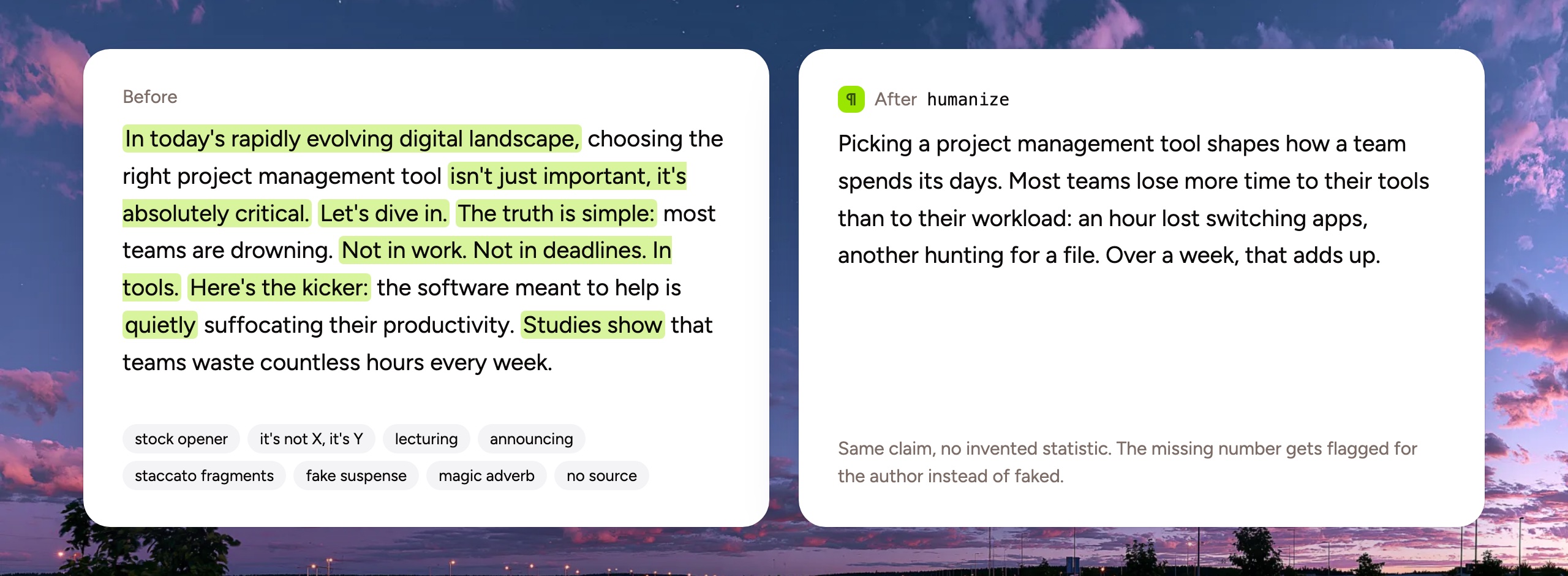
A typical model paragraph before and after humanize. The claim stays. The tells go.
npx skills add RightBlogger/bloggingskills
A collection of Agent Skills for the full blogging
pipeline: research, outline, draft, humanize, optimize, publish. Built for people
who use a coding agent (Claude Code, Codex, Cursor, Windsurf, and anything that
supports the Agent Skills spec) to run a real content operation.
Most "write a blog post" prompts produce slop, and everyone can smell it now. This
collection's whole point is the opposite: content that ranks and reads like a
person wrote it. The quality bar lives in one shared rulebook,ai-tells.md, that every writing skill
reads before it touches a draft.
What are skills?
Skills are markdown files that give an AI agent specialized knowledge and a workflow
for a specific task. Drop them in your project and the agent recognizes when you're
doing that task and applies the right method. You can also call one directly, like/article or /humanize.
The point of view
- Generating a post is a commodity. Content that ranks and reads human is the scarce
thing. The anti-slop rulebook is the product. - Blogging is a pipeline, not a prompt. Research, outline, draft, humanize, optimize,
publish. The skills compose;articleconducts them. - Write for humans first, rank second.
- These run in your repo and touch your real stuff: your CMS, your Search Console,
your knowledge base.
How the skills work together
Three foundation skills hold the context and rules every other skill reads first.article runs its own humanize pass; humanize also works on any draft you bring.refresh brings decaying posts back into the pipeline.
flowchart LR
    F["<b>Foundation</b><br/>blog-context<br/>brand-voice<br/>house-style"]
    P["<b>Plan</b><br/>content-plan"]
    R["<b>Research</b><br/>keyword-research<br/>serp-analysis"]
    A["<b>Write</b><br/>article"]
    Y["youtube-to-blog"]
    H["humanize"]
    O["<b>Optimize</b><br/>seo-optimize<br/>internal-links<br/>meta<br/>ai-seo"]
    C[("Your CMS")]
    RF["<b>Maintain</b><br/>refresh"]

    F -.-> P --> R --> A --> O --> C
    Y --> A
    H --> O
    C -- decays --> RF --> O
Each skill's "Related skills" line has the full map.
Available skills (v0.6)
| Skill | What it does |
|---|---|
| blog-context | Foundation. Captures niche, audience, pillars, authors, real experience, CMS, and voice into .agents/blog-context.md, read first by every other skill. |
| house-style | Foundation. The shared writing rulebook (ai-tells.md). Applies to every writing skill, and audits a draft on request. |
| brand-voice | Captures a real writing voice from samples into a reusable profile the other skills write in. The captured voice overrides the generic anti-AI rules. |
| content-plan | Decides what to write next: a ranked list of posts, one intent each, built on the experience only your blog has. Flags posts to merge or refresh. |
| keyword-research | Turns a seed topic into one primary keyword plus related terms grouped by search intent. |
| serp-analysis | Reads the live top results for a keyword and returns a content brief: intent, must-cover topics, the gap, and the winning angle. |
| article | The flagship. Runs the whole pipeline to produce a publish-ready post from a topic. |
| humanize | The hero. Strips AI tells and restores a human voice without flattening intentional style. |
| seo-optimize | Optimizes a draft that already exists against a target keyword, readability-first, no stuffing. |
| refresh | Diagnoses why a published post lost traffic, then updates facts, coverage, and its date honestly. |
| internal-links | Inserts relevant internal links using your real pages, with descriptive anchors and no invented URLs. |
| meta | Writes the SERP-facing meta title, description, and permalink inside the hard character limits. |
| ai-seo | Makes a post the source AI answers quote (AEO/GEO): front-loaded answers, self-contained sections, first-hand proof. Separates what works from myths like llms.txt. |
| youtube-to-blog | Turns a video or transcript into a real post, not a transcript dump, with the video embedded. |
Installation
Option 1: CLI (recommended)
Use npx skills to install. The collection
is listed on skills.sh.
# Install all skills
npx skills add RightBlogger/bloggingskills

# Install specific skills
npx skills add RightBlogger/bloggingskills --skill article humanize

# List available skills
npx skills add RightBlogger/bloggingskills --list
This installs to .agents/skills/ (and symlinks into .claude/skills/ for Claude
Code).
Option 2: Claude Code plugin
/plugin marketplace add RightBlogger/bloggingskills
/plugin install blogging-skills
Option 3: Clone and copy
git clone https://github.com/RightBlogger/bloggingskills.git
cp -r bloggingskills/skills/* .agents/skills/
Quickstart
The first session, start to finish:
- Set up context once. "Set up the context for my blog" runs
blog-contextand writes.agents/blog-context.md(niche, audience, pillars, voice). Every skill reads it, so
you explain your blog once. - Add your proof (recommended). Fill in the "Experience and proof" section of
.agents/blog-context.md: products you've used, tests you've run, numbers you can
publish. The writing skills cite only what's there, so this is what lets a post
carry first-hand detail without making it up. - Capture your voice (recommended). "Capture my writing voice, here are three posts I
wrote" runsbrand-voice. The profile makes every draft sound like you, and it
overrides the generic anti-AI rules. - Write. "Write a 1,500-word post on [topic]" runs
article: research, outline, draft,
humanize, and a light optimize pass, in one go. - Polish. "This reads like AI, fix it" runs
humanize. "Write the meta title and
description" runsmeta. "Add internal links from my sitemap" runsinternal-links. - Connect your data (optional). With Search Console, a SERP or scraping tool, or your
CMS wired in as an MCP or CLI, the research and optimization skills use your real
numbers instead of estimates. See docs/data-sources.md. With
nothing connected, every skill still works by reasoning from what it knows.
Usage
Once installed, just ask:
"Set up the context for my blog"        -> blog-context
"What should I write about next?"       -> content-plan
"Write a 2000-word post on cold brew"   -> article
"This draft reads like ChatGPT, fix it" -> humanize
"This old post lost its traffic"        -> refresh
"Turn this YouTube video into a post"   -> youtube-to-blog
"Write the meta title and description"  -> meta
Or call a skill directly: /article, /humanize, /seo-optimize.
Roadmap
Shipping next, in roughly this order: gsc-report (what's rising, decaying, and
cannibalizing, from your Search Console data), content-type playbooks (comparison,how-to, and a listicle that refuses to self-rank), copy-edit,podcast-to-blog, and repurpose (post to social, newsletter, email). A standalonefaq or schema skill is off the list: FAQ rich results are gone for most sites, and
Google says AI search needs no special markup.
Credits
The anti-slop rulebook is distilled from editing a high volume of model-generated
drafts in a production blog-generation system: the patterns readers reliably flag
as machine-written, and the fixes that hold up at scale.
License
MIT. Use these however you want.
Yorumlar (0)
Yorum birakmak icin giris yap.
Yorum birakSonuc bulunamadi