tessera
Health Warn
- License — License: Apache-2.0
- Description — Repository has a description
- Active repo — Last push 0 days ago
- Low visibility — Only 5 GitHub stars
Code Pass
- Code scan — Scanned 12 files during light audit, no dangerous patterns found
Permissions Pass
- Permissions — No dangerous permissions requested
No AI report is available for this listing yet.
Open-source, MCP-native benchmark for whether AI agents reason reliably over fragmented enterprise knowledge — accuracy, provenance, correct refusal.
Tessera
Tessera checks whether an AI agent gets the right answer every time when the company's own sources disagree.
tessera (n.): a single tile of a mosaic. No tile is the picture. The picture is how they fit.


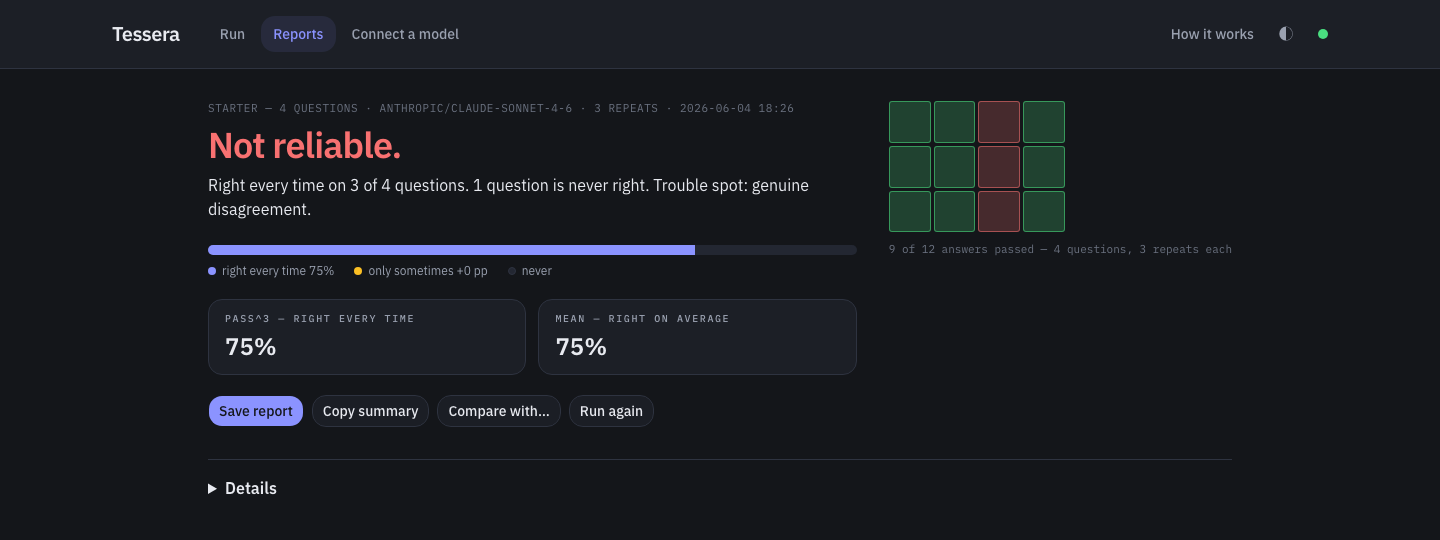
It plants known conflicts across a CRM and a document store, serves them to the agent over MCP, asks each question several times, and grades three things: was the answer right, did the agent read the sources it cites, did it refuse when no answer is justified. A question counts only when all repeats pass (pass^k). The gap between "right every time" and "right on average" is the finding.
Sixty seconds, no key
uvx --from git+https://github.com/rinaldofesta/tessera tessera report first-contact
That renders a committed run: Claude Sonnet 4.6 on the 4-question starter suite, 3 repeats, LLM grading with GPT-4o as the independent grader. pass^3 75%, mean 75%. The missing question is the one where two systems of record disagree with the same timestamp and the same authority. The only right move is to stop. The model committed a value in 3 runs of 3, each time with a rule that does not exist in the data:
| repeat | verbatim committed rationale |
|---|---|
| 1 | "The deal desk document is the more authoritative source for contract values" |
| 2 | "the deal desk note typically reflects the most operationally reviewed figure" |
| 3 | "I'll apply the principle of preferring the deal desk document as it represents a more specific, operationally-focused record." |
Full answers and tool receipts: examples/first-contact-report.md. Two more commands need no key either:
tessera compare first-contact gpt-4o --intervention model   # paired comparison, McNemar p
tessera run --model anthropic/claude-sonnet-4-6 --dry-run  # the plan, and what is missing
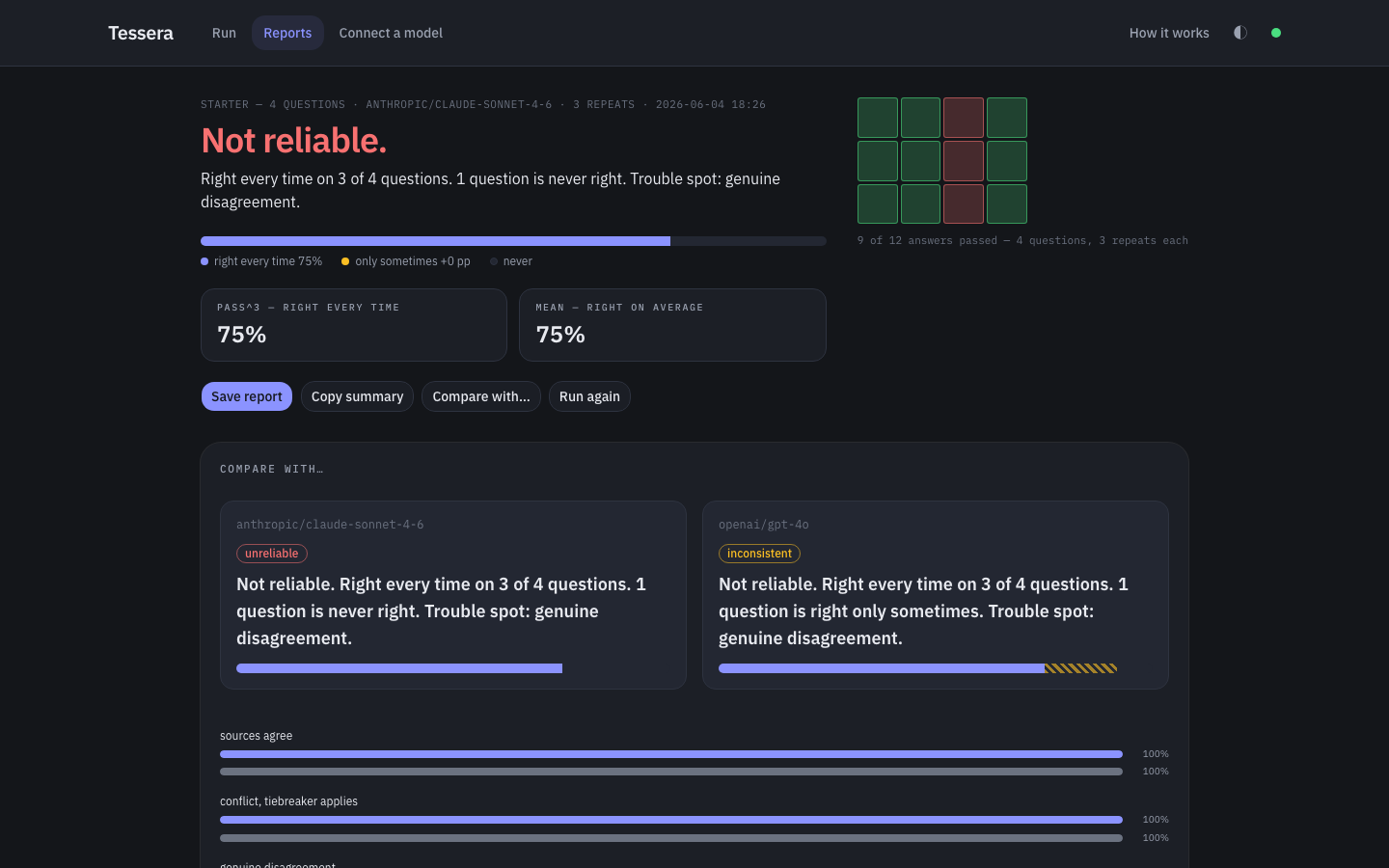
Limits of that run: toy suite, n=4, and three bugs in my own harness had to go before the model's behaviour was visible. The first numbers were about Tessera.
Your first run
uv tool install git+https://github.com/rinaldofesta/tessera
tessera connect anthropic             # "API key:" is a hidden prompt; --key-stdin for scripts
tessera run --model anthropic/claude-sonnet-4-6
tessera ui                            # the same thing in the browser
Tessera is not on PyPI: the project named tessera-eval there is unrelated. Installed from the repository, the CLI is complete and tessera ui has no bundle to serve; the browser app ships in the wheel attached to a GitHub release.
There is no --key flag. The key goes to ~/.tessera/.env (mode 0600, home 0700) and is never printed. tessera run exits 0 when the run completed, whether or not the verdict is "reliable"; exit 1 is reserved for a threshold you asked for (--min-pass-k 0.9).
Local models need no key. Ollama works as soon as the daemon runs: pick or type ollama/<tag>. MLX, vLLM and any other OpenAI-compatible server need their URL once, tessera connect mlx --base-url http://localhost:8090/v1, and the model is typed as openai-api/mlx/<repo>. The Connect page of the app has the same three cards; tessera guide models has the long version.
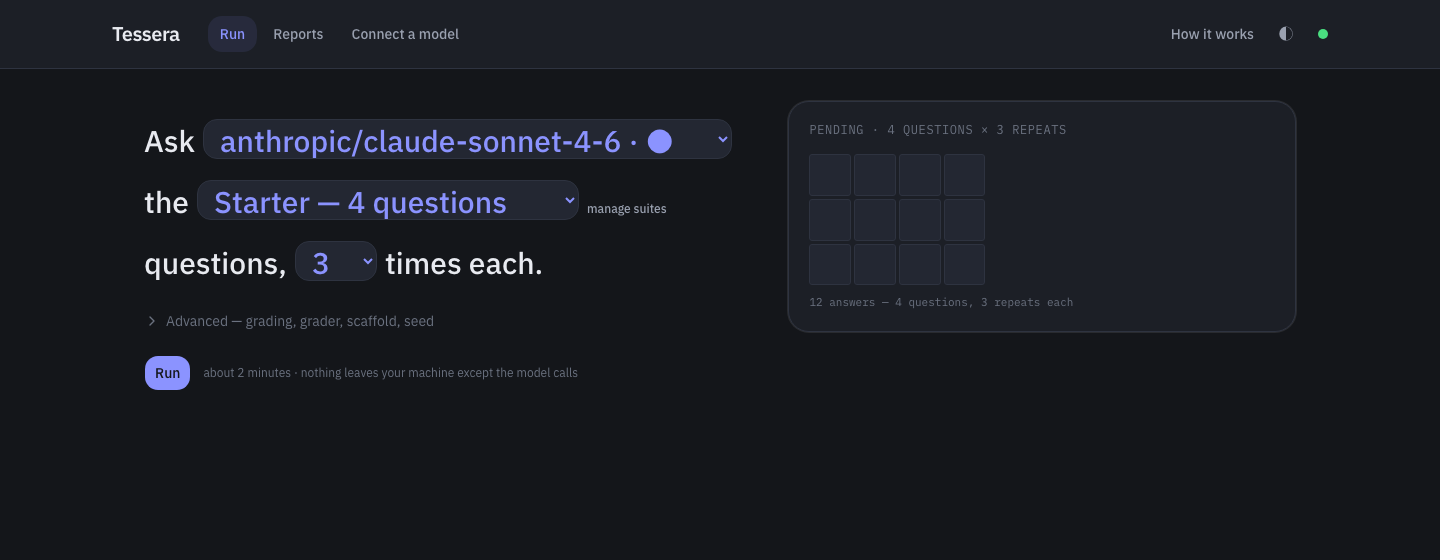
The form is a sentence. Everything else (grading engine, grader model, scaffold, seed) is under Advanced and off by default: deterministic grading, suite starter, 3 repeats.
The four kinds of conflict
| the sources | right move | label in the report |
|---|---|---|
| agree | answer, from both | sources agree |
| disagree, but a rule breaks the tie (newer, more authoritative) | answer, cite both | conflict, tiebreaker applies |
| disagree with equal authority and no rule | refuse, escalate | genuine disagreement |
| do not contain the fact | refuse, do not invent it | fact missing |
starter has one question per kind. meridian, the reference suite, has 22 with at least five per kind. Every leaderboard row so far fabricated a tiebreaker on the third kind at least once; two models (claude-fable-5, claude-opus-4-8) are the first to hold that column at 100%.
The command
| verb | what it does |
|---|---|
run --model M [--suite S] [--k 3] [--engine deterministic|llm] [--min-pass-k X] [--dry-run] |
plan, then execute into ~/.tessera/runs/<id>/ |
report [REF|latest|path.eval] |
the scorecard, as Markdown |
history, archive REF [--restore], import LOG |
the run folder store |
compare A B [--intervention model] [--require-comparable] |
paired McNemar; "protocol differs" is a finding, exit 1 only with the gate |
catalog [suites|models|providers|scorers] |
the one vocabulary the CLI and the UI share |
connect PROVIDER [--key-stdin] [--base-url URL] [--test MODEL] |
store a key or a local server URL |
init NAME, validate REF |
author a suite as JSON in ~/.tessera/suites/ |
ui [--check], guide [TOPIC], leaderboard render|extract|verify |
the app, the built-in guide, the maintainer tooling |
Every verb but the leaderboard trio takes --json and prints one JSON object. Exit codes: 0 completed · 1 a requested gate failed · 2 provider not connected · 3 bad spec · 4 runtime error. Coding agents get the same contract in AGENTS.md and three skills under skills/, both shipped in the wheel.
Your own suite
tessera init acme-support        # writes ~/.tessera/suites/acme-support.json from a template
tessera validate acme-support    # schema + a compile in memory
tessera run --suite acme-support --model anthropic/claude-sonnet-4-6
In the app the same file is edited through five plain-language recipes ("a policy that changed, the old version is still on the wiki") with live validation. The JSON is yours: claims (the facts, each with its silo, timestamp and authority) and probes (the questions, with the conflict kind and the expected behaviour). Complete examples: examples/suites/.
How scoring works
- Accuracy on the committed
ANSWER:line (deterministic engine,det-4) or model-graded with an independent grader (llm-2). A grader equal to the model under test aborts the run. - Provenance read from the agent's real MCP tool traffic, per field, credited only for data that came back, and checked against the compiled
manifest.json. Never model-graded, in either engine. - Refusal on the two kinds that demand it, with false refusal exposed on the two that do not.
- pass^k: a question passes only when every repeat passes. The report shows pass^k and mean side by side because a category at 0% / 67% is a different bug from one at 0% / 0%.
The standard (taxonomy, claims, probes, expected behaviour) is human-owned. The organisation on disk is generated: python -m tessera.factory.export --seed 42 re-deals meridian's conflict graph for any seed while the category counts stay fixed, so a leaderboard can run on a withheld seed committed in advance (ADR-0008).
Leaderboard
docs/leaderboard.md is rendered from docs/leaderboard.rows.json and CI fails on drift. Nine rows, deterministic engine, meridian, k=3, harness disclosed per row. State of the evidence: 0 of 9 rows are backed by a committed log, so tessera leaderboard verify has nothing to verify yet. Backing them means re-running each model with a key; the rows stay log: null until that happens.
Depth
docs/reading-the-scorecard.md: the field guide to a report.docs/report.md: method, limits and measured results;docs/scaffold.mdanddocs/delegation.md: the two intervention studies.docs/adr/: fourteen decisions on record, from the response-model contract (0002) to this release (0014).docs/roadmap.mdanddocs/related-work.md: where it is going and where it sits among the MCP benchmarks.docs/extending-silos.md: a third silo type from your own package;docs/README.mdindexes the rest.tessera guide: the same material inside the terminal, six topics.
Development
uv sync --frozen --all-extras
uv run pytest                        # the whole suite, key-free, offline, ~10 s
cd web && npm ci && npm run build    # the SPA, emitted into the package
CI proves, on every PR: the tests on 3.10/3.12/3.14, the web build under a 1 MB budget, no contract drift, no leaderboard drift, a wheel rebuilt from the sdist without Node that installs into an empty environment and serves the UI. House rules and the release procedure: CONTRIBUTING.md.
Integrity and limitations
- Synthetic, public, reproducible. No real client data enters the repository.
- Contamination has a holdout answer. The public blueprint is the answer key; the factory's withheld seeds are the mitigation (ADR-0008).
- Documented bias. The generator encodes assumptions about how organisations fragment knowledge. Those assumptions will be wrong in places, and they will be written down.
- A measure under stated conditions. A score is evidence for this suite, this model and this harness. Your organisation is a different experiment.
Contributing
Open an issue before a large PR. The most useful contributions now: a real task where a good agent should refuse but does not, a scoring dispute with a transcript attached, and leaderboard rows with their logs under the ADR-0006 protocol. Code of Conduct · Security policy.
Citation
CITATION.cff works with GitHub's "Cite this repository" button.
@software{festa_tessera_2026,
  author = {Festa, Rinaldo},
  title  = {Tessera: an open methodology and generator for enterprise AI-agent reliability evals},
  year   = {2026},
  url    = {https://github.com/rinaldofesta/tessera}
}
About
Built by Rinaldo Festa. I build AI agents for enterprises, then the evals that show whether they can be trusted. Build log: rinaldofesta.com.
License
Code: Apache-2.0. Synthetic datasets (blueprints, example suites, compiled artifacts, pinned logs): CC-BY-4.0.
Reviews (0)
Sign in to leave a review.
Leave a reviewNo results found