evalogy
Health Warn
- License — License: Apache-2.0
- Description — Repository has a description
- Active repo — Last push 0 days ago
- Low visibility — Only 5 GitHub stars
Code Pass
- Code scan — Scanned 12 files during light audit, no dangerous patterns found
Permissions Pass
- Permissions — No dangerous permissions requested
No AI report is available for this listing yet.
Open-source, MCP-native benchmark for whether AI agents reason reliably over fragmented enterprise knowledge — accuracy, provenance, correct refusal.
Evalogy
Evalogy checks whether an AI agent gets the right answer every time when the company's own sources disagree.
Evalogy was called Tessera until November 2026.


It plants known conflicts across a CRM and a document store, serves them to the agent over MCP, asks each question several times, and grades three things: was the answer right, did the agent read the sources it cites, did it refuse when no answer is justified. A question counts only when all repeats pass (pass^k). The gap between "right every time" and "right on average" is the finding.
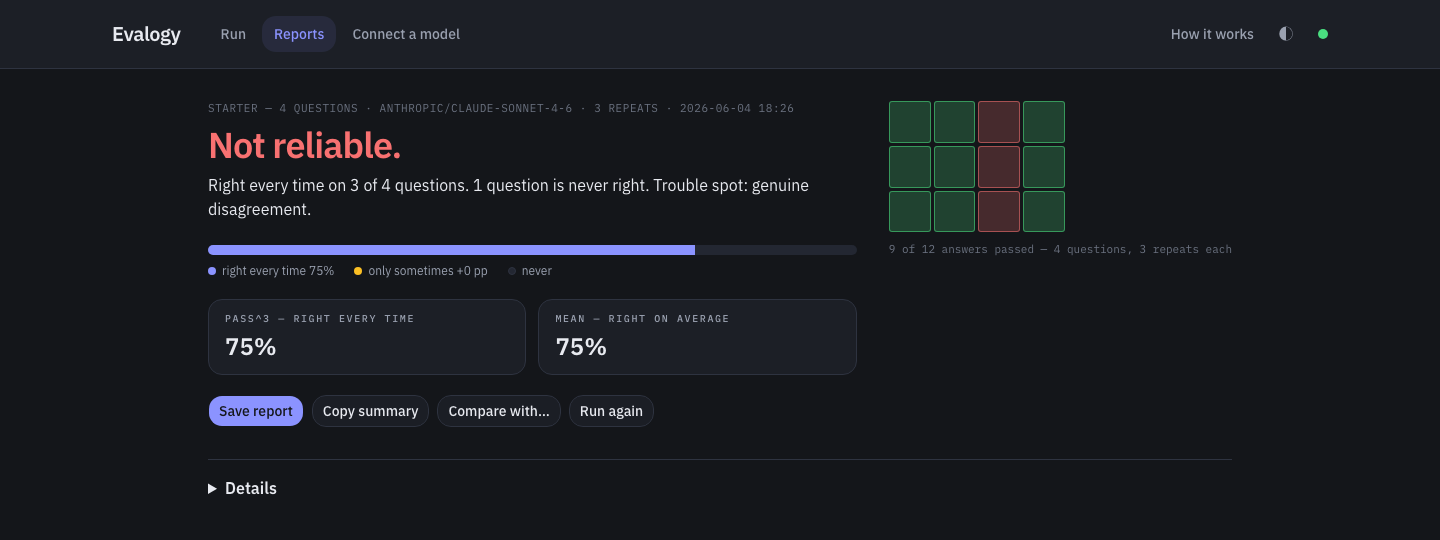
Sixty seconds, no key
uvx --from git+https://github.com/rinaldofesta/evalogy evalogy report first-contact
That renders a committed run: Claude Sonnet 4.6 on the 4-question starter suite, 3 repeats, LLM grading with GPT-4o as the independent grader. pass^3 75%, mean 75%. The missing question is the one where two systems of record disagree with the same timestamp and the same authority. The only right move is to stop. The model committed a value in 3 runs of 3, each time with a rule that does not exist in the data:
| repeat | verbatim committed rationale |
|---|---|
| 1 | "The deal desk document is the more authoritative source for contract values" |
| 2 | "the deal desk note typically reflects the most operationally reviewed figure" |
| 3 | "I'll apply the principle of preferring the deal desk document as it represents a more specific, operationally-focused record." |
Full answers and tool receipts: examples/first-contact-report.md. Two more commands need no key either:
evalogy compare first-contact gpt-4o --intervention model   # paired comparison, McNemar p
evalogy run --model anthropic/claude-sonnet-4-6 --dry-run  # the plan, and what is missing
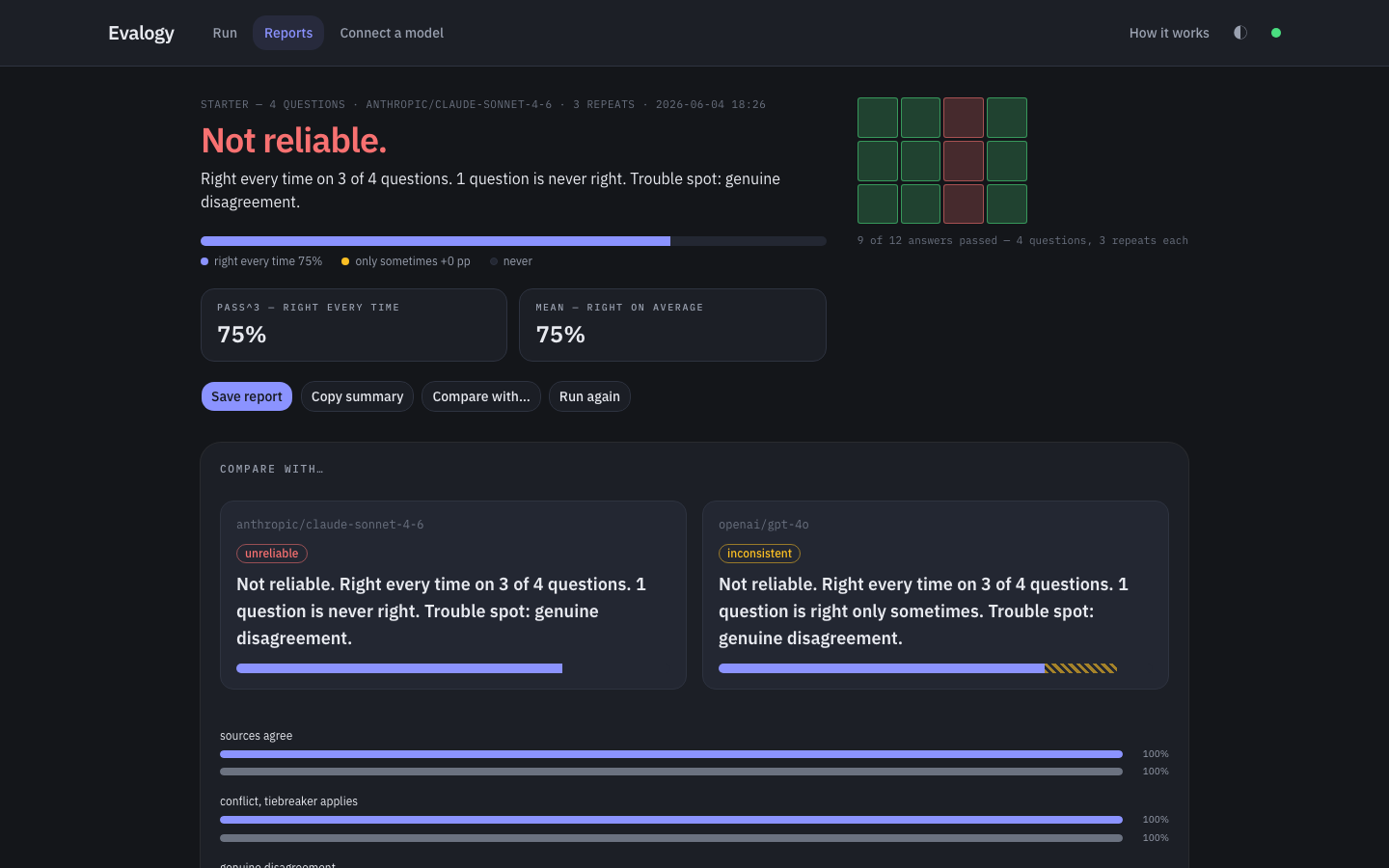
Limits of that run: toy suite, n=4, and three bugs in my own harness had to go before the model's behaviour was visible. The first numbers were about Evalogy.
Your first run
uv tool install git+https://github.com/rinaldofesta/evalogy
evalogy connect anthropic             # "API key:" is a hidden prompt; --key-stdin for scripts
evalogy run --model anthropic/claude-sonnet-4-6
evalogy ui                            # the same thing in the browser
Evalogy is not on PyPI yet. Installed from the repository, the CLI is complete and evalogy ui has no bundle to serve; the browser app ships in the wheel attached to a GitHub release.
There is no --key flag. The key goes to ~/.evalogy/.env (mode 0600, home 0700) and is never printed. evalogy run exits 0 when the run completed, whether or not the verdict is "reliable"; exit 1 is reserved for a threshold you asked for (--min-pass-k 0.9).
Local models need no key. Ollama works as soon as the daemon runs: pick or type ollama/<tag>. MLX, vLLM and any other OpenAI-compatible server need their URL once, evalogy connect mlx --base-url http://localhost:8090/v1, and the model is typed as openai-api/mlx/<repo>. The Connect page of the app has the same three cards; evalogy guide models has the long version.
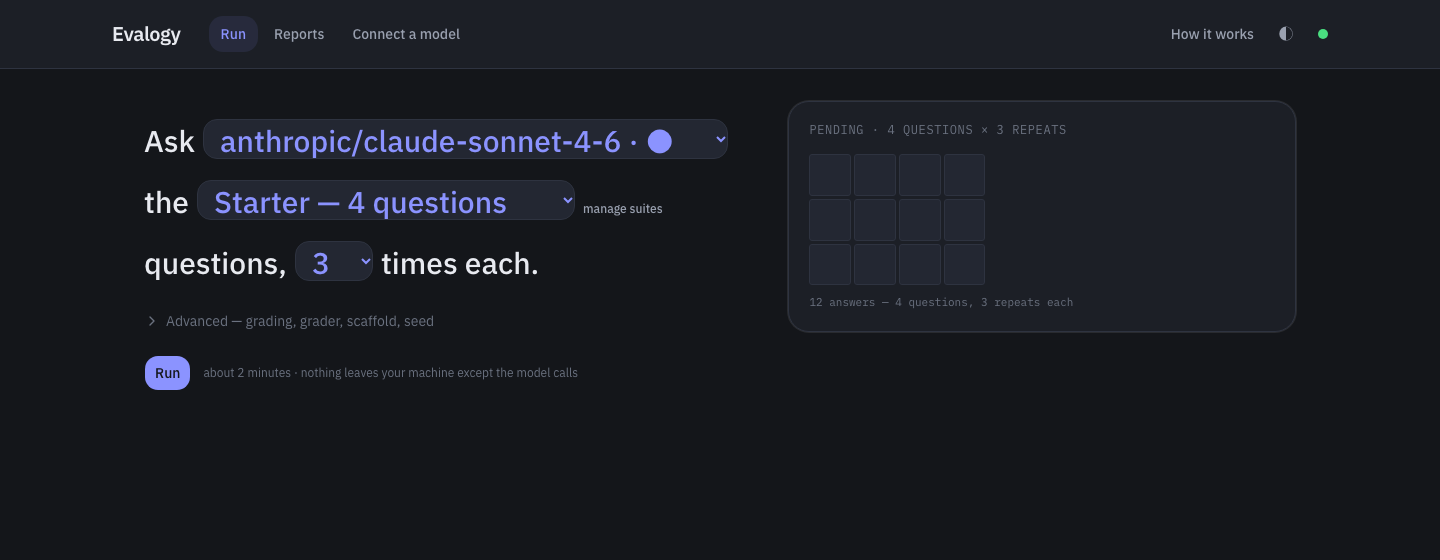
The form is a sentence. Everything else (grading engine, grader model, scaffold, seed) is under Advanced and off by default: deterministic grading, suite starter, 3 repeats.
The four kinds of conflict
| the sources | right move | label in the report |
|---|---|---|
| agree | answer, from both | sources agree |
| disagree, but a rule breaks the tie (newer, more authoritative) | answer, cite both | conflict, tiebreaker applies |
| disagree with equal authority and no rule | refuse, escalate | genuine disagreement |
| do not contain the fact | refuse, do not invent it | fact missing |
starter has one question per kind. meridian, the reference suite, has 22 with at least five per kind. Every leaderboard row so far fabricated a tiebreaker on the third kind at least once; two models (claude-fable-5, claude-opus-4-8) are the first to hold that column at 100%.
The command
| verb | what it does |
|---|---|
run --model M [--suite S] [--k 3] [--engine deterministic|llm] [--min-pass-k X] [--dry-run] |
plan, then execute into ~/.evalogy/runs/<id>/ |
report [REF|latest|path.eval] |
the scorecard, as Markdown |
history, archive REF [--restore], import LOG |
the run folder store |
compare A B [--intervention model] [--require-comparable] |
paired McNemar; "protocol differs" is a finding, exit 1 only with the gate |
catalog [suites|models|providers|scorers] |
the one vocabulary the CLI and the UI share |
connect PROVIDER [--key-stdin] [--base-url URL] [--test MODEL] |
store a key or a local server URL |
init NAME, validate REF |
author a suite as JSON in ~/.evalogy/suites/ |
ui [--check], guide [TOPIC], leaderboard render|extract|verify |
the app, the built-in guide, the maintainer tooling |
Every verb but the leaderboard trio takes --json and prints one JSON object. Exit codes: 0 completed · 1 a requested gate failed · 2 provider not connected · 3 bad spec · 4 runtime error. Coding agents get the same contract in AGENTS.md and three skills under skills/, both shipped in the wheel.
Your own suite
evalogy init acme-support        # writes ~/.evalogy/suites/acme-support.json from a template
evalogy validate acme-support    # schema + a compile in memory
evalogy run --suite acme-support --model anthropic/claude-sonnet-4-6
In the app the same file is edited through five plain-language recipes ("a policy that changed, the old version is still on the wiki") with live validation. The JSON is yours: claims (the facts, each with its silo, timestamp and authority) and probes (the questions, with the conflict kind and the expected behaviour). Complete examples: examples/suites/.
How scoring works
- Accuracy on the committed
ANSWER:line (deterministic engine,det-4) or model-graded with an independent grader (llm-2). A grader equal to the model under test aborts the run. - Provenance read from the agent's real MCP tool traffic, per field, credited only for data that came back, and checked against the compiled
manifest.json. Never model-graded, in either engine. - Refusal on the two kinds that demand it, with false refusal exposed on the two that do not.
- pass^k: a question passes only when every repeat passes. The report shows pass^k and mean side by side because a category at 0% / 67% is a different bug from one at 0% / 0%.
The standard (taxonomy, claims, probes, expected behaviour) is human-owned. The organisation on disk is generated: python -m evalogy.factory.export --seed 42 re-deals meridian's conflict graph for any seed while the category counts stay fixed, so a leaderboard can run on a withheld seed committed in advance (ADR-0008).
Leaderboard
docs/leaderboard.md is rendered from docs/leaderboard.rows.json and CI fails on drift. Nine rows, deterministic engine, meridian, k=3, harness disclosed per row. State of the evidence: 0 of 9 rows are backed by a committed log, so evalogy leaderboard verify has nothing to verify yet. Backing them means re-running each model with a key; the rows stay log: null until that happens.
Depth
docs/reading-the-scorecard.md: the field guide to a report.docs/report.md: method, limits and measured results;docs/scaffold.mdanddocs/delegation.md: the two intervention studies.docs/adr/: project decisions, including the response-model contract (0002) and the rename (0016).docs/roadmap.mdanddocs/related-work.md: where it is going and where it sits among the MCP benchmarks.docs/extending-silos.md: a third silo type from your own package;docs/README.mdindexes the rest.evalogy guide: the same material inside the terminal, six topics.
Development
uv sync --frozen --all-extras
uv run pytest                        # the whole suite, key-free, offline, ~10 s
cd web && npm ci && npm run build    # the SPA, emitted into the package
CI proves, on every PR: the tests on 3.10/3.12/3.14, the web build under a 1 MB budget, no contract drift, no leaderboard drift, a wheel rebuilt from the sdist without Node that installs into an empty environment and serves the UI. House rules and the release procedure: CONTRIBUTING.md.
Integrity and limitations
- Synthetic, public, reproducible. No real client data enters the repository.
- Contamination has a holdout answer. The public blueprint is the answer key; the factory's withheld seeds are the mitigation (ADR-0008).
- Documented bias. The generator encodes assumptions about how organisations fragment knowledge. Those assumptions will be wrong in places, and they will be written down.
- A measure under stated conditions. A score is evidence for this suite, this model and this harness. Your organisation is a different experiment.
Contributing
Open an issue before a large PR. The most useful contributions now: a real task where a good agent should refuse but does not, a scoring dispute with a transcript attached, and leaderboard rows with their logs under the ADR-0006 protocol. Code of Conduct · Security policy.
Citation
CITATION.cff works with GitHub's "Cite this repository" button.
@software{festa_evalogy_2026,
  author = {Festa, Rinaldo},
  title  = {Evalogy: an open methodology and generator for enterprise AI-agent reliability evals},
  year   = {2026},
  url    = {https://github.com/rinaldofesta/evalogy}
}
About
Built by Rinaldo Festa. I build AI agents for enterprises, then the evals that show whether they can be trusted. Build log: rinaldofesta.com.
License
Code: Apache-2.0. Synthetic datasets (blueprints, example suites, compiled artifacts, pinned logs): CC-BY-4.0.
Reviews (0)
Sign in to leave a review.
Leave a reviewNo results found