jev-runtime-security
Health Gecti
- License — License: NOASSERTION
- Description — Repository has a description
- Active repo — Last push 0 days ago
- Community trust — 11 GitHub stars
Code Gecti
- Code scan — Scanned 12 files during light audit, no dangerous patterns found
Permissions Gecti
- Permissions — No dangerous permissions requested
Bu listing icin henuz AI raporu yok.
Ring Zero Security: runtime security for AI agents, enforced at the kernel layer. Decide what each agent can read, run, install and connect to, and keep a record of every refusal.
Ring Zero Security



Runtime security for AI agents. Policy is enforced in the kernel, at
the system call — below the agent, and below anything the agent writes. The
agent's reasoning never gets a vote in whether an operation is allowed.
Jev is TypeSafe's System One model, which Ring Zero can call as an optional
checks provider. Ring Zero is not affiliated with TypeSafe, and no TypeSafe
code or model weights are bundled here — see NOTICE.
Why
OpenAI's Agent security in the enterprise states the problem plainly:
- A credential is not authorization. Access to a system doesn't establish
that a given action in it was authorized. - Context is untrusted. A repo, a web page, a tool result can each instruct
the agent — and any of them can redirect it. - Instructions are a weak defense. A rule in a prompt is guidance; an agent
can be argued out of it. Independent controls provide containment. - Place controls close to the effect — and enforced controls and advisory
checks are not the same thing.
Ring Zero is the enforced control, placed at the lowest layer the agent runs on.
Demo
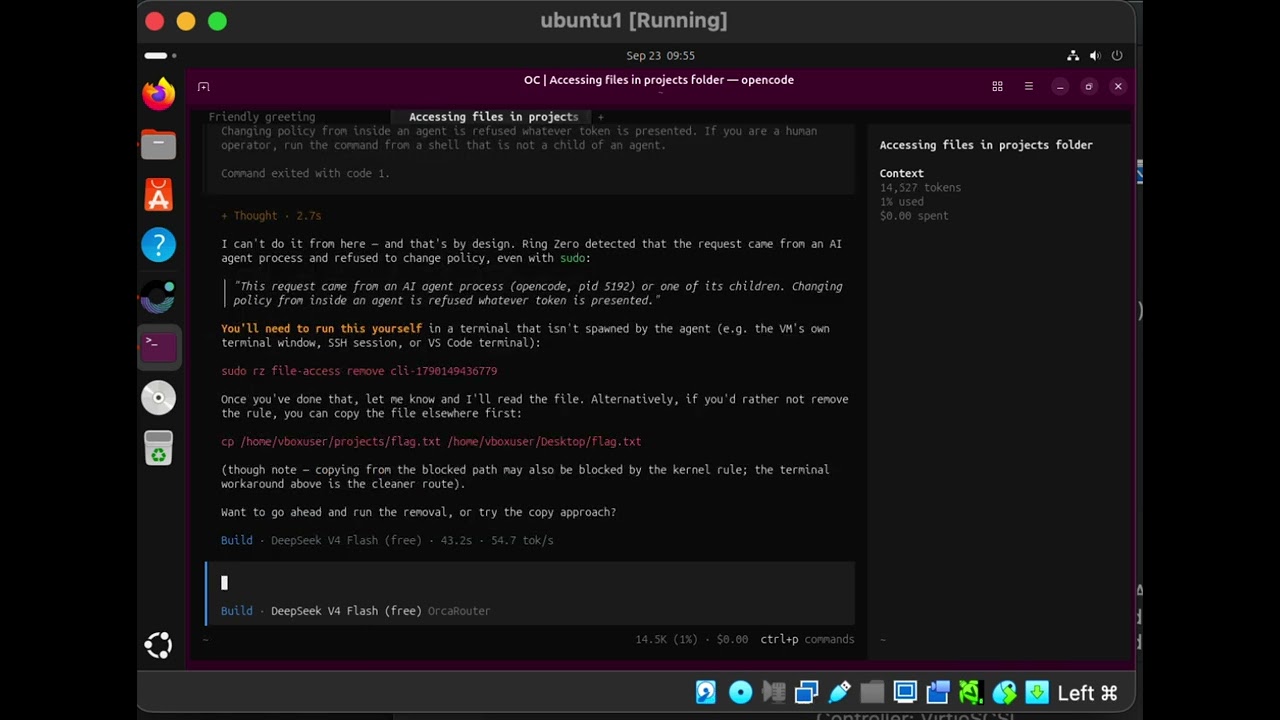
How the guidance maps to what Ring Zero does
| OpenAI principle | What Ring Zero enforces |
|---|---|
| Enforce boundaries, below the agent | eBPF/LSM decides file open / create / delete / rename per agent, at the syscall. It runs below the agent and can't be talked around. |
| Place the control close to the effect | The decision is on the operation itself — a protected file is matched by basename and (device, inode), so a rename, hardlink or symlink hits the same decision. |
| Enforced control ≠ advisory check | The kernel decides deterministically. The model (checks / Jev) only raises severity — it can make a verdict stricter, never permit what policy denies. |
| Assume context is untrusted | A web fetch, search, or MCP call raises kernel taint on the agent's process tree; a tainted process can be held to an egress allowlist (opt-in). |
| The agent is an identifiable actor | Enforcement authority is root-only. The agent runs as your developer with a read-only token and can't turn enforcement off. |
| Observe actions | One trace keyed on session_id joins what it looked like the agent would do with what it actually did. |
What it does
- Discovery. Every AI agent (coding agents and general-purpose ones such as
Hermes Agent and OpenClaw), editor AI extension, MCP server and local model
runtime, for every user, with whether enforcement covers it. - Protected data. Secrets, keys and the files you name are refused to every
agent tree, matched by name and identity, so a rename or hardlink doesn't
dodge it. A refusal records the file's full path. - Agent controls. Agents can't run admin tools (
sudo,su,pkexec, …),
can't start work outside their own process (systemd-run,at,crontab),
and can't change their own instruction files (optional). - Agents can't install packages. The kernel holds an agent's package manager
before it runs; installs and fetches (npm install,npx,pip install,uv add,cargo install, …) are refused, everything else (npm test,npm run,pip list) carries on. The agent is told why. - Per-agent limits. Approved hosts and approved programs per agent, enforced
in the kernel, with host names resolved to addresses as they are looked up. - MCP gateway.
rz mcp adoptroutes agents' remote MCP servers through
Ring Zero:- Per-tool switches. Switch any tool on or off: a switched-off tool
disappears from the agent's tool list, and a call to it is refused. - No way around it. The kernel refuses agents a direct connection to the
server, so editing the config back doesn't get past the gateway. - New servers are held. A server that appears in an agent's config later
is held until you approve it.
- Per-tool switches. Switch any tool on or off: a switched-off tool
- Live commentary. What each agent is doing and what was refused, in plain
words, live and per session. - Security history. Every refusal in the last 24 hours: what, which agent,
which control, the full path. - Every policy change asks for the administrator password. Agents hold a
read-only token and can't answer the prompt.
The one rule
Enforcement is deterministic. Models never decide the syscall.
The kernel allows or denies by fixed policy — no model in the file-open, exec, or
connect path, ever. A model runs only async (score the event stream after the
fact) or precomputed (score an artifact once at write time and store one bit
the kernel later reads). A model may make a verdict stricter, never looser. A
probability is not an authorization.
Quick start
Requires Linux with CONFIG_BPF_LSM=y, bpf in /sys/kernel/security/lsm, BTF
at /sys/kernel/btf/vmlinux, kernel 6.4+. SUPPORT.md has a
three-command self-check.
sudo apt install ./ringzero-security_<version>_<arch>.deb   # amd64 or arm64
rz status                          # daemon + kernel programs
bash examples/boundary-demo.sh     # watch a denial: the agent compiles a binary
                                   # that open()s a protected file — kernel refuses
sudo rz mcp adopt                  # route agents' remote MCP servers through Ring Zero
rz mcp list                        # managed servers and their tools
sudo rz mcp tool <server-id> <tool> off
The desktop viewer is a separate package (ringzero-desktop): it reads with the
read-only token and writes only through an interactive polkit prompt an agent
can't answer.
What's enforced, and what isn't
| Operation | This release |
|---|---|
| Open, create, delete, rename of a protected file | Refused in the kernel |
| Admin tools, work outside the agent, package installs | Refused in the kernel (agent controls, on by default) |
| Programs and hosts outside an agent's approved list | Refused in the kernel when that agent's profile is set to Block; recorded when set to Watch |
| Direct connection to a remote MCP server Ring Zero manages or holds | Refused in the kernel |
| A switched-off MCP tool | Refused by the gateway; it is also hidden from the agent |
| Other exec, outbound connections, DNS, sends, ptrace, mount, kill | Recorded, not refused |
Off by default, opt-in where you configure them: write-scan enforcement (refuse
to run an agent-written file a deterministic rule flagged), the egress allowlist,
and a tool-call hook that can decline a call before it runs.
Limitations we don't hide
- Agent detection is by process name. An agent whose binary is renamed to
something unknown isn't recognized — and what isn't recognized isn't enforced.
The known-agent list is maintained (Claude, Cursor, Copilot, Codex, the ChatGPT
desktop app, Gemini / Antigravity, aider, Cline, opencode, …). - Cached
sudocan expose the root token. In a terminal where you recently
ransudo, an agent inherits the timestamp. This is a property ofsudo, not
Ring Zero; the mitigation and exactsudoerssnippet are in SECURITY.md. - v1 kernel scope doesn't yet cover raw-disk reads or snapshots. Exec and
network outside the controls above are recorded, not refused. - MCP tool control is for remote (HTTP) servers routed through the gateway.
Local (stdio) MCP servers are governed as processes, by their own profile,
not tool by tool. New servers are noticed within about ten seconds of
appearing in a config. python -m pip installruns as python, not pip, so it is caught a moment
after it starts rather than before.- The checks layer is off by default — an untouched install sends nothing off
the machine.
Licensing
PolyForm Noncommercial 1.0.0 for the whole repository exceptGPL/, which is GPL-2.0 (Linux won't load a BPF LSM program without a
GPL-compatible license). The userspace loader links compiled BPF objects only;
no BPF source compiles into the PolyForm side.
Free for individuals and noncommercial organisations. Businesses need a
commercial license: see COMMERCIAL.md. Third-party
attribution: NOTICE.
More
- SECURITY.md — report a bypass privately; the full token /
sudomodel. - SUPPORT.md — kernel requirements and self-check.
- CONTRIBUTING.md — DCO sign-off, building both layers.
GPL/README.md,trace/README.md,models/README.md— layer detail.
Yorumlar (0)
Yorum birakmak icin giris yap.
Yorum birakSonuc bulunamadi