kolea
Health Warn
- License — License: MIT
- Description — Repository has a description
- Active repo — Last push 0 days ago
- Low visibility — Only 5 GitHub stars
Code Fail
- exec() — Shell command execution in .claude/skills/sqlite-dev/templates/db.production.ts
- process.env — Environment variable access in .claude/skills/sqlite-dev/templates/db.production.ts
- exec() — Shell command execution in .claude/skills/sqlite-dev/templates/db.ts
- process.env — Environment variable access in .claude/skills/sqlite-dev/templates/db.ts
- process.env — Environment variable access in .claude/skills/sqlite-dev/templates/drizzle.config.ts
Permissions Pass
- Permissions — No dangerous permissions requested
No AI report is available for this listing yet.
Kōlea — self-hosted broadcasts, drip sequences, and transactional email in one Cloudflare Worker. Unsubscribe is scoped: leaving a sequence doesn't remove you from the list.

Kōlea
Broadcasts, drip sequences, transactional email, and a blog — one Cloudflare Worker.
A self-hosted replacement for a paid ESP, where the list, the sending,
the engagement data, and the archive stay yours.




Install · Architecture · Spec · Contributing
🐦 Why Kōlea
The kōlea (koh-LEH-ah) — the Pacific golden plover — flies from Alaska to
Hawaiʻi every autumn. Three thousand miles of open ocean, nonstop, no land to
rest on. Then it lands in the same yard it left, and does it again the next year,
and the year after that.
Delivery, and the same address, every time. There isn't a better name for a
mailer.
Status: feature-complete and runnable locally, and built for a single
operator — not multi-tenant, by design rather than by omission.docs/INSTALL.mdis the honest list of what stands between
a clone and a live send.
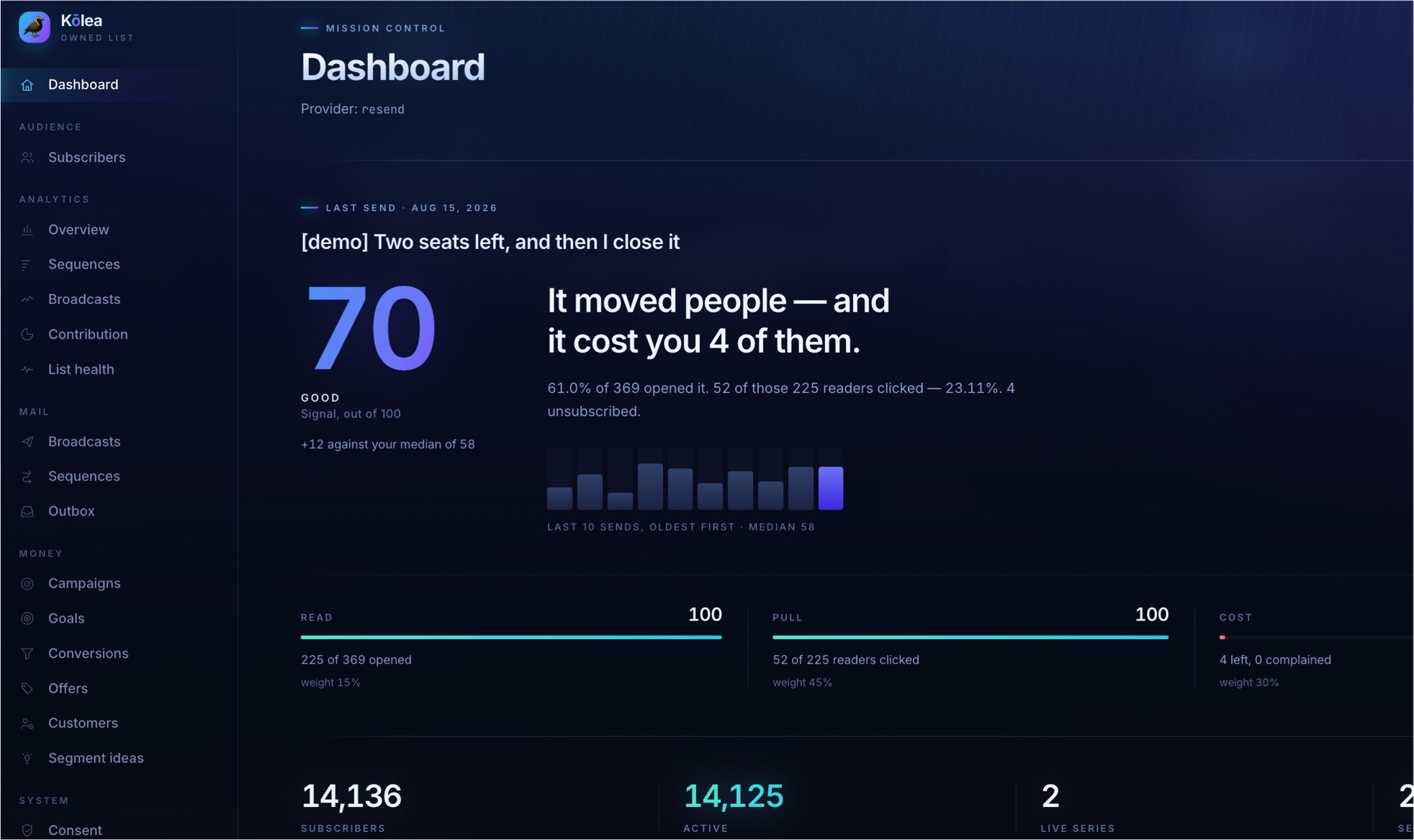
The dashboard after seeding demo data. Consent, by scope is the panel that
matters: two people left an individual series and are still on the list. On a normal
ESP those two numbers are the same number.
💡 The idea
Every ESP treats unsubscribe as one switch. Someone finishes your onboarding
series, clicks "unsubscribe" to stop that, and quietly leaves your newsletter
forever. You never find out. The number just goes down.
Here, consent is scoped. Leaving one sequence takes you off that sequence.
Leaving the newsletter doesn't cancel a series you deliberately opted into. Only
an explicit "unsubscribe from everything", a hard bounce, or a spam complaint
removes someone outright.
That asymmetry is the reason this exists, and everything else in the codebase is
arranged so it can't be broken by accident.
And the mail is also the website. A post is a broadcast — same piece, written
once, mailed to the list and up on its own readable URL as it goes out, with a "read
this online" link in the mail that already resolves. Not a second CMS bolted on, and
not a sync job between two copies of your own writing.
🚀 Install
Three commands, and it mails nobody.
git clone https://github.com/robconery/kolea.git
cd kolea
bun install
bun run db:migrate     # applies migrations to the local D1 database
bun run dev            # → http://localhost:8787
Open http://localhost:8787 and click Seed demo data: twelve people, two live
series, a sent broadcast. Then open the Outbox to read the mail that "went out."
🔒 Nothing leaves your machine
EMAIL_PROVIDER=consoleis the local default. It writes fully rendered mail —
footer, merge tags, tracking links and all — to the in-app Outbox instead of
sending it. No API key needed, and no way to accidentally mail a real person
while you poke at it.
You need: Bun 1.1+. That's the whole list for local. No
database to install, no Redis, no server — wrangler dev emulates D1, R2 and
Queues locally.
Going live? → docs/INSTALL.md walks the full
deploy: D1, R2, queues, DNS and DMARC, the Cloudflare Access apps, secrets, and
a pre-flight checklist to work through before you trust it with a list. It
takes about an hour, most of it waiting for DNS, and there are two steps that
are painful to undo.
🎯 Try the thing it's for
- Subscribers → pick someone → Open their preference center
- Add
?scope=sequence:2to that URL. This is what a link inside a sequence email
looks like. - Hit Stop just this series
- Go back to their subscriber page: still
active, still on the newsletter, out of
exactly one series - Consent shows everyone who left a single series versus the (empty) list of
people gone entirely
Send a broadcast afterwards and they'll still receive it. That's the whole argument.
Sequence delays are in days, and the first step defaults to 0 (arrives on join)
while later steps default to 1. Which means a seeded series won't finish while you
watch it, so the dashboard has Fast-forward the clock (local only): it pulls every
pending step to now and runs a tick. Use it and you'll watch step 2 skip the people
who left that series.
📊 Measurement
An ESP will happily show you an open rate and let you draw your own conclusions. The
five screens under Analytics exist because a mailing list is the one asset here you
cannot inspect by looking at it: you can read every broadcast you ever wrote and still
have no idea whether the list is healthy, and no amount of staring at a sequence tells
you which mail in it loses people.
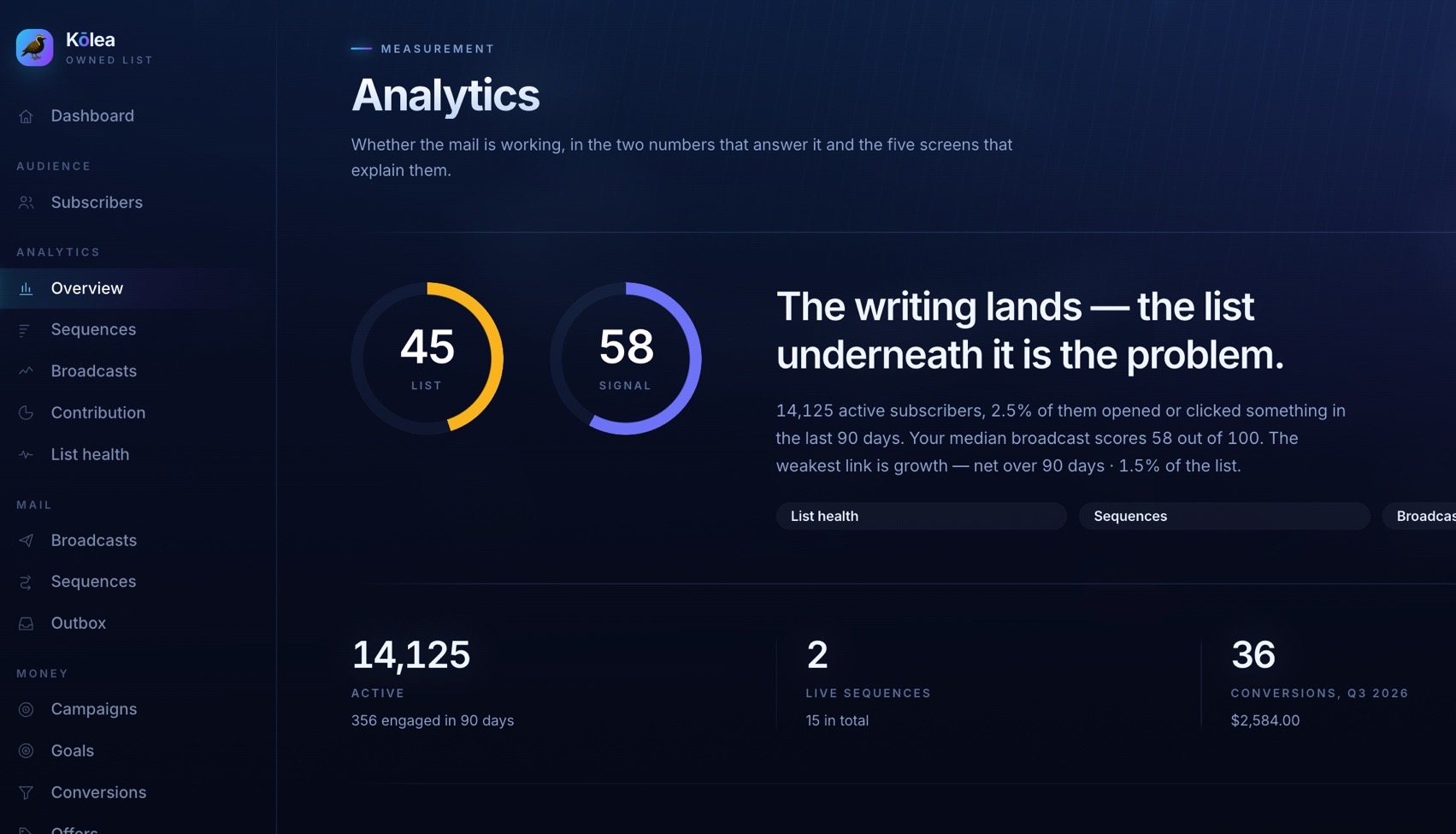
The step waterfall for one sequence. Retention is measured against step one, never
against the previous step — chained ratios hide a slow bleed across six mails behind six
unremarkable-looking numbers. The line at the bottom names the biggest drop and what it
usually means.
| Screen | The question |
|---|---|
| Overview | Two dials — the health of the list, and the median score of the writing. A healthy list carrying weak sends and a weak list carrying great sends look identical on any single number, and they want opposite responses. |
| Sequences | Every series ranked, with the two things a rate can't tell you: who finishes, and what it earned. Flags series switched off with people still inside them. |
| Broadcasts | Every send scored against your own median, which is the only benchmark that survives contact with reality. |
| Contribution | Which mail actually moved a goal — by channel, and by the individual broadcast or sequence that earned the credit. |
| List health | Growth, engagement, churn, delivery and money, each with the sentence saying what to do about it. |
Every figure on these screens carries the two integers underneath it, because a rate
with no denominator is how dashboards mislead people who trust them. Nothing here
writes — no forms, no POST routes, by construction. An analytics page that can send
mail is one misclick from mailing the whole list.
bun scripts/seed-analytics-demo.ts # local only, and there is no --remote flag
That seeds a world worth looking at: demo people spread over a year, two live sequences
with real message and event history, imported broadcasts, conversions and a couple of
goals. --clean removes every row of it again.
🗂 What's in here
src/
  worker.tsx      fetch + scheduled + queue handlers, and the hostname split
                  between the admin app and the public site — 248 lines
  core/           domain logic: consent, sending, sequences, segments, publishing,
                  rendering, scoring (signal.ts) and measurement (analytics.ts)
  db/             Drizzle schema (37 tables) and the D1 client
  web/            server-rendered admin console (Hono + JSX, no frontend framework),
                  the five read-only analytics screens, the reader's preference
                  center, and site.tsx — the public blog
  api/            transactional send API, signup forms, media upload, bearer-key auth
  mcp/            MCP server — 103 tools, 4 resources, 4 prompts
  providers/      EmailProvider port + console and Resend adapters
  client/         the only browser JS in the project: the TipTap editor bundle
migrations/       drizzle-kit generated, applied by wrangler
scripts/          list importers, the archive publisher, and the browser smoke test
tests/            specs/ — the behavioral spec, executable (bun:test)
                  ui/    — browser tests against a real server (Playwright)
                  support/ — a D1 implementation over bun:sqlite, and factories
docs/             install guide, architecture, spec, stories, and a decision log
Roughly 32k lines of TypeScript. bun run typecheck covers the Worker, the
browser bundle, the scripts and the tests separately, and is clean.
🧱 Architecture at a glance
Cloudflare Workers · D1 (SQLite) via Drizzle · Queues for send fan-out · Cron Triggers
for scheduling · R2 for media · Hono + JSX server-rendered admin · Cloudflare Access for
auth · a pluggable EmailProvider port with console and Resend adapters.
The decisions worth knowing about, and why:
Every messages row is materialized before a single send goes out. A broadcast
resolves its full recipient list up front, writes a row per intended send, and only
then fans out to the queue. That makes a broadcast resumable after a crash, idempotent
across queue retries, and auditable afterward. Resolving recipients lazily at send time
is cheaper and turns any mid-broadcast failure into an unrecoverable mess.
Consent is re-checked immediately before the provider call, not at enqueue time.
A queue can deliver minutes after the message was created, and someone can opt out in
between. Checking at enqueue would mail them anyway.
Queue concurrency is pinned to 6. One batch is one provider request, so batch
concurrency is the request rate. Left unset, Cloudflare Queues autoscales to 250
concurrent consumers, buries Resend's 10 req/s limit under 429s, burns all three
retries, and dead-letters perfectly good mail. Six batches of 100 leaves ~600
emails/sec of headroom while staying under the limit.
Suppression is keyed by email address, not by subscriber. Transactional recipients
and bounced addresses often have no subscriber row at all, so a subscribers.status
flag would silently miss them.
Anything observable is a row in D1, never a log line. Workers logs expire in 3–7
days. An audit trail with a one-week retention isn't one. mcp_calls records every
agent action including the refusals; sync_runs records every Stripe pull.
The admin console has no password. Cloudflare Access terminates identity at the
edge, and src/web/auth.ts verifies the forwarded JWT properly: signature against the
team's live JWKS (cached per isolate, with a forced refetch on an unknown key id),alg pinned to RS256, plus audience, issuer, exp and nbf. Presence of the header
proves nothing and is never treated as proof. Misconfigure it and the middleware
fails closed and locks everyone out, including you. That's the correct direction to
fail.
One scorer, two subjects. A broadcast and a sequence are graded by the same
instrument (core/signal.ts), so a sequence's 62 and a broadcast's 62 are the same 62
and "is this series better than my newsletter?" is a question with an answer. Every rate
in the system divides by people reached — recipients minus bounces — and never by
delivered: provider delivered webhooks cover a fraction of what goes out, and dividing
by them reports open rates above 100%.
A number that could never have been measured is null, not 0. Mail imported from
a previous ESP has no per-recipient history here and never will, so no click could be
recorded and no conversion could ever attach to it. Those rows drop the MONEY component
and renormalize the rest, rather than scoring a decade of good work as a zero on
something that was never measurable. Same reflex everywhere: a sequence under 30 people
reached is unscored, because a 100% click rate across eight people is noise wearing a
suit.
Attribution is last-click, inside a per-source window. An open is never a touch —
Apple's Mail Privacy Protection fires opens from proxies, so crediting them hands
revenue to whoever mailed most recently. Anything with no click in the window isdirect, which is the honest answer for most sales on most lists and is drawn as an
ordinary result rather than a hole in the data.
There are two renderers, not one with a flag. core/render-doc.ts emits email
HTML; core/render-web.ts emits web HTML for the public site. They walk the same
TipTap document and agree on nothing else — inlined styles versus classes, click
tracking versus none, a consent footer versus none, merge tags resolved per recipient
versus neutral copy. One function with a web: true flag was the obvious move and the
wrong one: the flags multiply, and the failure mode is an unsubscribe footer rendered
onto a public page.
The email HTML renderer is hand-written (core/render-doc.ts) rather than using@tiptap/html, whose server entry point needs happy-dom and doesn't run insideworkerd. It turned out to be the better answer anyway: the walker inlines every style
(Gmail strips <style>) and emits nested tables for buttons (Outlook ignores padding
on <a>), which generic HTML serialization wouldn't do.
📖 The full picture, written to be read by a person or an agent — including the
alternatives that were rejected and why — is indocs/ARCHITECTURE.md.
🔐 Consent model
Three independent scopes. A narrow choice never escalates to a wide one.
| Scope | Stored as | Effect |
|---|---|---|
| Sequence | sequence_optouts row |
Off that one series. Everything else continues. |
| Broadcast | subscribers.status |
Off the newsletter. Series keep running. |
| Global | suppressions row |
Off everything. The legal escape hatch. |
Only an explicit "unsubscribe from everything", a hard bounce, or a complaint writes a
global suppression.
Sequence sends deliberately ignore status = 'unsubscribed', because that flag is
broadcast-scoped: someone who left the newsletter still gets the onboarding series they
asked for. Transactional mail (receipts, downloads) ignores marketing consent entirely
and is blocked only by a dead address or a spam complaint. A receipt isn't marketing,
and an unsubscribed customer still needs their download.
✍️ The editor
Block-style rich text, TipTap v3, vanilla (no React). Open the seeded draft
"Draft: everything the editor can do" to see the lot.
/on a line → block menu: headings, lists, checklist, quote, code, table, toggle,
divider, image, YouTube, CTA button@→ personalization fields as real nodes, sofirst_namecan't be misspelled- Drag the handle in the left margin to reorder; shift-select spans multiple blocks
- Drop or paste an image anywhere → uploads to R2, inserts when the URL returns
- Code blocks are syntax-highlighted (15 languages, incl. Ruby, Elixir, TS, SQL)
- Select text for the bubble menu; select a button and the bubble menu becomes its
URL and colour picker
Buttons and merge tags are custom nodes built specifically for email. A CTA renders
as a nested table, and every style is inlined. A merge tag is a node rather than raw{{first_name}} text, because a typo in raw text mails "Hi {{frist_name}}" to the
entire list.
Bodies are stored as TipTap JSON in body_json. Legacy markdown in body_md still
renders and is converted the moment you open it in the editor. Nothing is migrated in
bulk, because a bulk migration that goes wrong takes the archive with it.
The client bundle is ~226KB gzipped and loads only on the two screens that compose
mail. Everything else in the admin console is server-rendered with zero JavaScript.
There's a browser smoke test (bun run smoke, 33 checks) driving real Chromium,
because a renamed extension option fails silently in the browser and the body field
just never saves. Nothing server-side can catch that.
🪄 AI writing help (optional)
Kōlea runs fine without AI, and that is the default. Add an
OpenRouter key and three helpers appear. Leave it out and
none of them render: no buttons, no links, and the /ai/* endpoints return 404.
The key is the only switch.
| Helper | Where it shows up | Default model | Typical cost |
|---|---|---|---|
| Suggest a subject | Under the subject line in the composer | anthropic/claude-sonnet-5 |
under 1 cent |
| Clean this up | Under the slop dial in the composer | anthropic/claude-opus-5.5 |
2 to 10 cents |
| Draft it for me | "Make it yours" on any sequence template | anthropic/claude-opus-5.5 |
20 to 40 cents per sequence |
None of them can send anything. A suggested subject fills in only when you click
it. A clean-up replaces the draft in the editor as one change, and ⌘Z brings yours
back. It rewrites prose only, so images, buttons, quotes, code and merge tags come
back untouched. A drafted sequence is created paused, and every mail opens with an[[ AI draft ]] note. That note blocks activation until you have rewritten each mail
yourself.
🔑 Turning it on
Create a key at openrouter.ai/settings/keys,
and give it a credit limit while you're there.Locally, add it to
.dev.vars:OPENROUTER_KEY=sk-or-v1-...In production, store it as a secret and redeploy:
bunx wrangler secret put OPENROUTER_KEY --env production
bun run deploy
To turn AI off again, delete the secret (bunx wrangler secret delete OPENROUTER_KEY --env production) or remove the line from .dev.vars.
💸 Keeping the bill small
Every call is recorded in the ai_calls table, along with the cost OpenRouter
reports. Before each call, the month's total is checked against a cap, and once
the cap is reached every helper says so and stops. The cap is $10 unless you set
your own. The key's credit limit on OpenRouter is a second lock.
Optional settings, as vars or secrets:
AI_MONTHLY_BUDGET_USD=10                      # the monthly cap, in dollars
AI_MODEL_SUBJECT=anthropic/claude-sonnet-5    # any OpenRouter model id
AI_MODEL_CLEANUP=anthropic/claude-opus-5.5
AI_MODEL_SEQUENCE=anthropic/claude-opus-5.5
Any model on OpenRouter works if it supports structured outputs, because subject
suggestions and sequence drafts are requested as JSON. A cheaper model is a
reasonable choice for subjects. For clean-ups, a weaker model tends to swap one
stock phrase for another.
The writing guide the models get lives in src/core/ai/style.ts. It's plain text,
it's derived from a real writer's style guide, and it's the place to make the
output sound like you.
📰 The public site
Optional, off by default, and one variable to turn on. Set SITE_URL to a second
hostname on the same Worker and the archive becomes a blog:
- Newest-first cards with featured images, full-text search, and human-readable
slugs - A post page, an RSS feed carrying the whole post (owning the list means the
reader gets all of it wherever they read), a sitemap, and OG tags - A signup box that posts to your ordinary
/f/:slugform endpoint, so consent
arrives by exactly the same path as every other signup — no second implementation - Server-rendered, no JavaScript, the same palette as the console, and a single
column with an 18px gutter on a phone
The post goes up as the mail goes out. publish_on_send defaults to on, and it is
read at exactly one place: the scheduled → sending transition, the one moment every
send passes through whether you clicked Send or the cron picked it up. It happens
before a single message renders, so the "read this online" link in the mail resolves
the moment it lands instead of 404ing for your fastest reader. A publish failure is
caught and the send continues — the mail is the point, the page is the bonus.
Reading it in one place is what keeps the blast radius small. An import or a backfill
writes status directly and never comes through that function, so a restored archive
stays inert. A preview never publishes. And unchecking the box in the composer
sidebar mails something without giving it a public URL, which is what a sales push or a
note to one segment wants.
Publishing is still one decision per post. published_at is nullable and otherwise
independent of the send lifecycle: a broadcast can go up months after it was mailed,
come down, and go back up, and none of that touches status, the segment, or the send
cursor. There is no bulk publish — not in core/, not in the admin, not in MCP —
because an archive imported from a previous ESP is hundreds of sent rows and "publish
everything" is a keystroke you can't take back.
For that one case there's an offline script, deliberately kept where nothing reachable
from the running app can call it:
bun scripts/publish-archive.ts --remote --dry-run   # print the plan and stop
bun scripts/publish-archive.ts --remote             # publish the archive
bun scripts/publish-archive.ts --remote --unpublish # take it all back down
It sends nothing. It writes published_at, slug, excerpt, search_text andfeature_image, and touches nothing else. It's idempotent — anything already published
is skipped — and --unpublish keeps every slug, so the same URLs come back.
The mail carries "read this online" and a share link, both built outside the body —
the only thing click tracking rewrites — so the chrome stays untracked exactly like the
preference-center and download links. Both are omitted entirely when there is no
published post (a sequence step, a receipt, a broadcast taken down) rather than pointing
somewhere that 404s. The post page has a share link too: a plain link tox.com/intent/post, not an embedded widget — no third-party script, and nothing
reporting who read what.
Featured images come from your own upload or from Unsplash search, built into the
publishing screen. Unsplash photos are hotlinked rather than copied, the download
endpoint is pinged only on a real pick, and the photographer's credit is stored on
the row and rendered under the image on the public page — where the reader is, not
in the admin where only you would see it.
It is a separate Hono app, dispatched by hostname before either router runs. The
admin app puts requireOperator on *; the way to be certain a reader's request
never enters it, and that a new admin route can never be exposed by being registered
above a line, is for the two never to share a router.
"SITE_URL": "https://www.example.com",   // unset = the site doesn't exist
"SITE_TITLE": "Your Publication",
"SITE_FORM_SLUG": "newsletter"           // omit to hide the signup box
🤖 Drive it from Claude Code
The Worker serves an MCP server at POST /mcp/<secret>: 103 tools covering the
whole mailer, so an agent can cut segments, draft and send broadcasts, build sequences,
publish posts, read campaign performance, and reconcile Stripe.
# 1. a path secret (this is what makes the endpoint exist at all)
openssl rand -hex 24                      # → put in .dev.vars as MCP_PATH_SECRET

# 2. an admin-scoped key — POST /dev/seed prints one, or use apikey_create

# 3. point Claude Code at it
claude mcp add --transport http --scope local \
  --header "Authorization: Bearer $KOLEA_KEY" \
  kolea "http://localhost:8787/mcp/$MCP_PATH_SECRET"
Three gates, cheapest first. An unguessable path secret compared in constant time
(a miss returns 404, not 403, because a URL nobody guessed should look like nothing
is there), then an admin-scoped bearer key (transactional send keys can't reach
it), then per-tool guards. Every call lands in mcp_calls, including the refusals.
Irreversible sends need a preflight. broadcast_send refuses without a token frombroadcast_preflight: single-use, 10-minute expiry, invalidated by any edit to the
content or the audience. Same for sequence_activate. On top of that, MCP_ALLOW_SEND
is "false" in production, so MCP can read and draft everything but cannot put mail on
the wire until you deliberately flip it. Flipping it back is the instant off-switch.
Agents should read kolea://conventions before touching consent. Scoped unsubscribe is
not the shape anything trained on normal ESPs expects, and getting it wrong is exactly
the failure this project was built to avoid.
📖 docs/ARCHITECTURE.md is written as an agent's reference —
the invariants, the code map, the traps, and where to add things.
💳 Stripe → campaign attribution
Set STRIPE_SECRET_KEY (restricted, read-only on charges/refunds/customers) andSTRIPE_WEBHOOK_SECRET, then point a Stripe webhook at /webhooks/stripe. A charge
becomes an attributed sale within seconds, credited to the buyer's last attribution
touch or to metadata.campaign when the charge carries one.
A daily cron at 09:17 UTC walks the same charges again as a safety net. Everything is
idempotent on the Stripe charge id, so re-runs and overlapping backfills are harmless.
stripe_sync_preview dry-runs it, sales_unattributed is the worklist of what the
heuristic couldn't place, and sync_runs_list proves the nightly job is actually
running.
🔧 Make it yours
Swapping the mail provider is one file. Resend is the first adapter, not a
dependency — nothing in core/ names a vendor, anywhere. That's deliberate:
deliverability is the risk most likely to sink a self-hosted mailer, so the
escape hatch had to be cheap. If Resend's reputation goes sideways, or you'd
rather be on SES because you're already in AWS, the diff is one adapter.
The whole port is four members:
export interface EmailProvider {
  readonly name: string
  send(email: OutgoingEmail): Promise<SendResult>
  /** Providers rate-limit on API *requests* — this is the difference between a
      15,000-email broadcast taking 25 minutes and taking seconds. */
  sendBatch(emails: OutgoingEmail[]): Promise<SendResult[]>
  /** Verify + parse a provider webhook. Returns [] if it isn't ours to handle. */
  parseWebhook(request: Request, secret?: string): Promise<ProviderEvent[]>
}
Three steps to add Amazon SES, Mailgun, Postmark, Cloudflare Email
Service, or anything else with an HTTP API:
- Write
src/providers/ses.tsimplementing the interface above. Copyresend.ts— it's 191 lines and it's the reference. - Add a branch to
providerFor()insrc/core/sending.ts(it's three lines). - Set
EMAIL_PROVIDER=sesand push whatever key it needs withwrangler secret put.
That's it. Broadcasts, sequences, transactional sends, consent, suppression and
tracking all keep working untouched, because none of them know a provider exists.
🤖 Or just ask Claude Code to write it
The port is small enough, and
resend.tsis a close enough template, that this
is genuinely a single prompt:Read
src/providers/types.tsandsrc/providers/resend.ts, then writesrc/providers/ses.tsimplementingEmailProvideragainst the Amazon SES
v2 API. Wire it intoproviderFor()insrc/core/sending.tsand add the
env vars tosrc/types.ts. Map SES bounce and complaint notifications ontoProviderEvent.Then check it with
bun run typecheck, run it withEMAIL_PROVIDER=console
first, and read the Outbox before you point it at a real key.
⚠️ Don't skip parseWebhook. It's what turns hard bounces and spam
complaints into suppressions rows. An adapter that only sends will happily
keep mailing dead addresses and people who reported you, and your sending
reputation degrades silently — the slow way to lose deliverability for your
whole domain. Soft bounces must not suppress; that's what hardBounce onProviderEvent is for.
Other things worth changing
| Want to change | Look at |
|---|---|
| The look | src/web/layout.tsx — the whole "Abyssal" design system is one file of CSS tokens |
| What an email looks like on the wire | src/core/render-doc.ts — the hand-written TipTap → email-HTML walker |
| What a published post looks like | src/core/render-web.ts for the body, src/web/site.tsx for the page and its stylesheet |
| Editor blocks | src/client/extensions/ for the node, and a matching branch in render-doc.ts, or it renders as nothing in email |
| Who a segment can target | SegmentRule in src/db/schema.ts, resolved in src/core/segments.ts |
| What agents can do | src/mcp/tools/*.ts — thin wrappers, so add the rule to core/ first |
| How a send is scored | ANCHORS and WEIGHTS in src/core/signal.ts — the anchors are what a good rate looks like on your list |
| What the analytics screens measure | src/core/analytics.ts — the pages are dumb and just draw what it returns |
📖 docs/ARCHITECTURE.md has a full "where to add things"
table, plus the invariants you must not break while doing it.
🧪 Tests
bun test            # 436 server-side tests. No server, no network, ~2 seconds
bun run test:ui     # 15 browser tests. Starts its own server on :8788
bun run typecheck   # Worker, browser bundle, scripts, tests — four passes
bun run test:all    # all of the above, in that order
The suite is docs/SPEC.md made executable. Every test traces
back to a numbered requirement through a story indocs/STORIES.md — 23 stories, 8 epics — and each spec file is
one story:
Feature      one file, one user story
  Scenario   one situation; arranges all its data once, in beforeAll
    it()     exactly one assertion
Happy paths first and exhaustively, failure cases segregated into their own
blocks below them, and every Feature drives a deployed entry point —worker.fetch, worker.scheduled or worker.queue — rather than an internal
function underneath it. Mocks define test reality; only the entry point defines
production reality.
Almost nothing is mocked
tests/support/d1.ts is a working D1Database on top of bun:sqlite — foreign
keys enforced, last_row_id populated, bound values coerced the way the D1 wire
does it — and the tests apply the real migrations/*.sql. D1 is SQLite, so a
spec runs the production SQL, the production Drizzle codecs, the real routers and
the real renderer. The only fakes are at the platform edge: R2 in memory, no queue
binding (so dispatch() takes the inline fallback it already has forwrangler dev), and EMAIL_PROVIDER=console.
⚠️ Nothing in the suite can reach the wire. The console provider is
hard-coded increateWorld(); mail lands indev_outboxand the spec reads it
back. There are real people in the production database and exactly one thing
standing between a test run and all of them.
The browser tests run a real wrangler dev on port 8788 with a database of its
own under .wrangler/ui-test-state, reset and reseeded per run, so they never
touch your ordinary dev data. They cover the three things a server-side test
structurally cannot reach: whether the preference page leads a reader to the
narrow choice (with JavaScript off, too), whether the TipTap composer actually
persists what it shows, and whether the sequence editor states the whole flow on
one screen.
📖 tests/README.md — the conventions, the harness, and the
places where a spec deliberately records behaviour that diverges from SPEC.
▶️ Commands
bun run dev |
Build the client bundle, then serve on :8787 |
bun run watch:client |
Rebuild the editor bundle on change (alongside dev) |
bun test |
The server-side suite — docs/SPEC.md, executable |
bun run test:ui |
Browser tests (Playwright). Starts its own server on :8788 |
bun run test:all |
Typecheck, then both suites |
bun run smoke |
Deeper browser smoke test of the editor. Needs dev running |
bun scripts/seed-analytics-demo.ts |
Fill the analytics screens with local demo data (--clean to undo) |
bun run db:migrate |
Apply migrations to local D1 |
bun run db:generate |
Generate a migration after editing src/db/schema.ts |
bun run db:studio |
Drizzle Studio against the local database |
bun run typecheck |
Worker, browser bundle, scripts and tests, separately |
bun run deploy |
Build, then wrangler deploy --env production. Read INSTALL first |
📚 Docs
docs/INSTALL.md |
🛠 Local setup, full production deploy, integrations, troubleshooting |
docs/ARCHITECTURE.md |
🏗 System design, invariants, code map. Written for an LLM to read before changing anything |
docs/SPEC.md |
📐 Numbered behavioral requirements. The reference for intended behavior |
docs/PROJECT.md |
🎯 The problem, who it's for, and what's explicitly out of scope |
docs/PLAN.md · docs/STORIES.md |
✅ Build status and the (thin) backlog |
🤝 Contributing
Bug reports, correctness fixes, and email-client rendering fixes are very welcome.
Start with the test suite: bun test runs the server-side specs andbun run test:ui the browser ones — see tests/README.md for
how they are organized. Every spec traces back to a numbered requirement indocs/SPEC.md through a story indocs/STORIES.md, so a change that alters behaviour should
change all three.
Multi-tenancy, a drag-and-drop builder, and self-run SMTP are out of scope on purpose.
See CONTRIBUTING.md before opening a PR, andSECURITY.md if you've found a vulnerability (please report it
privately, not as an issue).
Forking is genuinely encouraged. This is small enough to read end to end and make your
own. Participation is covered by the Code of Conduct.
📄 License
MIT © Rob Conery
Reviews (0)
Sign in to leave a review.
Leave a reviewNo results found