McpBastion
Health Gecti
- License — License: MIT
- Description — Repository has a description
- Active repo — Last push 0 days ago
- Community trust — 11 GitHub stars
Code Uyari
- fs module — File system access in console/package.json
Permissions Gecti
- Permissions — No dangerous permissions requested
Bu listing icin henuz AI raporu yok.
Security gateway for MCP JSON-RPC traffic - session capture, per-tool policy engine, argument inspection, secrets scrubbing, audit exports. Rust gateway + TypeScript console.
McpBastion
03:14 — a session you didn't fully trust just asked a tool server to run
shell.exec { "cmd": "rm -rf /" }.
The client thought it was fine. The server would have obeyed. Between them sat one process reading the line offstdin, matchingshell.*against a deny rule, writing nothing tostdout, and dropping a single JSON audit event that says exactly why. That process is McpBastion.
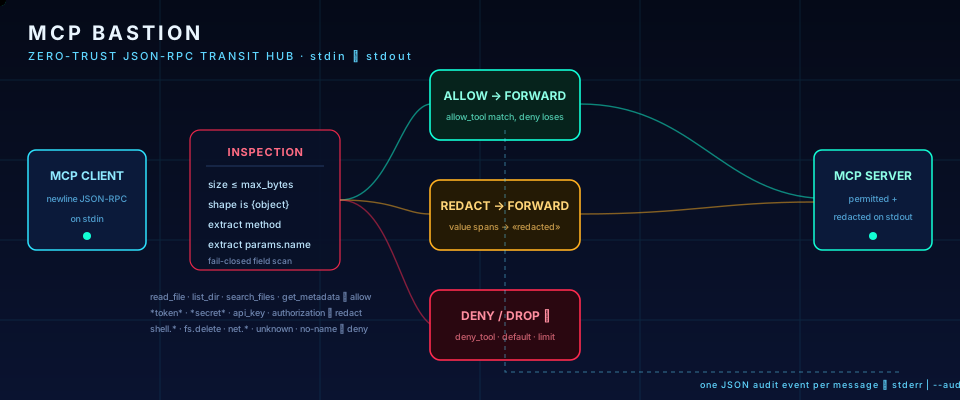
McpBastion is a local zero-trust checkpoint for the Model Context Protocol. It reads newline-delimited JSON-RPC from stdin, decides each message against a policy — allow / deny / redact — and writes only what survives to stdout. Every message, forwarded or not, leaves a one-line audit record. It runs entirely on your machine, uses no third-party runtime dependencies, and fails closed: anything it cannot confidently authorise is denied or dropped, never forwarded.
What this actually is (and is not)
Read this before anything else — the honesty here is the whole point.
- It is a line-oriented relay that sits on the MCP
stdiotransport, inspects a handful of JSON-RPC fields, and enforces a policy ontools/call. - It is not a transport proxy. It does not speak HTTP or SSE, does not open sockets, does not manage the MCP handshake, and does not spawn the downstream server for you. It moves bytes between one
stdinand onestdout, framed as one JSON object per\n-terminated line. That is the entire I/O contract. - It is not a JSON validator. There is no full parser inside. There is a small, single-pass field extractor (
gateway/src/json_scan.rs) that reads exactly four fields —method,id,params.name,params.arguments— while correctly skipping string literals so a{or"inside a value can never be mistaken for structure. When it cannot confidently extract a field it needs, it stops guessing and denies.
Two components, two languages, zero runtime deps:
| Component | Language | Role |
|---|---|---|
gateway/ |
Rust (std only) |
The enforcement point. Reads, decides, redacts, forwards, audits. |
console/ |
TypeScript (Node stdlib only) | The read-side. Aggregates audit logs, tails events, lints policies. |
Control-room index
- What this actually is (and is not)
- The checkpoint, message by message
- Standing up the gateway
- The demo session, replayed
- Policy routing
- The redaction pipeline
- Rate, size and depth controls
- The audit console
- The JSON extractor: honesty and limits
- Fail-closed behaviour
- Operational recipes · Exit behaviour · Troubleshooting · Roadmap
The checkpoint, message by message
Every non-empty input line runs the same gauntlet, in this order. The first gate that fires decides the message; nothing downstream of it runs. This is the pipeline in gateway/src/engine.rs::process_line:
- Size. If the raw line is longer than
max_bytes, it is dropped — before any parsing. A huge line never gets the chance to be interesting. - Shape. If, after leading whitespace, the line does not begin with
{, it is dropped as "not a JSON object". - Classify. The top-level
methodis extracted. Onlytools/callis tool-gated; every other method (initialize,tools/list, …) is governed solely by thedefaultdecision, sodefault = denylocks the checkpoint down to an audited allow-list of tool calls. - Name. For a
tools/call,params.nameis extracted. Atools/callwith no extractable string name is denied — reasontools/call missing extractable params.name. - Deny list. If the name matches any
deny_toolglob → deny. Deny always beats allow. - Allow list. Else if it matches any
allow_toolglob → continue. Else applydefault. - Rate. A would-be-forwarded message arriving while the rolling window is full is dropped. Only forwarded messages count against the window.
- Redact & forward. Matching argument values are spliced with the mask, and the message — every other byte intact — is written to
stdout.
Whatever the outcome, one audit event is emitted describing it.
Standing up the gateway
Prerequisites: a Rust toolchain (cargo) and Node.js ≥ 18.
make build          # cargo build --release  +  npm install && npm run build
make demo           # runs the whole gauntlet end-to-end and prints the report
make demo is the fastest way to see the checkpoint work; it is the exact command below, wired to the shipped sample session so the whole thing is self-contained and deterministic:
cat sessions/demo-session.jsonl \
  | gateway/target/release/McpBastion \
      --policy policies/default.policy \
      --audit sessions/demo-audit.jsonl \
      --stats --epoch-ms 0 \
  > sessions/demo-forwarded.jsonl
The flags, precisely:
| Flag | Meaning |
|---|---|
--policy <FILE> |
Required. The policy to enforce. |
--audit <FILE> |
Write audit events here instead of stderr. |
--stats |
Append a {"summary":true,…} line at EOF. |
--epoch-ms <N> |
Pin the base timestamp for deterministic demos/tests. |
--help / --version |
Print usage or version and exit. |
Placing it inline (the honest way)
In real use the checkpoint belongs in the pipe between your client and your MCP server, framed as newline JSON both ways. Because the gateway is strictly a stdin → stdout relay, you compose it with the shell (or your client's launch config), not with a built-in "wrap this server" flag:
your-mcp-client \
  | McpBastion --policy policies/default.policy --audit audit.jsonl \
  | some-mcp-server
This repo ships the single-direction replay form (cat session | McpBastion > forwarded) so the demo needs no live server. There is no reverse channel management, no request/response correlation, and no transport translation — don't read more into it than that.
The demo session, replayed
The sample sessions/demo-session.jsonl is ten messages: a handshake, a tools/list, six real tool calls, a couple of dangerous ones, and one malformed tools/call with no name. Under policies/default.policy (deny-by-default, read-only allow-list, credential redaction) it yields 4 forwarded, 6 denied, 0 dropped.
What comes out on stdout is the four survivors, with credentials — and nothing else — replaced. Note how the {brace} and escaped "quotes" inside the note string ride through untouched: proof the extractor respects string boundaries.
{"jsonrpc":"2.0","id":5,"method":"tools/call","params":{"name":"search_files","arguments":{"query":"password","access_token":"«redacted»","note":"contains a {brace} and \"quotes\""}}}
The six that never reach the server, and why:
| id | tool / method | decision | reason |
|---|---|---|---|
| 1 | initialize |
deny | default deny (non tools/call) |
| 2 | tools/list |
deny | default deny (non tools/call) |
| 6 | shell.exec |
deny | deny_tool shell.* |
| 7 | fs.delete |
deny | deny_tool fs.delete |
| 8 | format_disk |
deny | default deny (not on allow-list) |
| 10 | (missing name) | deny | tools/call missing extractable params.name |
Everything the gateway wrote to the audit sink for this run is captured verbatim in sessions/demo-audit.jsonl, and the forwarded stream in sessions/demo-forwarded.jsonl.
Policy routing
A policy is a tiny, line-oriented file (key = value or key value; # comments; blank lines ignored). The default.policy posture reads like a checkpoint duty roster:
default = deny

allow_tool = read_file
allow_tool = list_dir
allow_tool = search_files
allow_tool = get_metadata

deny_tool  = shell.*
deny_tool  = fs.delete
deny_tool  = net.*

redact_arg = *token*
redact_arg = *secret*
redact_arg = api_key
redact_arg = authorization

max_bytes      = 65536
rate_limit     = 20
rate_window_ms = 1000
redaction_mask = "«redacted»"
Routing rules that matter:
- Deny wins. If a tool matches both an
allow_tooland adeny_tool, it is denied. - Globs are literal +
*.*matches any run of characters (including empty); there is no?or character class. Matching is case-sensitive and must cover the whole name. Soshell.*catchesshell.execbut notshellx, and*token*catchesauth_token,token, andx_token_y. defaultis also the gate for non-tools/callmethods. Withdefault = deny, aninitializeortools/listis denied unless you flip the default.
Three sample postures ship in policies/:
| File | Posture |
|---|---|
default.policy |
Deny by default; read-only allow-list; credential redaction. |
strict.policy |
A single allowed tool (read_file); aggressive redaction; max_bytes 8192, rate_limit 5. |
permissive.policy |
Allow by default; a small deny-list; light redaction — dev only. |
The authoritative format reference is docs/POLICY.md.
The redaction pipeline
Redaction is surgical, not cosmetic. Given a forwarded tools/call, the gateway locates params.arguments (an object) with the extractor, walks its immediate members, and for each key matching a redact_arg glob it replaces only that value's byte span with the mask encoded as a JSON string. Everything outside those spans is relayed verbatim (gateway/src/redact.rs).
- Splices are applied from the end of the line backwards, so earlier byte offsets stay valid.
- A non-string value redacts wholesale:
{"creds":{"k":"v"}}withredact_arg = credsbecomes{"creds":"«redacted»"}. - The redacted key names (not the values) are recorded in the audit event's
redactedarray, so you can prove what was masked without ever logging the secret itself. - If there is no
params.argumentsobject, nothing changes and the original bytes pass through.
In the demo, api_key, access_token, and authorization are masked across three messages — visible as bytes_out < bytes_in on those audit lines.
Rate, size and depth controls
Three independent limiters, each with a distinct job and a distinct outcome:
max_bytes— a hard ceiling checked first, before parsing. Over-limit lines are dropped (decision: drop). Default262144.rate_limit/rate_window_ms— a sliding-window counter over forwarded messages only. When the window is full, the next would-be-forwarded message is dropped.rate_limit = 0means unlimited. Denied messages never consume the budget.max_depth— advisory only. The structural scan records the maximum nesting depth per message into the audit fieldmax_depth, but a deep message is not rejected on that basis. It is a signal for the console, not a gate. (Thebalancedaudit field is similarly advisory.)
The audit console
The TypeScript console never touches the wire; it reads the audit log the gateway wrote. Three subcommands, all Node-stdlib-only:
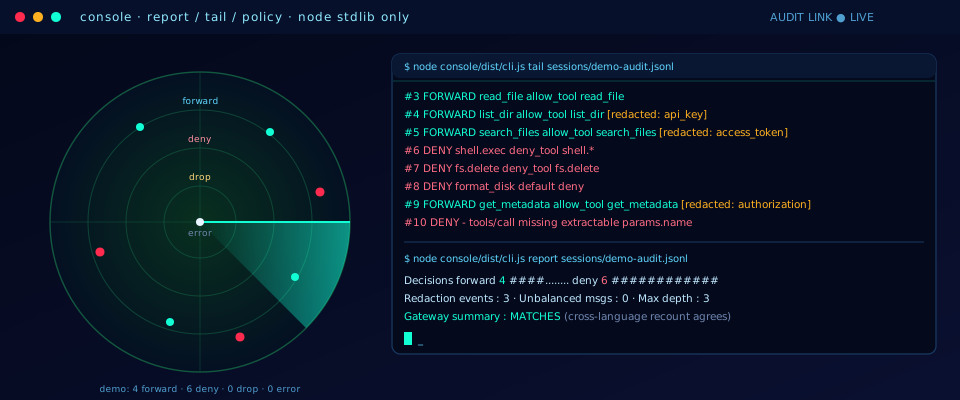
node console/dist/cli.js report <audit.jsonl> [--json] [--decision D] [--tool S]
node console/dist/cli.js tail   <audit.jsonl> [--decision D]
node console/dist/cli.js policy <policy-file>
report on the demo log:
McpBastion — Audit Report
==========================

Total messages : 10
Bytes in/out   : 1204 / 582
Redaction events: 3
Unbalanced msgs : 0
Max depth seen  : 3
Gateway summary : MATCHES

Decisions
---------
  forward      4 ################........
  deny         6 ########################
  drop         0 ........................
  error        0 ........................
reportaggregates decisions, per-tool activity, redacted-key tallies, byte totals, and top reasons.--jsonemits the machine form;--decision/--toolnarrow the per-event listing.tailprints one compact line per event —#3 FORWARD read_file allow_tool read_file, with[redacted: …]appended when values were masked.policyparses, summarises, and lints a policy: unknown directives and non-integer numbers are errors; adeny_toolshadowing anallow_tool, or a redundant allow-list underdefault = allow, are warnings.
Gateway summary : MATCHES is the load-bearing line. With --stats the Rust gateway appends its own count of forward/deny/drop/error; the console independently recounts the log and compares. Agreement is a cheap cross-language integrity check — and report exits non-zero if they disagree.
The JSON extractor: honesty and limits
The security of this checkpoint rests on one modest promise: the extractor never mistakes the inside of a string for structure. It keeps that promise (gateway/src/json_scan.rs) and makes no larger claim.
It will:
- Skip string literals correctly, honouring
\",\\, and\uXXXXescapes, so{,},,,:inside a string are inert. - Track object/array nesting so a key is matched only at the depth you asked for — a nested
"method"insideparamsnever shadows the top-level one. - Return the raw byte span of a value, and decode a string field (including surrogate pairs) when it needs the text of
methodorparams.name.
It will not:
- Validate that the whole line is well-formed JSON.
- Build a document tree, or decode numbers, booleans, or
nullinto typed values. - Normalise or de-duplicate repeated keys, or care about key ordering.
The consequence is deliberate and safe: the gateway reads the minimum needed for a decision, shrinking the attack surface versus a full parser, and when it cannot confidently extract a needed field it fails closed rather than improvising. It never pretends to understand more of your traffic than it does.
Fail-closed behaviour
The default answer is "no." Concretely, a message is refused (denied or dropped) rather than forwarded whenever:
- it exceeds
max_bytes(drop); - it is not a JSON object (drop);
- it is a
tools/callwhoseparams.namecannot be extracted as a string (deny); - its tool matches a
deny_tool(deny); - its tool is on no list and
default = deny(deny); - a non-
tools/callmethod arrives underdefault = deny(deny); - the rate window is full (drop).
There is no path in which uncertainty resolves to "forward." If the checkpoint cannot articulate a positive reason to pass a message, it does not pass it.
Operational recipes
# Watch only what got blocked, live
node console/dist/cli.js tail audit.jsonl --decision deny

# Machine-readable rollup for a dashboard or CI gate
node console/dist/cli.js report audit.jsonl --json

# Everything a single tool did across a session
node console/dist/cli.js report audit.jsonl --tool read_file

# Lint a policy before you trust it (exits non-zero on errors)
node console/dist/cli.js policy policies/strict.policy

# Send audit to stderr (no --audit) and keep only the forwarded stream
cat session.jsonl | McpBastion --policy p.policy 2>/dev/null > forwarded.jsonl
Exit behaviour
Streams:
- stdout — permitted, redacted messages, one per line. Flushed after every write.
- audit sink — one JSON event per input line;
stderrby default, or the--auditfile. Also flushed per write. - stderr — errors and, absent
--audit, the audit events themselves.
Exit codes (from gateway/src/main.rs):
| Code | Meaning |
|---|---|
0 |
Clean EOF — the session ended normally. |
1 |
I/O error during the session. |
2 |
Usage error (bad or missing arguments). |
3 |
Policy could not be read or parsed. |
error as an audit decision is reserved and not emitted in 0.1 — the pipeline maps every message to forward, deny, or drop.
Troubleshooting
reportexits non-zero withGateway summary : MISMATCH!— the gateway's--statscounts and the console's recount disagree. Confirm you ran the gateway with--stats, and that the audit file wasn't truncated or appended to across runs (the gateway creates the file fresh with--audit).- Everything is denied, including
initialize. Expected underdefault = deny: non-tools/callmethods are gated bydefault. Setdefault = allowif you want the handshake through, or scope with explicit rules. - A tool call I allowed is still denied. Check for a
deny_toolglob that also matches it — deny wins. Also confirm the match is case-sensitive and whole-string (read_file≠read_files). - Nothing was redacted although a secret went through. The value's key must match a
redact_argglob and sit directly insideparams.arguments. A secret nested deeper, or under another key, won't match — widen the pattern (e.g.*token*) or add the key. - A large message vanished with no deny reason. It was likely dropped by
max_bytes(checked before anything else) or by the rate limiter — look fordecision: dropin the audit line. policyreports lint errors and exits non-zero. Fix unknown directives and non-integer numeric values; those are hard errors. Shadowed allows and redundant allow-lists are only warnings.
Roadmap
0.1 is intentionally small and honest. Out of scope for now:
- Response-side inspection. Today the checkpoint reasons about requests; correlating and gating responses/results is future work.
- Richer matching.
?and character-class globs, and per-tool argument schemas, are candidates beyond the current literal-plus-*matcher. - Live transport adapters. The
stdin/stdoutJSONL contract is fixed by design; any HTTP/SSE bridging would be a separate, clearly-scoped component — not implied here. - The
errordecision. Reserved in the schema; wiring internal processing faults to it is planned.
See CHANGELOG.md for what 0.1.0 actually shipped.
Repository layout
McpBastion/
├── gateway/            Rust std-only gateway CLI (the enforcement point)
│   └── src/            json_scan · policy · redact · audit · engine · main
├── console/            TypeScript, Node-stdlib-only audit & policy viewer
│   └── src/            audit · report · policy · render · cli (+ node:test)
├── policies/           default · strict · permissive samples
├── sessions/           demo session + captured forwarded/audit output
├── docs/               POLICY.md, PROTOCOL.md, assets/ (SVGs)
├── Makefile            build / test / lint / demo orchestration
└── .github/workflows/  CI across both languages + integration
License
MIT.
Milestones
All shipped. This is the delivery record, oldest first.
- M01 - Session capture: record MCP JSON-RPC traffic to the sessions log (2020-06-14)
- M02 - Policy engine skeleton: allow/deny per tool name (2020-11-02)
- M03 - Path-based tool argument inspection (2021-03-19)
- M04 - Per-session policy switching (2021-09-27)
- M05 - Strict mode: deny everything not explicitly allowed (2022-02-18)
- M06 - Argument schema validation for known tool families (2022-07-30)
- M07 - Rate limiting per client session (2022-12-09)
- M08 - Audit events with stable IDs and severity (2023-04-21)
- M09 - Shell-command detection in tool arguments (2023-08-14)
- M10 - Egress host allowlist for network-touching tools (2023-12-01)
- M11 - Policy files: default / permissive / strict bundles (2024-03-15)
- M12 - Session replay for incident forensics (2024-06-28)
- M13 - Diff view between two sessions (2024-09-20)
- M14 - Secrets scrubbing in logged arguments (2024-12-13)
- M15 - Gateway hot reload of policy files (2025-02-07)
- M16 - Per-tool risk scoring heuristic (2025-05-23)
- M17 - Console v1: policy editor + live session view (2025-08-29)
- M18 - Export audit reports (markdown + JSON) (2025-11-14)
- M19 - Anomaly flagging: unusual argument sizes and repeat calls (2026-01-16)
- M20 - Demo sessions + forward pipeline for testing (2026-02-27)
- M21 - Wildcard tool matching with explicit-deny precedence (2026-04-17)
- M22 - Console v2: audit timeline + finding drill-down (2026-06-26)
- M23 - 1.0 hardening: fuzzed parser inputs, zero-dependency TS console (2026-08-14)
Yorumlar (0)
Yorum birakmak icin giris yap.
Yorum birakSonuc bulunamadi