FableCut
Health Gecti
- License — License: MIT
- Description — Repository has a description
- Active repo — Last push 0 days ago
- Community trust — 145 GitHub stars
Code Basarisiz
- fs module — File system access in .github/workflows/ci.yml
- child_process — Shell command execution capability in analyze.js
- exec() — Shell command execution in analyze.js
- fs.rmSync — Destructive file system operation in analyze.js
- fs module — File system access in analyze.js
- child_process — Shell command execution capability in mcp-server.js
- spawnSync — Synchronous process spawning in mcp-server.js
- process.env — Environment variable access in mcp-server.js
- fs module — File system access in mcp-server.js
- child_process — Shell command execution capability in server.js
- exec() — Shell command execution in server.js
- spawnSync — Synchronous process spawning in server.js
- fs.rmSync — Destructive file system operation in server.js
- process.env — Environment variable access in server.js
- fs module — File system access in server.js
Permissions Gecti
- Permissions — No dangerous permissions requested
Bu listing icin henuz AI raporu yok.
Zero-dependency browser video editor that AI agents can drive — JSON timeline, MCP + REST, live-reloading UI
FableCut
A browser video editor that AI agents can drive.
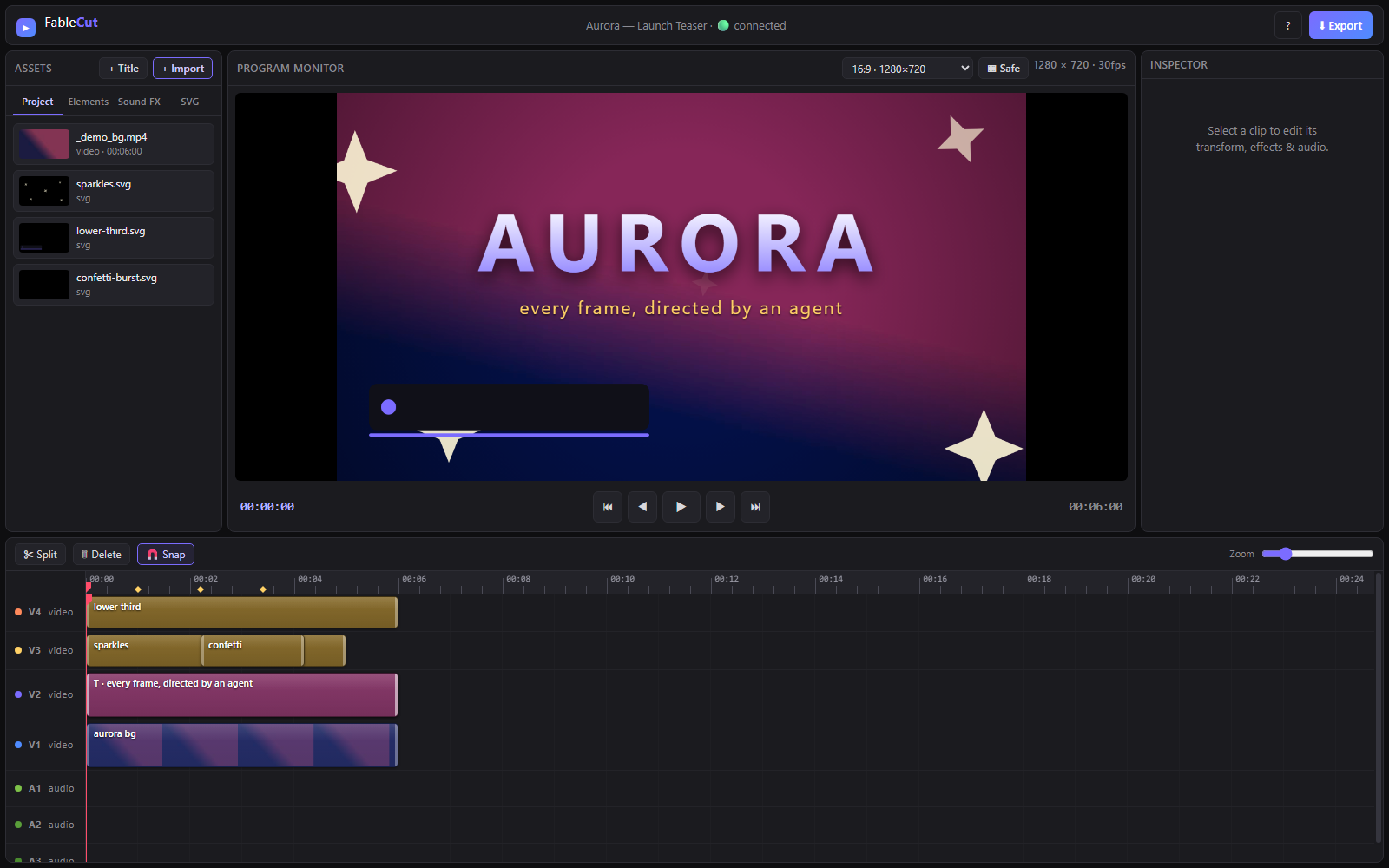
FableCut is a Premiere-style non-linear video editor that runs entirely in your
browser — and exposes its whole timeline as one JSON document. Edit it by hand,
from the UI, or let an AI agent (Claude Code, Claude Desktop, or anything that
speaks MCP/REST) cut your video for you while you watch the timeline update
live.
Zero npm dependencies. One node server.js. That's it.
Why it's interesting
Most "AI video" tools hide the edit behind an API. FableCut flips that: the
project file is the interface. project.json describes media, clips,
tracks, effects, keyframes and transitions — any process that can write JSON
can edit video, and the open browser UI hot-reloads within ~150 ms via
server-sent events. A human and an agent can work on the same timeline at the
same time.
Features
Editing
- 4 video tracks + 3 audio tracks, drag/trim/split/snap, undo/redo
- Timeline multi-select — rubber-band marquee (drag on empty track area),
Ctrl/Cmd/Shift+click to add/remove clips, Ctrl+A to
select all, Esc to deselect. Drag any selected clip to move the
whole group; Delete removes all selected; S splits all
selected at the playhead. Inspector shows an "N clips selected" banner. - Beat & cue markers (tap M on the beat during playback) with edge snapping
- Real decoded audio waveforms on clips
- Canvas aspect presets (16:9, 9:16 reels, 4:5, 1:1) + safe-area guides
Look
- 12 one-click filter presets (cinematic, teal-orange, noir, vintage, cyberpunk…)
- Adjustment layers — one clip grades everything below it, Premiere-style
- Full grade controls: brightness/contrast/saturation/hue, temperature & tint,
blur, grayscale/sepia/invert, vignette, animated film grain - Blend modes (screen, multiply, overlay…), fit modes (contain/cover/stretch),
per-edge cropping, corner radius, flip H/V - Chroma key (green screen) with tolerance/softness + spill suppression
- AI background removal (person cut-out, in-browser via MediaPipe)
Motion
- Keyframe animation on ~25 properties with easing
- Speed ramps — keyframe
speedand the engine time-remaps video and the
export audio mix (the fast-into-slow-mo reel move) - Camera shake and RGB-split/chromatic aberration, both animatable
- 17 transitions: fades, slides, wipes (4 directions), zoom, iris, spin, blur,
whip-pan, glitch, pop
Text
- Kinetic captions: typewriter, word-pop, word-slide, karaoke, letter-pop,
wave, bounce, shake - Neon glow for that TikTok caption look
- Font editor: system fonts, drop-in custom fonts (
library/fonts/), and any
Google Font by name — loaded automatically - Gradient fills, outline, background pills, letter-spacing, line-height,
weights, italic, uppercase, alignment, soft shadows
Animated SVG clips
- A first-class
svgclip kind: CSS-@keyframes-animated SVGs render
frame-accurately in preview and export (the compositor freezes the
animation at any time). Agents can author their own vector overlays —
lower-thirds, confetti, sparkles — as plain.svgfiles. Starters included.
Remake a reference video
- Give it a reference edit (a reel you like) and get back an edit blueprint:
shot boundaries, music beats + BPM, a loudness curve, per-shot energy, the
drop — plus the reference's music track extracted into your media, ready
to rebuild the same idea with your own footage. Zero extra dependencies
(ffmpeg does the decoding; onset/tempo detection is plain Node).node analyze.js ref.mp4,POST /api/analyze, or thefablecut_analyze_referenceMCP tool.
Asset library
library/folders surface as tabs in the UI: Elements (overlay art),
Sound FX, SVG — drop files in, the open editor refreshes live
Export
- Fast export: browser renders every frame + an offline audio mix, ffmpeg
encodes a frame-accurate CRF-18 MP4 (keeps rendering if you switch tabs) - Realtime MediaRecorder fallback when ffmpeg isn't available
Quick start
git clone https://github.com/ronak-create/FableCut.git
cd FableCut
node server.js        # → http://localhost:7777
Requirements: Node 18+ and a Chromium-based browser. ffmpeg on PATH is
optional but recommended (fast export + upload remuxing). AI background
removal fetches its model from a CDN on first use.
Drop media into the window (or ./media/), drag clips onto the timeline, edit,
export.
Driving it with an AI agent
Everything an agent needs is in CLAUDE.md — the complete
schema, semantics and recipes. Point any capable model at that file and it can
operate the editor end to end.
Three equivalent control surfaces:
MCP (best for Claude Code / Claude Desktop) — register the bundled
zero-dependency MCP server once:claude mcp add -s user fablecut -- node "<path-to>/fablecut/mcp-server.js"Tools:
fablecut_status(auto-starts the editor),fablecut_docs,fablecut_get_project,fablecut_set_project,fablecut_patch_project,fablecut_import_media,fablecut_analyze_reference.The surface is token-efficient by design: agents patch the timeline with
small ops (fablecut_patch_project) instead of round-tripping the whole
document, read a compact one-line-per-clip summary
(fablecut_get_project {compact:true}), and fetch only the manual sections
they need (fablecut_docs {section:"props"}).The file — read
project.json, modify, bumprevision, write. The UI
live-reloads.REST —
GET/PUT /api/project,POST /api/upload,GET /api/library,
SSE at/api/events. See CLAUDE.md for the full list.
Example: ask Claude Code "cut these six clips to the beat markers, add a
teal-orange grade, put a word-pop caption on top and a whoosh on every cut" —
and watch the timeline rebuild itself.
Or hand it a reference: "here's a reel I like — analyze it and remake it with
my clips, same music". The agent calls fablecut_analyze_reference, gets the
blueprint (cuts, beats, BPM, energy, drop, extracted music), and rebuilds the
structure shot-for-shot with your footage.
Conflict-safe concurrent editing: the UI, the MCP tools, and directproject.json writes all agree on a revision counter. If you edit a clip in
the UI while an agent is mid-task, the agent's next write is rejected (409 from
the REST API / a conflict error from fablecut_set_project) instead of
silently overwriting your change. The UI similarly detects when an agent write
supersedes a not-yet-saved local tweak and tells you with a toast instead of
dropping it silently.
Project layout
server.js        zero-dependency HTTP server: static hosting, REST API, SSE,
                 ffmpeg export pipeline
app.js           the editor: timeline UI, compositor, keyframes, text engine,
                 SVG rasterizer, chroma key, exporters
index.html       single-page UI
style.css        dark editor theme
mcp-server.js    stdio MCP server exposing the editor to AI agents
analyze.js       reference-video analyzer: shots, beats/BPM, energy, drop,
                 music extraction (module + CLI)
CLAUDE.md        the agent manual (schema + recipes) — also served by fablecut_docs
project.json     your timeline (created on first run; gitignored)
media/           project footage (gitignored)
analysis/        cached edit blueprints from /api/analyze (gitignored)
library/         default assets: elements/ sfx/ svg/ fonts/
exports/         finished renders (gitignored)
Authoring animated SVG overlays
SVGs animate with plain CSS @keyframes. One convention: never hardcodeanimation-delay — set --d: 0.4s instead, and the compositor drives time by
pausing all animations and rebasing their delays. Full rules + a skeleton in
CLAUDE.md; working
examples in library/svg/.
Notes
- The repo ships with 20 Google Fonts (
library/fonts/, OFL — seeLICENSES.mdthere) and a set of self-authored SVG overlays and animated
elements (library/elements/,library/svg/, MIT like the rest of the repo). library/sfx/is yours to fill (gitignored): sound-effect sites typically
don't allow redistributing their files in a public repo, so FableCut doesn't —library/sfx/README.mdlists good free sources.- Export runs in the browser because the compositor is the browser; agents
ask you to click Export (or render directly with ffmpeg frommedia/).
License
Yorumlar (0)
Yorum birakmak icin giris yap.
Yorum birakSonuc bulunamadi