relay
Health Pass
- License — License: MIT
- Description — Repository has a description
- Active repo — Last push 0 days ago
- Community trust — 43 GitHub stars
Code Fail
- exec() — Shell command execution in internal/programui/assets/app-deferred.js
- network request — Outbound network request in internal/programui/assets/app-deferred.js
- exec() — Shell command execution in internal/programui/assets/app-deferred.min.js
- network request — Outbound network request in internal/programui/assets/app-deferred.min.js
- network request — Outbound network request in internal/programui/assets/app.js
- network request — Outbound network request in internal/programui/assets/app.min.js
- network request — Outbound network request in internal/programui/assets/overview.js
- network request — Outbound network request in internal/programui/assets/overview.min.js
Permissions Pass
- Permissions — No dangerous permissions requested
No AI report is available for this listing yet.
Skills to orchestrate coding agents to do long horizon tasks with little to no steering
Relay
Relay turns software work into durable, resumable workflows for coding agents. It works with Claude
Code, GitHub Copilot CLI, and Codex CLI.
Use Relay for:
- One change delivered as a pull request.
- A larger change delivered as an ordered stack of pull requests.
- A program where one tech lead agent manages goals, decisions, workers, and pull requests.
Relay keeps the state on disk. Agents can stop, restart, or hand work to a subagent without relying
on conversation history.
Quick start
git clone https://github.com/ronaknnathani/relay
cd relay
make install
relay setup copilot
Replace copilot with claude or codex if needed.
Start a single change:
cd <your-repository>
relay "Add retry logic to the HTTP client"
Relay creates a branch, a worktree, and a project. It then launches deliver-pr, which drives the
change through:
clarify -> plan -> implement -> simplify -> review -> validate -> open-pr
Resume it later with:
relay resume <project-slug>
Workflows
Deliver one pull request
deliver-pr is the default workflow. It delegates each phase to a focused subagent and records the
result under ~/.relay/projects/.
relay "Add request validation to the API"
relay --name request-validation "Add request validation to the API"
When the project runs under Herdr, deliver-pr starts relay pr watch after the pull request opens.
It observes checks, review feedback, conflicts, and merge state, then wakes the exact project session
only when there is something to do. The watcher is read-only. pr-monitor triages the event and
delegates fixes to pr-fix. Outside Herdr, invoke /pr-monitor manually.
Deliver a stack of pull requests
Use stack-ship when one goal needs several dependency-ordered pull requests.
relay --workflow stack-ship "Introduce the new storage API and migrate callers"
The orchestrator creates the stack, delegates each pull request through deliver-pr, watches the
front pull request, and advances the stack after merge. Agents never approve or merge their own work.
Programs
Programs add a management layer above ordinary Relay projects. You describe a larger goal to one
tech lead agent. The tech lead turns it into contracts, decisions, and dependency-aware assignments.
Each assignment runs as its own visible worker session and produces a pull request.
You continue talking to the tech lead instead of managing each worker directly.
You
 |
 v
Tech lead session
 |  goal, priorities, contracts, decisions
 v
Worker projects
 |  clarify, plan, implement, review, validate
 v
Pull requests
Managed programs require Herdr and currently support Copilot and Claude. Herdr
keeps the tech lead, workers, program patrol, and PR watchers visible in separate terminal tabs.
Create a program from a Herdr pane:
cd <your-repository>
relay program new "Move our authentication system to short-lived tokens"
Relay creates a draft program and launches its tech lead. Work with the tech lead to define the goal,
approve architecture contracts, and resolve decisions. The tech lead then dispatches ready work to
worker sessions.
The program patrol checks durable state on its own schedule and rings the existing idle tech lead pane
when something needs attention, without changing the user's focus. Ask the tech lead for a change to a
pull request that already exists and it routes the request from live GitHub state; ask it to retire a
merged item and it stops that item's watcher, exits its worker, closes the tab, and archives the child
project.
Useful commands:
relay program status <program-slug>          # current program state
relay program queue <program-slug>           # ready, active, and blocked work
relay program resume <program-slug>          # reopen the tech lead session
relay program worker list <program-slug>     # live worker sessions
relay program worker cleanup <program-slug> <item>  # retire a merged item's runtime
relay program ui                             # unified active-program UI
relay program ui <program-slug>              # open one active program in the unified UI
relay program patrol status <program-slug>   # scheduler and wake status
relay program patrol start <program-slug>    # start the program patrol
Program state lives under ~/.relay/programs/. Worker state remains under~/.relay/projects/. Communication between the tech lead and workers uses durable inboxes and
outboxes. GitHub pull requests remain the review boundary, and a real human approval remains the
merge gate. The unified UI discovers programs from the active storage tree, refreshes automatically,
and highlights dispatched, in-review, and blocked work across programs.
Read Relay Programs for the full model and command reference.
Reviewing other people's pull requests
relay review reviews a pull request you didn't write and leaves a draft GitHub review for you to
edit and submit.
relay review https://github.com/<owner>/<repo>/pull/<number>
relay review <owner>/<repo>#<number>
Inside a clone of the pull request's repository, Relay checks the head out in a detached worktree at.worktrees/review-pr-<number>. Anywhere else it keeps one blobless clone per repository under/tmp/relay-reviews/<host>/<owner>/<repo>/ with a worktree per pull request. Running the command
again reuses that checkout and moves it to the latest head.
You can also skip the command and ask any agent session to run the review-pr skill on a pull
request. The skill runs relay review <pull-request> --no-launch itself, which prepares the same
checkout and state without starting another session.
The review-pr skill reviews against your global and repository AGENTS.md, reading the repository
guidance from the base commit. It runs review and simplify in report mode, so it never edits the
checkout. It writes inline comments with write-like-me, plus a top-level comment only when the
overall approach needs one, and leaves them in a pending review marked as AI-drafted, at most one per
pull request head. It never submits the review. The summary stays in the session, and when nothing
is left to fix it tells you to approve.
State lives under ~/.relay/reviews/<host>/<owner>/<repo>/<number>/: review.json (written by
Relay), context.md (what the change does), findings.md (a ledger of findings with stable IDs and
status), and rounds.md (each reviewed head and its draft). A later run re-verifies every open
finding against the new head before it raises anything new.
Pull request watcher
The PR watcher moves deterministic polling out of the agent:
relay pr watch start <project-slug>
relay pr watch status <project-slug>
relay pr watch tick <project-slug>
relay pr watch stop <project-slug>
It checks immediately, then uses a 15, 30, and 60 minute backoff. New code, new actionable feedback,
or a changed blocker resets it to the fast interval. The watcher prints high-level activity in its
Herdr pane and stores private digests under ~/.relay/run/pr-watch/.
Read Relay PR Watch for cadence, routing, and digest details.
Skills
Skills are authored once under skills/ and generated for each supported agent.
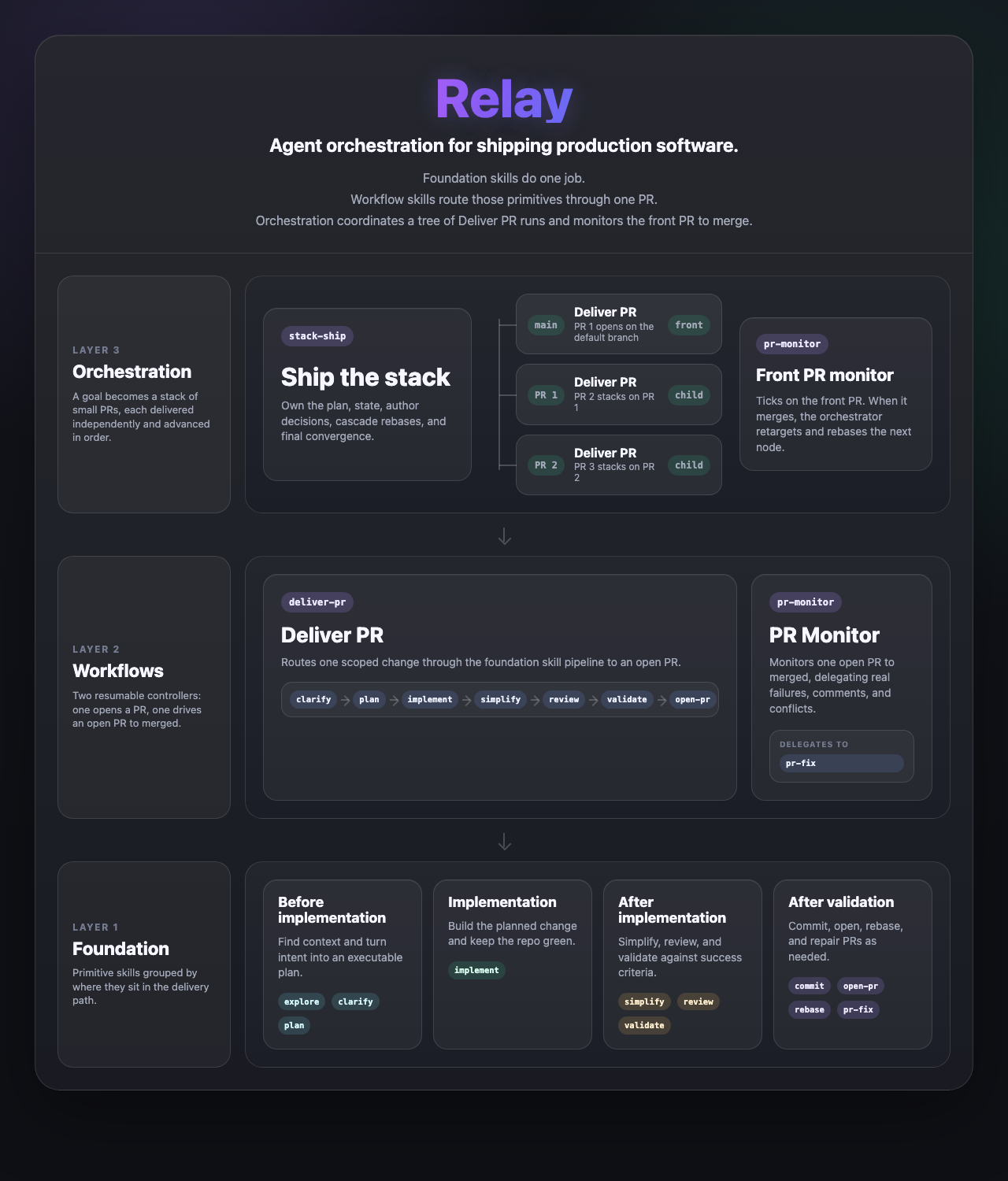
The library has three layers:
- Foundation skills handle one phase, such as
clarify,plan,implement,review,validate,pr-fix, andopen-pr. - Workflow skills compose phases.
deliver-prowns one pull request andpr-monitorhandles one
watcher event. - Orchestrators coordinate larger goals.
stack-shipmanages a PR stack andtlmanages a
Relay program.
Run relay setup <agent> after changing skills or updating Relay. Setup generates the agent package
and links Relay-managed skills into the agent's personal skill directory.
Installation and configuration
Relay requires Go 1.25+ and at least one supported coding-agent CLI on PATH.
make install
relay setup <agent>
| Agent | Setup | Installed skills |
|---|---|---|
| Claude Code | relay setup claude |
~/.claude/skills |
| GitHub Copilot CLI | relay setup copilot |
~/.copilot/skills |
| Codex CLI | relay setup codex |
~/.codex/skills |
The first setup records a branch prefix, default agent, and permission mode in~/.relay/config.json.
relay config default-agent <agent>
relay config permission-mode <agent> <mode>
Claude sessions default to --permission-mode auto; explicitly configureddefault and bypass modes are honored. Every Codex session starts with-c 'shell_environment_policy.inherit="all"'. These settings apply to both
individual projects and managed program launches.
Relay-managed state:
~/.relay/config.json        user configuration
~/.relay/projects/          individual and worker projects
~/.relay/programs/          managed programs
~/.relay/reviews/           pull request reviews
~/.relay/run/               patrol and watcher runtime state
<repo>/.worktrees/          project and review worktrees
/tmp/relay-reviews/         clones for reviews started outside the repository
Contributing
See CONTRIBUTING.md for skill conventions and the generation workflow.
License
Reviews (0)
Sign in to leave a review.
Leave a reviewNo results found