ai-sdlc-graph
Health Pass
- License — License: MIT
- Description — Repository has a description
- Active repo — Last push 0 days ago
- Community trust — 10 GitHub stars
Code Pass
- Code scan — Scanned 12 files during light audit, no dangerous patterns found
Permissions Pass
- Permissions — No dangerous permissions requested
No AI report is available for this listing yet.
An executable graph written in Markdown, not code. nodes, guards, bounded retry loops, durable run state — carrying a feature from spec to merged. No framework, no SDK, no dependencies: your coding agent is the runtime.
SDLC Graph Engineering
The software lifecycle as a guarded graph your coding agent can actually execute — typed nodes,
total exit guards, bounded retry loops, durable run state, and a ledger of every gate that could not
run.
It ships working. sdlc-graph is my own lifecycle, and installing it drives a feature from idea
to merged with nothing to configure. That is how most people should use it.
Nothing in it is locked, though. The graph is three Markdown files rather than code, so if your
team's definition of done differs from mine, changing it is editing a row in a table rather than
forking a framework. Entirely optional. → Make it yours
https://github.com/user-attachments/assets/c717c1dc-214d-4b6b-8ad5-55dd5107baf1
What you are watching is sdlc-graph driving a real feature end to end, rendered bysdlc-graph-viewer. Both ship here.
*Two minutes, no audio — the fast cut. If it moves too quickly, there is a
five-minute walkthrough on YouTube, which is
also where to go if the player above does not load.*




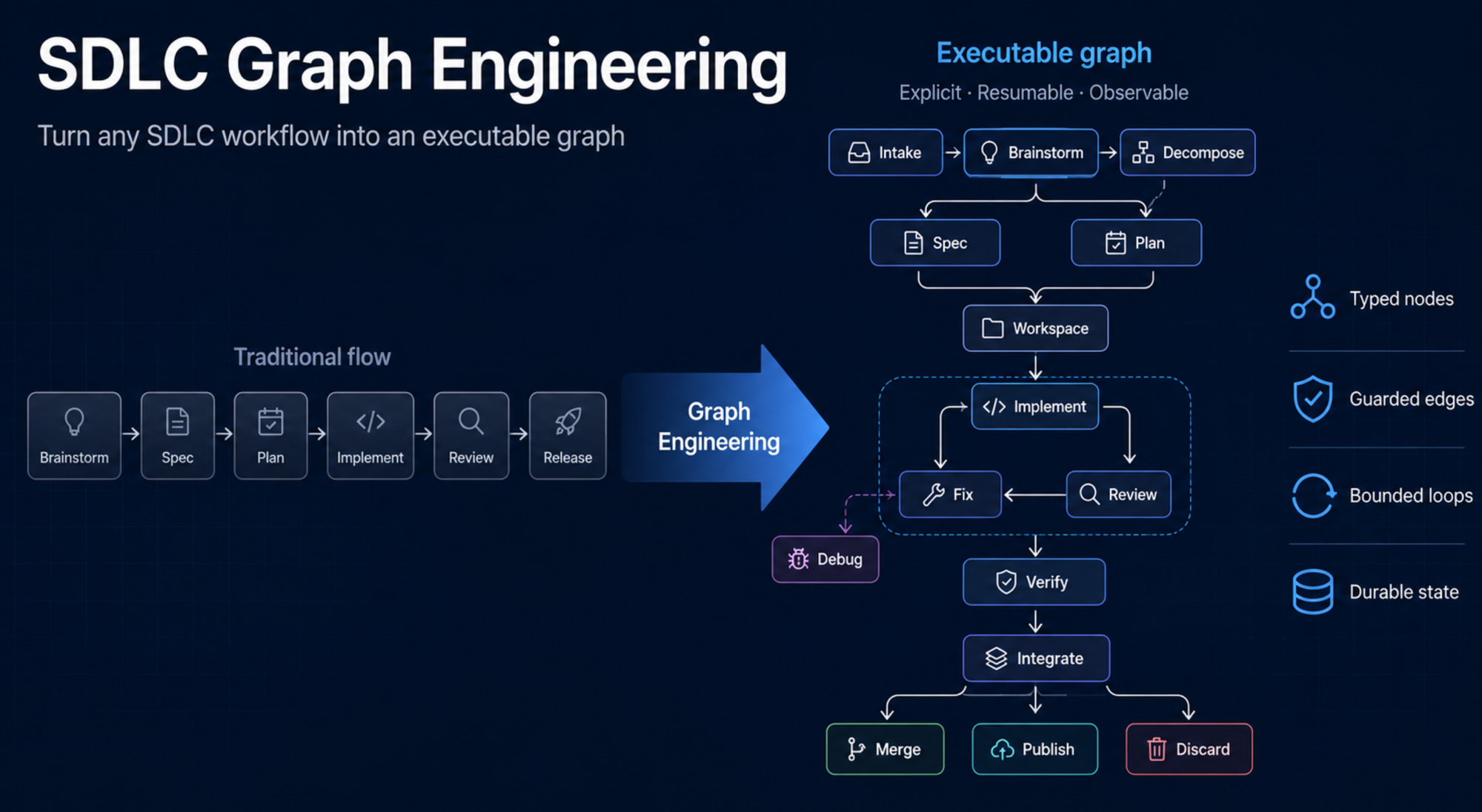
Table of Contents
- How it works
- Installation
- The basic workflow
- When something goes wrong
- What's inside
- Make it yours
- Optional tools, and what happens without them
- How this is tested
- Philosophy
- Contributing
- Updating
- Credits
- License
How it works
You say /sdlc-graph and describe what you want. Nothing auto-triggers it — running an entire
lifecycle is not something to enter on a description match.
From there the run is a state machine, not a prompt. Twenty nodes, forty transitions, and every
transition guarded: guards are evaluated in table order and exactly one must match. Zero matching
guards halts the run as a defect rather than letting an agent guess its way forward. Every retry loop
declares a bound, counted per item, never reset. Every transition writesdocs/graph-runs/<run-id>/state.json before the next node starts, so a crash between two nodes
still leaves a file saying exactly where the run was — and "where were we?" resumes it.
Five things follow from that, and they are the whole point:
| Written as prose | Executed as a graph | |
|---|---|---|
| Run state | nothing records where it got to; an interruption restarts from guesswork | one typed file per run, written on every transition, resumable |
| Conditions | "re-run if the findings are significant" — a condition nothing checks | a guard that evaluates, in a table where exactly one must match |
| Loops | real cycles, none naming a limit | every cycle bounded, per item, and the bound is enforced |
| Skipped work | "never claim a gate you didn't run" — unenforceable if nothing records the absence | preflight resolves each node's requires; a missing tool appends to skipped_gates[] and the node cannot be marked passed |
| Human stops | invented ad hoc, so a 20-node run becomes 20 interruptions | six declared stops, derived from the node contracts so the list cannot drift |
The work itself does not happen in the orchestrator's context. A milestone agent is spawned per
milestone, runs the whole build-and-review loop, and returns one typed bundle. The orchestrator
verifies that bundle against git, against a test suite it re-runs itself, and against the agent's
journal — and only then writes the transition. A gate it cannot evidence is re-run, not recorded.
Installation
Claude Code:
/plugin marketplace add RonMizrahi/sdlc-graph-engineering

/plugin install sdlc-graph@sdlc-graph-engineering                       # the graph
/plugin install sdlc-graph-viewer@sdlc-graph-engineering                # optional: watch a run
/plugin install sdlc-graph-engineering-install@sdlc-graph-engineering   # optional: the method
Install any one of them on its own; none requires the others. No npm install, no runtime, no
service — every eval suite is plain Python 3 with an empty import list, and the viewer's server
imports nothing but node:*.
Breaking change, 0.7.0. The method plugin was
sdlc-graph-engineeringthrough 0.6.0 and issdlc-graph-engineering-installfrom 0.7.0. The marketplace name is unchanged, so/plugin marketplace addstill works — but an existing install must be removed and re-added under
the new id.
Then, in the project you want driven:
/sdlc-graph <context>
That is the whole interface. There is no sub-command grammar, because nothing parses one —<context> is free text, read the way you would brief a colleague who is about to start.
More context is better, and it is the cheapest thing you can give it. A sentence works. A page
works better: everything you leave out becomes something SPEC has to stop and ask you about, and
everything you assume becomes something it has to guess. The ticket, the constraints, the acceptance
criteria, the files you already know are involved, what must not be touched — all of it is useful,
none of it needs a format.
/sdlc-graph build an ice cream store web app

/sdlc-graph review this task https://linear.app/team/issue/ENG-4412 and build it

/sdlc-graph <your entire prompt, pasted whole — ticket, constraints, acceptance
             criteria, the files involved, what not to touch>
Run that once and you are done issuing commands. From there the graph drives itself: it stops at
the six places it declares and nowhere else, and an interrupted run is picked up by saying so —
"where were we?" — not by a different command.
The basic workflow
INTAKE— detects stack, whether there is a UI, branch and host; creates the run directory.SPEC→ stops for you. A design dialogue, then it waits for approval.PLAN→ stops for you. Writes the plan file, then waits. The last cheap moment to change
direction.STRATEGY→ stops for you. Branching A/B/C/D, and whether PRs open automatically.- Then it runs by itself, per milestone. A milestone agent is spawned per milestone — under
strategy C, one per worktree, all in one message — and runsBRANCH → IMPLEMENT → TEST → GATE_A → [E2E] → GATE_B, returning one typed bundle the orchestrator
verifies before recording anything. The loop returns toBRANCHfor the next milestone without
opening a PR.GATE_Aexecutes JavaScript: changed files grouped by module, four review steps per group,
groups concurrent. 1,000 files → 85 groups → 340 agents, every file reviewed.E2Edoes not exist without a UI — the node is absent, not skipped.
CONSOLIDATE(strategy C only) merges every worktree into one integration branch in
dependency order, runs the integrated suite, removes the worktrees, then a whole-diffGATE_B.- One shared tail, every strategy —
CLOSE_OUT → PR → PR_FINAL_REVIEW → CI → QA → VERDICT → MERGE.
Nothing reaches the main branch until QA has passed, so the diff a human approves carries its
own QA verdict, plan updates and regression tests.MERGEwaits for you; it never merges. DONE— and it reports what was skipped, first.
Where it stops for you
Six places, and nowhere else.
| Stop | Type | What it needs |
|---|---|---|
SPEC |
approval-after |
Approve the design |
PLAN |
approval-after |
Approve the milestones |
STRATEGY |
choice-after |
Branching, and auto-open-MR |
PR |
confirm-before |
Only if you asked it not to open automatically |
MERGE |
await-external |
Not a question — it waits for the merge |
VERDICT |
escalation |
Only on the second exhausted QA reopen |
That table is derived from the human field on each node contract, so it cannot drift from them.
What each gate catches
Not redundant — each sees a defect class the others structurally cannot.
| Gate | Scope | Catches |
|---|---|---|
TEST |
one milestone's code | Logic. Breadth lives here — every branch, validation rule, edge case. |
GATE_A |
each file in isolation, four steps per file | File-local defects: bugs, needless complexity, vulnerabilities. Fans out so files review concurrently. |
E2E |
the running UI | Whether a user can actually complete a money path. |
GATE_B |
the whole diff at once | Cross-file interaction and coherence — invisible to a per-file pass, which is why passing Gate A never exempts a change from Gate B. |
CI |
the real pipeline | "Passes locally, red in CI" — environment, ordering and config reality. |
QA |
the deployed, running app | What a committed suite structurally cannot reach: boot and config reality, authorization abuse across two accounts, injection, serialization leaks. |
Branching strategy changes the topology
Not a parameter — a different graph.
| Milestone agents | Where milestones are built | How they converge | |
|---|---|---|---|
| A one branch, one MR | one at a time | BRANCH once, then the loop on that branch |
already one branch |
| B current branch | one at a time | same as A; BRANCH is a no-op |
already one branch |
| C worktree per milestone | N at once | each milestone in its own git worktree, independent ones concurrent | CONSOLIDATE merges them into one integration branch |
D delegate to /batch |
none | the graph writes the plan and stops at HANDOFF |
user-run |
QA gates the merge under every strategy, and a BLOCK verdict never reaches the main branch.
Watching a run live
With sdlc-graph-viewer installed, the graph starts it at run start and the page follows the run —
live, or as a snapshot that opens from file://. Without it the run proceeds identically; you watch
the state file instead of a page. → the viewer's README
When something goes wrong
A run that died resumes. Read the state file, then re-derive the current node's progress from the
world — was the branch created? are the tests green? has the PR merged? The filesystem, git and the
host are the truth; the state file only says where to look. attempts is never rewound, because
rewinding hands a stuck loop an unlimited budget.
Four states: RUNNING · BLOCKED (something failed; resumable) · HANDOFF (a deliberate stop,
nothing wrong) · DONE — not necessarily clean, so read the ledger first.
A run that finished badly gets reviewed. /sdlc-graph:graph-run-reviewer reads a finished or stuck
run, runs the offline auditor over its whole history, triages each finding as a spec defect, a run
defect or an eval gap — and writes the evals the run should have had. It is read-only with respect to
the run.
The ledger is the load-bearing part. Any process can claim it ran a step. Only one that records the
absence can be trusted when it says it did. Entries are append-only: installing the tool later does
not retroactively pass the gate.
What's inside
sdlc-graph — the lifecycle graph
| Invocation | What it does | |
|---|---|---|
sdlc-graph (skill) |
/sdlc-graph — command only |
Drives a feature end to end through 20 nodes and 40 guarded transitions. Never auto-triggers. |
graph-run-reviewer (skill) |
/sdlc-graph:graph-run-reviewer |
Reviews a finished run and writes the evals it should have had. |
onboarding (skill) |
/sdlc-graph:onboarding |
The tooling checklist, invoked at the start of every run: which of the optional third-party tools below this session can actually invoke, the install line for each it cannot, and what a run does without it. Advisory — it installs nothing, emits nothing, and can never stop or delay a run. |
sdlc-graph-milestone (agent) |
never by hand | One per milestone — under strategy C, one per worktree. Returns a typed bundle the orchestrator verifies against git. |
The model is three files — graph/nodes.md (node contracts), graph/edges.md (the transition table
and its bounds), graph/state.md (the run-state schema, write points, resume rules, the ledger) —
plus eight node procedures loaded only when their node runs, and a hook that snapshots every state a--trace run passes through. Full detail:plugins/sdlc-graph/README.md, or the illustrated version,docs/artifacts/index.html.
Also in the bundle
Two optional companions, each with its own README — neither is needed to run the graph:
sdlc-graph-viewer |
The run viewer — the page in the video above. | → README |
sdlc-graph-engineering-install |
The method that builds a guarded graph for a process that has none — the third row of Make it yours. Domain-agnostic. | → README |
Make it yours
Optional, and not the common case. The twenty nodes are a working lifecycle, not a starting
template — most projects should run them as they are. This section is for the team that already
knows it wants something different.
Nothing here compiles. The model is three Markdown files — graph/nodes.md (what each node must
do), graph/edges.md (the transition table and its bounds), graph/state.md (the run-state schema).
No SDK, no framework, no build step: the coding agent you already have is the runtime. If you have
built on a graph framework before, the difference is where the graph lives — there it is code you
compile and a process you run; here it is a table the agent reads, so changing it is a pull request
rather than a fork.
Three levels, cheapest first — and most people never leave the first:
| What you change | What it costs | |
|---|---|---|
| Your tools | Every gate dispatches by name to whatever reviewer, coding-standards skill and CLAUDE.md improver your project has, and copies none of them. Install yours and the node picks it up; install nothing and the absence is ledgered. | Nothing — it is already how the gates work. |
| Your nodes | Fork the plugin and edit the tables: retitle a gate, add the node your team needs, tighten a guard, change a bound, declare a new stop. The nine eval suites fork with it, and they check the spec files against each other — so a guard changed in one place and not the others goes red and names the string. | An afternoon, and it stays yours across updates. |
| Your process | Not a lifecycle at all — an incident runbook, a release train, a data pipeline, a document review. sdlc-graph-engineering-install starts from the process you already have, in whatever form it exists, and produces the guarded graph for it: your nodes, your guards, your stops, plus the orchestrator that walks it and the auditor that checks it. |
Nine steps, and it assumes nothing about software. |
What carries over is never the nodes. It is the structure underneath them: guards that are
total, so exactly one matches and zero halts the run rather than letting an agent improvise; a
declared bound on every cycle; one typed state file per run, written before the next node starts; and
a ledger that records the step which could not run instead of quietly passing it.
Optional tools, and what happens without them
sdlc-graph dispatches to other tools at its gates rather than copying them, because a copied reviewer
drifts and then reviews against a stale rulebook. Every absence is recorded in skipped_gates[] and
the run continues — nothing is ever reported as passed because its tool was missing.
Every one of these is third-party, and the graph depends on none of them — its only hard
requirement is git. The full roster, with the node that dispatches each and how to install it, isplugins/sdlc-graph/docs/DEPENDENCIES.md./sdlc-graph:onboarding walks that roster and answers it for your session — invoked at the
start of every run, advisory, and unable to stop or delay one.
In short: the review tools at Gate A and Gate B, the CLAUDE.md improver at close-out, and whatever
coding-standards skill your project has at implement — the graph names none of them as a dependency
and bundles none of them. The roster is the one list, and this page deliberately does not copy it:
two lists of the same tools disagree eventually, and the one you would read is the roster.
The eight process skills the nodes came from are copied in, not depended on: they ship inside the
plugin as nodes/<name>-node.md, trimmed to their graph role. Nothing needs installing.
How this is tested
Two methods, because neither reaches what the other does.
python3 plugins/sdlc-graph/skills/sdlc-graph/evals/run_all.py          # 9 suites
python3 plugins/sdlc-graph-viewer/skills/view-run/evals/run_all.py     # 8 suites
Deterministic — spec consistency and its negative controls, scripted graph walks covering every
edge and every node, the offline auditor against its own selftest, and the viewer's copy of the
transition table against the spec. Dependency-free Python, about 3.6 seconds, and a repo hook runs them
on every edit to either plugin: editing the graph fires the viewer's suite too, because a guard
edited in edges.md is exactly what makes the viewer stale.
Executing — scenarios driven by a real orchestrator against a scripted agent, and tests with a real
milestone agent. These need a model and real minutes, so they run on demand, by a human who decided to
spend them: python3 .claude/hooks/eval-receipts.py --list.
A push carrying a red deterministic suite is blocked before it leaves the machine.
Philosophy
- A guard that cannot fire is a lie. Guards are total: exactly one matches, and zero halts the run.
- A check that cannot fail is not evidence. Every suite ships a negative control — a deliberately
broken input the checker must reject. - Record the absence. A gate whose tool was missing is ledgered, never quietly passed.
- Derive, never duplicate. The moment a summary table and the node contracts both state the six
stops, they can disagree — and the summary is what people read. - Put the irreversible node last. A verification step placed after the point of no return still
runs, still reports honestly, and is still worthless. - Report, never gate. The auditor is read-only; a monitor that halted runs would become a seventh
human stop right after you declared the list complete. - Verify the worker's claim against the world. A returned bundle is checked against git and a
re-run suite before a transition is written.
Contributing
Issues and PRs welcome. Three things make a change easy to accept:
- Say which failure it prevents. Every rule here exists because a real graph broke without it —
references/failure-modes.mdis the running list, and a new rule belongs beside a new entry. - A change is not done until it adds the eval that would have caught its absence, and that eval is
not done until a deliberately broken input makes it fail. mainis PR-only, and every change bumps the pluginversionin both manifests, so installed
users actually receive it.
git config core.hooksPath .githooks        # once per clone — arms the push gate
claude plugin validate ./plugins/<plugin> --strict && claude plugin validate .
Skill authoring follows the open Agent Skills spec. The rules
that bind a change to this repo are in CLAUDE.md; the rules that bind a change to the
graph are in plugins/sdlc-graph/docs/EDITING.md, and that file
comes first.
Updating
/plugin update <name>@sdlc-graph-engineering, or whatever your harness does for plugin updates.
Run state changed shape at 1.0.0 and there is no migration: a run written by 0.11.1 cannot be
resumed by 1.0.0 or later — the version check is an unconditional halt, because a half-understood state
file drives a graph into transitions nobody wrote. Finish in-flight runs before upgrading.
Credits
By Ron Mizrahi.
License
MIT — see LICENSE.
Two node procedures in sdlc-graph derive from obra/superpowers
(MIT, © 2025 Jesse Vincent) and carry its notice, as does the Superpowers diagram above: see
THIRD-PARTY-NOTICES.md. Everything else here is first-party.
Reviews (0)
Sign in to leave a review.
Leave a reviewNo results found