Maljan
Health Uyari
- License — License: MIT
- Description — Repository has a description
- Active repo — Last push 0 days ago
- Low visibility — Only 8 GitHub stars
Code Gecti
- Code scan — Scanned 12 files during light audit, no dangerous patterns found
Permissions Gecti
- Permissions — No dangerous permissions requested
Bu listing icin henuz AI raporu yok.
Maljan: Multi-Agent Malware Analysis Framework

Maljan
Multi-Agent Malware Analysis Framework


Maljan connects LLM agent teams to malware-analysis tools. A team is an ordered
list of stages — triage, then the passes the sample is worth, then a debate,
a verdict and a report — and each stage runs the agents it names over the tools
they are given: signature scanners, rule engines, binary and capture readers, a
sandbox, an ATT&CK catalogue. A stage carries a condition, so a team applies to
a sample rather than being written for one; a stage that declines says why. The
facts about a sample — what it is, its hashes and signature, what the rule
engines and the reputation services say — are established by code before any
agent starts and are cited by id; the decisions are the team's. The output is a
report against MITRE ATT&CK and a STIX 2.1 bundle.
The organising rule is that the agent decides and the code says what is wrong
with the decision. Nothing rewrites a claim, a technique id, a confidence or
an attribution behind the producer's back: a problem is put back to the producer
as feedback, it gets one turn to fix it, and what it will not fix stays on the
record where a reader can see it. Every tool call is written to an evidence
ledger with a citable id, and every section of the report names the ids it was
built from — so a claim in a report resolves back to the call it came out of.
Nothing is bound to Windows. Routing is by the sample's own format, and a
format nothing recognises gets the neutral path and a report that says so
rather than a rejection.
The teams that ship
| Team | Stages | For |
|---|---|---|
default |
triage_pack → analysis (static, dynamic, network) → debate → verdict → report |
The general case, and the architecture this project measured itself on. |
measurement |
The same four model stages, without the pack and with every tool server withheld | What the ensemble contributes on its own, with nothing to call. |
mobile |
triage_pack → triage → android_static → dynamic → debate → verdict → report |
An APK or a DEX. The Android stage declines on anything else and says so. |
deep_static |
triage_pack → triage → static → reversing → network → debate → verdict → report |
Reading the code: the reversing stage takes each static finding into the decompiler. |
team_lead |
triage_pack → lead → verdict → report |
One lead agent plans, asks the specialists through ask_<agent> tools, and reports what they established. |
triage_pack is the deterministic pre-analysis pack, which runs no model; thetriage stage after it is the triage agent.
Teams are configuration, not code. A team of your own is an ordered list of
stages and a prompt per agent, written in the console; see
docs/configuration.md.
Samples are submitted, tracked and read in a web console; the whole
configuration of a deployment lives in that console as well, not in environment
files.
How Maljan compares
We ran the default team six times on a small set of samples, with fixes in
between, and scored the reference sample's report item by item against a
published human analysis. Every run used the mock sandbox, so nothing was
executed and every finding is static. The default model is Qwen3.6-35B-A3B on
llama.cpp, one run per cell.
| It. 1 | It. 2 | It. 3 | It. 4 | It. 5 | It. 6 | |
|---|---|---|---|---|---|---|
| Samples completed | Latrodectus, sample A, PuTTY, ELF | Latrodectus, sample A, PuTTY | PuTTY (Latrodectus stopped by the 6 GB memory rule) | Latrodectus, PuTTY | Latrodectus, PuTTY | Latrodectus, PuTTY |
| Verdicts right | 4 of 4 | 3 of 3 | 1 of 1 | 2 of 2 | 2 of 2 | 2 of 2 |
| Signed PuTTY (false-positive control): malicious sentences / techniques published / draft rules | 3 / 3 / 20 | 3 / 0 / 0 | 4 / 13 / 0 | 4 / 0 / 0 | 2 / 0 / 0 | 3 / 7 / 0 |
The reference sample is a Latrodectus bot DLL (6091f258…) that
Bitsight, Latrodectus, are you coming back? (João Batista, 2024-06-17)
lists among the samples it analysed. From that report we drew 57 core items,
from identity and execution flow to C2, IOCs and ATT&CK:
| Maljan report on the reference sample | Found | Partly | Missed | Wrong |
|---|---|---|---|---|
| Baseline, before decoded strings and VirusTotal labels reached the triage pack | 3 | 7 | 46 | 1 |
| Small model (qwen3.8:27b), iteration 1 | 10 | 28 | 19 | 0 |
| Default model, iteration 1 | 12 | 29 | 16 | 0 |
| Default model, iteration 2 | 12 | 25 | 20 | 0 |
| Default model, iteration 2, with the r2 disassembler | 11 | 24 | 21 | 1 |
| Default model, iteration 4 | 15 | 25 | 17 | 0 |
| Default model, iteration 5 | 14 | 25 | 18 | 0 |
| Default model, iteration 6 | 12 | 28 | 17 | 0 |
Iteration 4 remains the best-scored reference run; iteration 3's was stopped by
the host's memory limit and is not scored. The score has plateaued within rerun
noise (12–15 found, none wrong), and the remaining gap is on the model's side:
control flow (anti-analysis checks, bot-ID derivation, beacon interval, command
IDs; with a disassembler attached, the model decompiled the right code but did
not turn it into claims) and the purposes of values it already prints. In
iteration 6, PuTTY's verdict fell back to text extraction and seven techniques
were published from the analyst's hedged claims.
This is one reference sample, one run per cell with no variance measured, on
an 8 GB-GPU laptop. The method, the per-group scores, the false-positive
control and the item-by-item score files are in
docs/benchmark/index.md.
The console
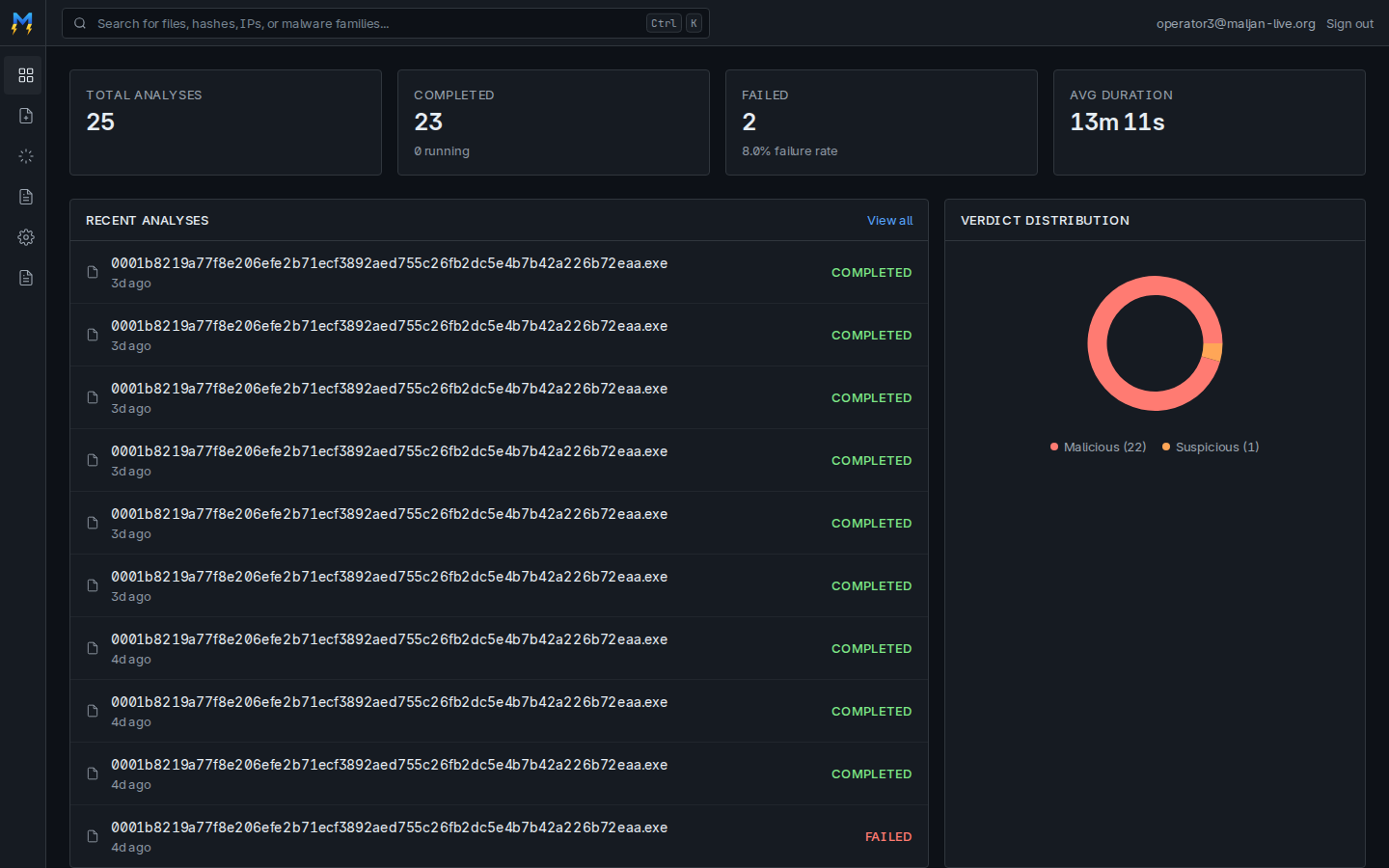 |
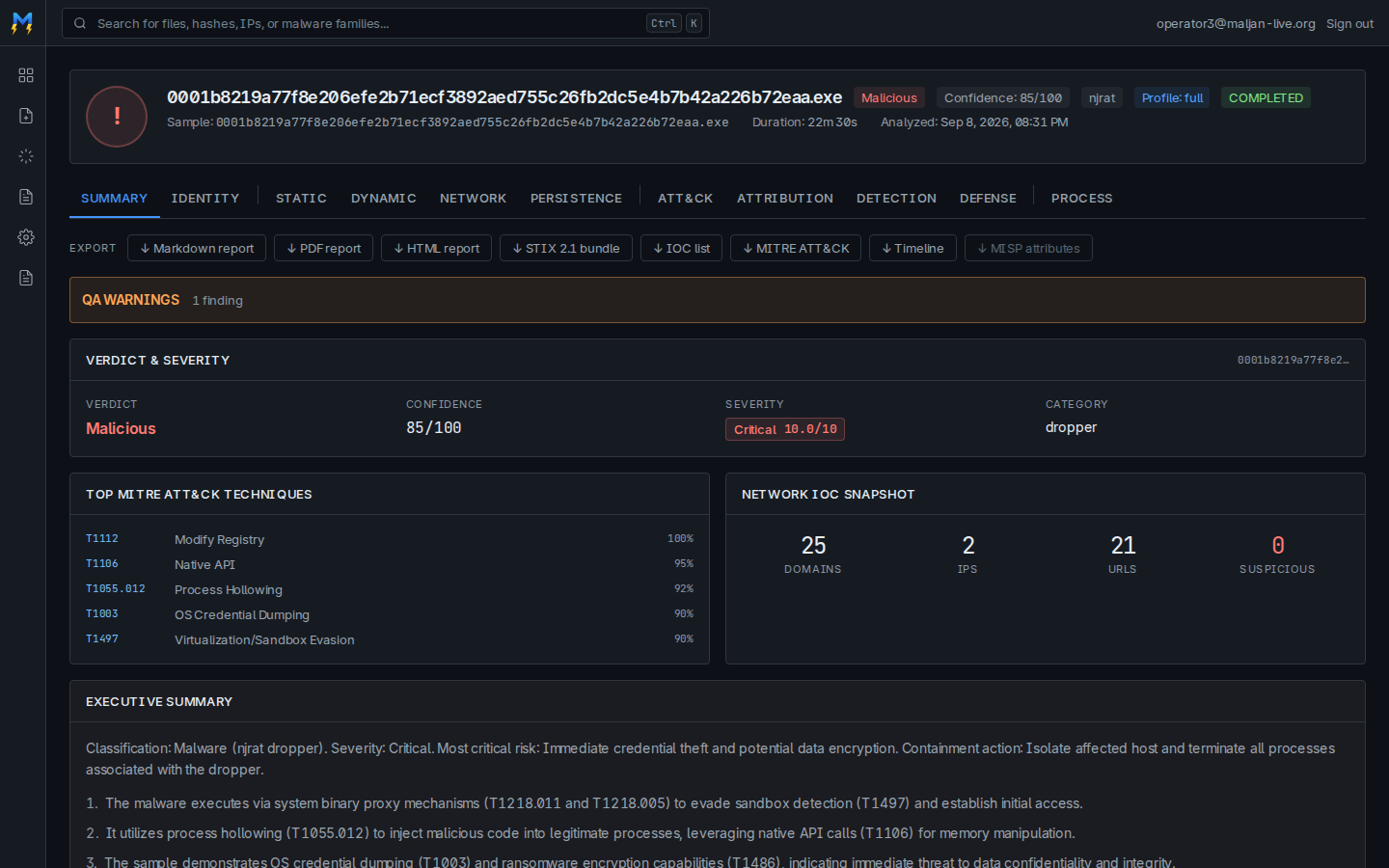 |
| Dashboard. Totals, failure rate, recent analyses and verdict distribution. | Analysis. One run, its stages, its evidence ledger and the report built from it, with Markdown, PDF, HTML, STIX 2.1 and MISP export. |
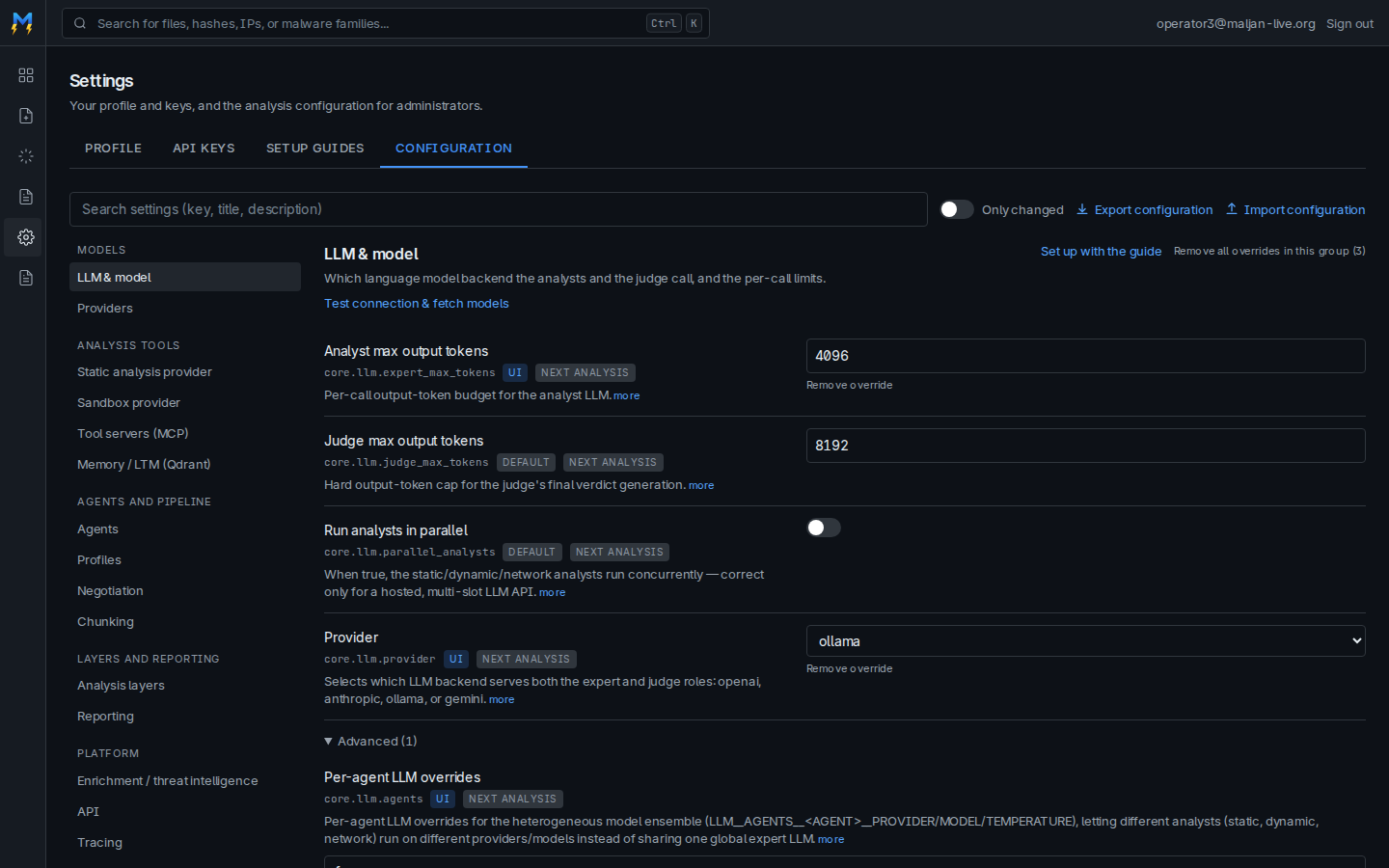 |
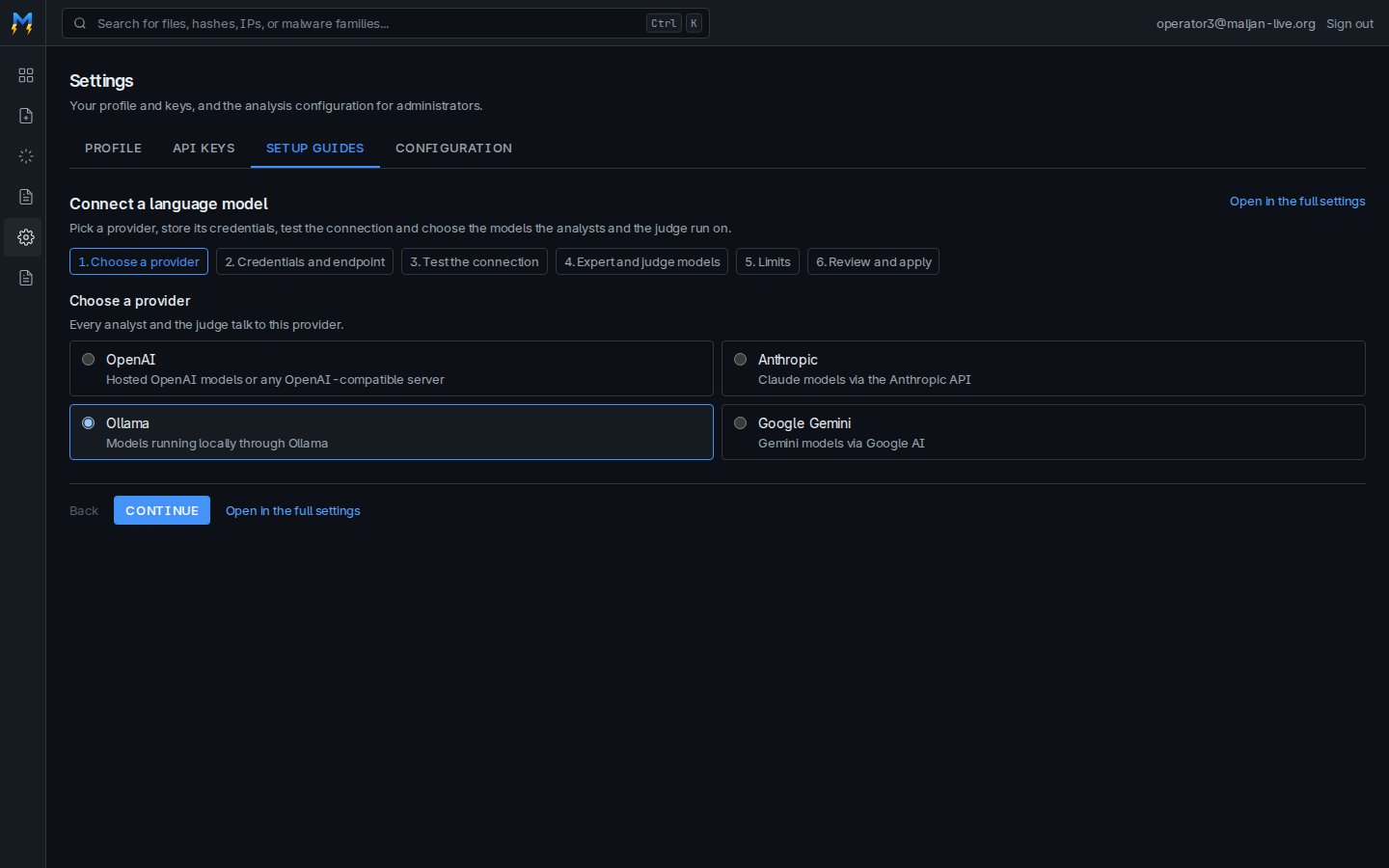 |
| Configuration. Every application setting, grouped, searchable, with its origin and when a change takes effect. | Setup guides. Short walkthroughs that configure one subsystem at a time and test the connection before saving. |
Quick start
The compose stack is the supported way to run Maljan. It needs Docker with the
Compose plugin, and make setup once to fetch the third-party trees theghidra-mcp image is built from.
git clone https://github.com/Root0ne/Maljan.git && cd Maljan
make setup                          # dependencies, pre-commit, external/
cp docker/.env.example docker/.env  # then fill in every secret it declares
make dev-up                         # docker compose up -d, development overlay
The development overlay is for a workstation; docs/deployment.md
covers a production deployment.
Every secret in docker/.env.example is declared with:? in the compose file, so the stack refuses to start while one is missing;
docs/getting-started.md has the commands that
generate them. Open http://localhost:3000, register the first account from
the login page, promote it to admin once in the database, then walk
Settings → Setup to point the deployment at a language model, a sandbox and
the rest. A fresh deployment starts on catalog defaults that arelocalhost-shaped, so that pass is not optional.
The API serves its OpenAPI schema and /docs only when DEBUG is true; a
production deployment has no interactive schema.
Documentation
Everything below lives in docs/ and is written against the
code in this repository. The same set is published as a browsable site at
https://root0ne.github.io/Maljan/.
| Document | What it covers |
|---|---|
| getting-started.md | Prerequisites, the two configuration files, starting the stack, first login and first analysis. |
| configuration.md | The bootstrap environment contract, Settings → Configuration, the setup guides, connection probes, JSON export and import, secret storage. |
| architecture.md | Components, the request and job lifecycle, teams as stages, agents and their tools, the evidence ledger, validation loops and report assembly. |
| deployment.md | Compose services and healthchecks, required secrets, health endpoints, Kubernetes and systemd notes, upgrades and migrations. |
| operations.md | Logs, what a run's metrics mean, staged samples, the audit trail, rate limits, backups and a troubleshooting table. |
| security.md | Authentication, roles, API keys, secret encryption, what an export leaves out, CORS and cookie flags, vulnerability reporting. |
| development.md | Repository layout, make targets, the test suites, CI jobs and the branch workflow. |
| api.md | Router groups, the evidence endpoint, the run-summary fields, the stage events on the WebSocket, authentication and pagination. |
| benchmark/index.md | The benchmark: samples, models, the scoring key, results across iterations and against a human report, the false-positive control and limitations. |
Release notes are in CHANGELOG.md.
Licence
MIT — see LICENSE. The third-party rule sets Maljan can use carry
their own licences and are not redistributed here; make external fetches
them, licence files included.
Yorumlar (0)
Yorum birakmak icin giris yap.
Yorum birakSonuc bulunamadi