rostam
Health Uyari
- License — License: Apache-2.0
- Description — Repository has a description
- Active repo — Last push 0 days ago
- Low visibility — Only 6 GitHub stars
Code Gecti
- Code scan — Scanned 12 files during light audit, no dangerous patterns found
Permissions Gecti
- Permissions — No dangerous permissions requested
Bu listing icin henuz AI raporu yok.
Open-source vector database and sub-microsecond key-value store in one Go engine — embed it as a library, run it standalone, or replicate it across a Raft cluster. HNSW/IVF/Vamana indexes, quantization, hybrid dense+sparse and BM25 search, WASM stored procedures. Apache-2.0.

Rostam



A high-performance vector database and sub-microsecond key-value store in a
single Go engine — run it as a standalone server, replicate it across a Raft
cluster, or embed it directly in your binary with no server at all.
At matched recall it serves ~2× the queries of Milvus and pgvector and
~4× Qdrant, with the fastest load in the set (1M × 768d in 282 s) and
the highest recall measured. → How it compares
Three ways to run it, one engine:
| Standalone server | REST, gRPC and a binary TCP protocol. Talk to it from Python or any language. |
| Replicated cluster | Per-shard Raft, online resharding, backups to S3, RBAC/JWT/mTLS. |
| Embedded library | Import it into a Go binary. No server, no cgo required. |
Agent memory over MCP
rostam-server mcp runs Rostam as an MCP
stdio server, giving Claude Code, Claude Desktop, Cursor, or any MCP client
persistent agent memory and vector-DB tools. No daemon, no cloud account, and
no embedding API key required — memory works out of the box on built-in
BM25, and pointing it at an OpenAI-compatible endpoint upgrades recall to
hybrid dense+BM25.
claude mcp add rostam -- rostam-server mcp
→ MCP server for the full tool
reference, client config snippets, and embedder configuration.
LLM response caching
rostam-server llm-proxy is an OpenAI-compatible caching reverse proxy:
change one line (base_url="http://localhost:8484/v1") and an eligible
repeated chat-completions request — cacheable shape, matching scope, and a
prompt that hits the cache — is answered from a local semantic cache instead
of hitting the upstream API. Exact byte-identical matching works out of the
box with no embedding key; pointing it at an OpenAI-compatible embedder
upgrades it to matching near-duplicate prompts too.
rostam-server llm-proxy
→ LLM caching proxy for
flags, cache-scoping rules, and what's never cached.
RAG in a box
rostam-server rag chunks and indexes your documents, then answers
questions from them with cited sources — no separate vector-store setup or
ingestion pipeline required:
rostam-server rag ingest ./docs
rostam-server rag ask "How does the LLM proxy decide what's cacheable?"
Retrieval works out of the box on BM25 full-text search; pointing it at an
OpenAI-compatible embedder upgrades it to dense+BM25 hybrid fusion by default
(-no-hybrid selects pure dense search). rag query does retrieval alone,
with no LLM required.
→ RAG CLI for flags,
embedded-vs-remote mode, and supported file types.
And two engines, usable together or entirely on their own:
- a vector search engine (
vector/) — HNSW, IVF and Vamana
indexes, SQ8/binary/PQ quantization, hybrid dense+sparse fusion, BM25 full
text, and metadata filtering with an exact filter-first query planner that
does not fall off a recall cliff. Depends on nothing else in the repo. - a key-value store — an in-process session cache, a replicated store, or a
TCP server, all behind oneStoreinterface, with server-side custom ops and
sandboxed WASM stored procedures.
Both are built for the latency-sensitive end of the spectrum: reads are
zero-copy and lock-light, the hot paths are allocation-free, and the distance
kernels are hand-vectorized.
Status: Beta. Actively developed and tested (race-clean, benchmarked).
APIs may still change ahead of a 1.0 release.
📚 docs.rostamlabs.com — quickstart, concepts,
guides, and full API references (HTTP, gRPC, Go, Python). The site is built from
the docs/ tree in this repository (mkdocs.yml), so
it can also be read here or served locally.
How it compares
Under VectorDBBench — a neutral,
third-party harness — on Cohere-1M (768d, cosine). Six engines, 27 cases, one
continuous session, with HNSW m=16 / ef_construction=200 / k=100 pinned
identically on every engine and ef swept.
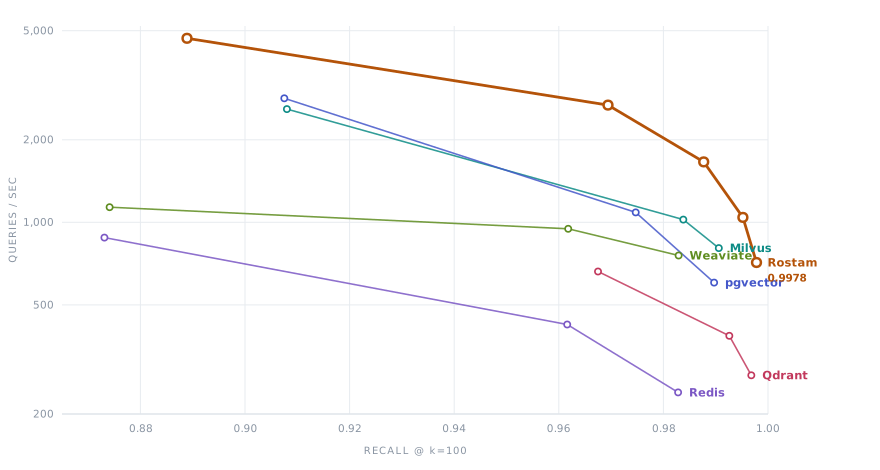
Read at matched recall, which is the only like-for-like comparison — engines
land at different recall for the same ef, and a segmented engine runs that ef
against every segment, so equal ef is not equal work:
| Matched recall | Rostam | vs Milvus | vs pgvector | vs Weaviate | vs Qdrant | vs Redis |
|---|---|---|---|---|---|---|
| 0.95 | 3,161 QPS | 1.84× | 1.83× | 3.25× | — | 6.54× |
| 0.97 | 2,642 QPS | 2.02× | 2.18× | 3.03× | 4.16× | 7.53× |
| 0.98 | 2,088 QPS | 1.90× | 2.28× | 2.67× | 3.98× | 7.90× |
| 0.99 | 1,471 QPS | 1.78× | — | — | 3.55× | — |
The lead is stable across the whole curve, so it does not depend on picking a
favourable operating point. Rostam also loads fastest (282 s for 1M × 768d)
while spending the least total CPU of any multi-core engine in the set, and
reaches the highest recall measured (0.9978).
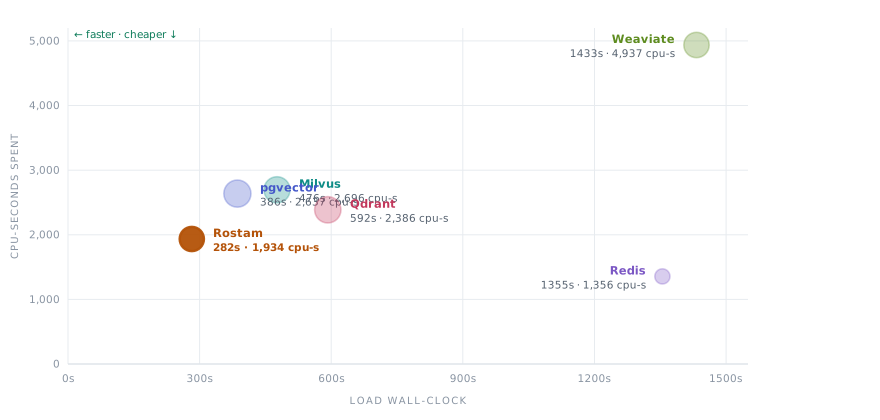
Two caveats that bound all of this, and they are not footnotes: every number is
same-session, because this hardware drifts up to 42% between sessions on
unchanged code; and the benchmark client shares the box, which penalises the
fastest engine hardest — so the throughput figures are floors, not ceilings.
Floors in one more way: the sweep runs over Rostam's JSON wire, and at theef=300 point its binary query framing measures +16.8% QPS and −19%
single-client p99 on the same box and corpus. That is one point on the curve,
not a uniform uplift — the wire saves a fixed cost per query, so its share
shrinks as the search itself gets more expensive.
Full per-ef curves, per-engine CPU accounting, the filter case, four paired A/B
controls and the complete methodology (including where the data cuts against
Rostam) are inrostam-bench/vectordbbench.
And the key-value side
Rostam is two engines, so the KV half gets measured the same way — seven engines
over the wire, one machine, one session:
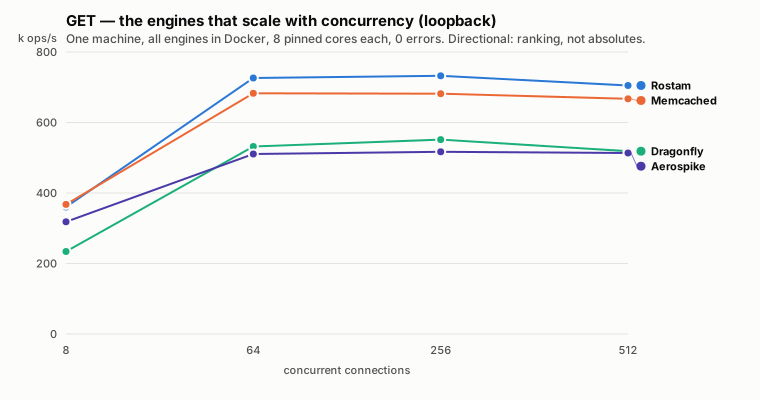
| GET ops/s | Rostam | Memcached | Dragonfly | Aerospike | Valkey | Redis | KeyDB |
|---|---|---|---|---|---|---|---|
| 64 conns | 726.1k | 682.9k | 532.0k | 510.6k | 239.1k | 228.3k | 206.3k |
| 256 conns | 732.4k | 681.7k | 551.6k | 516.9k | 227.9k | 219.6k | 208.8k |
p99 at 512 connections: Rostam 2.02 ms, best of the seven (Memcached 2.32,
Aerospike 2.75, Redis 4.69). Memcached wins at 8 connections; Rostam pulls ahead
as concurrency rises.
Replicated writes (RF=2) against Aerospike CE 8.1 at matched commit
semantics — both acking only after the replica has the write:
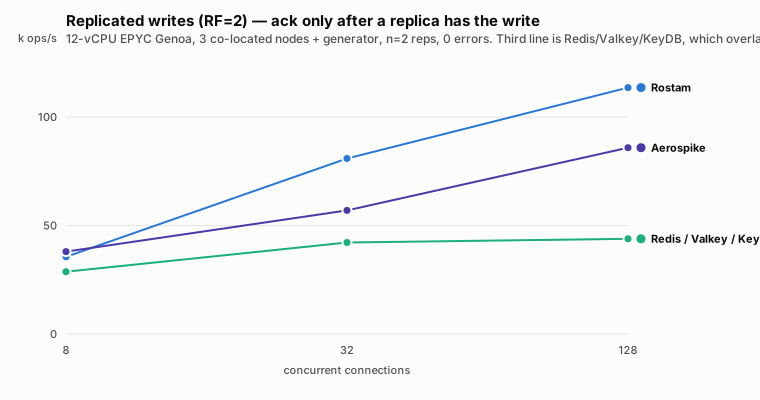
| RF=2, replica-ack | 8 conns | 32 conns | 128 conns | p50 @128 |
|---|---|---|---|---|
| Rostam PB | 35.6k | 80.9k | 113.6k | 0.99 ms |
| Aerospike CE | 38.0k | 57.0k | 85.9k | 1.35 ms |
Redis 7 (WAIT 1) |
28.7k | 43.2k | 42.9k | 2.95 ms |
Valkey 8 (WAIT 1) |
28.0k | 42.2k | 45.9k | 2.72 ms |
Rostam's lead is a scaling property. Aerospike wins at 8 connections — and
has the better tail there — while Rostam overtakes at 32 and leads +42% / +32%
at 32/128, with the better median from 32 upward. The Redis-protocol engines
flatten above 32 connections, which is a per-instance ceiling. Relaxing Rostam
and Aerospike to ack-at-master keeps the shape (157.4k against 125.7k at 128).
Measured twice on the same box four days apart; Rostam reproduced within ~1–4% at
the anchor points.
Over a real network on separate nodes it tightens to near-parity, with Rostam's
tail still ahead (p99 ~8 ms vs 17–22 ms). Both runs, the full posture matrix, and
why a single load generator invalidates this comparison entirely are inrostam-bench/netkv.
Two ways to use it. Run the server and talk to it over REST, gRPC or a
binary TCP protocol from any language — or embed the Go library directly, with
no server in the picture. Start below; the Go embedding path is
further down.
Install
# Prebuilt binary — verifies the release checksum before installing
curl -fsSL https://raw.githubusercontent.com/rostamlabs/rostam/main/install.sh | sh

# ...to a system path instead (prompts for sudo; ROSTAM_NO_SUDO refuses)
curl -fsSL https://raw.githubusercontent.com/rostamlabs/rostam/main/install.sh \
  | ROSTAM_INSTALL_DIR=/usr/local/bin sh

# Container (amd64 + arm64)
docker run -p 8080:8080 -e ROSTAM_API_KEY=secret ghcr.io/rostamlabs/rostam:latest

# Go toolchain
go install github.com/rostamlabs/rostam/cmd/rostam-server@latest   # the server
go get github.com/rostamlabs/rostam                                # the library

# Python client
pip install rostam-client
Prefer not to pipe a script into a shell? Download the archive andchecksums.txt from the latest release,
then verify before extracting — that is all the script does, plus picking the
right file for your platform:
sha256sum -c checksums.txt --ignore-missing        # Linux
shasum -a 256 -c checksums.txt --ignore-missing    # macOS
The release binaries are pure-Go builds: everything works except WASM stored
procedures, which return wasm: stored procedures require a cgo build. The
container image always includes them. go install includes them only when it
builds with cgo — a native build (cgo defaults off when cross-compiling) on a
machine with a C compiler.
Local in-process embeddings are pure Go (rembed) —
no cgo, no ONNX Runtime, nothing to install — so they are built into every
binary and image. Just point at a model:
docker run -p 8080:8080 -e ROSTAM_API_KEY=secret \
  -e ROSTAM_EMBED_LOCAL=minilm-l6-v2 -e REMBED_CACHE=/models -v rostam-models:/models \
  ghcr.io/rostamlabs/rostam:latest
Weights download from the Hugging Face Hub on first use into REMBED_CACHE
(default the OS user cache dir); point it at a mounted volume — as above — to
persist them across restarts. ROSTAM_EMBED_LOCAL also accepts any Hugging Faceorg/model id beyond the built-in catalog.
See Local embeddings for the model catalog and configuration.
Quick start — run the server
go run ./cmd/rostam-server -http 127.0.0.1:8080 -data ./data
With no authenticator configured the server refuses to bind a reachable
address rather than serve an open datastore to the network — so a bare:8080 will not start. To listen beyond loopback, give it auth (-api-key or-keys-file), or pass -insecure to run open deliberately.
curl -s localhost:8080/v1/collections \
  -d '{"name":"docs","config":{"dim":4,"metric":"cosine"}}'
curl -s localhost:8080/v1/collections/docs/points \
  -d '{"id":1,"vector":[0.1,0.2,0.3,0.4],"content":"hello rostam","upsert":true}'
curl -s localhost:8080/v1/collections/docs/points/search \
  -d '{"query":[0.1,0.2,0.3,0.4],"k":3}'
Or in a container
The image binds 0.0.0.0, so it requires authentication — pass the token by
environment variable, which keeps it out of the process table and out ofdocker inspect:
docker build -f cmd/rostam-server/Dockerfile -t rostam-server .
docker run -p 8080:8080 -e ROSTAM_API_KEY=secret rostam-server

curl -s localhost:8080/v1/collections -H 'Authorization: Bearer secret' \
  -d '{"name":"docs","config":{"dim":4,"metric":"cosine"}}'
GET /v1/health and /v1/ready stay auth-exempt, so orchestrator probes work
without the token. For a deliberately open dev container, append -insecure.
Clustering (per-shard Raft, online resharding), auth (RBAC/JWT/mTLS), TLS,
backups to S3, and Prometheus metrics are flag-driven.
→ Running the server ·
Clustering ·
Security ·
HTTP API reference
Quick start — Python
pip install rostam-client # stdlib-only; optional [langchain] [llamaindex] [haystack]
One class, Rostam(target), picks the transport from the target string: anhttp(s):// URL speaks REST, a tcp://host:port (or bare host:port)
speaks the native binary protocol. Vector methods are identical either way:
from rostam import Rostam, filters as f

c = Rostam("http://localhost:8080")   # REST, port 8080
c.create_collection("docs", dim=768, full_text=True)
vec = [0.0] * 768  # replace with a real embedding
c.upsert("docs", 1, vec, content="hello", metadata={"tenant": "acme"})

# Dense kNN, hybrid dense+sparse, or BM25 full text — one call each.
hits = c.hybrid_text("docs", dense=vec, text="hello", k=5)

# Metadata filtering goes through the exact filter-first planner, so a
# selective filter does not degrade recall.
hits = c.search("docs", vec, k=10, filter=f.eq("tenant", "acme"))
Point the same class at the -tcp port instead for the native binary
protocol — same flat vector API, plus r.kv.* for the key-value store, which
has no REST surface:
r = Rostam("tcp://localhost:7000")    # or Rostam("localhost:7000") — bare host:port defaults to TCP

r.create_collection("docs", dim=768, full_text=True)
vec = [0.0] * 768  # replace with a real embedding
r.upsert("docs", 1, vec, content="hello", metadata={"tenant": "acme"})
hits = r.hybrid_text("docs", dense=vec, text="hello", k=5)

r.kv.put("user:42", b'{"coins":100}', ttl_ms=300_000)   # TCP-only
r.kv.incr("views:42", 1)                                  # atomic; missing key counts as 0
Working against one collection? r.collection(name) binds it so you stop
repeating the name (mirrors the Go client's client.Collection):
docs = r.collection("docs")
docs.upsert(1, vec, content="hello")
hits = docs.hybrid_text(dense=vec, text="hello", k=5)
Bulk ingest (bulk_stage + bulk_build, HTTP-only) ships vectors as raw f32
over a binary wire rather than JSON text, which is what makes large loads
fast — a 1M × 768d load runs in 282 s.
→ Python client docs
Other languages talk to the same server over
REST or gRPC.
Quick start — vector search (Go library)
Embedding the engine in a Go process: no server, no cgo, no other dependencies:
import "github.com/rostamlabs/rostam/vector"

col, _ := vector.NewCollection("docs", vector.Config{
    Dim:    768,
    Metric: vector.Cosine,
    Quant:  vector.QuantSQ8, // 4× smaller, ~98% recall retained
})
defer col.Close()

// Insert is create-only (ErrDuplicateID on a live id); Upsert replaces.
_ = col.Insert(1, embedding, 0, vector.Metadata{
    "tenant": vector.NewString("acme"),
}, nil)

// Exact, fast filtered search — the payload index narrows to tenant=acme.
hits, _ := col.SearchFiltered(query, 10, vector.Filter{
    Op: vector.FilterEq, Field: "tenant", Value: vector.NewString("acme"),
})

// Diversified retrieval for RAG:
diverse, _ := col.SearchMMR(query, 10, vector.MMROpts{Lambda: 0.5})
Beyond kNN: hybrid dense+sparse fusion (RRF/weighted/DBSF), BM25 full-text,
recommendation (± examples), discovery, group-by, scroll with order-by, IVF and
Vamana indexes, binary/PQ quantization with mmap-resident codes, per-collection
quotas and TTL. → Vector engine docs
Quick start — key-value store (Go library)
import (
    "github.com/rostamlabs/rostam"
    "github.com/rostamlabs/rostam/ops"
)

reg := ops.NewRegistry()
_ = ops.RegisterBuiltins(reg) // get / put / del / incr / expire / vector ops (Ops is required)
store, err := rostam.NewDirect(rostam.DirectConfig{Ops: reg /* DataDir: "..." */})
if err != nil {
    log.Fatal(err)
}
defer store.Close()

_ = store.Put(ctx, []byte("user:42"), []byte(`{"coins":100}`), 5*time.Minute)
v, _ := store.Get(ctx, []byte("user:42"))

// Atomic, server-side updates — one round trip, serialized per shard:
_, _ = store.Call(ctx, "incr", ops.EncodeIncrArgs([]byte("views:42"), 1))
_, _ = store.Call(ctx, "expire", ops.EncodeExpireArgs([]byte("user:42"), time.Hour))
Swap the constructor for a different backend — same Store interface:
| Constructor | Backend | When |
|---|---|---|
rostam.NewDirect |
in-process, no Raft | single node, library, fastest |
rostam.NewEmbedded |
in-process + per-shard Raft | replicated / multi-node durability |
rostam.NewClient |
TCP client to a remote cluster | talk to a running server |
You can also register your own Go functions as server-side ops (atomic
read-modify-write under the shard lock, no CAS loops) or ship sandboxed,
fuel-capped WASM procedures over the wire to a running cluster.
→ KV docs · Custom ops ·
WASM
Architecture
        vector/   ← standalone vector engine (usable on its own)
        HNSW · IVF · Vamana · GPU · quantization (SQ8/BQ1/PQ/PRQ, mmap) ·
        hybrid sparse+dense · BM25 · payload index + planner ·
        MMR/recommend/discover · tenants/auth/quotas

        rostam.Store  (Direct │ Embedded │ Client)      ← unified KV facade
              │
   ┌──────────┼───────────────┬──────────────────┐
 cache/     shard/+raft/     server/+client/     wasm/
 slab pool  per-shard        TCP protocol +      wasmtime UDF
 TTL, mmap  Raft + ops       smart routing       runtime
 warm-start registry
vector/'s only in-repo dependencies are the stdlib-only objstore/ package
and its own analysis subpackage — vendor those three as a pure vector
library. → Architecture
Micro-benchmarks
The head-to-head comparisons are at the top. These are
in-process numbers for both engines, plus accuracy properties that hold
independently of the machine.
Accuracy properties — these are properties of the algorithms, not of the
machine, so they hold anywhere:
| Result | |
|---|---|
| SQ8 quantization (4× smaller) | recall@10 ≈ 0.98 of exact |
| Binary quantization (32× smaller) | recall@10 ≈ 0.96 of exact (rescored) |
| Selective filtered search | exact filter-first path — no recall cliff |
| int8 (SQ8) distance kernel, AVX2 vs scalar | ~2.9–3.3× (768d–1536d) |
| int8 distance kernel, VNNI vs AVX2 | ~1.3× |
| float32 distance kernels, AVX2 vs scalar | ~12–14× |
Latencies (make bench, in-process unless noted):
| Result | |
|---|---|
KV Get (hit), Direct |
~29 ns/op |
KV Put, Direct |
~240 ns/op |
KV Get/Put, Embedded (Raft, no-sync) |
~222 ns / ~12.7 µs |
| Search, SIFT-1M, recall@10 0.968 | 173 µs p50 / 60.4k QPS |
KV Get/Put over TCP loopback (Direct server) |
~1.7 µs / ~1.8 µs |
Measured on the same 12-core AMD EPYC Genoa the VectorDBBench comparison above
runs on, so the two are directly comparable. The KV figures are parallel
benchmarks atGOMAXPROCS=12— per-op cost scales with core count, so a
wider machine reports a lower number for identical code. The loopback row is
the one exception: that box's NIC has a single queue and would measure the
adapter rather than the storage path, so it comes from a multi-queue host.
Re-runmake benchon your own machine before sizing anything.
Reproducible head-to-head comparisons against Redis, Aerospike, Qdrant, Milvus,
pgvector, and in-memory Go caches live in the separaterostam-bench repo, so this
module stays dependency-light. → Performance
Examples
examples/semantic-search— end-to-end RAG
pipeline: OpenAI embeddings → upsert → dense vs hybrid search.examples/filtered-recall-cliff— why
the filter-first planner exists, measured.
Development
Requires Go 1.26+. mmap persistence and the AVX2 kernels are Linux/amd64;
everything has a portable fallback. The full build needs cgo (wasmtime); the
vector/cache/ops packages build with CGO_ENABLED=0.
Two optional build tags add cgo-only functionality, compiled out by default:
| Tag | Enables | Requires |
|---|---|---|
-tags cuda |
GPU exact-KNN index | cgo + a CUDA toolchain |
make test    # tests           make race   # race detector
make bench   # benchmarks      make all    # lint + tests + race + bench
→ Development · CONTRIBUTING.md ·
SECURITY.md
License
Apache License 2.0 (Apache-2.0), © 2026 RostamLabs.
Rostam is open source. Use it, embed it, modify it, run it in production, offer
it as a service. Apache-2.0 also grants a patent licence explicitly — one that
terminates if you sue someone claiming Rostam infringes a patent.
Redistributing it asks a little more than attribution: ship a copy of the
licence and NOTICE, keep the notices already in the files, and
mark the files you changed. LICENSE is the authoritative text —
the paragraph above is a summary, not terms.
"Rostam" and the Rostam logo are trademarks of RostamLabs; the licence grants no
trademark rights.
Yorumlar (0)
Yorum birakmak icin giris yap.
Yorum birakSonuc bulunamadi