agenttel-sdk
Health Uyari
- License — License: Apache-2.0
- Description — Repository has a description
- Active repo — Last push 0 days ago
- Low visibility — Only 6 GitHub stars
Code Gecti
- Code scan — Scanned 12 files during light audit, no dangerous patterns found
Permissions Gecti
- Permissions — No dangerous permissions requested
Bu listing icin henuz AI raporu yok.
Agent-ready telemetry — enriches OpenTelemetry spans across backend (JVM) and frontend (TypeScript) with the context AI agents need to autonomously diagnose and resolve production incidents
AgentTel
Agent-Ready Telemetry













AgentTel enriches OpenTelemetry telemetry with the structured context AI agents need to autonomously diagnose, reason about, and resolve production incidents — without human interpretation of dashboards. Works across the full stack: JVM backends (Java, Kotlin, Scala), Go backends, Node.js/TypeScript backends, Python backends (FastAPI, Django, Flask), and browser frontends (TypeScript/JavaScript).
Standard observability answers "What happened?" AgentTel adds "What does an AI agent need to know to act on this?"
The Problem
Modern observability tools generate massive volumes of telemetry — traces, metrics, logs — optimized for human consumption through dashboards and alert rules. AI agents tasked with autonomous incident response face critical gaps:
- No behavioral context — Spans lack baselines, so agents can't distinguish normal from anomalous
- No topology awareness — Agents don't know which services are critical, who owns them, or what depends on what
- No decision metadata — Is this operation retryable? Is there a fallback? What's the runbook?
- No actionable interface — Agents can read telemetry but can't query live system state or execute remediation
AgentTel closes these gaps at the instrumentation layer.
Design Philosophy
Core principle: telemetry should carry enough context for AI agents to reason and act autonomously.
AgentTel enriches telemetry at three levels — all configurable via YAML, no code changes required:
| Level | Where | What | Example |
|---|---|---|---|
| Topology | OTel Resource (once per service) | Service identity, ownership, dependencies | team, tier, on-call channel |
| Baselines | Span attributes (per operation) | What "normal" looks like | P50/P99 latency, error rate |
| Decisions | Span attributes (per operation) | What an agent is allowed to do | retryable, runbook URL, escalation level |
Topology is set once on the OTel Resource and automatically associated with all telemetry by the SDK. Baselines and decision metadata are attached per-operation on spans. This avoids redundant data on every span while ensuring agents always have the full context.
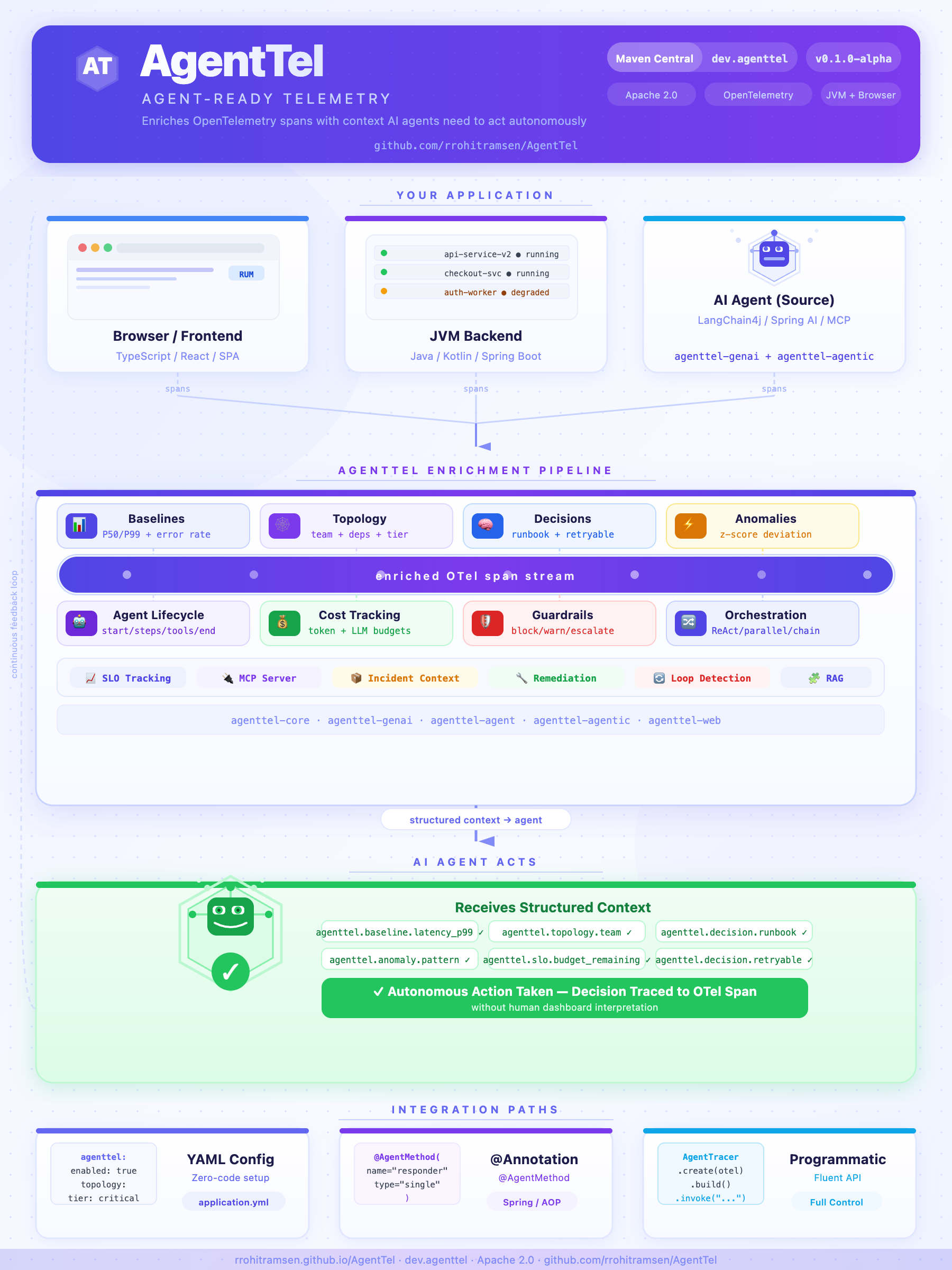
Quick Demo
Try AgentTel in one command — starts a demo payment service with OTel Collector and Jaeger:
cd examples/spring-boot-example
docker compose -f docker/docker-compose.yml up --build
Then open Jaeger to see enriched traces, Swagger UI for the API, and MCP Tool Docs for the agent interface.
What AgentTel Provides
Enriched Telemetry (agenttel-core)
Every span is automatically enriched with agent-actionable attributes:
| Category | Attributes | Purpose |
|---|---|---|
| Topology | agenttel.topology.team, tier, domain, dependencies |
Service identity and dependency graph |
| Baselines | agenttel.baseline.latency_p50_ms, error_rate, source |
What "normal" looks like for each operation |
| Decisions | agenttel.decision.retryable, idempotent, runbook_url, escalation_level |
What an agent is allowed to do |
| Anomalies | agenttel.anomaly.detected, pattern, score |
Real-time deviation detection |
| SLOs | agenttel.slo.budget_remaining, burn_rate |
Error budget consumption tracking |
Agent Interface Layer (agenttel-agent)
A complete toolkit for AI agent interaction with production systems:
| Component | Description |
|---|---|
| MCP Server | JSON-RPC server implementing the Model Context Protocol — exposes telemetry as tools AI agents can call |
| Health Aggregation | Real-time service health from span data with operation-level and dependency-level metrics |
| Incident Context | Structured incident packages: what's happening, what changed, what's affected, what to do |
| Remediation Framework | Registry of executable remediation actions with approval workflows |
| Action Tracking | Every agent decision and action recorded as OTel spans for full auditability |
| Context Formatters | Prompt-optimized output formats (compact, full, JSON) tuned for LLM context windows |
Frontend Telemetry (agenttel-web)
Browser SDK for agent-ready frontend observability:
| Feature | Description |
|---|---|
| Auto-Instrumentation | Page loads (Navigation Timing API), SPA navigation, fetch/XMLHttpRequest interception, click/submit interactions, JavaScript errors |
| Journey Tracking | Multi-step user funnel tracking with completion rates, abandonment detection, and duration baselines |
| Anomaly Detection | Client-side pattern detection — rage clicks, API failure cascades, slow page loads, error loops, funnel drop-offs |
| Cross-Stack Correlation | W3C Trace Context injection on all outgoing requests; backend trace ID extraction from responses |
| Route Baselines | Per-route configuration of expected page load times, API response times, error rates, and business criticality |
| Decision Metadata | Escalation levels, runbook URLs, retry policies, and fallback pages per route |
Instrumentation Agent (agenttel-instrument)
IDE-integrated MCP server for automated instrumentation setup:
| Tool | Description |
|---|---|
analyze_codebase |
Scans Java/Spring Boot source code — detects endpoints, dependencies, and framework |
instrument_backend |
Generates backend config — Gradle/Maven dependencies, annotations, agenttel.yml |
instrument_frontend |
Generates frontend config — React route detection, criticality inference, SDK initialization |
validate_instrumentation |
Validates agenttel.yml completeness against source code |
suggest_improvements |
Analyzes config and suggests fixes — missing baselines, uncovered endpoints, stale thresholds |
apply_improvements |
Auto-applies low-risk improvements using live health data; flags high-risk items for review |
GenAI Instrumentation (agenttel-genai)
Full observability for AI/ML workloads on the JVM:
| Framework | Approach | Coverage |
|---|---|---|
| Spring AI | SpanProcessor enrichment of existing Micrometer spans | Framework tag, cost calculation |
| LangChain4j | Decorator-based full instrumentation | Chat, embeddings, RAG retrieval |
| Anthropic SDK | Client wrapper | Messages API with token/cost tracking |
| OpenAI SDK | Client wrapper | Chat completions with token/cost tracking |
| AWS Bedrock | Client wrapper | Converse API with token/cost tracking |
Agent Observability (agenttel-agentic)
Full lifecycle tracing for AI agents with 70+ semantic attributes:
| Feature | Description |
|---|---|
| Invocation Lifecycle | Goal, status, step count, max steps for each agent execution |
| Reasoning Steps | Thought, action, observation, evaluation, revision tracking |
| Tool Calls | Tool name, success/error/timeout status per call |
| Task Decomposition | Nested task breakdown with depth and parent tracking |
| Orchestration Patterns | Sequential, parallel, evaluator-optimizer, handoff, ReAct, orchestrator-workers |
| Cost Aggregation | Automatic LLM cost rollup from GenAI spans to agent sessions |
| Guardrails | Block, warn, log, escalate actions with named guardrails |
| Human Checkpoints | Approval, feedback, correction gates with wait time tracking |
| Loop Detection | Detects stuck reasoning loops (identical tool calls) |
| Quality Signals | Goal achievement, human interventions, eval scores |
| RAG Pipeline | Retriever and reranker spans with relevance scoring |
| Error Classification | Source (LLM/tool/agent/guardrail/timeout/network), retryability |
Three integration styles — programmatic, annotation, or YAML config:
Programmatic:
AgentTracer tracer = AgentTracer.create(openTelemetry)
    .agentName("incident-responder")
    .agentType(AgentType.SINGLE)
    .build();

try (AgentInvocation inv = tracer.invoke("Diagnose high latency")) {
    inv.step(StepType.THOUGHT, "Need to check service metrics");
    try (ToolCallScope tool = inv.toolCall("get_service_health")) {
        tool.success();
    }
    inv.complete(true);
}
@AgentMethod annotation (Spring Boot):
@AgentMethod(name = "incident-responder", type = "single", maxSteps = 100)
public IncidentReport diagnose(String incidentId) {
    // Automatically wrapped in AgentInvocation — no manual tracer calls
    return analyzeAndRespond(incidentId);
}
YAML config (Spring Boot):
agenttel:
  agentic:
    agents:
      incident-responder:
        type: single
        max-steps: 100
        loop-threshold: 5
Quick Start
AgentTel supports multiple integration paths — pick what fits your stack:
| Path | Best For | Effort |
|---|---|---|
| Spring Boot Starter | Spring Boot applications | Add dependency + YAML config |
| Go SDK | Go services (net/http, Gin, gRPC) | go get + YAML config |
| Node.js SDK | Express / Fastify services | npm install + YAML config |
| Python SDK | FastAPI / Python services | pip install + YAML config |
| JavaAgent Extension | Any JVM app (no code changes) | JVM flag + YAML config |
| Web SDK | Browser/SPA applications | npm install + init call |
| Instrument Agent | IDE-assisted setup | Run MCP server in IDE |
Backend: Spring Boot
1. Add Dependencies
Maven:
<dependencies>
    <!-- Core: span enrichment, baselines, anomaly detection, SLO tracking -->
    <dependency>
        <groupId>dev.agenttel</groupId>
        <artifactId>agenttel-spring-boot-starter</artifactId>
        <version>0.2.0-alpha</version>
    </dependency>

    <!-- Optional: GenAI instrumentation -->
    <dependency>
        <groupId>dev.agenttel</groupId>
        <artifactId>agenttel-genai</artifactId>
        <version>0.2.0-alpha</version>
    </dependency>

    <!-- Optional: Agent interface layer (MCP server, incident context, remediation) -->
    <dependency>
        <groupId>dev.agenttel</groupId>
        <artifactId>agenttel-agent</artifactId>
        <version>0.2.0-alpha</version>
    </dependency>
</dependencies>
Gradle:
// build.gradle.kts
dependencies {
    // Core: span enrichment, baselines, anomaly detection, SLO tracking
    implementation("dev.agenttel:agenttel-spring-boot-starter:0.2.0-alpha")

    // Optional: GenAI instrumentation
    implementation("dev.agenttel:agenttel-genai:0.2.0-alpha")

    // Optional: Agent interface layer (MCP server, incident context, remediation)
    implementation("dev.agenttel:agenttel-agent:0.2.0-alpha")
}
2. Configure Your Service
All enrichment is driven by YAML configuration -- no code changes needed:
# application.yml
agenttel:
  # Topology: set once on the OTel Resource, associated with all telemetry
  topology:
    team: payments-platform
    tier: critical
    domain: commerce
    on-call-channel: "#payments-oncall"
  dependencies:
    - name: postgres
      type: database
      criticality: required
      timeout-ms: 5000
      circuit-breaker: true
    - name: stripe-api
      type: rest_api
      criticality: required
      fallback: "Return cached pricing"

  # Reusable operational profiles — reduce repetition across operations
  profiles:
    critical-write:
      retryable: false
      escalation-level: page_oncall
      safe-to-restart: false
    read-only:
      retryable: true
      idempotent: true
      escalation-level: notify_team

  # Per-operation baselines and decision metadata
  # Use bracket notation [key] for operation names with special characters
  operations:
    "[POST /api/payments]":
      profile: critical-write
      expected-latency-p50: "45ms"
      expected-latency-p99: "200ms"
      expected-error-rate: 0.001
      retryable: true               # overrides profile default
      idempotent: true
      runbook-url: "https://wiki/runbooks/process-payment"
    "[GET /api/payments/{id}]":
      profile: read-only
      expected-latency-p50: "15ms"
      expected-latency-p99: "80ms"

  baselines:
    rolling-window-size: 1000
    rolling-min-samples: 10
  anomaly-detection:
    z-score-threshold: 3.0
3. Optional: Annotate for IDE Support
Annotations are optional -- YAML config above is sufficient. Use @AgentOperation when you want IDE autocomplete and compile-time validation. Reference profiles to avoid repeating values:
@AgentOperation(profile = "critical-write")
@PostMapping("/api/payments")
public ResponseEntity<PaymentResult> processPayment(@RequestBody PaymentRequest req) {
    // Your business logic — spans are enriched automatically
}
When both YAML config and annotations define the same operation, YAML config takes priority. Per-operation values override profile defaults.
4. Start the MCP Server (Optional)
// Expose telemetry to AI agents via MCP
McpServer mcp = new AgentTelMcpServerBuilder()
    .port(8081)
    .contextProvider(agentContextProvider)
    .remediationExecutor(remediationExecutor)
    .build();
mcp.start();
AI agents can now call tools like get_service_health, get_incident_context, list_remediation_actions, and execute_remediation over JSON-RPC.
5. What You Get
Resource attributes (set once per service, associated with all telemetry):
agenttel.topology.team         = "payments-platform"
agenttel.topology.tier         = "critical"
agenttel.topology.domain       = "commerce"
agenttel.topology.on_call_channel = "#payments-oncall"
agenttel.topology.dependencies = [{"name":"postgres","type":"database",...}]
Span attributes (per operation, only on operations with registered metadata):
agenttel.baseline.latency_p50_ms = 45.0
agenttel.baseline.latency_p99_ms = 200.0
agenttel.baseline.error_rate     = 0.001
agenttel.baseline.source         = "static"
agenttel.decision.retryable      = true
agenttel.decision.runbook_url    = "https://wiki/runbooks/process-payment"
agenttel.decision.escalation_level = "page_oncall"
agenttel.anomaly.detected        = false
agenttel.slo.budget_remaining    = 0.85
When an incident occurs, agents get structured context via MCP:
=== INCIDENT inc-a3f2b1c4 ===
SEVERITY: HIGH
SUMMARY: POST /api/payments experiencing elevated error rate (5.2%)

## WHAT IS HAPPENING
Error Rate: 5.2% (baseline: 0.1%)
Latency P50: 312ms (baseline: 45ms)
Patterns: ERROR_RATE_SPIKE

## WHAT CHANGED
Last Deploy: v2.1.0 at 2025-01-15T14:30:00Z

## WHAT IS AFFECTED
Scope: operation_specific
User-Facing: YES
Affected Deps: stripe-api

## SUGGESTED ACTIONS
  - [HIGH] rollback_deployment: Rollback to previous version (NEEDS APPROVAL)
  - [MEDIUM] enable_circuit_breakers: Circuit break stripe-api
Backend: Python (FastAPI)
1. Install
pip install agenttel[fastapi]

# Optional extras
pip install agenttel[openai]       # OpenAI instrumentation
pip install agenttel[anthropic]    # Anthropic instrumentation
pip install agenttel[langchain]    # LangChain instrumentation
pip install agenttel[all]          # Everything
2. Configure
# agenttel.yml
agenttel:
  topology:
    service-name: payment-service
    team: payments-platform
    tier: critical
    domain: commerce
    on-call-channel: "#payments-oncall"
  operations:
    "POST /api/payments":
      expected-latency-p50: 45ms
      expected-latency-p99: 200ms
      retryable: true
      runbook-url: "https://wiki/runbooks/process-payment"
  slo:
    availability:
      target: 0.999
      type: availability
3. Instrument
from fastapi import FastAPI
from agenttel.fastapi import instrument_fastapi

app = FastAPI()
instrument_fastapi(app)  # One-line integration
All spans are now enriched with topology, baselines, anomaly detection, and SLO tracking — identical attributes to the JVM SDK.
Backend: Go
1. Install
go get go.agenttel.dev/agenttel@latest
2. Configure
# agenttel.yml — same format as JVM/Python SDKs
agenttel:
  topology:
    service-name: payment-service
    team: payments-platform
    tier: critical
  operations:
    "POST /api/payments":
      expected-latency-p50: 45ms
      expected-latency-p99: 200ms
      retryable: true
3. Instrument
import (
    agenttel "go.agenttel.dev/agenttel"
    agmw "go.agenttel.dev/agenttel/middleware/http"
)

cfg, _ := agenttel.LoadConfigFile("agenttel.yml")
engine := agenttel.NewEngineBuilder(cfg).Build()

// Wrap your handler with AgentTel middleware
handler := agmw.Middleware(mux,
    agmw.WithBaselineProvider(engine.BaselineProvider()),
    agmw.WithTopology(engine.TopologyRegistry()),
)
Also supports Gin (middleware/gin) and gRPC (middleware/grpc) out of the box. See Go Quickstart for details.
Backend: Node.js (Express / Fastify)
1. Install
npm install @agenttel/node @opentelemetry/api @opentelemetry/sdk-trace-node
2. Configure
# agenttel.yml — same format as all other SDKs
agenttel:
  topology:
    service-name: payment-service
    team: payments-platform
    tier: critical
  operations:
    "POST /api/payments":
      expected-latency-p50: 45ms
      expected-latency-p99: 200ms
      retryable: true
3. Instrument
import { AgentTelEngineBuilder, expressMiddleware, loadConfig } from '@agenttel/node';

const config = loadConfig('agenttel.yml');
const engine = new AgentTelEngineBuilder()
  .withTeam(config.topology?.team ?? 'my-team')
  .withTier(config.topology?.tier ?? 'critical')
  .build();

app.use(expressMiddleware({
  baselineProvider: engine.baselineProvider,
  topology: engine.topologyRegistry,
}));
Also supports Fastify (fastifyPlugin). See Node.js Quickstart for details.
Frontend: Browser SDK
npm install @agenttel/web
import { AgentTelWeb } from '@agenttel/web';

AgentTelWeb.init({
  appName: 'checkout-web',
  appVersion: '1.0.0',
  environment: 'production',
  collectorEndpoint: '/otlp',

  routes: {
    '/checkout/:step': {
      businessCriticality: 'revenue',
      baseline: { pageLoadP50Ms: 800, apiCallP50Ms: 300 },
      decision: { escalationLevel: 'page_oncall', runbookUrl: 'https://wiki/runbooks/checkout' },
    },
  },

  journeys: {
    checkout: {
      steps: ['/products', '/cart', '/checkout/shipping', '/checkout/payment', '/confirmation'],
      baseline: { completionRate: 0.65, avgDurationS: 300 },
    },
  },

  anomalyDetection: {
    rageClickThreshold: 3,
    apiFailureCascadeThreshold: 3,
    errorLoopThreshold: 5,
  },
});
The SDK automatically instruments page loads, SPA navigation, API calls, clicks, and errors — with cross-stack correlation via W3C Trace Context headers.
IDE: Instrument Agent
Run the instrument agent as an MCP server in your IDE (Cursor, VS Code, etc.):
pip install agenttel-instrument
agenttel-instrument --config instrument.yml
Then ask your IDE agent: "Analyze my codebase and generate AgentTel configuration" — it will scan your endpoints, detect dependencies, and generate a complete agenttel.yml.
Module Overview
┌─────────────────────────────────────────────────────────────────────┐
│                         Your Application                            │
│    Backend: application.yml + @AgentOperation                       │
│    Frontend: AgentTelWeb.init(config)                               │
├──────────────────────────┬──────────────────┬───────────────────────┤
│  agenttel-spring-boot-   │  agenttel-       │  agenttel-web         │
│  starter                 │  javaagent-      │  (@agenttel/web)      │
│  Auto-config · BPP · AOP │  extension       │  Browser SDK          │
│  (Spring Boot apps)      │  (any JVM app)   │  (TypeScript/JS)      │
├──────────────┬───────────┴──┬───────────────┴───────────────────────┤
│agenttel-core │agenttel-genai│     agenttel-agent                    │
│              │              │                                       │
│ SpanProcessor│ LangChain4j  │ MCP Server (JSON-RPC)                 │
│ Baselines    │ Spring AI    │ Health Aggregation                    │
│ Anomaly      │ Anthropic SDK│ Incident Context + Reporting          │
│  Detection   │ OpenAI SDK   │ Remediation Framework                 │
│ SLO Tracking │ Bedrock SDK  │ Trend Analysis · SLO Reports          │
│ Pattern      │ Cost Calc    │ Executive Summaries                   │
│  Matching    │              │ Cross-Stack Context                   │
├──────────────┴──────────────┴───────────────────────────────────────┤
│                          agenttel-api                                │
│       @AgentOperation · AgentTelAttributes · Data Models            │
├─────────────────────────────────────────────────────────────────────┤
│                      OpenTelemetry SDK                               │
└─────────────────────────────────────────────────────────────────────┘

  agenttel-go (Go SDK — full feature parity)
  Core · net/http · Gin · gRPC · GenAI · Agent/MCP · Agentic Observability

  agenttel-node (Node.js SDK — full feature parity)
  Core · Express · Fastify · GenAI · Agent/MCP · Agentic Observability

  agenttel-python (Python SDK — full feature parity)
  Core · FastAPI · GenAI · Agent/MCP · Agentic Observability

  agenttel-instrument (IDE MCP Server — Python)
  Codebase analysis · Config generation · Validation · Auto-improvements
| Module | Artifact | Description |
|---|---|---|
agenttel-api |
dev.agenttel:agenttel-api |
Annotations, attribute constants, enums, data models. Zero runtime dependencies. |
agenttel-core |
dev.agenttel:agenttel-core |
Runtime engine — span enrichment, static + rolling baselines, z-score anomaly detection, pattern matching, SLO tracking, structured events. |
agenttel-genai |
dev.agenttel:agenttel-genai |
GenAI instrumentation — LangChain4j wrappers, Spring AI enrichment, Anthropic/OpenAI/Bedrock SDK instrumentation, cost calculation. |
agenttel-agent |
dev.agenttel:agenttel-agent |
Agent interface layer — MCP server, health aggregation, incident context, remediation, trend analysis, SLO reports, executive summaries, cross-stack context. |
agenttel-agentic |
dev.agenttel:agenttel-agentic |
Agent observability — lifecycle, reasoning, orchestration patterns (ReAct, sequential, parallel, handoff, evaluator-optimizer), cost aggregation, quality signals, guardrails, loop detection. |
agenttel-javaagent |
dev.agenttel:agenttel-javaagent |
Zero-code OTel javaagent extension. Drop-in enrichment for any JVM app — no Spring dependency. |
agenttel-spring-boot-starter |
dev.agenttel:agenttel-spring-boot-starter |
Spring Boot auto-configuration. Single dependency for Spring Boot apps. |
agenttel-web |
@agenttel/web (npm) |
Browser telemetry SDK — auto-instrumentation of page loads, navigation, API calls, errors, Web Vitals, journey tracking, anomaly detection, W3C trace propagation. |
agenttel-go |
go.agenttel.dev/agenttel (Go module) |
Go SDK — full feature parity. Core enrichment, net/http + Gin + gRPC middleware, GenAI instrumentation, MCP agent interface, agentic observability. |
agenttel-node |
@agenttel/node (npm) |
Node.js SDK — full feature parity. Core enrichment, Express + Fastify middleware, GenAI instrumentation, MCP agent interface, agentic observability. |
agenttel-types |
@agenttel/types (npm) |
Shared TypeScript types, enums, and attribute constants for @agenttel/web and @agenttel/node. |
agenttel-python |
agenttel (pip) |
Python SDK — full feature parity with JVM SDK. Core enrichment, FastAPI integration, GenAI instrumentation, MCP agent interface, agentic observability. |
agenttel-instrument |
agenttel-instrument (pip) |
IDE MCP server — codebase analysis, config generation, validation, improvement suggestions, and auto-apply for both backend and frontend instrumentation. |
agenttel-testing |
dev.agenttel:agenttel-testing |
Test utilities for verifying span enrichment. |
Documentation
Full documentation site: agenttel.dev
| Document | Description |
|---|---|
| Project Overview | Vision, motivation, and design philosophy |
| Semantic Conventions | Complete attribute and event schema reference |
| Architecture | Technical architecture, data flow, and extension points |
| Agent Layer | MCP server, incident context, remediation, and agent interaction |
| GenAI Instrumentation | LLM framework instrumentation and cost tracking |
| API Reference | Annotations, programmatic API, and configuration reference |
| Roadmap | Implementation phases and release plan |
| Design Considerations | Trade-offs, evolution path, and future direction |
| API Documentation | Swagger UI, MCP tool docs, and aggregated Javadoc |
Examples
Working examples to get you started quickly:
| Example | Description | Run Command |
|---|---|---|
| Spring Boot Example | Payment service with span enrichment, topology, baselines, anomaly detection, and MCP server | ./gradlew :examples:spring-boot-example:bootRun |
| LangChain4j Example | GenAI tracing with LangChain4j — chat spans, token tracking, and cost calculation | ./gradlew :examples:langchain4j-example:run |
| Go Service Example | Go payment service with net/http middleware, topology, baselines, anomaly detection | cd examples/go-service-example && go run . |
| Express Example | Node.js payment service with Express middleware, topology, baselines, anomaly detection | cd examples/express-example && npm run dev |
| React Checkout Example | React SPA with frontend telemetry — journey tracking, anomaly detection, cross-stack correlation | cd agenttel-web/examples/react-checkout && npm start |
Each example includes a README with step-by-step instructions and curl commands to exercise the instrumentation.
Compatibility
Backend (JVM)
| Component | Supported Versions |
|---|---|
| Java | 17, 21 |
| OpenTelemetry SDK | 1.59.0+ |
| Spring Boot | 3.4.x |
| Spring AI | 1.0.0+ (optional) |
| LangChain4j | 1.0.0+ (optional) |
| Anthropic Java SDK | 2.0.0+ (optional) |
| OpenAI Java SDK | 4.0.0+ (optional) |
| AWS Bedrock SDK | 2.30.0+ (optional) |
Backend (Go)
| Component | Supported Versions |
|---|---|
| Go | 1.22+ |
| OpenTelemetry SDK | 1.33.0+ |
| net/http | Standard library |
| Gin | 1.9+ (optional) |
| gRPC | 1.60+ (optional) |
Backend (Node.js)
| Component | Supported Versions |
|---|---|
| Node.js | 18+ |
| TypeScript | 5.0+ |
| OpenTelemetry SDK | 1.30.0+ |
| Express | 4.x / 5.x (optional) |
| Fastify | 4.x+ (optional) |
Frontend (Browser)
| Component | Supported Versions |
|---|---|
| TypeScript | 4.7+ |
| Modern browsers | Chrome, Firefox, Safari, Edge (ES2020+) |
| React (example) | 18+ |
Backend (Python)
| Component | Supported Versions |
|---|---|
| Python | 3.11+ |
| OpenTelemetry SDK | 1.20.0+ |
| FastAPI | 0.100.0+ (optional) |
| OpenAI SDK | 1.0+ (optional) |
| Anthropic SDK | 0.20+ (optional) |
| LangChain | 0.1+ (optional) |
| AWS Bedrock (boto3) | 1.28+ (optional) |
Tooling
| Component | Supported Versions |
|---|---|
| Python (instrument agent) | 3.11+ |
Build Tool Support
AgentTel publishes standard Maven artifacts to Maven Central. Your application can use any build tool — Maven, Gradle, sbt, Bazel, or anything that resolves Maven dependencies.
Maven
<dependency>
    <groupId>dev.agenttel</groupId>
    <artifactId>agenttel-spring-boot-starter</artifactId>
    <version>0.2.0-alpha</version>
</dependency>
Gradle (Kotlin DSL)
implementation("dev.agenttel:agenttel-spring-boot-starter:0.2.0-alpha")
Gradle (Groovy DSL)
implementation 'dev.agenttel:agenttel-spring-boot-starter:0.2.0-alpha'
All Available Artifacts
Maven/Gradle (JVM):
| Group ID | Artifact ID | Description |
|---|---|---|
dev.agenttel |
agenttel-api |
Annotations and constants (zero dependencies) |
dev.agenttel |
agenttel-core |
Runtime engine |
dev.agenttel |
agenttel-genai |
GenAI instrumentation |
dev.agenttel |
agenttel-agent |
Agent interface layer (MCP, health, incidents, reporting) |
dev.agenttel |
agenttel-agentic |
Agent observability (lifecycle, orchestration, cost, quality) |
dev.agenttel |
agenttel-javaagent |
Zero-code OTel javaagent extension |
dev.agenttel |
agenttel-spring-boot-starter |
Spring Boot auto-configuration |
dev.agenttel |
agenttel-testing |
Test utilities |
Go module:
| Module | Description |
|---|---|
go.agenttel.dev/agenttel |
Go SDK — core enrichment, middleware (net/http, Gin, gRPC), GenAI, Agent/MCP, agentic observability |
npm (Browser + Node.js):
| Package | Description |
|---|---|
@agenttel/node |
Node.js SDK — core enrichment, middleware (Express, Fastify), GenAI, Agent/MCP, agentic observability |
@agenttel/types |
Shared TypeScript types, enums, and attribute constants |
@agenttel/web |
Browser telemetry SDK with auto-instrumentation |
pip (Python SDK + Tooling):
| Package | Description |
|---|---|
agenttel |
Python SDK — core, FastAPI, GenAI, agent/MCP, agentic observability |
agenttel-instrument |
IDE MCP server for instrumentation automation |
Zero-Code Mode (JavaAgent Extension)
For applications where you cannot add a library dependency, use the javaagent extension. No code changes, no Spring dependency:
java -javaagent:agenttel-javaagent.jar \
     -Dagenttel.config.file=agenttel.yml \
     -jar myapp.jar
The javaagent bundles the OTel agent with AgentTel enrichment in a single JAR. It reads configuration from agenttel.yml, system properties (-Dagenttel.topology.team=payments), or environment variables (AGENTTEL_TOPOLOGY_TEAM=payments).
FAQ
See FAQ.md for frequently asked questions about code changes, performance, telemetry size, compatibility, and more.
Building from Source
# Java (requires JDK 17+)
./gradlew clean build
./gradlew test
./gradlew :agenttel-agent:build

# Go (requires Go 1.22+)
cd agenttel-go && go test -race ./...

# Node.js (requires Node.js 18+)
cd agenttel-node && npm ci && npm test

# Shared TypeScript types
cd agenttel-types && npm ci && npx tsc --noEmit
Contributing
Contributions are welcome. Please read the Contributing Guide for build instructions, PR guidelines, and code style conventions. See the Architecture document for design guidance.
For security issues, please see our Security Policy.
License
AgentTel is released under the Apache License 2.0.
Yorumlar (0)
Yorum birakmak icin giris yap.
Yorum birakSonuc bulunamadi