EvoOntology
Health Gecti
- License — License: MIT
- Description — Repository has a description
- Active repo — Last push 0 days ago
- Community trust — 208 GitHub stars
Code Gecti
- Code scan — Scanned 12 files during light audit, no dangerous patterns found
Permissions Gecti
- Permissions — No dangerous permissions requested
Bu listing icin henuz AI raporu yok.
EvoOntology: A Self-Evolving Ontology Layer for Data Agents ⚙️ EvoOntology插件为Claude Code/Codex 建立&进化本体层

EvoOntology: A Self-Evolving Ontology Layer for Data Agents






Demo · Quick start · Community · Star history
Authors: Meiduo Chong, Shaolei Zhang*, Ju Fan, Xiaoyong Du
Renmin University of China
EvoOntology bridges the agent-data gap over heterogeneous tables, files, and databases. It exposes a versioned Ontology Layer through MCP tools, grounds that layer in real workload evidence, and continuously adapts it from execution trajectories.
🧭 Why EvoOntology
- Raw data leaves semantics implicit. Table names, columns, file paths, and isolated observations rarely explain metric definitions, entity relationships, or business constraints. Agents must infer them repeatedly and are prone to semantic errors.
- Static semantic layers do not scale with use. Hand-authored layers require sustained expert maintenance, become stale as data and workloads change, and consume increasing context when injected in full.
- Agents need semantics that can adapt. EvoOntology provides a workload-grounded Ontology Layer that agents query on demand and that evolves from observed execution behavior under controlled evaluation.
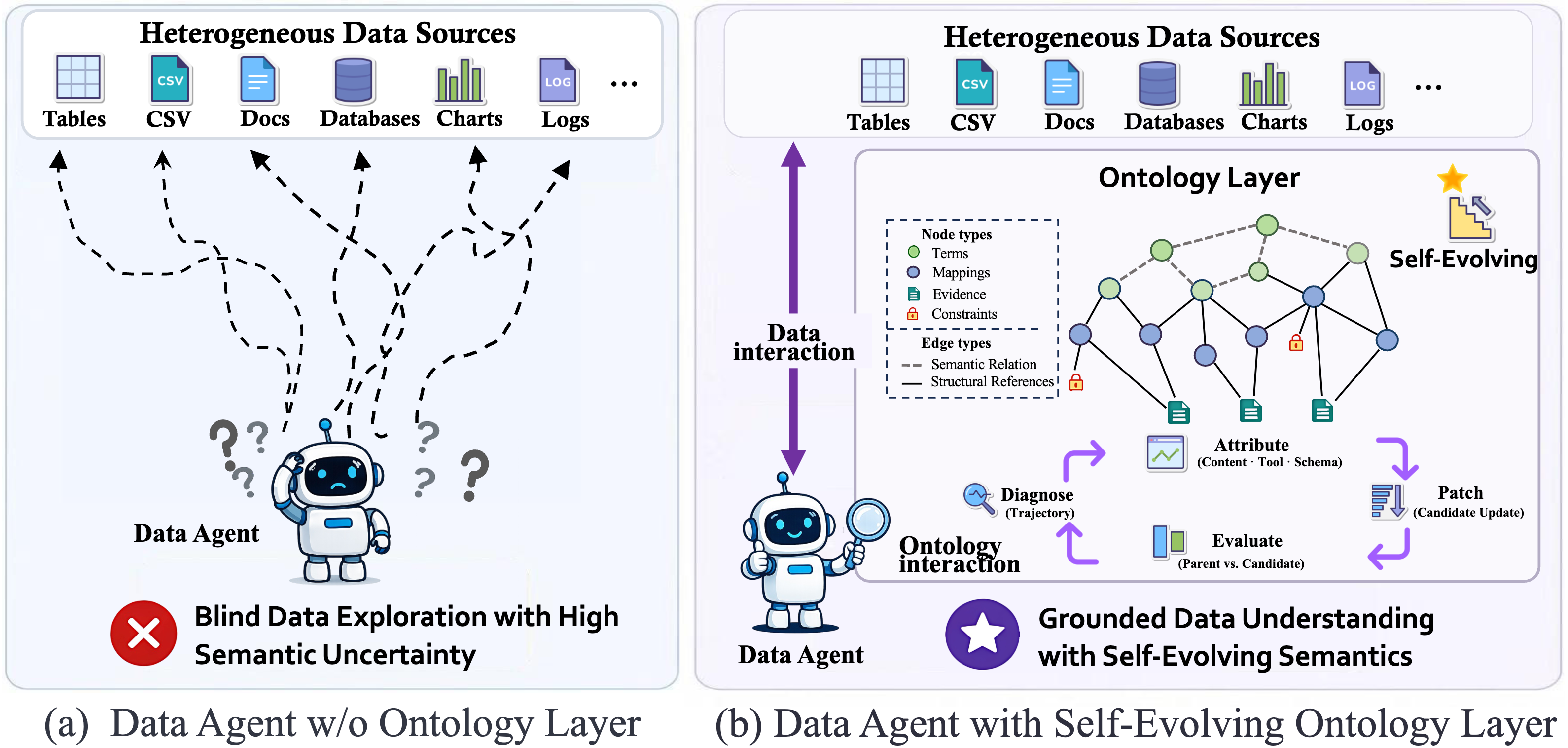
An agent-first, self-evolving ontology layer for Data Agents.
🎬 Demo
The Codex and Claude Code plugins build and evolve ontology layers over your data.
https://github.com/user-attachments/assets/e15f4acd-7161-4ae1-ba41-f2f3ea05488b
✨ Highlights
🎯 Problems We Address
- Semantic uncertainty. Make domain concepts, data mappings, relationships, and constraints explicit instead of leaving agents to guess from raw sources.
- Repeated data exploration. Reuse grounded knowledge across tasks so agents can focus on relevant data rather than rediscovering the environment for every request.
- Costly semantic maintenance. Adapt the Ontology Layer to changing workloads and agent behavior while keeping updates inspectable, comparable, and reversible.
🧩 Design Highlights
| Principle | Core idea |
|---|---|
| Active access | Retrieve only the semantics needed for the current step through MCP tools instead of injecting the full ontology. |
| Grounded construction | Build around the workload and commit semantic objects only after verification against the underlying data. |
| Targeted evolution | Diagnose interaction trajectories and apply localized updates to the interconnected Content, Schema, and Tool Layers. |
| Gated versioning | Publish a Candidate only when paired evaluation shows a reproducible improvement over its Parent. |
| Agent integration | Connect the ontology workspace and MCP runtime directly to supported agents through plugins. |
⚙️ How It Works
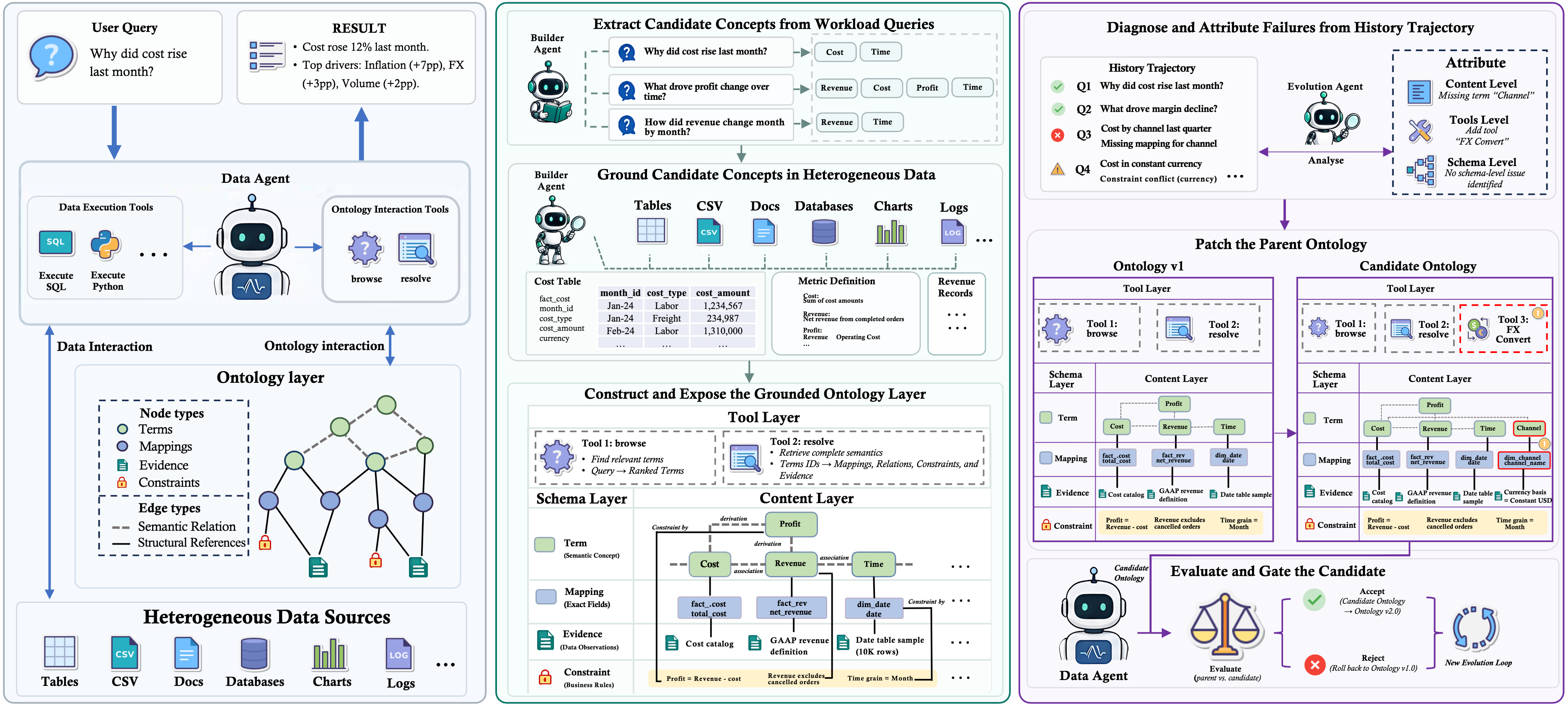
EvoOntology treats the Ontology Layer as trainable agent state—not model weights. A builder initializes grounded semantic objects from the workload and underlying data; an evolution agent then uses historical interactions to propose bounded updates and validates every Candidate against its Parent.
🧠 The Ontology Layer
Three interconnected layers define the ontology's knowledge, representation rules, and runtime access:
| Layer | Role |
|---|---|
| Content Layer | A typed semantic graph with four node families: Terms, Mappings, Constraints, and Evidence. Semantic Relations connect Terms, while Structural References link Terms to Mappings and attach Constraints or Evidence to the objects they govern or support. |
| Schema Layer | Defines the fields of the four node families, the allowed Semantic Relation types, and the permitted Structural Reference patterns, thereby setting the ontology's representational boundaries. |
| Tool Layer | Exposes the ontology through browse_semantics, resolve_semantics, and a compact session manifest. The manifest initializes the session; detailed records and linked objects are retrieved on demand. |

Content Layer: inspect grounded concepts, mappings, constraints, evidence, and their relationships.
 Schema Layer: inspect object types, fields, and controlled relationship rules. |
 Tool Layer: inspect MCP tools and the compact runtime manifest. |
Click any screenshot to open the full-resolution view.
🔄 Lifecycle
- Build — derive candidate concepts from the workload, verify them against raw sources, and publish
ontology_v0. - Use — let the Data Agent query the Ontology Layer on demand while its tool interactions and outcomes are recorded.
- Evolve — diagnose recurring behavior, attribute it to Content, Tool, or Schema, and produce a localized Candidate patch.
- Evaluate — compare Parent and Candidate with the same data, agent, decoding settings, and interaction budget.
- Publish or reject — publish the passing Candidate as
ontology_vN+1; otherwise retain the Parent and use the result in the next round.
🚀 Quick Start
Install the plugin from the GitHub marketplace—no repository clone, virtual environment, or separate pip install is required.
🤖 Claude Code
claude plugin marketplace add MeiduoChong/EvoOntology
claude plugin install evoontology@evoontology
claude plugin list
Start a new session, then run:
/evo-build
/evo-evolve
/evo-visualize
🤖 Codex
codex plugin marketplace add MeiduoChong/EvoOntology
codex plugin add evoontology-codex@evoontology
codex plugin list
Start a new thread, then ask Codex to use:
$build-ontology
$evolve-ontology
$explore-ontology
Codex prepares questions from user needs, relevant project history and grounded exploration; question/trajectory files are optional. Build and Evolve automatically open the outcome explorer. SQLite has built-in read-only task replay; other data sources use host tools with explicit observation recording. See Codex plugin.
Once built, the Data Agent can call browse_semantics and resolve_semantics without additional ontology configuration. See the usage guide for the full workflow and data boundaries.
📊 Performance
Across the four-backbone analysis subset, the builder-constructed Initial Ontology Layer improves over ReAct without an Ontology Layer, and self-evolution produces a further gain with EvoOntology on all three benchmarks.
| Benchmark | Primary metric | ReAct without Ontology Layer | Initial Ontology Layer | EvoOntology | Gain over ReAct |
|---|---|---|---|---|---|
| DDR-Bench (10-K) | Trajectory-Wise | 69.5 | 81.8 | 89.5 | +20.0 |
| InsightBench | Insight | 53.2 | 54.0 | 54.2 | +1.0 |
| BIRD | Execution Accuracy (EX) | 63.6 | 68.7 | 72.4 | +8.8 |
Results use the four-backbone analysis subset in the paper: GPT-5.5, GPT-5.6-sol, Claude-Sonnet-5, and Claude-Opus-4.8. DDR-Bench values are reported directly in Tables 2 and 8; InsightBench and BIRD values are one-decimal means of the Figure 3 scores and match the stage gains stated in the accompanying analysis. See Tables 1, 3, and 4 for the full six-backbone results and evaluation protocols.
🧪 Evaluation Environments
EvoOntology includes self-contained adapters for three complementary Data Agent settings:
| Benchmark | Task | Directory |
|---|---|---|
| BIRD | Text-to-SQL over real-world databases | benchmarks/bird/ |
| DDR-10K | Open-ended research over heterogeneous financial data | benchmarks/ddr_10k/ |
| InsightBench | Iterative business analysis and insight generation | benchmarks/insightbench/ |
Each environment implements an EvolutionAdapter and preserves its native rollout and evaluation protocol. List registered environments with python -m benchmarks list; see Adding a benchmark for the integration contract.
🗂️ Repository Layout
| Path | Purpose |
|---|---|
assets/ |
README media, framework figures, and ontology-layer interface screenshots. |
evoontology/ |
Deterministic core: ontology store, runtime/MCP, trajectories, triggers, evaluation, evolution state, validation, and visualization. |
plugins/ |
Self-contained Claude Code and Codex plugins with Build, Evolve, and Visualize skills. |
benchmarks/ |
BIRD, DDR-10K, and InsightBench evaluation environments. |
docs/ |
Architecture and benchmark-integration documentation. |
scripts/ |
Core-to-plugin synchronization utilities. |
📚 Documentation
- Usage guide — installation, workspace, lifecycle, configuration, and end-to-end operation.
- Architecture — module boundaries, evolution state machine, and evaluation modes.
- Add a benchmark — adapter, data loader, rollout, configuration, and seed-skill contract.
- Claude Code plugin and Codex plugin — client-specific installation and usage.
🌐 Community & Coverage
Thank you to the community for sharing and discussing EvoOntology.
| Source | Coverage |
|---|---|
| Gorden Sun · X | An introduction to how EvoOntology helps data agents understand business semantics. |
| Bloss0m | An independent paper walkthrough of the semantic layer, MCP interface and controlled evolution. |
⭐ Star History
Stars and forks track the official ruc-datalab/EvoOntology repository. The views badge counts today / total image requests (Asia/Shanghai), starting when enabled; image caching affects the count, which is not a unique-visitor metric.
🖋 Citation
If this repository is useful for you, please cite as:
@misc{chong2026evoontologyselfevolvingontologylayer,
      title={EvoOntology: A Self-Evolving Ontology Layer for Data Agents},
      author={Meiduo Chong and Shaolei Zhang and Ju Fan and Xiaoyong Du},
      year={2026},
      eprint={2609.15779},
      archivePrefix={arXiv},
      primaryClass={cs.AI},
      url={https://arxiv.org/abs/2609.15779},
}
If you have any questions, please feel free to submit an issue or contact [email protected].
Yorumlar (0)
Yorum birakmak icin giris yap.
Yorum birakSonuc bulunamadi