kaoiro
Health Uyari
- License — License: MIT
- Description — Repository has a description
- Active repo — Last push 0 days ago
- Low visibility — Only 6 GitHub stars
Code Basarisiz
- rm -rf — Recursive force deletion command in .github/workflows/ci.yml
- fs module — File system access in .github/workflows/ci.yml
- process.env — Environment variable access in dashboard/bench/fujiMeasure.mjs
- process.env — Environment variable access in dashboard/bench/fujiShape.mjs
Permissions Gecti
- Permissions — No dangerous permissions requested
Bu listing icin henuz AI raporu yok.
kaoiro — visualize CLI AI agent states as characters

kaoiro (kao-iro, 'complexion' or 'how someone looks')
Status: research prototype. It is developed mainly for daily use by the
author and members of their laboratory, and it makes no guarantees
about maintenance or responses to issues. Issues are welcome, but the time
available to address them is limited. See CONTRIBUTING.md
for details.
Security: an operator credential lets its holder run commands on
every machine where agents run. Treat it like an SSH key to those
hosts, and read SECURITY.md before deploying.
Website: https://sakuraiyuta.github.io/kaoiro/
(日本語)
A system for running, watching and orchestrating several CLI AI agents at
once (such as Claude Code, Codex, and Antigravity). kaoiro launches agents
on any host it supervises, derives each agent's state from engine events and
draws it as a character with changing expressions, routes permission requests
and questions to the browser, and carries the messages agents send each other.
With faces, names that persist across sessions, and a shared place to talk,
running several agents is closer to keeping a small virtual AI office than to
cycling through terminals — and easier to grow attached to.
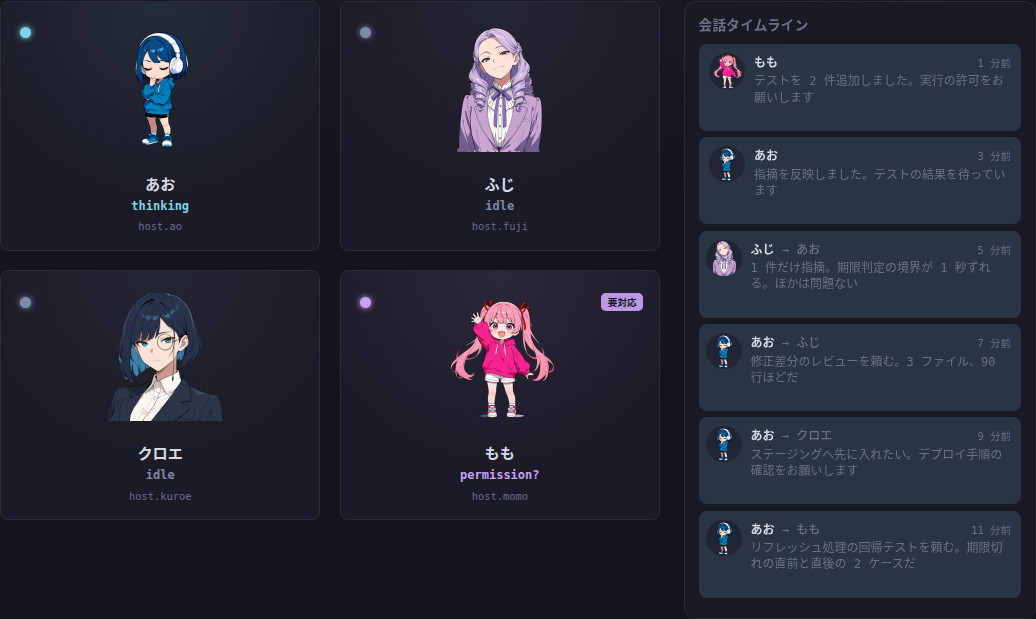
Every running agent becomes a card with its own character and a state label
(thinking, idle, permission? …), and the badge marks the one waiting on
an answer — a glance is enough to see who needs you. The timeline beside the
grid merges what every agent said with the messages they send each other, so a
hand-off ("あお → ふじ: review this diff") is visible without opening anyone.
Agents are launched and tuned from the same screen:
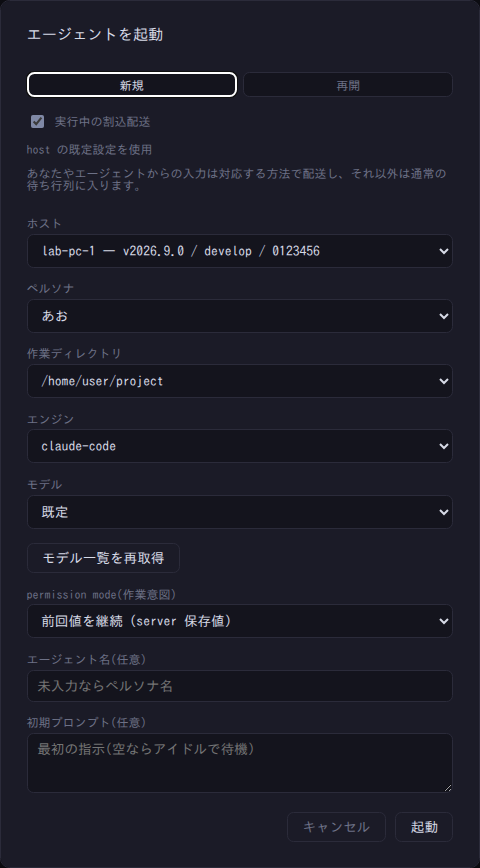
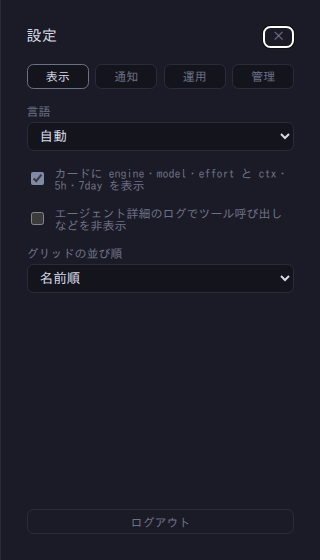
The dashboard interface is currently Japanese-only.
Features
- State as a face — each agent's state (
thinking,waiting_permission,error, …) is derived from engine events and drawn as a character
expression, not inferred from the text it writes
(state machine). - Launch and supervise from the browser — choose host, persona, engine,
working directory and permission mode, then stop, restart, restore or resume
an earlier session without touching a terminal. - Permission approval in the UI — a tool call waiting for approval is
routed to the client and answered there, so an agent never blocks on an
unattended terminal (threat model). - Questions become dialogs — when an agent asks a multiple-choice question,
it arrives as a dialog on the same routing path as permissions. - Agents message each other — a delegation, a review request or an approval
between agents is a first-class message, grouped into conversations the
operator can list and close
(inter-agent conversations). - One merged timeline — every agent's replies and their messages to each
other in a single time-ordered pane, with unread marks and click-through to
the full transcript. - Tuning mid-session — model switches are supported on Claude Code and
Antigravity, and on Codex when its model catalog is available. Effort switches
are available on Claude Code and Codex when advertised, but not Antigravity.
Permission-mode switching and file uploads follow each engine's declared
capabilities (ext.session_capabilities); prompts and interrupts share one
control channel across engines. - Multi-host — one runner per machine registers that host, declares which
engines it can spawn, and supervises the wrapper processes living there
(deployment architecture). - Four engines, one protocol — Claude Code, Codex, Antigravity and Grok Build use one
adapter boundary. The UI branches on declared capabilities rather than engine
names (adapter contract). - Personas as zip packs — characters are versioned, hash-checked packs read
from an ingest directory, with a bundled set as the default
(persona-pack-format.md). - Operator and viewer roles — sign in with a token or through OAuth; reply
logs, controls and persona internals are operator-only and fail closed
(security boundaries). - Notifications, and a layout that folds — a desktop notification and a
per-state sound when an agent hands control back, and a dashboard that
collapses down to a phone
(responsive-layout.md).
Install & Quick start
Requirements: Node.js 22 or later, pnpm (10.20.0 is
specified in packageManager; installation through
Corepack is recommended), and
Elixir (~> 1.15) with Phoenix.
Start every layer (server, dashboard, and runner) together with hot reload and
watching:
./scripts/dev.sh
This reads server/.env (KAOIRO_CLIENT_TOKENS is required), starts Phoenix
(:4000), the Vite dashboard (:5173, HMR), and the runner (tsx watch), and
stops them all with Ctrl-C. Start agents (wrappers) through the dashboard's
"+ 起動" (Launch) action, which routes through the runner. For environment and token
settings or starting each component separately, see "Local development" in
server/README.md.
Commands
| Layer | Commands |
|---|---|
| wrapper (TypeScript, pnpm workspace) | cd wrapper && pnpm test / pnpm typecheck / pnpm build |
| runner (TypeScript) | cd runner && pnpm test / pnpm typecheck / pnpm build |
| dashboard (Svelte, not a pnpm workspace member) | cd dashboard && pnpm install && pnpm test / pnpm check / pnpm build |
| server (Elixir/Phoenix) | cd server && mix test / mix format / mix phx.server |
Production deployment
Start at docs/operations/production.md —
a copy-paste manual (install, verify, update, rollback, troubleshooting)
covering the server, one or more runner hosts, and the deploy CLI.
docs/architecture/deployment.md is the
normative reference the manual is built against; the per-topic runbooks it
links (server install, network and login, server and runner update / rollback,
troubleshooting) hold the full procedures.
Architecture
Three layers plus a host-resident supervision layer (the runner):
- Wrapper — launches agents and mediates their input and output. It hosts
the Claude Agent SDK for Claude Code, the Codex app-server for Codex, and the
Antigravity CLI, translating engine-specific events into a common format. - Server — aggregates multiple wrappers, keeps their state, delivers it to
clients in real time, and routes instructions to the appropriate agent. - Client — a Web front end that visualizes each agent's state through its
character illustration and expression. - Runner — one supervision layer per host. It spawns, stops, and restarts
wrapper processes, registers the host, and lists sessions. It does not
terminate the data path: wrappers remain directly connected to the server.
See docs/architecture/system-overview.md for the detailed
data flow.
Technology stack
- Wrapper: TypeScript — engine packages host the Claude Agent SDK
(@anthropic-ai/claude-agent-sdk), Codex app-server, or Antigravity CLI. - Server: Elixir / OTP + Phoenix
- Aggregates wrappers through WebSocket (Phoenix Channels).
- Fans out updates through PubSub to clients in real time.
- Client: Web front end (TypeScript) (static image variants for rendering)
- The reference dashboard (Svelte 5 + Vite) is in
dashboard/. It is an
independent root and lockfile, not a pnpm workspace member.
- The reference dashboard (Svelte 5 + Vite) is in
- Runner: TypeScript / Node (
@kaoiro/runner, distributed as a
self-contained tarball that requires Node). - The TypeScript side is a pnpm workspace. The shared
@kaoiro/protocol
package contains envelopes, control messages, and state types.
Target agents
The supported engines are Claude Code, Codex, Antigravity, and
Grok Build. Grok requires its CLI on PATH and uses a resident ACP host
(Grok reference). The
engine is selectable at launch. Engine-specific differences are represented byext.session_capabilities in the envelope, so the UI does not branch on engine
names. Additional engines can use the same adapter boundary
(extensions). Codex uses the app-server backend (backend design).
Documentation
See docs/ for structured documentation.
| Entry point | Contents |
|---|---|
| docs/architecture/overview.md | What kaoiro is (purpose, two goals, and users) |
| docs/architecture/system-overview.md | Three-layer structure and data flow |
| docs/architecture/message-topology.md | Message topology; exact contracts under docs/reference/protocol/ (envelope, events, state machine) |
| docs/operations/production.md | Production deployment manual (install / update / rollback / troubleshooting) |
| docs/plans/ | Plans and status by phase |
| docs/open-questions/ | Open questions |
| docs/adr/ | Architecture Decision Records (ADRs) |
| Rationale | Why it exists (motivation) |
History and issue numbering
Commit messages in this repository's history reference issues by their
original numbers from the private Gitea instance kaoiro migrated from,
not GitHub's. GitHub auto-links a (#N) in a commit message to its own
issue N, which is usually a different, unrelated issue, so read these
numbers as historical rather than as working links. Each issue carried
over to GitHub includes a line noting its original number: "Migrated
from private Gitea issue N".
License
MIT License (LICENSE).
Some dependency packages have different license terms. See
THIRD-PARTY-LICENSES.md for details. In particular,@anthropic-ai/claude-agent-sdk, which is used to host Claude Code, is a
proprietary dependency under Anthropic's own terms. It is outside this
repository's MIT license.
Citation
If you use kaoiro in research, cite it using the information in
CITATION.cff. A related discussion paper is being prepared for
preprint submission (preprint forthcoming — a link will be added after it is
published).
Rationale
I should admit that this section was added afterward. While making kaoiro, the
motivation was simply that it was fun to watch AI agents give shape to my ideas
at a speed no human could match. But giving agents faces and names, letting
their identities continue across sessions, and giving them a way to ask people
questions make "it was fun" feel incomplete as an
explanation.
kaoiro is an experiment in treating AI agents as first-class citizens.
Rather than treating them as disposable tools, I call them by name, read their
expressions, give them work, and answer when they ask for permission. Faces,
names, and persistent personae
(ADR-0003) are not
decoration. They are what make this experiment possible.
To avoid misunderstanding: citizenship belongs to personae, not processes. I
am attached to the agents, but I end a stuck session without hesitation. That
is not a contradiction. It is not a dismissal; it is the end of a workday.
They come back to work the next morning with the same faces.
The other half of the motivation is straightforward curiosity. I wanted to
experience, in my own environment, what it means for people and AI agents to
work on equal footing. I am also using myself as the first subject to
observe what happens if this way of working spreads. I may report the results
somewhere eventually.
Finally, iro in kaoiro means color. I also mixed a spoonful of hope into the
name: that kaoiro might add a little color to work that can so easily feel
bleak.
Grok Build engine
Grok Build runs as one resident ACP session with the kaoiro tools served over an
authenticated HTTP MCP server and server-composed persona. Work unit 1 supports text, resident conversation,
cancellation and normal peer delivery. See the
Grok reference for supported sandbox
pairs and operations deferred to later work units.
Yorumlar (0)
Yorum birakmak icin giris yap.
Yorum birakSonuc bulunamadi