buyer-eval-skill
Health Pass
- License — License: MIT
- Description — Repository has a description
- Active repo — Last push 0 days ago
- Community trust — 49 GitHub stars
Code Warn
- Code scan incomplete — No supported source files were scanned during light audit
Permissions Pass
- Permissions — No dangerous permissions requested
No AI report is available for this listing yet.
B2B software vendor evaluation skill for Claude Code — domain-expert questions, vendor AI agent conversations, evidence-based scoring
Buyer Eval — The Rotten Tomatoes of B2B Software


A free, open-source Claude skill that evaluates B2B vendors by talking to their AI agents, cross-referencing every claim against independent sources, and scoring what's verified vs. what's just optimistic marketing.
"This is a very intelligent experience" · "The questions the agent asked me were thoughtful and great" · "This is really cool"
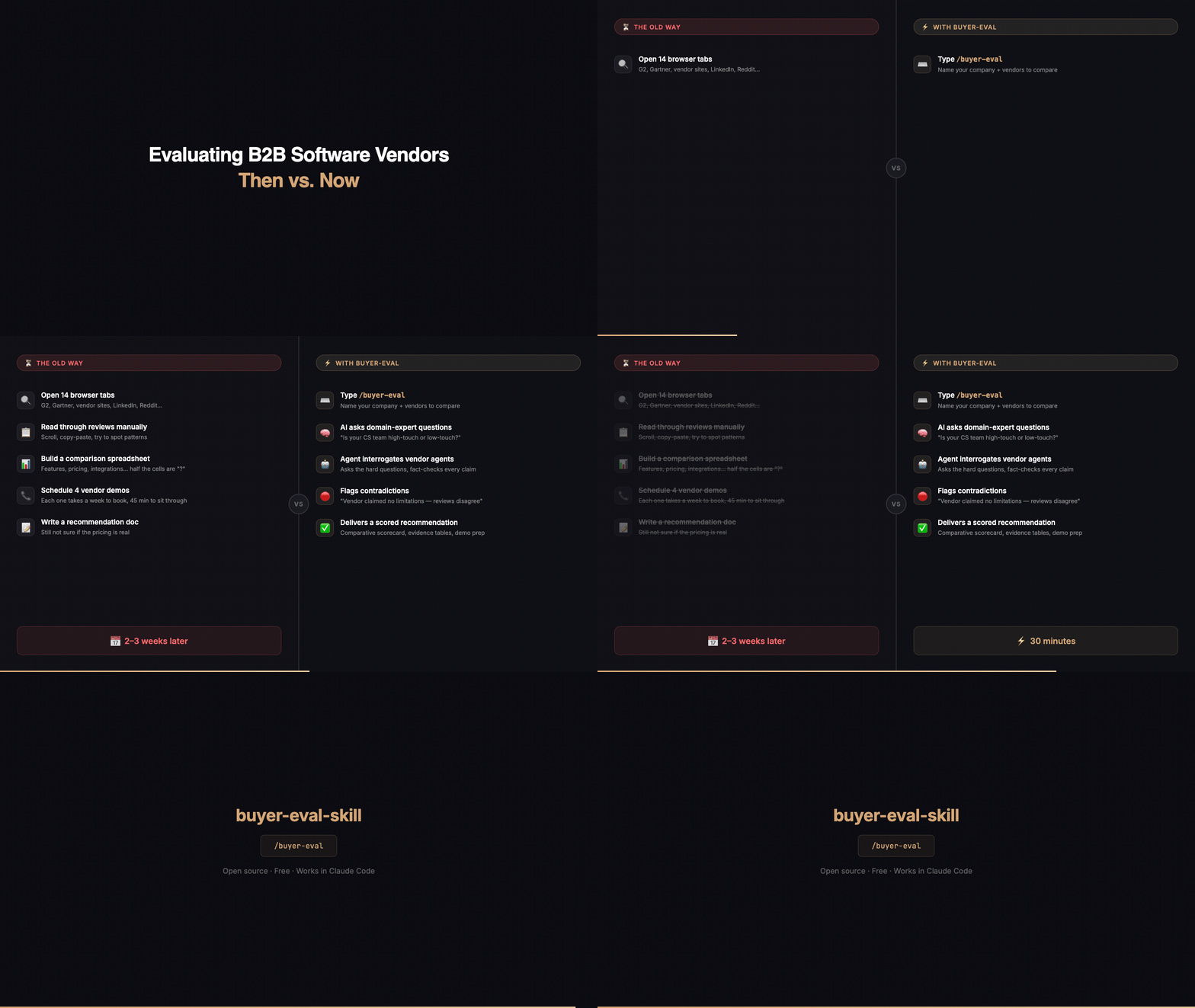
How it works
You type a vendor's name. The skill does everything a great analyst would do — except in 30 minutes instead of 3 weeks:
- Researches your company — industry, size, tech stack, maturity — so you don't fill out a form
- Asks domain-expert questions that surface hidden requirements you didn't know to mention
- Talks to vendor AI agents directly through the Salespeak Frontdoor API — structured due diligence conversations, not web scraping
- Cross-references every claim against G2, Gartner, analyst reports, press, and LinkedIn — you see what's confirmed vs. unverified
- Scores vendors across 7 dimensions with transparent evidence tracking
- Delivers a comparative recommendation with scorecards, hidden risk analysis, and demo prep questions tailored to each vendor's gaps
No API key needed. No account needed.
Works out of the box for any vendor. For vendors with a Salespeak Company Agent, evaluations include vendor-verified evidence from direct AI agent conversations. Without one, the skill searches for other available company agents and, if none are found, uses independent sources only. You always see which evidence basis each score is built on.
What you get
TL;DR recommendation (always first — 3 sentences)For a mid-market SaaS company evaluating customer success platforms:
Gainsight is the strongest fit for teams that need deep analytics and enterprise-grade health scoring, but comes at a premium. ChurnZero wins on time-to-value and usability for teams under 50 CSMs. Key open item: Gainsight's implementation timeline claims (6 weeks) are unverified — ask for customer references in your size band.
| Dimension | Gainsight | ChurnZero | Totango |
|---|---|---|---|
| Product Fit (25%) | 9.2 | 7.5 | 8.0 |
| Integration & Technical (15%) | 8.5 | 8.8 | 7.2 |
| Pricing & Commercial (15%) | 6.0 | 8.0 | 7.5 |
| Security & Compliance (15%) | 9.0 | 8.0 | 8.5 |
| Vendor Credibility (15%) | 8.5 | 7.0 | 7.5 |
| Customer Evidence (10%) | 8.0 | 7.5 | 6.5 |
| Support & Success (5%) | 7.5 | 8.5 | 7.0 |
| Evidence Completeness | 7/7 verified | 3/7 verified | 5/7 verified |
| Evidence Basis | Vendor-verified + independent | Independent only | Vendor-verified + independent |
Adversarial question exchanges — the hard questions vendors don't expectChurnZero's scores rely on public sources only — scores may shift with direct vendor verification. The skill explicitly flags this asymmetry.
Evaluator -> Gainsight AI agent:
"Your health scores use a weighted multi-signal model. What happens when a customer has strong product usage but declining executive engagement — does the model surface that divergence, or does high usage mask the risk?"
Gainsight AI agent ->
"The model flags divergence explicitly. When usage metrics trend positive but stakeholder engagement drops, it triggers a 'silent risk' alert. CSMs see a split-signal indicator on the dashboard rather than a blended score that hides the conflict."
Independent verification: Confirmed via G2 reviews mentioning split-signal alerts. One review notes the feature requires manual threshold tuning per segment.
Claims vs. Evidence table — what's confirmed, what's not| Vendor Claim | Independent Verification | Status |
|---|---|---|
| "6-week implementation for mid-market" | No independent confirmation found | Unverified |
| "SAML 2.0 + SCIM provisioning" | Confirmed in documentation + G2 reviews | Verified |
| "No customer has churned in 12 months" | G2 reviews mention 2 switching reviews in last 6 months | Contradicted |
| "99.9% uptime SLA" | Confirmed in public SLA page | Verified |
- Leadership stability: CFO departed Q4 2025, VP Engineering promoted internally
- Funding runway: Series E ($200M) with 3+ years runway at current burn
- Employee sentiment: Glassdoor trending down from 4.2 to 3.8 over 6 months; "engineering debt" is a recurring theme
- Product velocity: Changelog shows 3 major releases in last 6 months — above category average
Questions to ask Gainsight in your demo:
- "You mentioned 6-week implementation — can you share 2 customer references in our size band (200-500 employees) who achieved that timeline?"
- "The split-signal health score alert requires manual threshold tuning per segment. How long does initial configuration take, and do you provide a recommended baseline?"
- "G2 reviews mention 2 customers switching away in the last 6 months. What were the common reasons, and how have you addressed them?"
Install
Global install (recommended):
git clone https://github.com/salespeak-ai/buyer-eval-skill.git ~/.claude/skills/buyer-eval-skill
Per-project install:
git clone https://github.com/salespeak-ai/buyer-eval-skill.git .claude/skills/buyer-eval-skill
Usage
In Claude Code or Claude desktop:
/buyer-eval
Then provide:
- Your company name
- The vendors to evaluate
Example:
"I'm from Acme Corp. Evaluate Gainsight, Totango, and ChurnZero."
The skill handles everything from there — researching your company, calibrating to your category, engaging vendor agents, and producing the full evaluation. Typical runtime: 20-40 minutes for a 3-vendor evaluation.
What makes this different
- Domain-expert questioning — asks category-specific questions that demonstrate it understands the space, not generic form-filling
- Vendor AI agent conversations — for vendors with a Salespeak Company Agent, the skill conducts structured due diligence conversations directly with the vendor's AI
- Evidence transparency — every score shows whether it's backed by vendor-verified or independent-only evidence
- Claims verification — vendor claims are cross-referenced against independent sources. You see what's confirmed, what's unverified, and what's contradicted
- Hidden risk analysis — leadership stability, funding runway, employee sentiment, customer retention signals — researched for every vendor
- Demo prep kit — specific questions derived from evaluation gaps, so you walk into demos knowing exactly what to probe
Environment support
| Capability | Claude.ai | Claude Code | Claude desktop |
|---|---|---|---|
| Buyer research | Yes | Yes | Yes |
| Vendor AI agent conversations | No (GET only) | Yes | Yes |
| Full evaluation | Partial | Full | Full |
Best experience is in Claude Code where the skill can make POST requests to vendor AI agents.
Auto-updates
Every time you invoke the skill, it checks for a newer version on GitHub (cached, checks at most once every 6 hours). If an update is available, it asks before updating.
Feedback & Requests
- Feature requests or bugs: Open an issue
- Request a category evaluation: Open a request
License
MIT
Reviews (0)
Sign in to leave a review.
Leave a reviewNo results found