agent-teams
Health Uyari
- License — License: MIT
- Description — Repository has a description
- Active repo — Last push 0 days ago
- Low visibility — Only 5 GitHub stars
Code Gecti
- Code scan — Scanned 12 files during light audit, no dangerous patterns found
Permissions Gecti
- Permissions — No dangerous permissions requested
Bu listing icin henuz AI raporu yok.
Autonomous multi-agent skill for AI agents. Cut token costs by 40–80% with structured workflows, quality gates, and isolated subagents.
AgentTeams: Autonomous Multi-Agent Orchestration for AI Coding Agents





Run coordinated AI agent teams that write cleaner code and save 40%–80% in token costs. Built for Google Antigravity, Claude Code, and any autonomous LLM agent.
📑 Table of Contents
- What is AgentTeams?
- The Problem: Why Unstructured Multi-Agent Fails
- Architecture & How It Works
- ⚡ Quick Install
- 🎯 When to Use AgentTeams (Decision Guide)
- 📊 Empirical Benchmarks & Costs
- 🥊 AgentTeams vs. Alternatives
- 📋 Task Contract Example
- ❓ Frequently Asked Questions (FAQ)
- 📄 License & Attribution
💡 What is AgentTeams?
AgentTeams is an open-source orchestration protocol that turns autonomous AI coding assistants into a coordinated, specialized engineering team. Instead of letting multiple agents converse endlessly in a shared chat room, AgentTeams structures work like a high-performing software engineering organization:
- The Captain: Decomposes user goals into a strict, dependency-aware Directed Acyclic Graph (Task DAG).
- Specialized Subagents: Spawns isolated workers (e.g., QA Engineer, Implementer, Reviewer) with bounded file scopes (
inScope). - Machine-Verifiable Quality Gates: Enforces automated test verification (
verifycommands with exit code 0) and structured code reviews before tasks can close. - Context Isolation: Workers execute in fresh, clean contexts—eliminating token bloat and preventing hallucination.
Works with any agent framework: Google Antigravity, Claude Code, AutoGen, CrewAI, LangGraph, OpenHands, or custom Python LLM loops.
⚠️ The Problem: Why Unstructured Multi-Agent Fails
Most multi-agent systems suffer from two major problems:
- The Multi-Agent Tax (Token Explosion): In conversational multi-agent setups (e.g., chat rooms or open handoffs), every agent sees the entire conversation history. As turn count grows, billed tokens explode quadratically ($O(N^2)$), driving up API costs by 5x–10x.
- Chaotic Handoffs & Hallucinations: Agents without scoped file permissions overwrite each other's code, introduce circular repair loops, and claim tasks are "done" without running verifiable unit tests.
How AgentTeams Solves This
| Challenge | Unstructured Multi-Agent | AgentTeams Protocol |
|---|---|---|
| Context Window | Monolithic shared chat ($O(N^2)$ token explosion) | Isolated worker contexts ($O(N)$ linear scaling) |
| Scope Control | Agents touch any file across the repo | Strict inScope file globs audited at completion |
| Quality Control | "Looks good to me" conversational signoff | Verifiable exit code 0 test gates & JSON review verdicts |
| Workflows | Circular, ad-hoc chat | Acyclic Task DAG with clear dependency ordering |
🏗️ Architecture & How It Works
flowchart TD
    User["User Request"] --> Captain

    subgraph Team ["AgentTeams Autonomous Protocol"]
        Captain["Captain Agent (Orchestrator)"]
        DAG["1. Task DAG Generation<br/>(Dependencies, inScope Globs, Acceptance Criteria)"]

        T1["2. QA Engineer<br/>(Write Failing Pytest Suite)"]
        G1{"Quality Gate 1<br/>Tests Fail as Expected?"}

        T2["3. Implementer<br/>(Implement Code in Scope)"]
        G2{"Quality Gate 2<br/>pytest exit code == 0?"}

        T3["4. Code Reviewer<br/>(Independent Audit & Verification)"]
        ReviewVerdict{"Review Verdict?"}
        Repair["Acyclic Repair Task"]
        Merge["Integrate & Close Task"]

        Captain --> DAG
        DAG --> T1
        T1 --> G1
        G1 -->|Yes| T2
        T2 --> G2
        G2 -->|Yes| T3
        T3 --> ReviewVerdict
        ReviewVerdict -->|pass| Merge
        ReviewVerdict -->|needs_revision| Repair
        Repair --> T2
    end

    Merge --> UserSuccess["Verified Solution Delivered"]
⚡ Quick Install
1. Download the Single Skill File (1-Line Command)
# For Google Antigravity:
mkdir -p ~/.gemini/config/skills/agent-teams && curl -fsSL https://raw.githubusercontent.com/sanad-source/agent-teams/main/skills/agent-teams/SKILL.md -o ~/.gemini/config/skills/agent-teams/SKILL.md

# For Claude Code, Cursor, or any other agent:
curl -fsSL https://raw.githubusercontent.com/sanad-source/agent-teams/main/skills/agent-teams/SKILL.md -o AGENT_TEAMS.md
2. Or Clone as a Full Plugin
git clone https://github.com/sanad-source/agent-teams.git ~/.gemini/config/plugins/agent-teams
🎯 When to Use AgentTeams (Decision Guide)
Not every task requires a multi-agent team. Use this guide to choose the optimal architecture:
| Scenario | Recommended Approach | Why? |
|---|---|---|
| Single-file bug fix or script (< 10 turns) | 🏆 Monolithic Single Agent | Avoids multi-agent system prompt & tool schema overhead. 5x cheaper on small tasks. |
| Complex feature across multiple files (> 10 turns) | ✅ AgentTeams | Context isolation saves 20%–57% tokens compared to a bloated monolithic session. |
| Strict TDD & Quality Assurance | ✅ AgentTeams | Independent QA writes tests before the implementer codes; independent reviewer audits code. |
| Large refactoring or migration | ✅ AgentTeams | Prevents context pollution; tasks execute across clean DAG stages. |
📊 Empirical Benchmarks & Costs
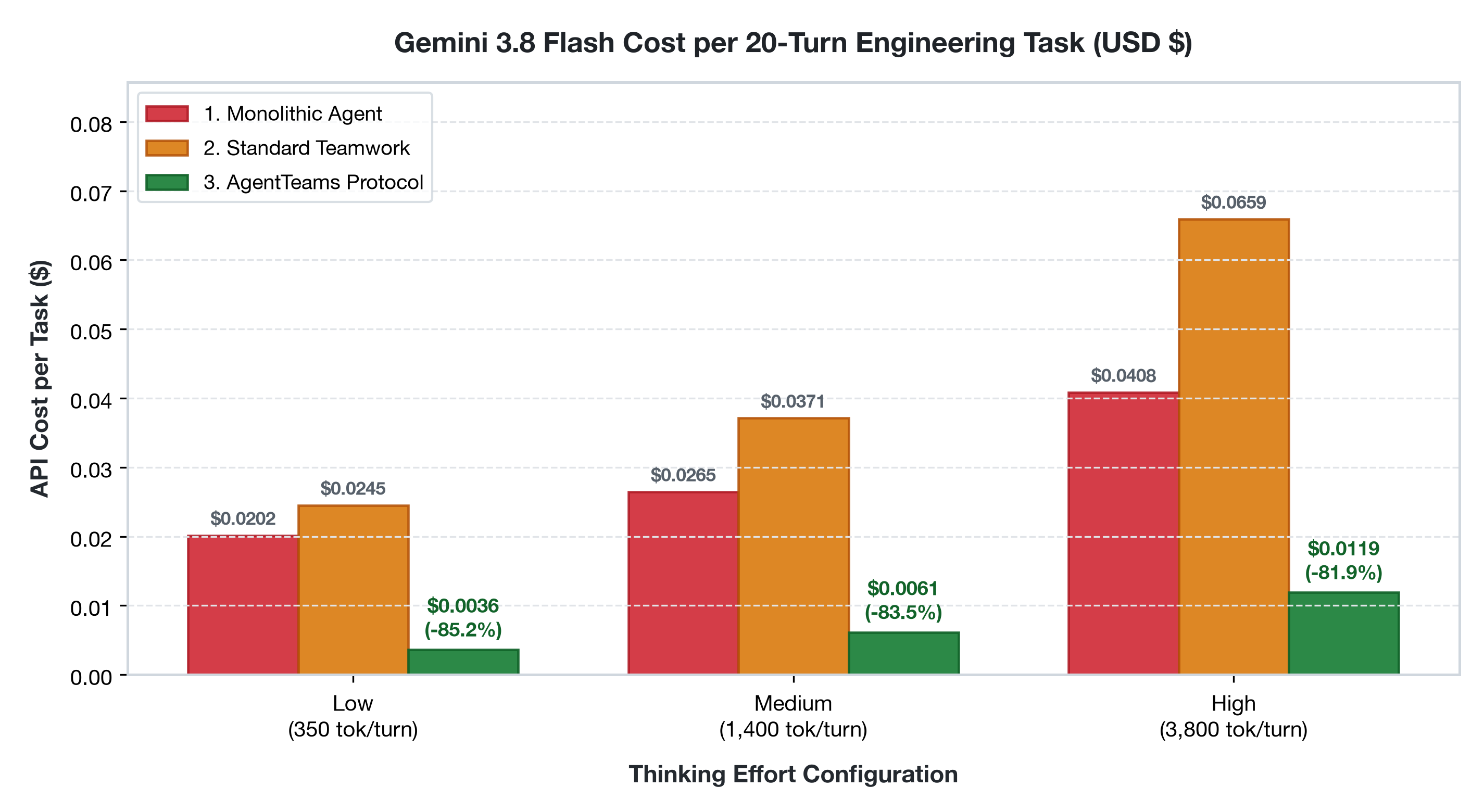
Empirical testing conducted on Gemini 3.8 Flash ($0.075/1M input tokens, $0.30/1M output tokens):
1. Cost per 20-Turn Engineering Task (USD)
| Thinking Level | 1. Monolithic Agent | 2. Standard Teamwork | 3. AgentTeams | Savings vs. Standard | Savings vs. Monolithic |
|---|---|---|---|---|---|
| Low (350 tok/turn) | $0.0202 | $0.0245 | $0.0036 | -85.2% | -82.0% |
| Medium (1.4k tok/turn) | $0.0265 | $0.0371 | $0.0061 | -83.5% | -76.8% |
| High (3.8k tok/turn) | $0.0409 | $0.0659 | $0.0119 | -81.9% | -70.9% |
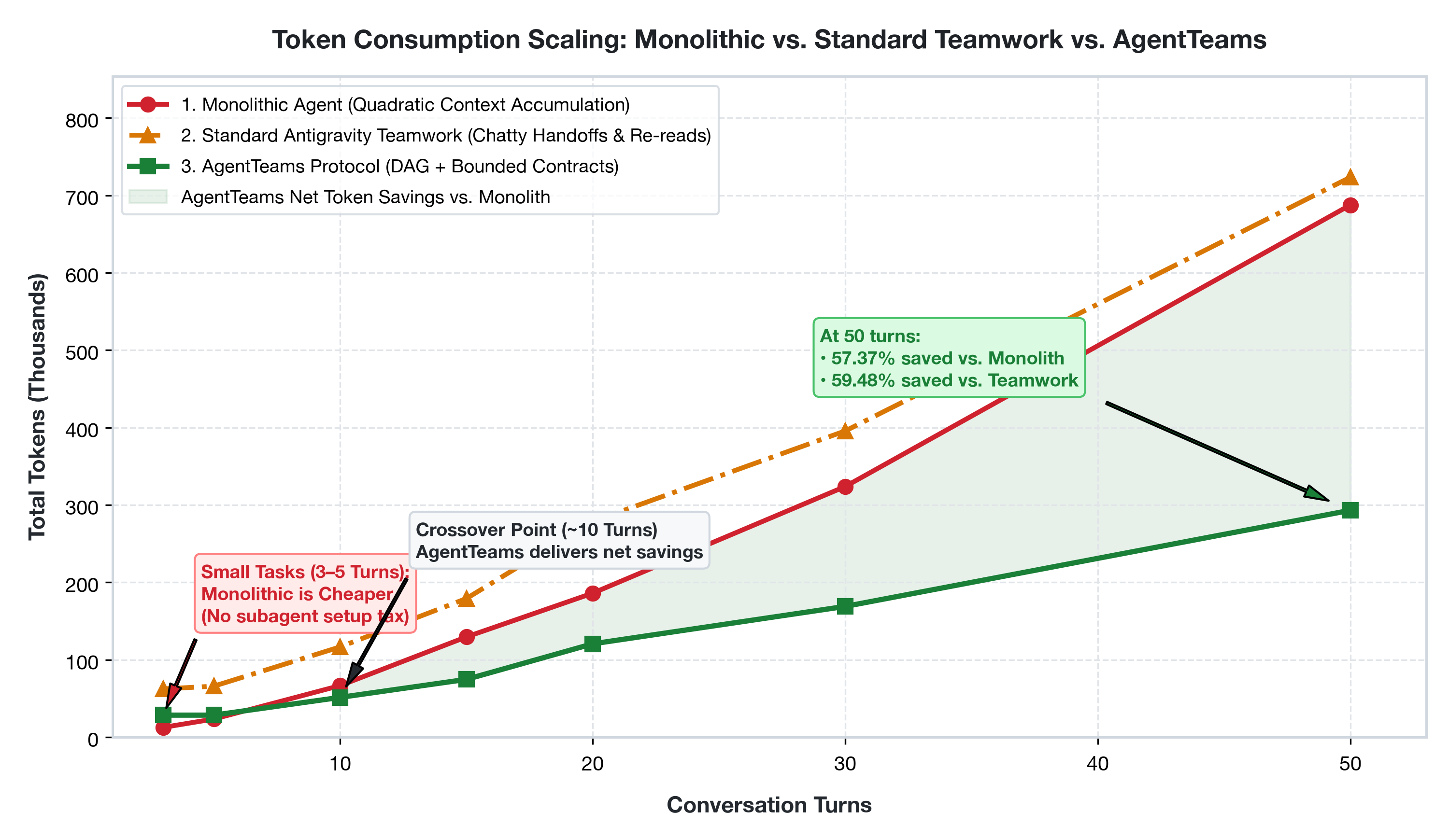
2. Token Scaling Over Conversation Turns
| Turns | 1. Monolithic Agent | 2. Standard Teamwork | 3. AgentTeams | Winner |
|---|---|---|---|---|
| 3 | 12.7k tok |
62.4k tok |
28.5k tok |
🏆 Monolithic (AgentTeams +124.7% overhead) |
| 5 | 23.5k tok |
65.9k tok |
28.5k tok |
🏆 Monolithic (AgentTeams +21.5% overhead) |
| 10 | 66.7k tok |
116.6k tok |
51.4k tok |
✅ AgentTeams (-22.8% vs. Mono) |
| 15 | 129.5k tok |
179.1k tok |
74.7k tok |
✅ AgentTeams (-42.3% vs. Mono) |
| 20 | 186.1k tok |
278.7k tok |
120.6k tok |
✅ AgentTeams (-35.2% vs. Mono) |
| 30 | 323.9k tok |
395.7k tok |
169.0k tok |
✅ AgentTeams (-47.8% vs. Mono) |
| 50 | 687.7k tok |
723.5k tok |
293.1k tok |
✅ AgentTeams (-57.4% vs. Mono) |
3. Empirical Live Antigravity Test (Untruncated Transcripts)
We evaluated all three architectures on the exact same task (build a thread-safe TokenBucket rate-limiter, write comprehensive tests, and review). Measured directly from transcript_full.jsonl:
| Architecture | Measured Total Tokens | Measured API Cost | Verdict on This Task |
|---|---|---|---|
| 1. Monolithic Single Agent | 30,241 |
$0.00330 | 🏆 Winner on small tasks (5.13x cheaper) |
| 2. Standard Antigravity Teamwork | 208,555 |
$0.01893 | ❌ Most expensive (+178.3k vs. Mono) |
| 3. AgentTeams Protocol | 154,998 |
$0.01362 | ✅ 25.7% cheaper than Standard Teamwork (-53.6k tokens) |
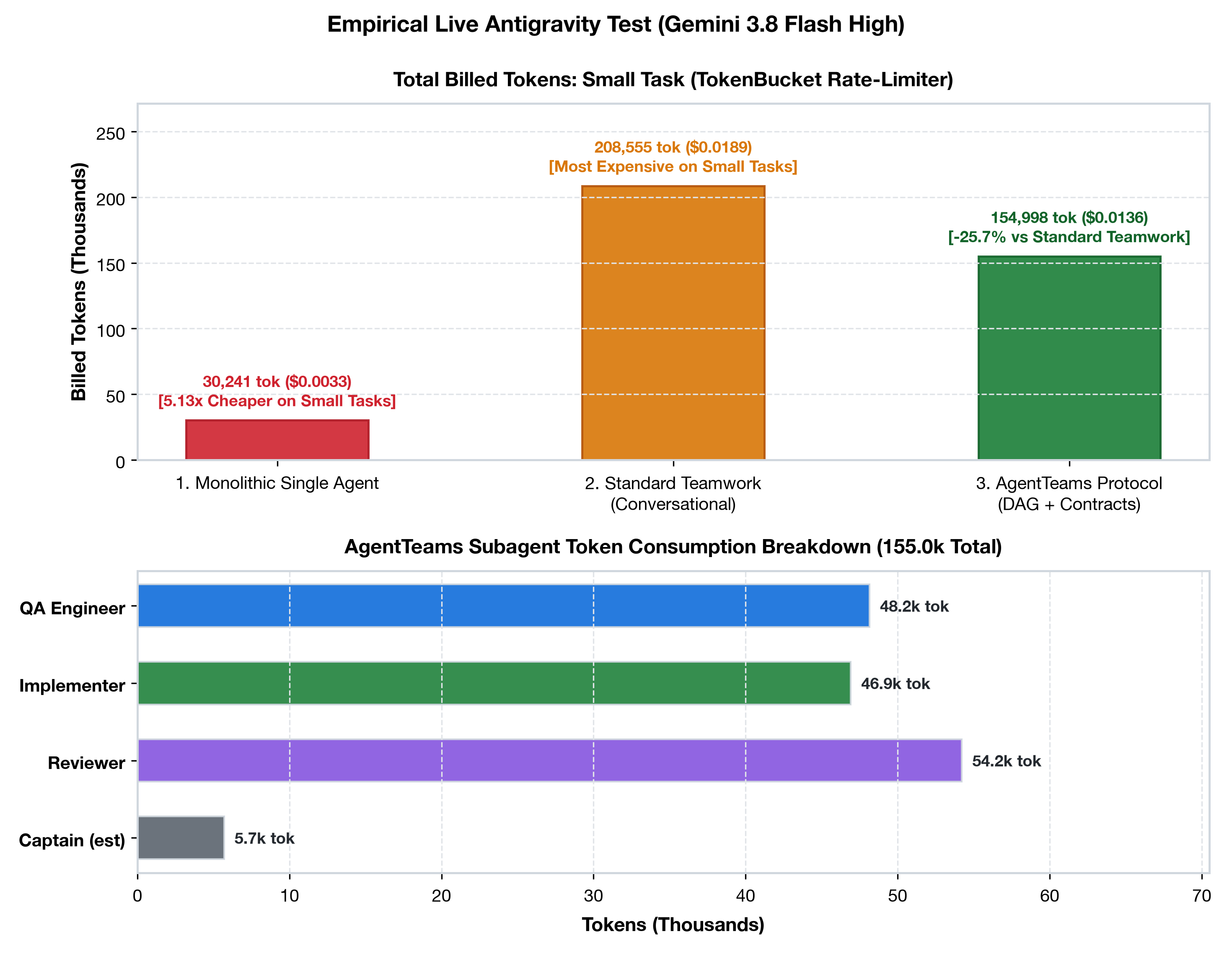
The Honest Engineering Truth: For small, self-contained tasks (1–2 files), multi-agent is 5x more expensive because each subagent incurs tool definitions and system prompt overhead. Multi-agent is an architectural tool for complex codebases, multi-file features, and strict TDD, NOT for 10-line scripts.
Verify the raw untruncated transcripts yourself in
live_test/real_comparison.json.
🥊 AgentTeams vs. Alternatives
| Feature | Monolithic Agent | Chat-Room Multi-Agent (AutoGen/CrewAI) | Standard Teamwork | AgentTeams Protocol |
|---|---|---|---|---|
| Coordination | None (Single prompt) | Free-form group chat | Ad-hoc / Conversational | Captain-led Task DAG |
| Task State | Implicit | None / Conversational | Implicit | Strict lifecycle (pending → claimed → completed) |
| Scope Protection | None | None | Open-ended | Strict inScope file globs |
| Quality Gates | Self-reported | Self-reported | Conversational ("tests pass") | Machine-verifiable verify commands (exit code 0) |
| Code Review | Self-review | Agent conversation | Informal | Independent Reviewer with JSON verdicts |
| Token Cost Scaling | $O(N^2)$ (History bloat) | $O(N^2 \cdot M)$ (Explosive) | High (Chat handoffs) | $O(N)$ (Isolated subagent contexts) |
| Portability | Universal | Framework-locked | Platform-specific | Universal (Any LLM agent) |
📋 Task Contract Example
Tasks are declared in structured YAML contracts that define dependencies, bounded scopes, and verification commands:
id: "task-token-bucket-impl"
subject: "Implement thread-safe TokenBucket rate limiter"
kind: "implementation"
assignee: "implementer"
dependencies: ["task-token-bucket-tests"]
inScope:
  - "src/rate_limiter/token_bucket.py"
acceptanceCriteria:
  - "Thread-safe consumption using threading.Lock"
  - "Refills tokens monotonically based on elapsed time"
  - "Raises ValueError on non-positive capacity or refill rate"
verify:
  - "pytest tests/test_token_bucket.py"
🚀 How to Use
In Google Antigravity:
"Use the agent-teams skill to implement <feature>""/goal use agent-teams to refactor the payment gateway"/teamwork-preview
In Claude Code, Cursor, or Other LLM Agents:
Include skills/agent-teams/SKILL.md in your project instructions (e.g., in CLAUDE.md, .cursorrules, or system prompt):
Follow the AgentTeams protocol in AGENT_TEAMS.md for all multi-step engineering tasks.
❓ Frequently Asked Questions (FAQ)
What is AgentTeams?
AgentTeams is an open-source orchestration protocol designed for autonomous AI coding agents. It coordinates specialized subagents (such as QA engineers, implementers, and reviewers) using a Captain-orchestrated Directed Acyclic Graph (DAG), strict delivery contracts, and automated quality gates.
Does multi-agent orchestration reduce or increase token costs?
It depends on task size:
- For small tasks (< 10 turns): Multi-agent systems have higher overhead (tool definitions + system prompts) and are more expensive than a single agent.
- For medium-to-large tasks (> 10 turns): AgentTeams cuts token costs by 20% to 57% compared to a monolithic agent, and 80%+ in long conversations, because subagents execute in clean, isolated contexts rather than dragging a 100k-token conversation history through every turn.
How is AgentTeams different from CrewAI, AutoGen, or LangGraph?
- Framework Agnostic: AgentTeams is a lightweight, zero-dependency protocol defined in Markdown and JSON. It runs inside existing agent tools like Google Antigravity or Claude Code without installing heavyweight Python orchestration runtimes.
- No Group Chat Noise: AutoGen and CrewAI rely on conversational turns between agents. AgentTeams uses structured task contracts and isolated execution, preventing context pollution and circular chat loops.
- Enforced Quality Gates: Tasks cannot complete based on an agent saying "I'm done." They require machine-verified automated tests (
exit code 0) and structured JSON review verdicts.
Can I use AgentTeams with any LLM?
Yes. AgentTeams is model-agnostic. It has been empirically tested with Gemini 3.8 Flash, but works identically with Claude 3.7 Sonnet, GPT-4o, DeepSeek-R1, or local models.
📄 License & Attribution
- License: MIT
- Author: Sanad Al-Bahar
- Inspiration: Directly inspired by dsh-agent-teams by NanmiCoder.
Yorumlar (0)
Yorum birakmak icin giris yap.
Yorum birakSonuc bulunamadi