ClaudeGate
Health Pass
- License — License: MIT
- Description — Repository has a description
- Active repo — Last push 0 days ago
- Community trust — 23 GitHub stars
Code Fail
- Hardcoded secret — Potential hardcoded credential in .github/workflows/ci.yml
Permissions Pass
- Permissions — No dangerous permissions requested
No AI report is available for this listing yet.
High-performance bridge proxy connecting Claude Code CLI & Anthropic SDK to ANY OpenAI-compatible LLM provider (DeepSeek, OpenRouter, Groq, Ollama, Gemini, OpenAI) with zero-crash streaming, failover & secret redaction.

ClaudeGate
High-Performance Universal Bridge connecting Claude Code CLI & Anthropic SDKs to ANY AI Model.
Zero-crash streaming, multi-provider failover, chain-of-thought sanitization, PII redactor, and 24+ provider presets.




📑 Table of Contents
- 📌 1. Project Overview
- 📸 2. Live Demo & Terminal Previews
- ✨ 3. Features
- 🛠️ 4. Tech Stack
- 🏗️ 5. Architecture
- 📁 6. Project Structure
- ⚙️ 7. Installation and Setup
- 🚀 8. Usage & User Flow
- 🧪 9. Testing & Diagnostics
- 🔒 10. Security & Privacy Safeguards
- 💡 11. Engineering Decisions
- 🔮 12. Limitations and Future Improvements
- 🤝 13. Contributing & Code of Conduct
- 📄 14. License
📌 1. Project Overview
Claude Code CLI is one of the most capable agentic coding tools available today. However, it is natively locked to Anthropic's commercial cloud endpoints.
ClaudeGate is a lightweight, high-throughput, and secure local API gateway that bridges Anthropic's Messages API protocol (/v1/messages and /v1/messages/count_tokens) into standard OpenAI-compatible Chat Completions.
With ClaudeGate, developers can power Claude Code CLI, Cursor, and Anthropic SDK applications using:
- 🆓 Free & Frontier AI Cloud Models: Stealth Ox Alpha, OpenRouter (Claude Opus 5 / Sonnet 5 / Haiku 4.5), OpenAI (GPT-5.6 Sol / Terra / Luna), DeepSeek (V4-Pro & V4-Flash), Google Gemini (3.1 Pro / 3.7 Flash / 3.5 Flash-Lite), Alibaba Qwen (Qwen3.8-Max / Qwen3.7-Plus / Qwen3.8-27B), Moonshot Kimi (K3 2.8T & K2.7 Code), Meta (Muse Spark 1.2 & Muse Glimmer), Z.ai GLM (GLM-5.3 & GLM-5-Turbo), MiniMax (M3 & M2.7), Cohere (Command A+ / A / R7B), Mistral (Large 3 / Medium 3.5 / Small 4), Perplexity (Sonar Reasoning Pro).
- 🔒 100% Private Local Offline Models: Ollama, LM Studio, vLLM (DeepSeek V4-Pro quantized, Qwen3.6-35B-A3B, Muse Glimmer - zero data leaves your machine).
- 🧠 Next-Gen Model Mapping: Seamlessly routes all Claude versions (Claude 3.5, 3.7, 4.x, 4.5, 5.x, Fable, Mythos) to your configured
BIG_MODEL,MIDDLE_MODEL, andSMALL_MODELtiers or passes through direct model slugs. - 🏢 Enterprise Private Deployments: Azure OpenAI Service, AWS Amazon Q (via Kiro Bridge), Meta Muse Spark.
📸 2. Live Demo & Terminal Previews
ClaudeGate in active operation, translating Claude Code CLI tool calls, bash commands, and streaming tokens in real-time:
⚡ ClaudeGate Proxy Gateway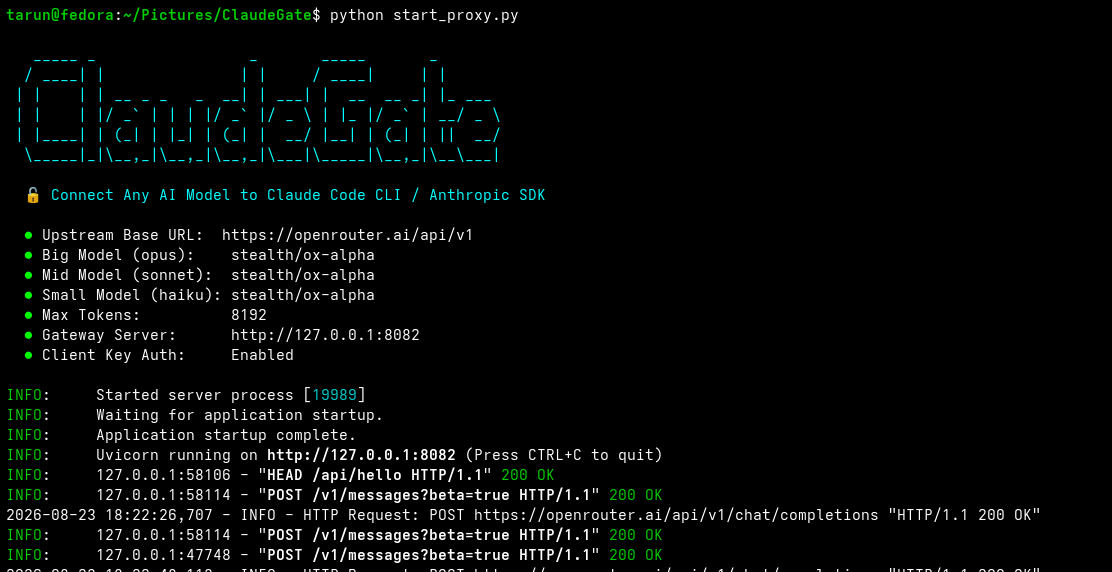
|
🤖 Claude Code CLI in Action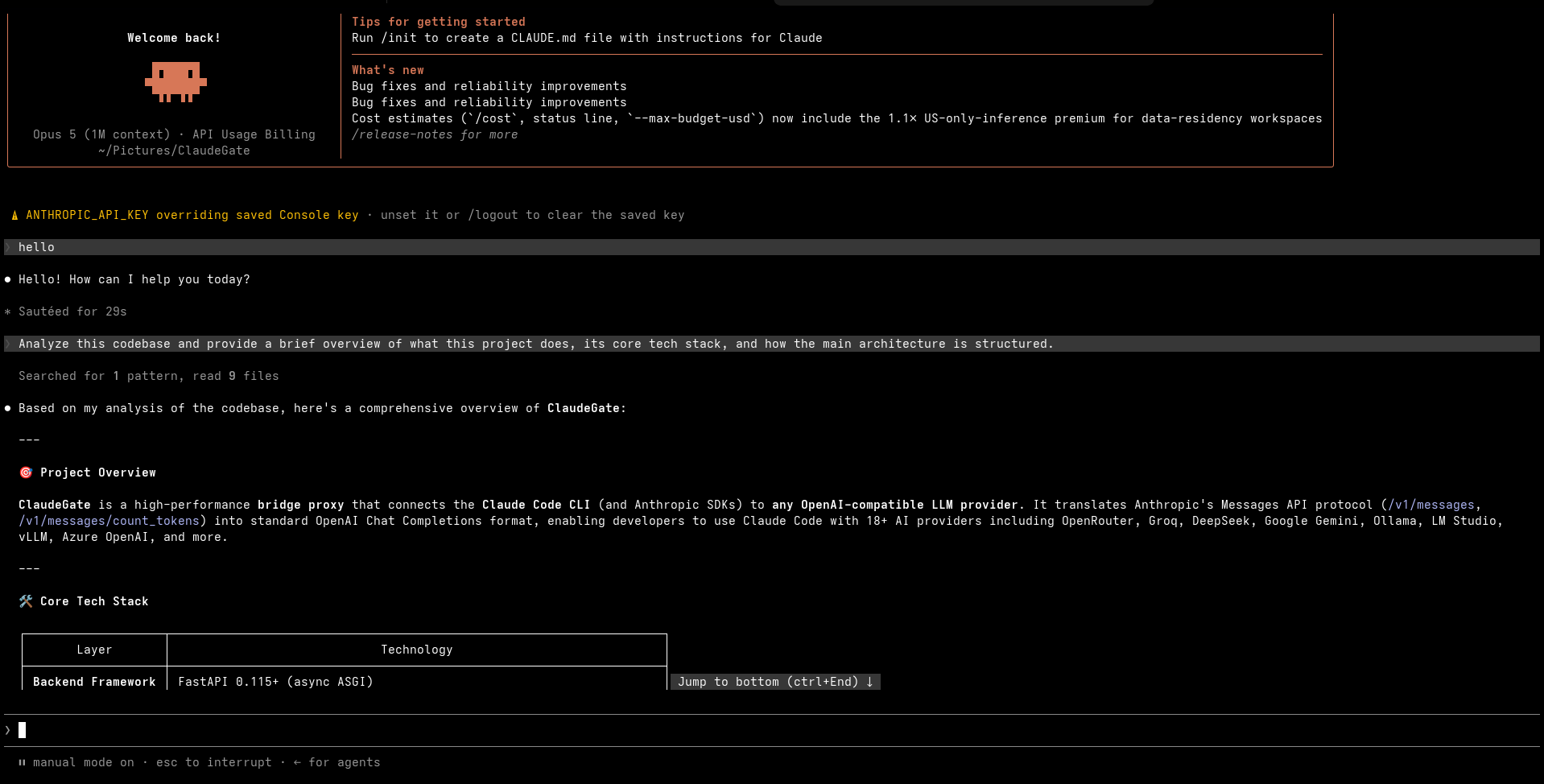
|
✨ 3. Features
- ⚡ Zero-Crash SSE Streaming: Translates raw OpenAI chunk streams into Anthropic Server-Sent Events (
content_block_start,content_block_delta,message_delta,message_stop). Mid-stream disconnects and upstream errors are caught gracefully without crashing Starlette/ASGI. - 🔄 Automatic Multi-Provider Failover: Seamlessly fails over from primary upstream to backup providers (e.g. OpenRouter $\rightarrow$ Groq $\rightarrow$ local Ollama) on transient
503,429, or timeout errors without dropping the active client session. - 🛡️ PII & Secret Sanitizer: Intercepts outgoing prompts and automatically scrubs AWS keys, GitHub PATs, OpenAI tokens, and SSH private keys before requests leave your computer (
SANITIZE_SECRETS=true). - 🛠️ Full Bi-directional Tool / Function Calling: Seamlessly translates Claude Code file-system operations, terminal commands, and search tools into OpenAI function calls and vice versa.
- 🧹 Chain-of-Thought /
<thinking>Sanitizer: Cleanses internal reasoning tokens and<thinking>blocks from conversation history so multi-turn reasoning models (like DeepSeek R1/V4) never trigger400 Bad Requesterrors on follow-up turns. - ⏳ Extended 10-Minute Keep-Alive: Tuned TCP socket lifespan (
timeout_keep_alive=600) to prevent Node.jsECONNRESETdrops during prolonged user typing pauses. - 🎛️ Universal CLI Tooling: Interactive setup wizard (
--setup), live connectivity diagnostic (--test), and 24+ instant preset switches (--preset <name>). - 🐳 Docker & Compose Ready: Run as a standalone daemon container with health-check monitoring.
🛠️ 4. Tech Stack
- Backend Framework: FastAPI (High-performance async ASGI web framework)
- ASGI Server: Uvicorn (Configured with custom socket keep-alives and signal handling)
- Data Validation & Schemas: Pydantic v2 (Strict type serialization for Anthropic & OpenAI payloads)
- HTTP Clients: httpx & openai-python (Async connection pooling and streaming response parsing)
- Security & Crypto: Python
hmac(Constant-time token authentication) and Regex Token Redaction Engine - Containerization: Docker & Docker Compose (Multi-stage Python slim base image)
🏗️ 5. Architecture
ClaudeGate sits transparently between Claude Code CLI and your chosen AI model provider:
flowchart LR
    A["Claude Code CLI\nor Anthropic SDK"] -- "POST /v1/messages\n(Anthropic Schema)" --> B["ClaudeGate Gateway\n(FastAPI / Port 8082)"]

    subgraph CoreEngine ["ClaudeGate Core Engine"]
        B --> C["Constant-Time Auth & IP Validator"]
        C --> D["Request Sanitizer\n(PII & Credential Redaction)"]
        D --> E["Protocol Converter\n(Tools, Messages, System Prompts)"]
        E --> F["Upstream Client & Failover Controller"]
    end

    subgraph Upstream ["Upstream AI Providers"]
        F -- "Primary Request" --> G["Primary Provider\n(OpenRouter / DeepSeek / Gemini)"]
        F -. "Auto Failover on 503/429" .-> H["Backup Provider\n(Groq / Local Ollama)"]
    end

    G -- "OpenAI Chunk Stream" --> I["SSE Stream Adapter\n(Zero-Crash Generator)"]
    H -- "OpenAI Chunk Stream" --> I
    I -- "Anthropic SSE Events" --> A
📁 6. Project Structure
ClaudeGate/
├── assets/                    # Visual assets and screenshots
│   ├── ClaudeGate.png         # Project Banner & Logo
│   ├── claude_terminal_ss.png # Claude Code CLI in action
│   └── proxy_terminal.png     # ClaudeGate terminal proxy log
├── Dockerfile                 # Container image specification
├── docker-compose.yml         # Container service configuration
├── requirements.txt           # Python package dependencies
├── pyproject.toml             # Modern package build configuration
├── setup.py                   # Legacy pip install compatibility
├── start_proxy.py             # CLI & Server launcher script
├── .env.example               # Comprehensive environment template
├── LICENSE                    # MIT License
├── SECURITY.md                # Security policy & reporting guidelines
├── CODE_OF_CONDUCT.md         # Community standard of conduct
├── CONTRIBUTING.md            # Contribution guidelines
├── CHANGELOG.md               # Version release history
├── README.md                  # Project documentation
│
├── presets/                   # Ready-to-use provider templates
│   ├── openrouter.env         # OpenRouter (Claude Opus 5, Sonnet 5, Haiku 4.5)
│   ├── groq.env               # Groq (DeepSeek V4-Pro, Llama 4 Maverick, Muse Glimmer)
│   ├── ollama.env             # Ollama (100% Local DeepSeek V4-Pro, Qwen3.6-35B, Muse Glimmer)
│   ├── deepseek.env           # DeepSeek (DeepSeek V4-Pro & V4-Flash)
│   ├── gemini.env             # Google Gemini (Gemini 3.1 Pro, 3.7 Flash & 3.5 Flash-Lite)
│   ├── openai.env             # OpenAI Official (GPT-5.6 Sol, GPT-5.6 Terra, GPT-5.6 Luna)
│   ├── kimi.env               # Moonshot AI (Kimi K3 2.8T Reasoning & K2.7 Code)
│   ├── qwen.env               # Alibaba Qwen / DashScope (Qwen3.8-Max, Qwen3.7-Plus, Qwen3.8-27B)
│   ├── mistral.env            # Mistral AI (Mistral Large 3, Mistral Medium 3.5, Mistral Small 4)
│   ├── perplexity.env         # Perplexity (Sonar Reasoning Pro, Sonar Pro & Sonar)
│   ├── cohere.env             # Cohere (Command A+, Command A & Command R7B)
│   ├── minimax.env            # MiniMax (MiniMax M3 Frontier & MiniMax M2.7)
│   ├── meta.env               # Meta AI (Muse Spark 1.2, Llama 4 Maverick, Muse Glimmer)
│   ├── zai.env                # Z.ai / Zhipu GLM (GLM-5.3 Flagship, GLM-5-Turbo, GLM-4.7-Flash)
│   ├── together.env           # Together AI (DeepSeek V4-Pro, DeepSeek V4-Flash, Qwen3.8-27B)
│   ├── fireworks.env          # Fireworks AI (DeepSeek V4-Pro, DeepSeek V4-Flash, Qwen3.8-27B)
│   ├── cerebras.env           # Cerebras (DeepSeek V4-Pro, Llama 4 Maverick, Muse Glimmer)
│   ├── sambanova.env          # SambaNova Cloud (DeepSeek V4-Pro, Llama 4 Maverick, Qwen3.8-27B)
│   ├── siliconflow.env        # SiliconFlow (DeepSeek V4-Pro, DeepSeek V4-Flash, Qwen3.8-27B)
│   ├── lmstudio.env           # LM Studio Desktop (DeepSeek V4-Pro & Muse Glimmer)
│   ├── vllm.env               # vLLM Self-Hosted GPU (DeepSeek V4-Pro & Qwen3.6-35B)
│   ├── azure.env              # Azure OpenAI Service (o1 & GPT-5.6 Enterprise Deployments)
│   ├── kiro.env               # AWS Amazon Q Developer / Claude Opus 5 Bridge
│   ├── ox.env                 # Stealth Ox Alpha (Frontier Reasoning Model)
│   └── nemotron.env           # Nvidia Nemotron Free Tier
│
├── scripts/                   # Verification & test utilities
│   ├── verify_failover.py     # Automated failover simulation runner
│   └── test_live_nemotron_ox.py # Live dual-model probe (Nemotron & Ox Alpha)
│
└── src/                       # Source code
    ├── main.py                # FastAPI app & Uvicorn lifecycle
    ├── cli.py                 # CLI commands, setup wizard & test runner
    ├── api/
    │   └── endpoints.py       # /v1/messages, /health & /count_tokens routes
    ├── conversion/
    │   ├── request_converter.py   # Anthropic -> OpenAI message & tool parsing
    │   └── response_converter.py  # OpenAI stream -> Anthropic SSE translation
    ├── core/
    │   ├── client.py          # Async client with failover & retry logic
    │   ├── config.py          # Dynamic environment loader & constant-time auth
    │   ├── constants.py       # Anthropic & OpenAI protocol constants
    │   ├── logging.py         # Structured logging configuration
    │   └── model_manager.py   # Intelligent model tier & slug router
    ├── models/
    │   ├── claude.py          # Pydantic schemas for Anthropic API
    │   └── openai.py          # Pydantic schemas for OpenAI API
    └── security/
        └── sanitizer.py       # Secret, AWS key, and PAT redaction engine
⚙️ 7. Installation and Setup
Step 1: Clone Repository & Create Environment
git clone https://github.com/Santosh-Prasad-Verma/ClaudeGate.git
cd ClaudeGate

python3 -m venv .venv
source .venv/bin/activate
pip install -r requirements.txt
Step 2: Configure Your Upstream Provider
Launch the interactive configuration wizard:
python start_proxy.py --setup
Or load a ready-made preset directly:
python start_proxy.py --preset openrouter
Step 3: Configure Claude Code CLI
You can configure Claude Code CLI to communicate with ClaudeGate using either Permanent or Session-Based configuration:
Option A: Permanent Configuration (Recommended)
Edit (or create) ~/.claude/settings.json to automatically route all future claude commands to ClaudeGate:
{
  "env": {
    "ANTHROPIC_BASE_URL": "http://127.0.0.1:8082",
    "ANTHROPIC_API_KEY": "sk-claudegate-local"
  }
}
Option B: Session-Based (Current Terminal Only)
Export the variables in your active shell before launching Claude:
export ANTHROPIC_BASE_URL="http://127.0.0.1:8082"
export ANTHROPIC_API_KEY="sk-claudegate-local"
Step 4: ✅ Verify It's Running
Run the built-in diagnostic test to verify your upstream provider connection and measure latency:
python start_proxy.py --test
Expected Output:
🔍 Testing upstream connection...
   Provider Base URL: https://openrouter.ai/api/v1
   Test Model:        stealth/ox-alpha
✅ Connection Successful! Model is active and responsive.
   Status: 200 OK
You can also probe the gateway health endpoint directly from your terminal:
curl http://127.0.0.1:8082/health
# {"status":"healthy","service":"claudegate"}
🚀 8. Usage & User Flow
🧭 End-to-End User Flow (How It Works in Practice)
Once setup is complete, your day-to-day workflow looks like this:
┌─────────────────────────────────────────────────────────────────────────────┐
│  TERMINAL 1: Start ClaudeGate Gateway Daemon                                │
│  $ cd ClaudeGate && python start_proxy.py                                   │
│  [Gateway listening on http://127.0.0.1:8082 (OpenRouter/Groq/Ollama)]       │
└──────────────────────────────────────┬──────────────────────────────────────┘
                                       │ (Translates Anthropic ⟷ OpenAI protocol)
                                       ▼
┌─────────────────────────────────────────────────────────────────────────────┐
│  TERMINAL 2: Your Codebase Workspace (Run Claude Code)                       │
│  $ cd /path/to/my-project                                                   │
│  $ claude                                                                   │
│                                                                             │
│  > "Add JWT authentication to src/auth.py and run the unit tests"           │
│                                                                             │
│  Claude Code ──────► ClaudeGate (8082) ──────► DeepSeek R1 / Qwen / Groq    │
│  (CLI Tool Calls)   (Translates schemas)       (Executes inference & tools) │
│  ◄────────────────── (Streams SSE Events) ◄──────────────────────────────── │
│                                                                             │
│  ✅ Claude Code automatically reads files, writes code, and runs bash tests! │
└─────────────────────────────────────────────────────────────────────────────┘
Step-by-Step Daily Execution:
Start the Gateway (Terminal 1):
cd ClaudeGate
python start_proxy.py
ClaudeGate will boot up, display active model mappings, and listen on
http://127.0.0.1:8082.Open Your Coding Project (Terminal 2):
Navigate to whatever software project or repo you want to work on:cd ~/my-flutter-app # or any project directoryLaunch Claude Code:
claudeYou can now type natural language instructions as usual. Claude Code will execute file inspections, bash commands, multi-file edits, and git commits powered entirely by your chosen backend model!
Switching Models On The Fly:
Want to swap from free cloud models (OpenRouter) to 100% private offline models (Ollama)?
In Terminal 1:python start_proxy.py --preset ollama python start_proxy.pyClaude Code in Terminal 2 will immediately begin routing through local Ollama without needing a restart.
💻 CLI Utilities & Commands
| Command | Purpose |
|---|---|
python start_proxy.py |
Start the ClaudeGate server |
python start_proxy.py --test |
Run live connectivity probe & measure upstream latency |
python start_proxy.py --setup |
Launch interactive 24-provider setup wizard |
python start_proxy.py --preset <name> |
Quick-load a preset (e.g. groq, gemini, ollama, deepseek) |
python start_proxy.py --help |
View help and available options |
python start_proxy.py --version |
Display current release version |
🐳 Running with Docker
If you prefer to run ClaudeGate as a background Docker container:
# Build and start container in the background
docker compose up -d --build

# View real-time logs
docker compose logs -f

# Check container health status
docker ps

# Stop container
docker compose down
🧪 9. Testing & Diagnostics
ClaudeGate includes built-in live diagnostics and automated test suites:
1. Upstream Connectivity & Latency Probe
Test your active model and measure upstream response latency:
python start_proxy.py --test
Output:
🔍 Testing upstream connection...
   Provider Base URL: https://openrouter.ai/api/v1
   Test Model:        stealth/ox-alpha
✅ Connection Successful! Model is active and responsive.
   Status: 200 OK
2. Multi-Provider Fallback Verification
Simulate an upstream outage to test automatic failover:
python scripts/verify_failover.py
3. Automated Pytest Suite
Run the full test suite covering non-streaming failover, SSE streaming, and endpoint security:
pytest tests/ -v
🔒 10. Security & Privacy Safeguards
ClaudeGate implements defense-in-depth privacy controls to ensure secure self-hosting:
- Localhost-Only Default (
127.0.0.1): Restricts incoming traffic exclusively to the local machine. - Constant-Time Authentication: Uses Python's
hmac.compare_digestto validatex-api-keyheaders, preventing side-channel timing analysis. - Secret & PII Redaction Engine: When
SANITIZE_SECRETS="true", prompts are automatically scrubbed for sensitive tokens (GitHub PATs, AWS Access Keys, OpenAI Keys, Private SSH keys) before reaching upstream providers. - Vulnerability Reporting: For responsible disclosure, please refer to our Security Policy.
💡 11. Engineering Decisions
Error Markers over Generator Exceptions:
- Problem: In Starlette / FastAPI, raising
HTTPExceptioninside an activeStreamingResponseasync generator after HTTP headers (200 OK) are flushed causes a fatalRuntimeError: response already startedand terminates the ASGI worker. - Decision: ClaudeGate's generator yields formatted
ERROR::<status>::<message>tokens that the SSE converter catches and translates into standard Anthropic error events, keeping the worker process healthy.
- Problem: In Starlette / FastAPI, raising
Multi-Turn
<thinking>Cleansing:- Problem: Reasoning models (like DeepSeek R1) output reasoning tokens. When Claude Code sends subsequent conversation turns containing these blocks in history, standard OpenAI endpoints reject the payload with
400 Bad Request. - Decision: The
request_converterautomatically identifies and filtersthinkingandredacted_thinkingcontent blocks before dispatching to upstream providers.
- Problem: Reasoning models (like DeepSeek R1) output reasoning tokens. When Claude Code sends subsequent conversation turns containing these blocks in history, standard OpenAI endpoints reject the payload with
Constant-Time Client Authentication:
- Problem: Standard string comparisons (
key == expected) are susceptible to side-channel timing attacks. - Decision: Implemented
hmac.compare_digestacross all header validation points.
- Problem: Standard string comparisons (
10-Minute TCP Keep-Alive (
timeout_keep_alive=600):- Problem: Node.js HTTP agents in Claude Code CLI drop connections with
ECONNRESETif an interactive user takes longer than 5 seconds between prompts. - Decision: Configured explicit keep-alive headers and Uvicorn socket timeouts to support extended interactive developer pauses.
- Problem: Node.js HTTP agents in Claude Code CLI drop connections with
🔮 12. Limitations and Future Improvements
Current Limitations
- Image Input Format: Multimodal image support currently converts Base64 images directly; URLs require public accessibility.
- Provider-Specific Parameters: Non-standard hyperparameters outside temperature and top_p are passed as standard OpenAI extensions.
Roadmap & Future Improvements
- Real-Time Web Dashboard: Built-in visual UI (
http://127.0.0.1:8082/dashboard) for live latency charts, token velocity, and cost tracking. - Prompt Cache & SQLite Deduplication: In-memory and SQLite KV caching for repetitive codebase index prompts.
- Dynamic Complexity Router: Automatic classification of task difficulty (e.g. routing simple edits to Groq and complex architectural refactors to DeepSeek R1).
- Unix Domain Sockets (UDS): Zero-network communication option over
/run/user/$UID/claudegate.sock.
🤝 13. Contributing & Code of Conduct
We welcome bug fixes, documentation improvements, new provider presets, and feature additions!
- Contributing Guide: Check out CONTRIBUTING.md for local environment setup and PR workflows.
- Code of Conduct: This project follows the Contributor Covenant v2.1.
- Adding Presets: To contribute a new preset, add
presets/<provider_name>.envand submit a pull request!
📄 14. License
Distributed under the MIT License. See LICENSE for more information.
Built with ❤️ for the open-source & AI developer community.
Empowering developers to run Claude Code with any model, anywhere, completely unrestricted.
⭐ If you find ClaudeGate useful, consider giving it a star on GitHub! ⭐
Reviews (0)
Sign in to leave a review.
Leave a reviewNo results found