databricks-document-intelligence-agent
Health Uyari
- License — License: MIT
- Description — Repository has a description
- Active repo — Last push 0 days ago
- Low visibility — Only 5 GitHub stars
Code Gecti
- Code scan — Scanned 12 files during light audit, no dangerous patterns found
Permissions Gecti
- Permissions — No dangerous permissions requested
This tool is a reference implementation for a Databricks-native document intelligence agent. It parses PDF documents, extracts structured data, and serves cited answers using Mosaic AI Vector Search.
Security Assessment
The tool does not request dangerous local permissions and a static code scan of 12 files found no malicious patterns or hardcoded secrets. However, because it is an agent designed to natively process documents and manage enterprise data within Databricks, it inherently accesses sensitive information. As a Shell-based project, it relies heavily on local CLI commands to deploy pipelines, vector search endpoints, and Databricks apps. While the local repository code appears safe, overall risk is rated Medium because the tool's deployment configuration will dictate the exact access controls, identity management, and network requests made to your Databricks workspace.
Quality Assessment
The project is highly active, with its most recent push occurring today. It is released under the permissive MIT license and includes excellent documentation, detailing everything from design and runbooks to explicit security (OBO, grants) and production readiness guidelines. The only drawback is its low community visibility, currently sitting at only 5 GitHub stars. Consequently, community trust and validation are minimal, so users must rely on their own testing rather than established community adoption.
Verdict
Use with caution — the local repository code is safe and well-documented, but low community adoption means you should carefully review the workspace permissions and identity configurations before deploying this agent against sensitive enterprise data.
Reference implementation of a Databricks-native document intelligence agent with cited answers.
Databricks Document Intelligence Agent




A Databricks-native reference implementation for document intelligence agents. It parses PDFs with Databricks AI Functions, extracts structured KPIs into governed Delta tables, indexes high-quality document summaries with Mosaic AI Vector Search, and serves cited answers through Agent Bricks and Databricks Apps.
The demo corpus is synthetic SEC 10-K filings, but the pattern applies to other enterprise document sets such as contracts, invoices, research reports, and regulatory filings.
PDFs in UC volume
      |
      v
Lakeflow pipeline: parse -> classify/extract -> quality score
      |
      +--> Gold KPI tables
      |
      +--> Vector Search index
               |
               v
Agent Bricks Knowledge Assistant + Supervisor Agent
               |
               v
Databricks App with citations, feedback, and Lakebase history
Where To Read
| Need | Doc |
|---|---|
| Architecture and Agent Bricks design | docs/design.md |
| Setup, deploy, operations, troubleshooting | docs/runbook.md |
| Validation commands and latest workspace evidence | VALIDATION.md |
| Production readiness gates | PRODUCTION_READINESS.md |
| Identity, OBO, grants, and secrets | SECURITY.md |
| Streamlit app local development | app/README.md |
What This Builds
- Lakeflow Spark Declarative Pipeline over raw PDF filings.
- Gold tables for parsed sections, structured KPIs, and quality scoring.
- Mosaic AI Vector Search Delta-Sync index over high-quality section summaries.
- Agent Bricks Knowledge Assistant grounded in the Vector Search index.
- Agent Bricks Supervisor Agent with Knowledge Assistant and UC SQL KPI tools.
- Streamlit Databricks App with citation chips, thumbs feedback, and Lakebase Postgres persistence.
- MLflow CLEARS eval gate for correctness, latency, execution, adherence, relevance, and safety.
The Agent Bricks code artifact is agent/document_intelligence_agent.py. It creates or updates the Knowledge Assistant, UC SQL function, Supervisor Agent, and serving-endpoint permissions.
Prerequisites
- Python 3.11 or 3.12.
- Databricks CLI >= 0.298.
- A Databricks workspace with Serverless SQL, Unity Catalog, Document Intelligence AI Functions, Mosaic AI Vector Search, Agent Bricks, Databricks Apps, Lakebase, and Lakehouse Monitoring enabled.
- A serverless SQL warehouse ID.
For production identity, Databricks Apps user token passthrough must be enabled. Demo can run with App service-principal fallback; prod must use OBO. See SECURITY.md.
Quickstart
Install local dependencies:
python -m venv .venv
.venv/bin/pip install -r agent/requirements.txt -r evals/requirements.txt pytest
Find a serverless warehouse:
databricks warehouses list
Validate the bundle:
databricks bundle validate --strict -t demo
Bring up a demo workspace:
DOCINTEL_CATALOG=workspace \
DOCINTEL_SCHEMA=docintel_10k_demo \
DOCINTEL_WAREHOUSE_ID=<warehouse-id> \
./scripts/bootstrap-demo.sh
Run the eval gate:
DOCINTEL_CATALOG=workspace DOCINTEL_SCHEMA=docintel_10k_demo \
.venv/bin/python evals/clears_eval.py \
  --endpoint "$(./scripts/resolve-agent-endpoint.sh demo)" \
  --dataset evals/dataset.jsonl
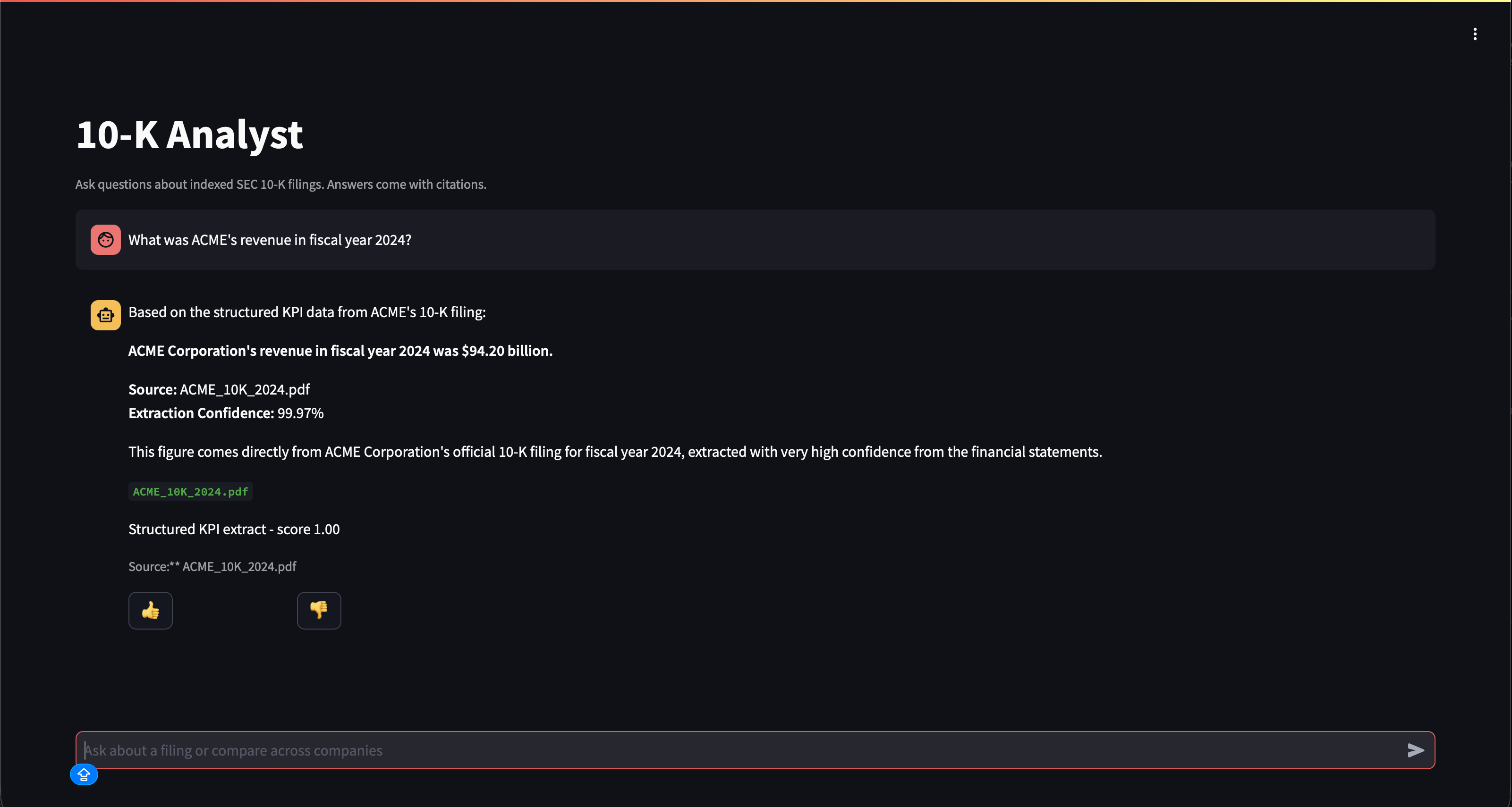
Open Apps -> doc-intel-analyst-demo in the Databricks workspace and ask:
What was ACME's revenue in fiscal year 2024?
Example deployed Databricks App validation:
Common Commands
# Unit tests
.venv/bin/python -m pytest agent/tests/ -q

# Static checks
bash -n scripts/bootstrap-demo.sh
.venv/bin/python -m py_compile \
  agent/document_intelligence_agent.py agent/tools.py \
  app/app.py app/agent_bricks_client.py app/agent_bricks_response.py app/lakebase_client.py \
  evals/clears_eval.py scripts/wait_for_kpis.py samples/synthesize.py

# Deploy app/config changes after first bring-up
AGENT_ENDPOINT_NAME="$(./scripts/resolve-agent-endpoint.sh demo)"
databricks bundle deploy -t demo --var "agent_endpoint_name=${AGENT_ENDPOINT_NAME}"
databricks bundle run -t demo --var "agent_endpoint_name=${AGENT_ENDPOINT_NAME}" analyst_app

# Apply Agent Bricks definition changes
DOCINTEL_CATALOG=workspace \
DOCINTEL_SCHEMA=docintel_10k_demo \
DOCINTEL_WAREHOUSE_ID=<warehouse-id> \
python -m agent.document_intelligence_agent --target demo
More deploy paths and failure handling live in docs/runbook.md.
Repo Layout
databricks/
├── databricks.yml                 # Bundle root: variables and demo/prod targets
├── pipelines/sql/                 # Bronze, Silver, Gold Lakeflow SQL
├── agent/                         # Agent Bricks definition and tool glue
├── app/                           # Streamlit Databricks App and Lakebase client
├── evals/                         # CLEARS dataset and MLflow eval runner
├── jobs/                          # Retention and Vector Search index refresh jobs
├── resources/foundation/          # DAB resources without data dependencies
├── resources/consumers/           # App, jobs, monitors, dashboards
├── scripts/                       # Bootstrap and workspace helper scripts
├── samples/                       # Regenerable synthetic 10-K PDFs
├── specs/001-doc-intel-10k/       # Spec-Kit artifacts
└── docs/                          # Design and runbook
Current Status
Latest demo evidence is tracked in VALIDATION.md. Readiness gates are tracked in PRODUCTION_READINESS.md.
License
Released under the MIT License.
Yorumlar (0)
Yorum birakmak icin giris yap.
Yorum birakSonuc bulunamadi