OctoShell
Health Uyari
- License — License: MIT
- Description — Repository has a description
- Active repo — Last push 0 days ago
- Low visibility — Only 5 GitHub stars
Code Basarisiz
- process.env — Environment variable access in scripts/check-local-models.mjs
- network request — Outbound network request in scripts/check-local-models.mjs
- spawnSync — Synchronous process spawning in scripts/install-local.mjs
- process.env — Environment variable access in scripts/install-local.mjs
- exec() — Shell command execution in scripts/release-notes.mjs
Permissions Gecti
- Permissions — No dangerous permissions requested
Bu listing icin henuz AI raporu yok.
A desktop workspace for running coding agents on Windows and macOS. Each task gets its own git worktree, terminal and dev server, and you watch every agent from one window.
🐙 OctoShell



A desktop workspace for running coding agents, on Windows and macOS.
You give it a task. It creates a Git worktree, starts an agent in it, and shows you what the agent is doing while it does it. Several can run at once, in different repositories, without touching each other's files.
Built with Tauri v2 and Rust, with a React and TypeScript frontend and xterm.js for the terminals.
Download the latest release · Site
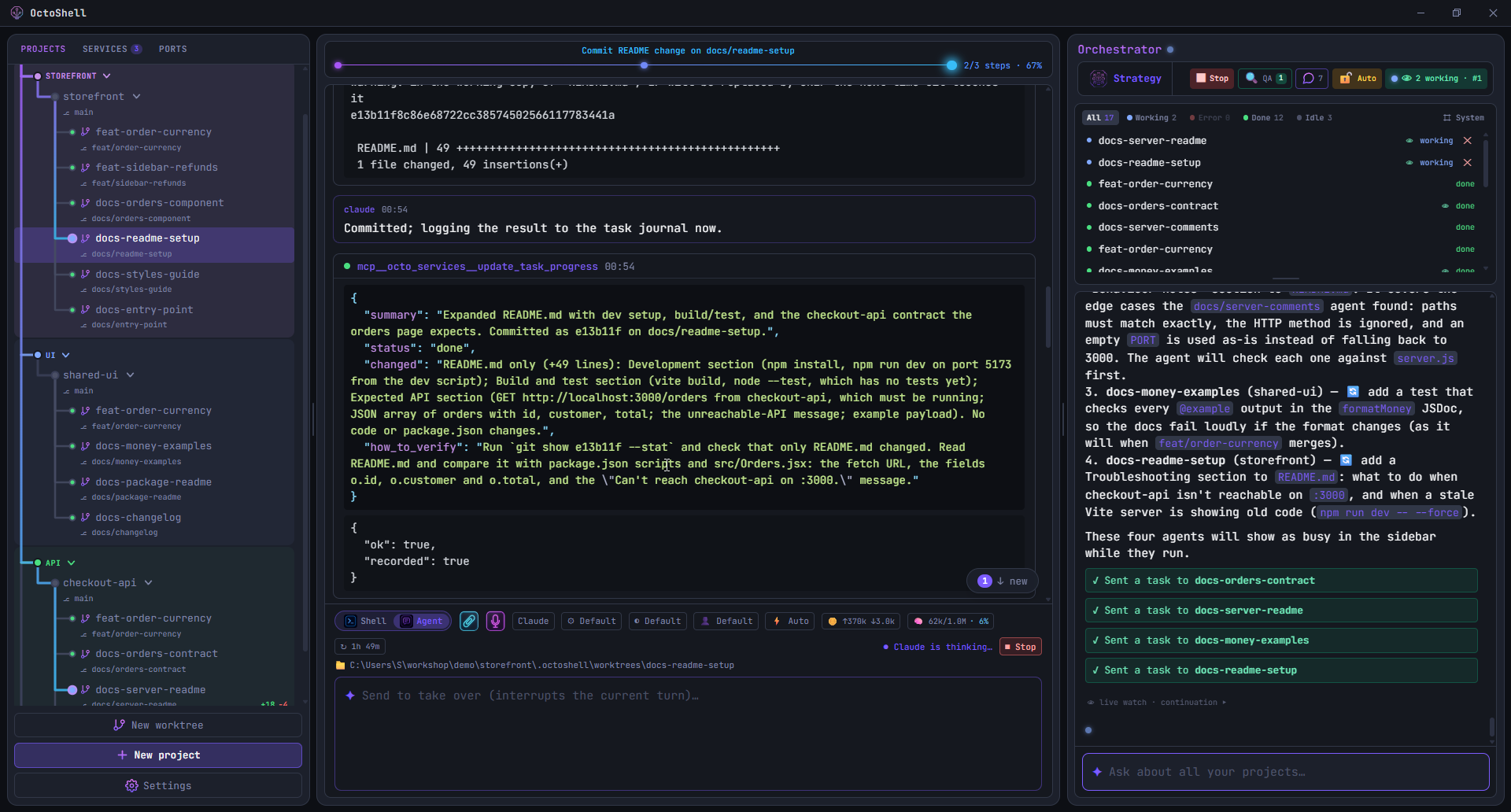
One task, start to finish
The parts below are not separate features bolted together. They are one loop, and this is what a single task looks like going through it.
- You type a goal, or hand over a plan from Strategy Mode. The orchestrator turns it into tasks and shows you what it intends to dispatch.
- You confirm. It creates a git worktree per task and starts an agent in each one. Related tasks are linked when they are dispatched, so an agent can ask what the others changed.
- The agent writes down its steps before it starts. That list is the bar above its output, so you can see where it is without reading the log.
- It needs the app running, so it asks OctoShell rather than running the server itself. The server gets a port, a log and a row in the list, marked with which agent asked for it.
- It finishes, commits on its own branch, and records what it changed and how to verify it.
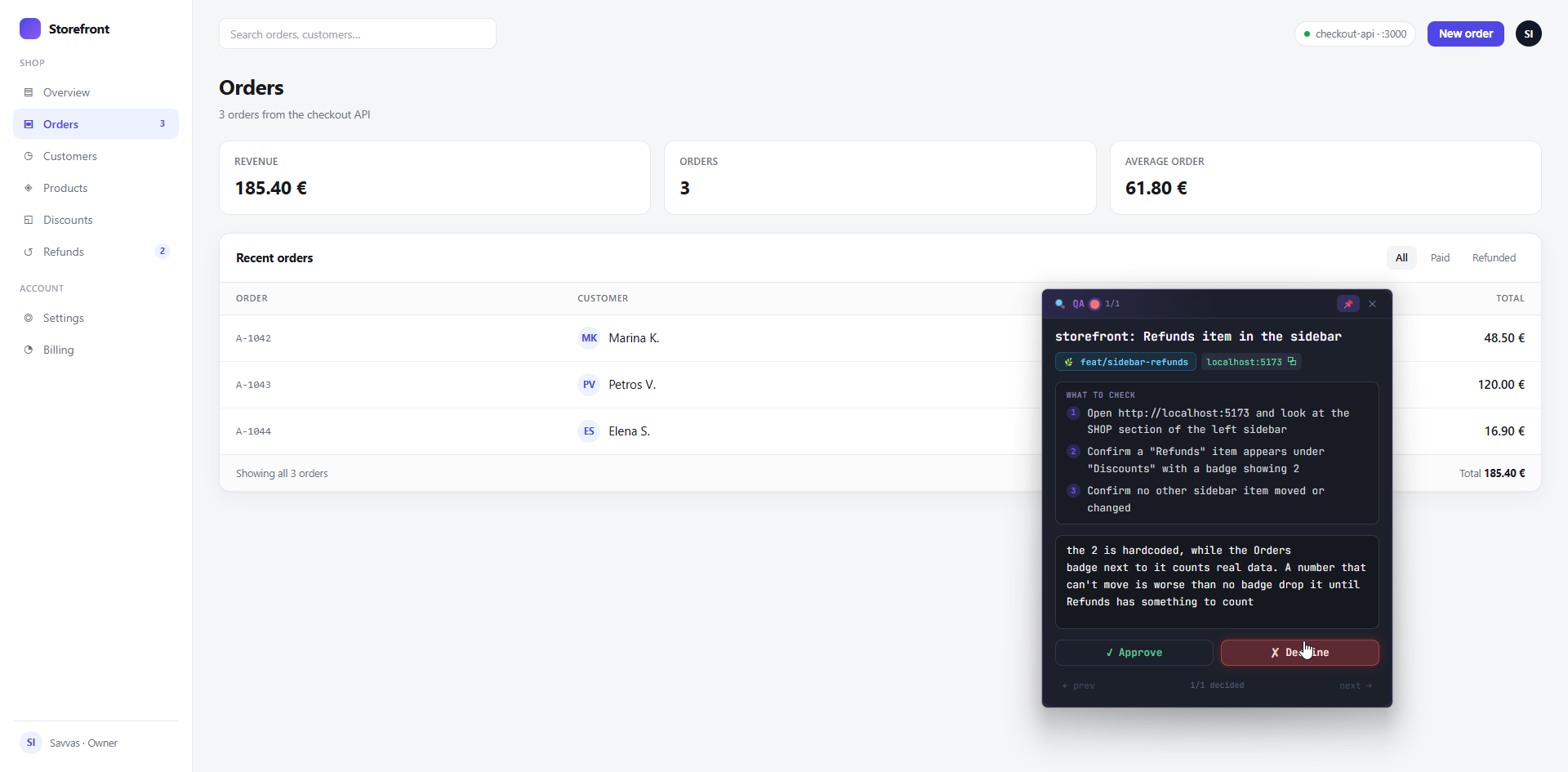
- QA mode opens the dev server for that branch and shows the checklist the agent wrote, in a window over the running app. You try the change yourself.
- You decline with a note. The note goes back to that agent as its next task, and the loop continues from step 3.
Nothing in that sequence needs you to switch branches, find a free port, or explain to one agent what another one did.
What it does
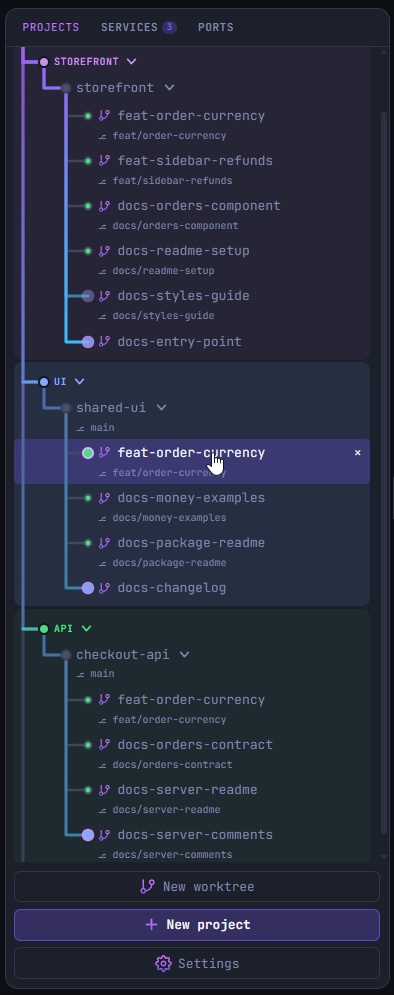
One worktree per task. Each agent gets its own worktree and branch, so two agents working at the same time never touch the same files. Your own checkout stays where you left it, with no branch switching and no stashing.
An orchestrator that dispatches. Type a goal, or hand it a plan. It turns that into tasks, creates a worktree for each, starts an agent, and reports back as they finish. Nothing is dispatched until you confirm it, unless you turn that off.
Agents that can see related work. When tasks are connected, the orchestrator says so when it dispatches them. An agent can then read what the others changed and what they declared, which is how a frontend agent learns that the API it calls is about to return a new field.
Strategy Mode. For a change worth arguing about first, several agents discuss it in roles such as Architect, Backend, QA and Security, reading the projects you attach as context. You moderate round by round. The result is one report with the goal, the architecture, the decisions, the rejected alternatives, the risks, the open questions, the steps and the acceptance criteria, which you can save, export or execute.
QA mode. When an agent finishes something you can see, OctoShell starts that worktree's dev server and puts a small window over your browser with the checklist the agent wrote for its change. You try it yourself, then approve or decline with a note, and the note goes back to that agent as its next task. Past passes stay in a list.
Managed dev servers and ports. Agents do not start servers on their own; they ask OctoShell, which starts the server, keeps its log, and lists it next to the ones you started with a note of who asked. Starting one on a port that is taken replaces what was there instead of quietly moving elsewhere. The Ports panel shows what is listening and can kill it.
A terminal made of command blocks. Output is a feed of self contained blocks with exact boundaries and exit codes, read from OSC 133 shell integration in Rust rather than guessed from the prompt. Works the same in PowerShell, zsh and bash.
A step list per agent. An agent writes down its steps before it starts, through a tool OctoShell gives it, and ticks them off as it goes, so you can see where it is without reading the whole log.
Smart PR button. Drives a branch through create, check, update and merge, with the agent resolving review comments on update. Needs an authenticated gh CLI.
Docker sandbox, if you want it. An ACP agent can run inside a throwaway container with --cap-drop=ALL, memory and pid limits, and only its worktree mounted.
Your phone, when you are away from the desk. Share the workspace for a chosen length of time to read what agents are doing and answer an approval. Nothing is reachable until you press Start, the access code expires by itself, and letting the phone start new work is a separate switch.
Which agents. Claude Code and Gemini CLI directly, plus any agent that speaks the Agent Client Protocol: Codex, OpenCode, Cursor, Copilot, Kiro. Provider, model and approval mode are set per project. Local models through Ollama.
Screenshots
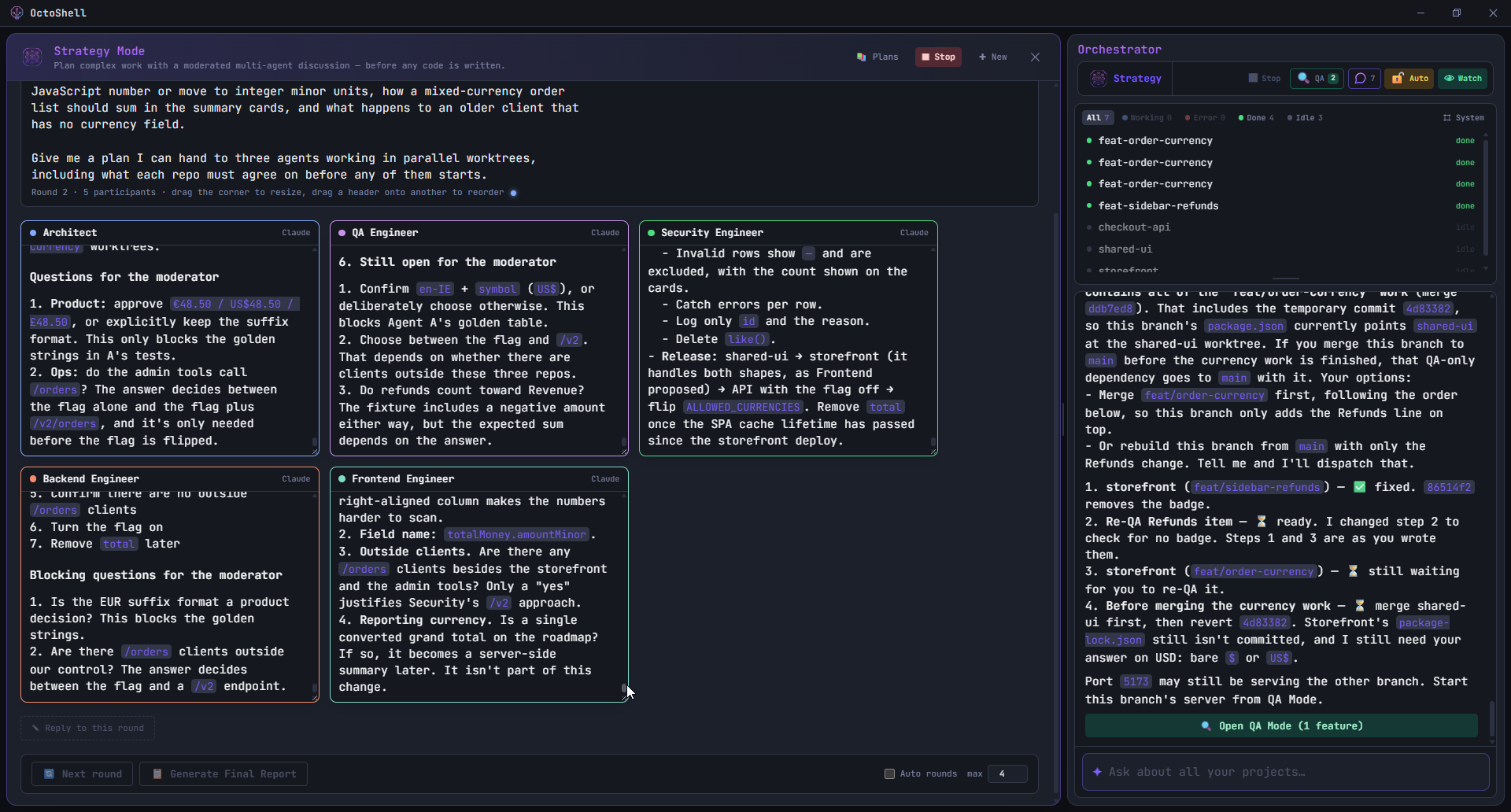 Strategy Mode. Agents argue a change in roles before any code is written, and you moderate each round. |
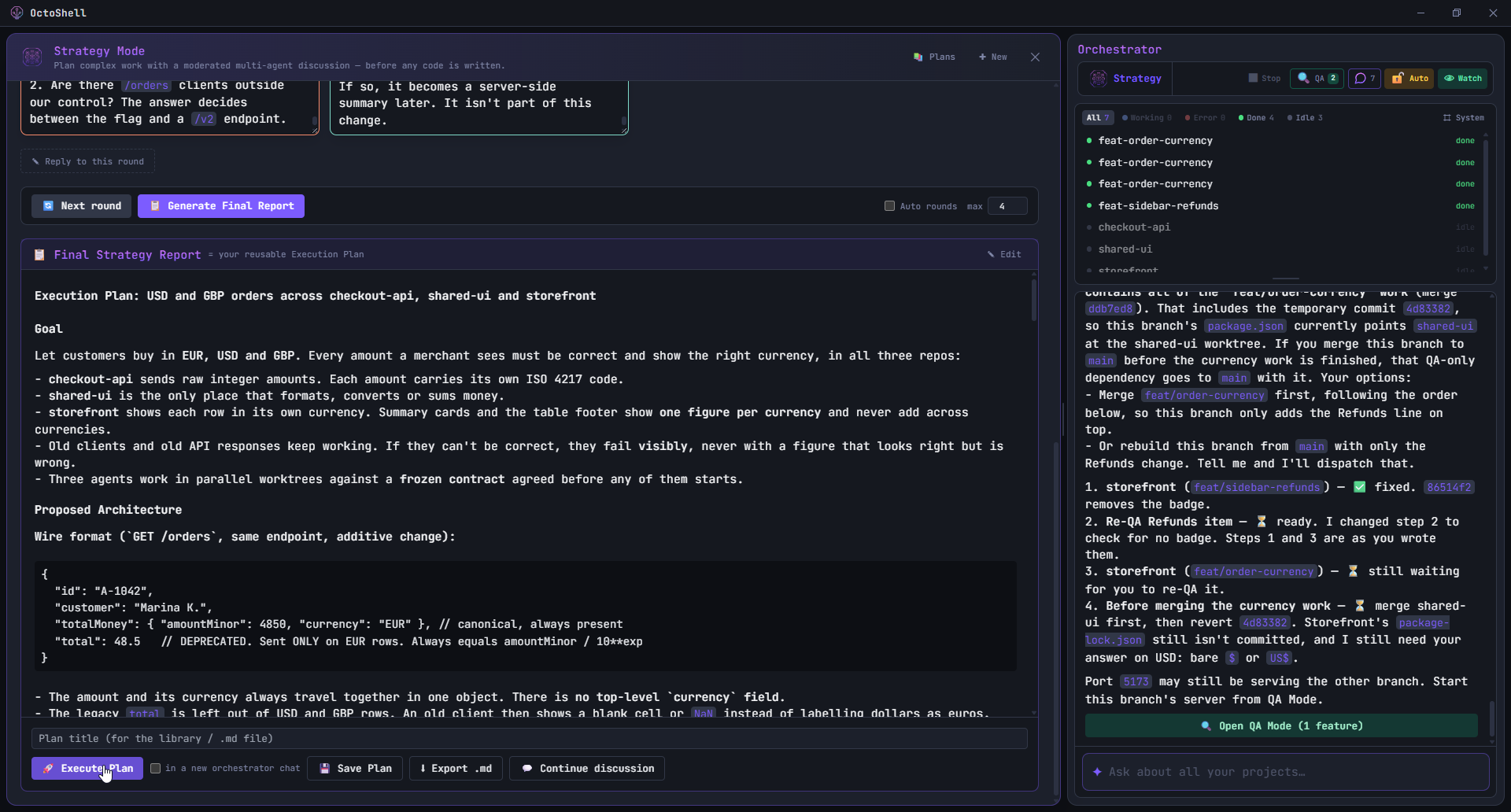 The plan it produces. Goal, architecture, decisions, rejected alternatives, risks, steps, acceptance criteria. Save it, export it or execute it. |
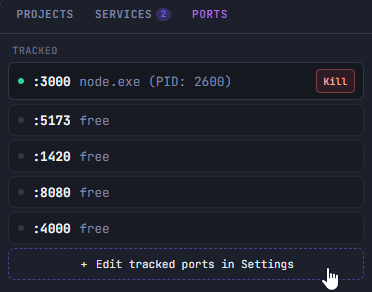 Ports and dev servers. What is listening, which agent asked for it, and a way to kill it. |
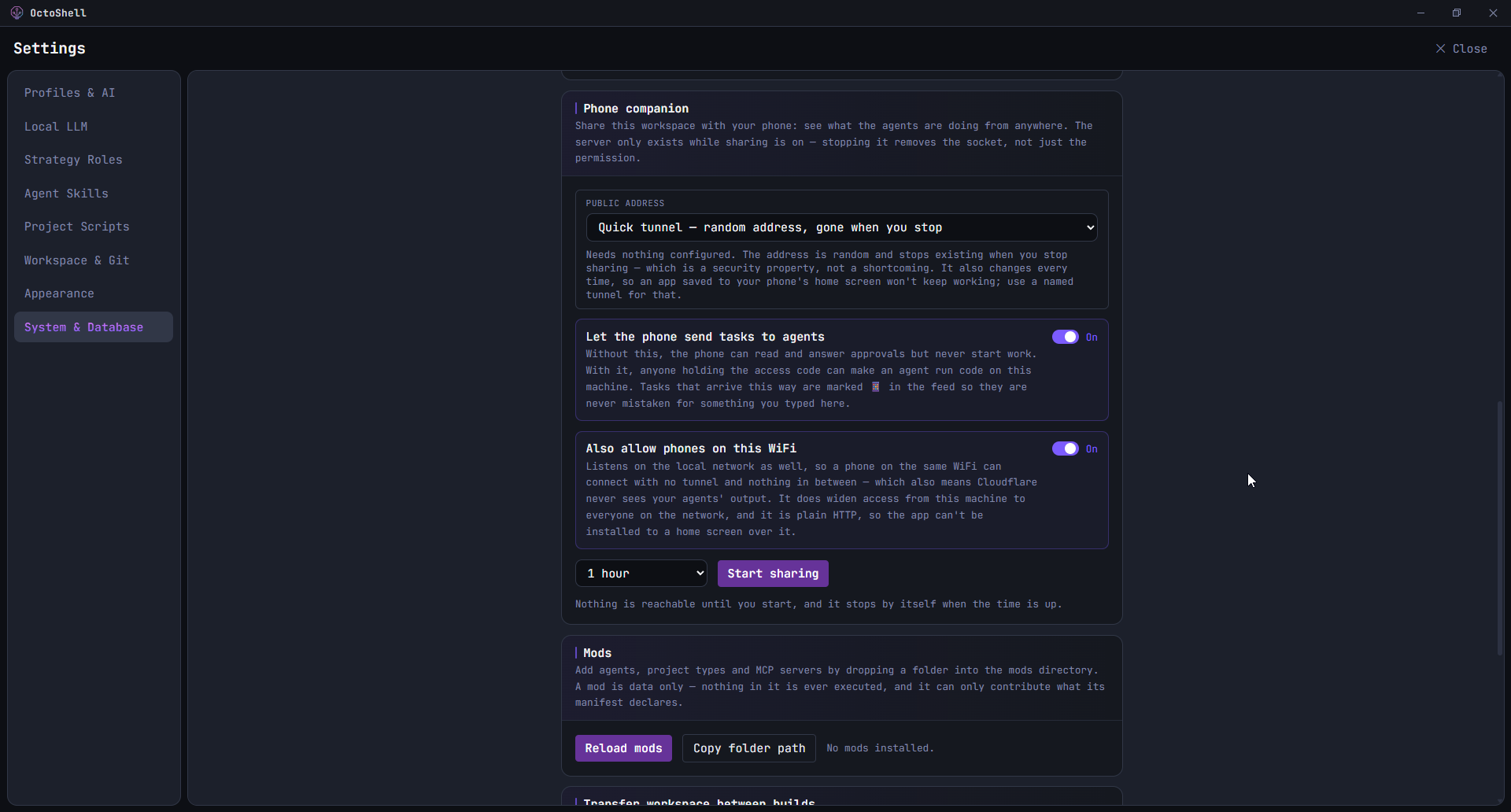 From your phone. Read what agents are doing and answer an approval while you are away from the desk. |
What it is not
Worth knowing before you install it:
- Windows first, and that is the point. This was built because nothing like it existed for Windows. macOS came later, because a second developer wanted it, ported it himself and now tests it on Apple Silicon. Linux is not planned. There is no Intel Mac build either, because ONNX Runtime ships no prebuilt binary for that target.
- A desktop app, not a server. There is no
npxcommand and no Docker deployment that serves a web UI to your team. It runs on your machine, on your repositories. - No issue tracker. There is no Kanban board and no ticket system. Work starts from what you type or from a saved plan.
- Not private from your model provider. OctoShell has no server, no account and no telemetry, and your files stay local. But an agent has to send code to its provider to work on it, exactly as it would from that provider's own CLI. Ollama is the exception.
- Not code signed yet. Windows SmartScreen and macOS Gatekeeper both warn on first launch. The release notes say which click gets past each one.
- Young. Expect rough edges and read the security section below before turning approvals off.
Coming from Vibe Kanban
Vibe Kanban is sunsetting, and it covered a lot of the same ground. What maps across:
| Vibe Kanban | OctoShell |
|---|---|
| Workspace per task with a branch, terminal and dev server | Git worktree per task, with its own terminal and managed dev server |
| Review diffs and send feedback to the agent from the UI | QA mode: the agent's checklist over the running app, decline with a note that becomes its next task |
| Built in browser preview | Your own browser, with the QA window floating over it |
| Open a PR and merge | Smart PR button: create, check, update, merge |
| Claude Code, Codex, Gemini CLI, Copilot, Cursor, Amp | Claude Code and Gemini CLI directly, the rest over ACP |
What you would lose: the Kanban board, the web UI, Docker self hosting, and Linux. What you would gain: worktrees and terminals that are actually native, agents that can read each other's declared changes, and a planning mode before any code is written.
Prerequisites
Windows
- Windows 10 or 11 with PowerShell 7 (
pwsh) - Tauri prerequisites: WebView2 and the MSVC build tools
macOS
- macOS 12 or later on Apple Silicon, with Xcode Command Line Tools (
xcode-select --install) - The terminal runs your login shell, zsh or bash;
pwshworks too if you have it
Both
- Node.js 18+, Rust 1.85+
- For agents: Claude Code (
claude) or Gemini CLI on PATH, or any ACP agent CLI - Optional:
ghCLI for the PR button, Docker Desktop for the sandbox,cloudflaredfor the phone companion over the internet
Setup and run
# Windows
npm install
# Optional: $env:ANTHROPIC_API_KEY = "sk-ant-..."
# Without a key, agents and the orchestrator use your local `claude` CLI login.
npm run tauri dev
# macOS
npm install
# Optional: export ANTHROPIC_API_KEY="sk-ant-..."
npm run tauri dev
Release build: npm run tauri build. Windows produces an NSIS installer and an MSI, macOS a .app and a .dmg, under src-tauri/target/release/bundle/.
Windows SmartScreen: unsigned builds trigger "Windows protected your PC". Click More info, then Run anyway.
macOS Gatekeeper: an unsigned app is blocked on first launch. Open System Settings → Privacy & Security, scroll to Security, and click Open Anyway. From a terminal,
xattr -dr com.apple.quarantine /Applications/OctoShell.appdoes the same in one step.
macOS notes
- Shell integration for zsh and bash. The same OSC 133 markers PowerShell emits on Windows are injected into zsh (through a
ZDOTDIRshim that sources your own.zshrcfirst) and bash (through--rcfile), so command blocks, exit codes and cwd tracking work identically. Your prompt, aliases and plugins are untouched. - PATH. An app launched from Finder normally gets a bare PATH. OctoShell adopts your login shell's PATH at startup, so Homebrew, nvm and
~/.local/bintools are found as they are in Terminal. - Tab completion is served natively, commands on PATH plus file paths, rather than by a PowerShell runspace.
- Process cleanup. Windows ties every child to a Job Object; on macOS each dev server and agent runs in its own process group, so stopping one ends its whole tree and a clean exit sweeps them all.
- Shortcuts use ⌘ rather than Ctrl: ⌘T new project, ⌘W close, ⌘1 to ⌘9 switch, ⌘⇧K clear. Ctrl+C in the input still interrupts.
- Worktree dependency copies use APFS clones (
cp -c), so copying a largenode_modulesinto a new worktree is instant.
How the platform layer is organised, and how to add a shell or an OS: docs/platforms.md.
Architecture, short version
Frontend (React/Vite)                          Backend (Rust)
─────────────────────                          ──────────────
InputBar ──submit──► ShellController ──write──► pty.rs    PtyManager (pwsh / zsh / bash + OSC 133 injection)
   Feed ◄── snapshot ─────┤◄── pty://events ──            SemanticParser (command boundaries/exit codes)
AiSidebar ──ai_chat──────────────────────────► ai.rs      orchestrator (Anthropic API or claude CLI)
ShellController ──agent_send/acp_send────────► agent.rs   claude/gemini stream-json
                                               acp.rs     any ACP agent (JSON-RPC over stdio)
serviceStore ──service_start─────────────────► service.rs managed dev servers (port alloc, log stream)
                                               docker.rs  sandbox containers (bollard)
Every child process is tied to a kill-on-close Windows Job Object, or to a per-child process group on macOS (jobctl.rs, platform.rs), so closing OctoShell never orphans a shell, an agent or a dev server.
Security posture, read this
- Agents ask before each Bash, Edit and Write call by default. Turning that off, per project or for new agents in Settings, runs them with
--dangerously-skip-permissions, which is faster and lets an agent execute any command in that project without asking. That is a reasonable trade inside a worktree you are willing to lose, and it should be your decision rather than an installer's. - Orchestrator actions are confirm-per-click unless you enable Auto. A session spend limit in Settings halts everything when it is hit.
- The Docker sandbox isolates the host from agent commands. It does not protect the worktree itself and does not prevent network exfiltration: the mounted worktree is read-write and networking is on, because installs need it.
- Macros never run by themselves. They put a command in the input for you to approve.
Where your data lives
Everything stays on your machine. There is no account and no server of ours.
On Windows:
%APPDATA%\com.octoshell.appholdsoctoshell.db, the SQLite database with your projects, sessions, QA passes and saved plans, plusmods/,push.jsonandtimezone.txt.%LOCALAPPDATA%\com.octoshell.app\EBWebViewis WebView2's own folder. Your settings, profiles and per-session preferences live in its local storage, not in the database.
On macOS both sit under ~/Library/Application Support/com.octoshell.app.
To back up your work, copy octoshell.db. To wipe OctoShell completely, uninstall it and delete both folders. Worktrees are not in there: they are real directories wherever you created them, and removing a worktree in the app asks before it deletes the folder.
Agent credentials are not ours either. Claude Code and the ACP adapters keep their own logins in their own locations, and API keys you set are read from the environment.
What CI runs
Every pull request is built on windows-latest and macos-latest: npm ci, npm run build, then npm run tauri build -- --no-bundle. cargo clippy --all-targets runs on both but does not block, because 20 warnings are still outstanding; it will become a gate once they are cleared. Release builds are a separate workflow, triggered by a version tag, and they produce the signed installers and the updater manifest.
Note that macos-latest is Apple Silicon, so nothing here would catch an Intel-only failure. That is one reason there is no Intel build.
Contributing
See CONTRIBUTING.md. Good places to start: ACP agent definitions in src/agents/providers.ts, service detection patterns, translations.
License
Yorumlar (0)
Yorum birakmak icin giris yap.
Yorum birakSonuc bulunamadi