middleman
Health Gecti
- License — License: Apache-2.0
- Description — Repository has a description
- Active repo — Last push 0 days ago
- Community trust — 153 GitHub stars
Code Basarisiz
- execSync — Synchronous shell command execution in apps/backend/src/build-hash.ts
- process.env — Environment variable access in apps/backend/src/build-hash.ts
- process.env — Environment variable access in apps/backend/src/config.ts
- process.env — Environment variable access in apps/backend/src/index.ts
Permissions Gecti
- Permissions — No dangerous permissions requested
This tool is a local-first, multi-agent orchestration platform. It acts as an automated project manager that dispatches and coordinates multiple AI coding agents to handle software development tasks in parallel.
Security Assessment
The tool requires you to provide your own OpenAI or Anthropic API keys, which are accessed and stored via environment variables. This means you must secure your local environment to prevent accidental key leakage. A notable security finding is the use of synchronous shell command execution (`execSync`) within the backend codebase. While this is common in local orchestration tools that spawn worker agents and manage git worktrees, hardcoded or unchecked command execution always warrants caution. There are no hardcoded secrets detected, and the tool does not request explicitly dangerous overarching permissions. Because it routes prompts to external AI APIs and spawns local processes, the overall risk is rated as Medium.
Quality Assessment
The project has a solid foundation with an active community, evidenced by 153 GitHub stars. It is under active development, with the most recent push occurring today. The code is legally safe to use and contribute to, as it is protected under the standard Apache-2.0 license. However, users should be aware that the project is explicitly labeled as a pre-v1 experimental release, meaning breaking changes should be expected during future updates.
Verdict
Use with caution: the project is active and well-structured, but its experimental nature, reliance on your API keys, and local shell execution require standard security awareness.
The middle manager for your agents
👔 Middleman
A local-first multi-agent orchestration platform. One manager, many workers, zero tab-juggling.
[!WARNING]
Middleman is pre-v1, experimental, and updated constantly. Expect breaking changes.
If you're using agentic coding tools, you've probably hit this wall: you start with one agent, then two, then five. You're branching, worktree-ing, reviewing, merging, context-switching. The agents are cranking out code. But your entire day is spent managing them, sequencing work, checking output, nudging things along.
You're not an IC anymore. You've become a project manager. You need a middle manager.
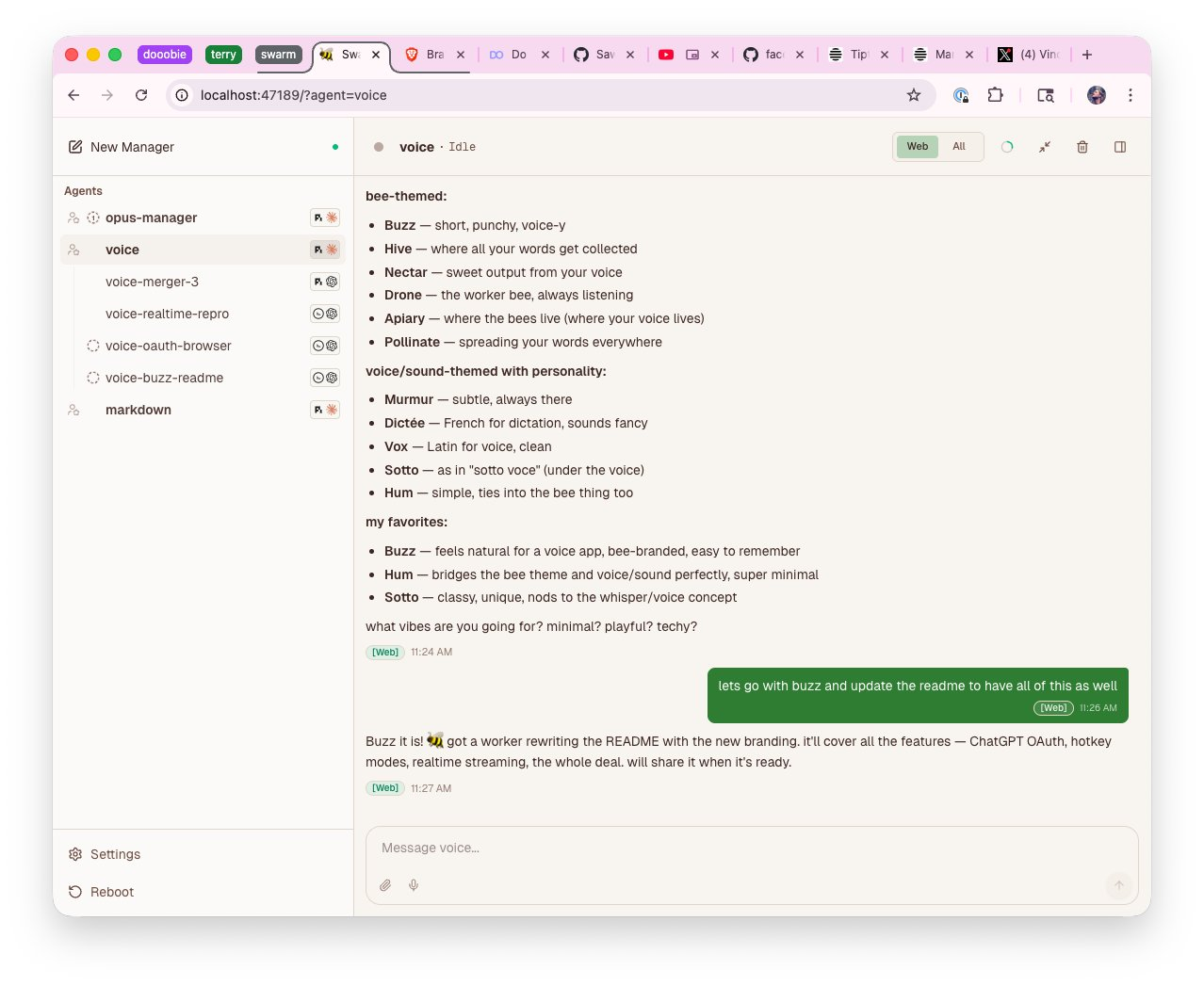
Middleman gives you one. You talk to a single persistent manager agent per project. You describe what needs to be done, whether it's a feature, a batch of bug fixes, or a refactor, and the manager dispatches workers, parallelizes where it makes sense, and surfaces only the things that need your attention.
Quick Start
npx middleman-app
That's it. Open http://localhost:47187, go to Settings, sign in with your OpenAI or Anthropic key, create a new manager, and start talking.
Development
git clone https://github.com/SawyerHood/middleman.git
cd middleman
pnpm i
pnpm dev
# http://127.0.0.1:47187
Key Features
- Persistent managers. Onboard once, work for days. Managers remember your preferences, workflow, and project context across sessions via compacting memory.
- Worker dispatch. The manager spawns workers (Codex, Pi/Opus, etc.) and routes messages between them. You describe work at a high level; it handles the breakdown.
- Parallel execution. Dump a list of tasks and the manager figures out what can run concurrently.
- Dashboard. A Conductor-style UI for watching agents work, chatting with your manager, and managing settings.
- Skills & automation. Built-in skills for web search, image generation, browser automation, cron scheduling, and more. Extensible via the pi skill system.
Architecture
Middleman is three things running on your machine:
┌─────────────────────────────────────────────┐
│  Dashboard UI (TanStack + Vite SPA)         │
│  Chat, agent status, settings, artifacts    │
└──────────────────┬──────────────────────────┘
                   │ WebSocket
┌──────────────────▼──────────────────────────┐
│  Backend Daemon (Node.js)                   │
│  HTTP + WS server, agent orchestration,     │
│  message routing, persistence, scheduler    │
└──────────────────┬──────────────────────────┘
                   │ spawns & messages
┌──────────────────▼──────────────────────────┐
│  Agents (pi / Codex)                        │
│  Manager → Workers → Merger                 │
│  Each in its own worktree                   │
└─────────────────────────────────────────────┘
apps/backendis the daemon. HTTP + WebSocket server, swarm orchestration runtime, persistence, and scheduler.apps/uiis the dashboard. Real-time agent monitoring, chat interface, and settings management.- The manager agent is built on pi, is event-driven, and never blocks. Always ready for the next message.
How It Works in Practice
- Create a manager for your project from the dashboard.
- Onboard it by chatting. Tell it your preferred workflow, what tools to use, how you want work sequenced.
- Dump tasks on it. A feature spec, a list of bugs, a vague idea.
- The manager spawns workers, assigns tasks, and orchestrates execution in parallel where possible.
- You review when you want, or let it roll.
A Note
This is a vibecoded project. It's here to inspire, not to be a polished product. Fork it, tear it apart, or use it as a starting point to build your own middle manager.
License
Apache-2.0
Yorumlar (0)
Yorum birakmak icin giris yap.
Yorum birakSonuc bulunamadi