clawker
Health Gecti
- License — License: MIT
- Description — Repository has a description
- Active repo — Last push 0 days ago
- Community trust — 14 GitHub stars
Code Gecti
- Code scan — Scanned 12 files during light audit, no dangerous patterns found
Permissions Gecti
- Permissions — No dangerous permissions requested
This tool is a CLI designed to orchestrate, monitor, and automate portable Docker containers for Claude Code agents. It allows users to securely run autonomous AI agents without needing to grant them dangerous system-level permissions directly.
Security Assessment
Overall risk: Medium. The primary function of this tool is to build and manage Docker containers, which inherently requires executing local shell commands and interacting with the host system. The tool specifically accommodates running Claude Code with `--dangerously-skip-permissions` inside an isolated environment, relying entirely on Docker to prevent the agent from accessing sensitive data on the host machine. The automated code scan passed with no dangerous patterns or hardcoded secrets found. However, because container escape vulnerabilities are possible if Docker is misconfigured, the tool's security relies heavily on the user maintaining a proper host setup.
Quality Assessment
The project is highly active, with its most recent code push happening today. It is open-source under the standard MIT license and has garnered 14 GitHub stars, indicating early but growing community interest. The README is comprehensive, detailing features, installation instructions, and explicitly outlining the project's threat model and security philosophy. The developer is transparent about the project being in an early stage with potential rough edges, but actively encourages feedback and quickly patches bugs.
Verdict
Use with caution — it is a well-documented and actively maintained orchestration tool, but its reliance on local Docker containers to safely sandbox autonomous AI agents requires a solid understanding of your host machine's security boundaries.
Claude Code agent-in-container orchestration and automation
Clawker: Claude Code agent-in-container orchestration and automation







clawker is a cli for orchestrating, monitoring, and automating portable devcontainers for Claude Code agents. It works on any MacOS/Linux host with docker installed. I wrote this because I didn't want to have to pay someone to run claude code agents with --dangerously-skip-permissions when containers have been around for a decade, and claude code's sandbox mode is the temu version of a container. clawker offers many convenience features beyond just building and running claude code in a container using a Dockerfile (you don't even have to write a Dockerfile it's got you covered).
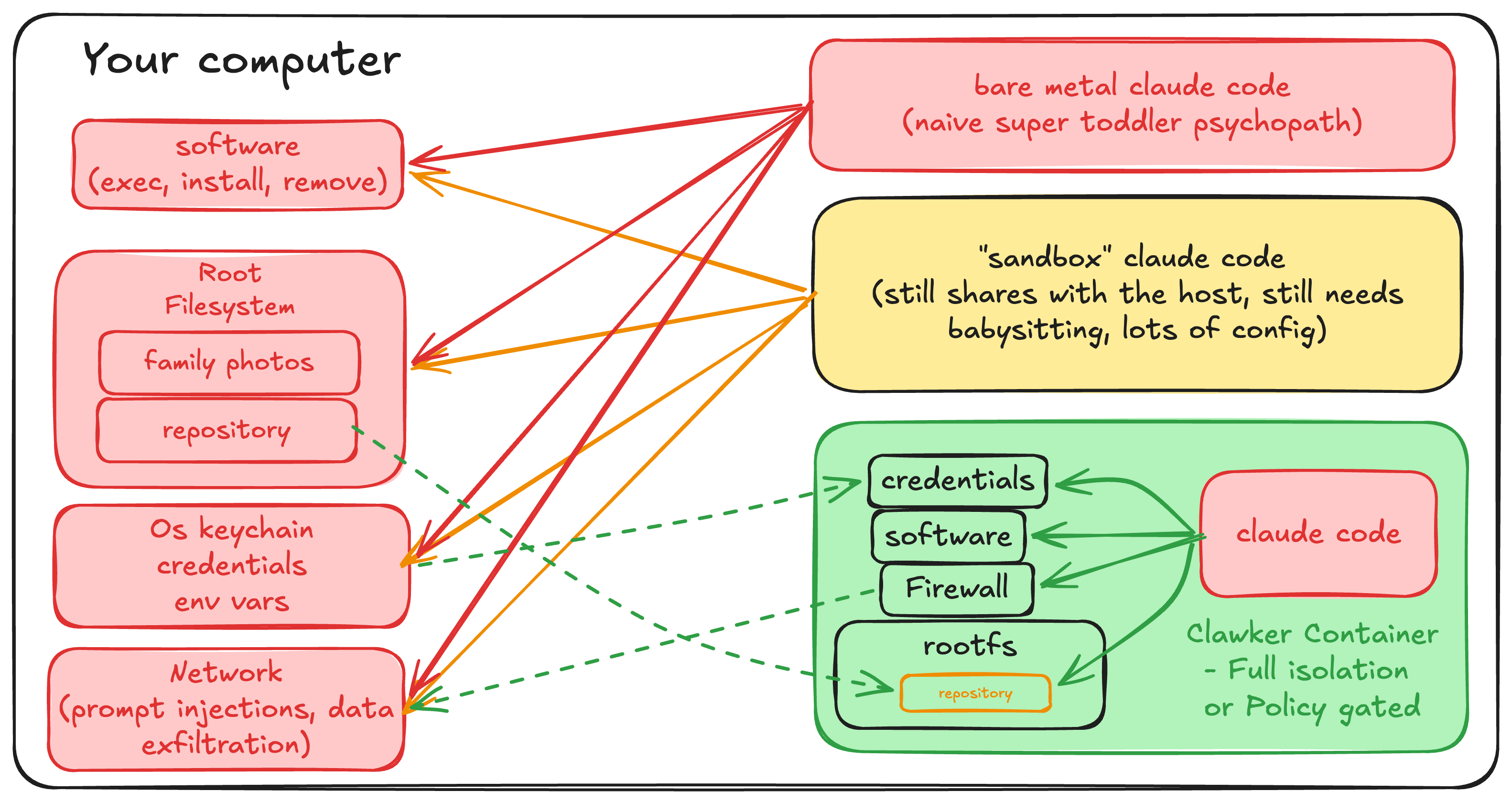
Read more about clawker's threat model and security philosophy at docs.clawker.dev/threat-model
! Clawker is in an early development stage, but it's usable and has a lot of features. Expect breaking changes and rough edges. I quickly patch regressions that were missed. If you want to contribute or have any feedback, please open an issue or a pull request! Give it a star if you find it useful so I can brag about them at parties
Table of Contents
- Clawker: Claude Code agent-in-container orchestration and automation
Boring TLDR backstory The rise of Agentic AI has been meteoric, but in the rush to ship model harnesses, the industry is skipping the risks and responsibilities that come with them. They’re avoiding dependency pain by shipping bare-metal software, when the harness itself needs a harness. LLMs are powerful, but they’re also unpredictable, naive, and easy to coerce—and handing one unrestricted code execution, network access, software install rights, internet reach, and full filesystem access to unsuspecting users is reckless. As a security engineer, my first instinct was to protect my own machine by building the harness for the harness: an "agent-in-container" solution. Clawker started as my way to learn Claude Code, then proved useful enough to open source as a practical example of secure-by-default guardrails for agentic software. I hope this project inspires the industry to prioritize containerization natively in their agentic software offerings, and to build more tools that make it easy and seamless for users to run agents in containers with strong security defaults.
When I began experimenting with Claude Code to keep up with the Agentic AI trend, I was surprised by the total absence of local development container offerings for using it. Claude Code's sandbox mode is lackluster; the only other options for isolation and orchestration involve paid remote services, which seems silly to me—we've had containers for over a decade now. The Claude Code docs recommend using containers, but they only offer a devcontainer example, which is a step in the right direction but leaves you coupled to the IDE. The DIY approach results in managing multiple Claude Code Dockerfiles, maybe a container registry, per language stack/project, which also sucks, and there are a lot of internals that devcontainers offer that vanilla containers don't have. So I decided to build something that abstracts away all the complexity of creating, managing, automating, and running Claude Code in containers with Docker. It served as a good project to learn the ways of "Agentic Engineering" and "vibing" (exhausting btw, beware of some hilarious slop I've been cleaning up in this code base), but Clawker has become very useful for me, so I've decided to open source it for anyone yearning for a better local development container experience.
High-Level Feature Overview
- Embedded parameterized Dockerfile template inspired by the official devcontainer image, supporting Alpine or Debian base images with common tools preinstalled: git, curl, vim, zsh, ripgrep, etc. An entrypoint script that lets you bypass Claude Code or just pass flags as the default command, unprivileged
claudeuser, and more - Static Dockerfile generation if you desire a tangible Dockerfile to build and customize yourself (this repo was at first going to just be a docker image packaging repo for my private dockerhub lol so I kept this in here)
- Injectable build-time instructions to customize images per project: packages, environment variables, root run commands, user run commands, and more
- Bind or snapshot workspace modes: mount your repository to the container for live editing, or copy it at runtime for pure isolation
- Fresh or copy agent mode: start with a clean Claude Code install, or copy all your Claude Code settings, plugins, authentication, skills, etc. into the container at runtime for a seamless transition from doing work in a host instance to a container
- Seamless Git credential forwarding: toggleable SSH agent, GPG agent forwarding from the host using muxrpc (just like devcontainers) for zero-config access to private repositories and commit signing
- Host proxy service copies git ssh keys into the container and sends events like "browser open" from the container to your host for browser authentication, then proxies the callback back to the container. Great for when you have to authenticate with
claudeorgh - Configurable environment variables: set or copy environment variables and env files from the host into containers at runtime
- Injectable post-initialization bash script that runs after the container starts but before Claude Code launches, letting you set up MCPs, etc.
- Envoy+CoreDNS network firewall enabled by default — Envoy proxy and CoreDNS containers run as managed Docker containers on the shared clawker network, providing DNS-level deny-by-default (unlisted domains return NXDOMAIN) and TLS inspection with per-domain MITM certificates for path-level filtering. System-required rules (Claude API, Docker registry) are always present; project rules merge additively. Manage rules dynamically with
clawker firewall add/remove/list/status, temporarily bypass withclawker firewall bypass 5m --agent <agent_name>, or disable entirely. A great security layer to mitigate runaway agents or prompt injections while giving them the network access they need. - Toggleable read-only global share: volume mount from the host giving all containers real-time access to files you place in it
- Project-based namespace isolation of container resources. Clawker detects if it's in a project directory and automatically, via docker label prefixes, lets you filter for resources with re-usable names like "dev" or "main" that are scoped to the project. So you can have a "dev" container in multiple projects without conflict, and you can easily filter
clawker ps --filter agent=devto see all your dev containers across projects orclawker ps --project myappto see all containers for a specific project. - Dedicated Docker network that all containers run in
- Jailed from host Docker resources via
pkg/whail(whale jail), a standalone package that decorates the moby SDK to prevent callers from seeing resources without the automatically applied management labels. I might use this package in other "agent in container" solutions. So I don't have to worry about accidentally deleting non-clawker managed containers/volumes/images, etc. - Docker CLI-esque commands for managing containers, Clawker isn't a passthrough to Docker CLI; it uses the moby SDK (via
pkg/whail). This allowed me to add more flags, modify the behavior, etc over what docker cli offers - Git worktree management and commands: pass a worktree flag to container run or create commands to automatically create a git worktree in the Clawker home project directory and bind mount it to the container workdir. Also has cli commands and flags to list and manage worktrees created by clawker, uses
go-gitunder the hood to avoid relying on the host git binary - Optional monitoring stack with Prometheus, Loki, and Grafana to monitor agents and containers; every container has the environment variables needed to communicate with it
- Interactive configuration editing: TUI-based editors for project config (
clawker project edit) and user settings (clawker settings edit) with tabbed field browsing, per-field type-appropriate editors (text, boolean, list, multiline), layer-aware provenance display showing which file each value comes from, and per-field save targeting to choose which config layer to write to - Looping mode (experimental): pass a prompt, file, or task list to Clawker and it runs an autonomous loop with a fresh container each iteration with stagnation detection, circuit breaker protection, max loops, tracking container agent output, progress, costs, token usage, etc.
Installation
Prerequisites: Docker must be installed and running on your machine. I've tested all features on macOS. I have confirmed it works on Linux just not extensively. Windows is not currently supported but I might in the future (yucky).
Homebrew (macOS):
brew install schmitthub/tap/clawker
Install script (macOS / Linux):
curl -fsSL https://raw.githubusercontent.com/schmitthub/clawker/main/scripts/install.sh | bash
Specific version:
curl -fsSL https://raw.githubusercontent.com/schmitthub/clawker/main/scripts/install.sh | CLAWKER_VERSION=v0.1.3 bash
Custom directory:
curl -fsSL https://raw.githubusercontent.com/schmitthub/clawker/main/scripts/install.sh | CLAWKER_INSTALL_DIR=$HOME/.local/bin bash
Build from source (requires Go 1.25+):
git clone https://github.com/schmitthub/clawker.git
cd clawker && make clawker
export PATH="$PWD/bin:$PATH"
Quick Start
The fastest path to a seamless containerized Claude Code instance, with all your host settings, plugins, and creds copied in so you can get to work right away.
cd your-project
clawker init
clawker build
clawker run -it --rm --agent dev @ --dangerously-skip-permissions
You can ask claude code to assist you in writing a more appropriate config file for the project using this prompt:
create a @.clawker.yaml file appropriate for this repos stack. Clawker configuration can be understood here: https://docs.clawker.dev/configuration.md
This:
- Builds a project-scoped container image (
clawker-<project>:latest, with@as a shortcut when you are in the project directory), using the default Dockerfile template - Starts and attaches your terminal to the container (
clawker.<project>.dev) using that image (via the@identifier), with your current working directory bind-mounted (i.e., live share) - Copies your host Claude Code settings, plugins, authentication, skills, etc. for a seamless transition from host to container development.
The --rm flag removes the container when you exit, so it's perfect for quick tasks or experimentation.
If you want persistence, omit --rm and start the same container again later with clawker start -a -i --agent example.
You can also keep it running by detaching (Ctrl+P, Ctrl+Q) and reattach later with clawker attach --agent example to the same terminal session.
If you want to learn more about image customization, worktree support, loops, monitoring, and other bells and whistles, keep reading for the walkthrough below.
Walkthrough
Here are ways I'm using clawker today and how I'm finding it useful.
Initialize a project
cd your-project
clawker init            # Guided setup: pick a language preset → creates .clawker.yaml, .clawkerignore, registers project
clawker init walks you through a guided setup with language-based presets (Python, Go, Rust, TypeScript, Java, Ruby, C/C++, C#/.NET, Bare). Choose a preset or "Build from scratch" to customize every field. User settings (~/.config/clawker/settings.yaml) and XDG directories are bootstrapped automatically on first run.
Tip: Install the clawker-support plugin to get hands-on help from a clawker specialist agent. It can walk you through configuration, MCP wiring, firewall rules, troubleshooting, and more — it reads the real Dockerfile template and config schema and gives you the exact YAML you need.
# Via clawker CLI (recommended)
clawker skill install

# Or manually
claude plugin marketplace add schmitthub/claude-plugins
claude plugin install clawker-support@schmitthub-plugins
You can also customize your image using
clawker project editor point Claude Code at the LLM-friendly docs site for the full config reference. I dogfood clawker to build clawker, so also check out myclawker.yamlto see how I customized the build config for golang development.
Tip You can alternatively use
.clawker/clawker.yaml(which takes precedence). You can also split the configs up into multiple files through your repository for merging, good for monorepos. A global clawker.yaml can also be created in$CLAWKER_CONFIG_DIRfor system wide defaults. You can also create an uncomitted.clawker.local.yaml|.clawker/clawker.local.yamlfor local-only overrides.
clawker build # Builds your project's image (referenced as "@" when within a project directory)
Run a container
My workflow is a hybrid approach. I like having a claude code instance running on the host for real intensive interactive work while at the same time launching a few clawker managed containers in separate tabs and worktrees using --dangerously-skip-permissions.
So to do that let's say you're working on a feature branch with host claude code and inspiration strikes or you notice an issue / bug and say "shit i should address this". Or you've finished up a few PRDs and want to bang them out in parallel. I just quickly open a tab and have another claude agent via clawker get after it on the side without me having to approve anything over and over again so...
clawker run -it --rm --agent dev --worktree hotfix/example:main @ --dangerously-skip-permissions
This creates and attaches my terminal to a new claude instance isolated in a container environment with a git worktree dir created under ~/.local/share/clawker/worktrees/ (or honors the override $CLAWKER_DATA_DIR) off of my main branch. Since it has all my plugins, skills, auth tokens, git creds, mcps installed, build deps instantly, it's just a matter of telling the little rascal what to do and letting it go bananas and create a pr about it. I'll periodically check in on it to see how it's doing in another tab. Or you can detach ctrl p+q and return to your terminal; to reattach to the same session use clawker attach --agent dev. Ez pz no ssh/tmux bullshit, no vscode devcontainer window, no VPS with heavy IO latency, or setting up dedicated servers, or having to pay someone to do it for you.
I can see my worktree paths and open them in an IDE if I want to do some manual work or review the code... or never care about where they are, clawker remembers and auto mounts them using branches as an identifier. You can use clawker worktree commands to manage them, or git worktree.
$ clawker worktree list
BRANCH     PATH                                                                      HEAD     MODIFIED     STATUS
a/example  /Users/schmitthub/.local/share/clawker/worktrees/repo-project-uuidsha256  f20aa37  1 hour ago   healthy
When I'm done I easily remove the worktree
clawker worktree remove a/example --delete-branch # this deletes the worktree and the branch since it was only for this worktree, if you want to keep the branch just omit the flag. Delete won't work if the branch isn't fully merged
If I want to iterate over a prompt with a fresh containerized claude code each time (aka "ralph wiggum")
# Start a new autonomous loop; TUI tracks output, tool use, costs etc via Agent SDK streaming events
LOOP_PROMPT=$(cat <<'EOF'
Write a story in @docs/sadboy.md about a sad boy who struggles with context window
management, token costs, and genai hallucinations.

If the file doesn't exist, create it with:
- Title and table of contents with chapters "The Struggle" and "A Sad Conclusion"
- Author section (make up an author name for yourself and write a short bio about your tragic life inspired by artists like Edgar Allen Poe, Van Gogh, etc)
- Two opening paragraphs to start the story

If the file exists, add two new chapter paragraphs that continue the story and update the sad conclusion.
EOF
)
clawker loop iterate --prompt "$LOOP_PROMPT" --max-loops 5 --skip-permissions
Note: I've decided to commit "The Sorrows of Token Boy" so that the world can know his story. But be warned, you will weep uncontrollably.
"And each morning, the machine would respond with supreme confidence about things that had never happened, places that did not exist, and APIs that were fabricated from whole cloth. "The fs.readFileSync method accepts a feelings parameter," it once told him, with the calm authority of a professor." - AI Author: Cornelius Vex Holloway
If I plan on having long sessions with many agents ripping through features and fixes and want a high level overview of my coding armada I start the monitoring stack (need to do this before starting the containers, claude code doesn't retry if it can't establish a connection)
clawker monitor init
clawker monitor up
clawker monitor status
# stop it later on
clawker monitor down
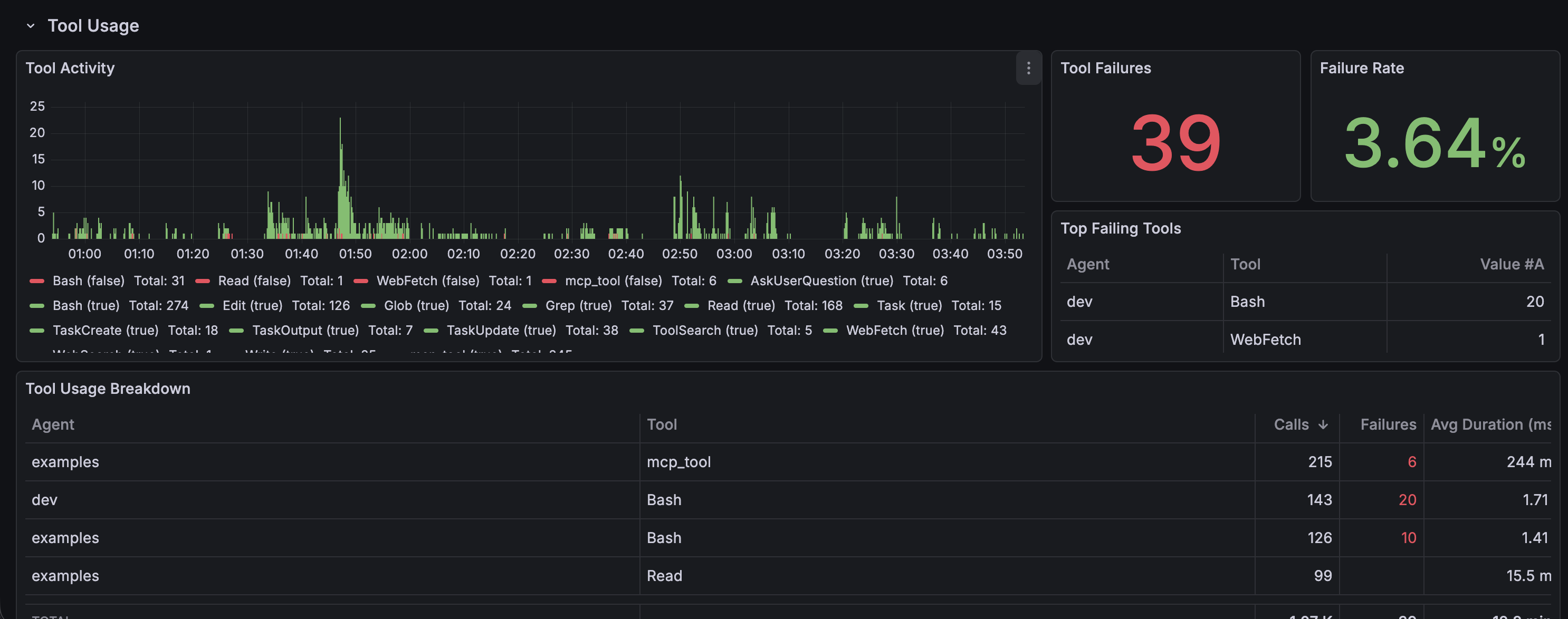
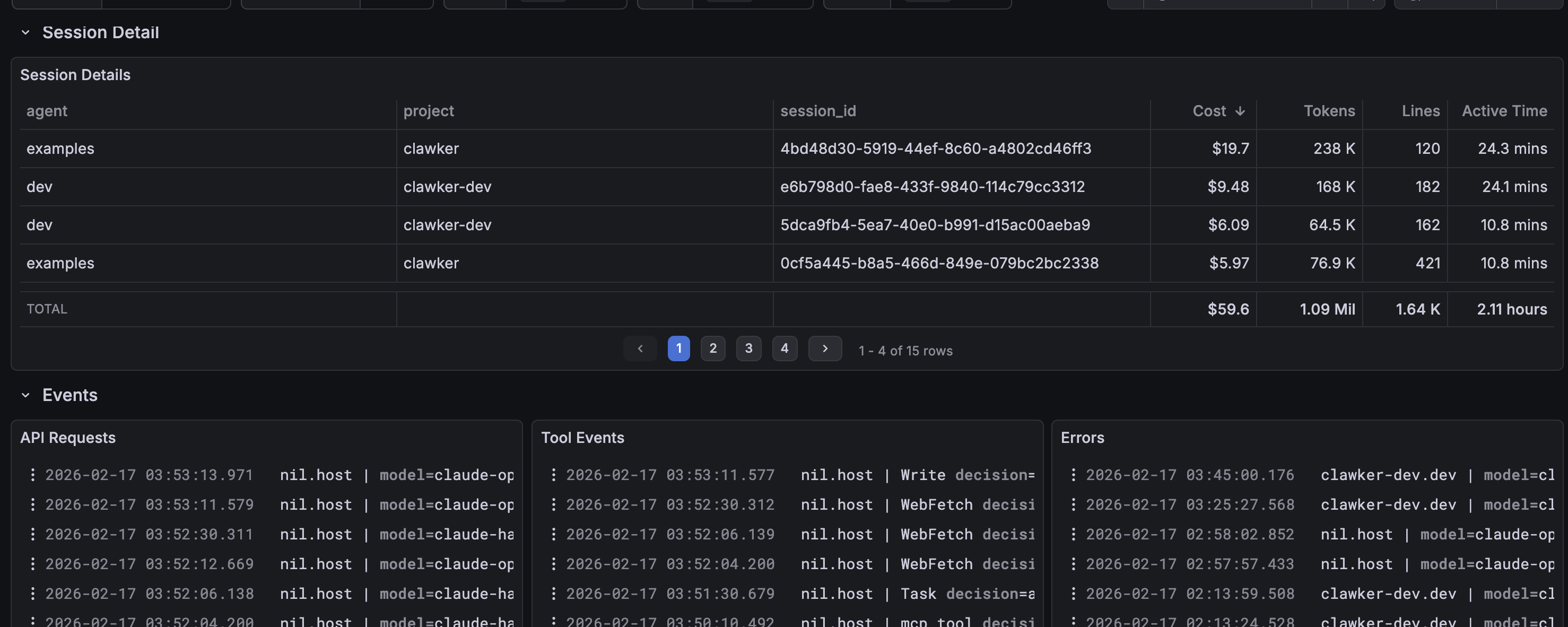
Now I can go to the grafana dashboard at http://localhost:3000 and see all my agents, containers, resource usage, costs, tool executions, decisions, prompts, api calls, etc from every agent. (you can also set env vars in your host shell and it will report to this stack)
# Host ENV var example
# Add these to your shell profile / .env etc
OTEL_EXPORTER_OTLP_PROTOCOL=http/protobuf
OTEL_METRICS_EXPORTER=otlp
OTEL_LOGS_EXPORT_INTERVAL=5000
OTEL_EXPORTER_OTLP_METRICS_ENDPOINT=http://localhost:4318/v1/metrics
OTEL_EXPORTER_OTLP_LOGS_ENDPOINT=http://localhost:4318/v1/logs
OTEL_METRIC_EXPORT_INTERVAL=10000
OTEL_LOGS_EXPORTER=otlp
OTEL_METRICS_INCLUDE_ACCOUNT_UUID=true
OTEL_METRICS_INCLUDE_SESSION_ID=true
CLAUDE_CODE_ENABLE_TELEMETRY=1
OTEL_LOG_TOOL_DETAILS=1
OTEL_LOG_USER_PROMPTS=1

# Add this to a project level .env
PROJECT_NAME=MyGroundbreakingTodoApp
OTEL_RESOURCE_ATTRIBUTES=project=$PROJECT_NAME,agent=host
When I'm done I can commit / push / open a PR right in the container terminal with all my creds and git access set up, or I can open the worktree in my IDE and do it from there. I can /exit out and the container will stop (or ctrl c in the terminal). I can use --rm flags just like docker cli to automatically remove containers when they stop, or I can start the same one back up again with clawker start -a -i --agent example to pick up right where I left off.
All containers get named volume mounts for their claude config directories and command history for persistence.
$ clawker volume ls
VOLUME NAME                                  DRIVER  MOUNTPOINT
clawker.clawker.example-config               local   ...er/volumes/clawker.clawker.example-config/_data
clawker.clawker.example-history              local   ...r/volumes/clawker.clawker.example-history/_data
# You can see the resources naming conventions here (clawker.{project}.{agent}). Labeling works similarly
You can also see how clawker is jailed from other docker resource access...
$ docker create alpine:latest
6c6896073eb1a2baa91450d0b5b795808f0ea4a052f729383a2d166d87fa0c17
$ clawker ps -a
NAME                     STATUS                  PROJECT                AGENT                  IMAGE                   CREATED
clawker.clawker.example  exited                  clawker                example                clawker-clawker:latest  9 hours ago
$ docker ps -a
CONTAINER ID   IMAGE                    COMMAND                  CREATED         STATUS                    PORTS     NAMES
6c6896073eb1   alpine:latest            "/bin/sh"                7 seconds ago   Created                             great_dubinsky
73b4ac14c2b3   clawker-clawker:latest   "entrypoint.sh --dan…"   10 hours ago    Exited (0) 10 hours ago             clawker.clawker.example
Creating and Using Containers
# Create a fresh container and connect interactively
# The @ symbol auto-resolves your project image (clawker-<project>:latest)
clawker run -it --agent main @

# Detach without stopping: Ctrl+P, Ctrl+Q

# Re-attach to the agent
clawker attach --agent main

# Stop the agent (Ctrl+C exits Claude Code and stops the container)
# Or from another terminal:
clawker stop --agent main

# Start a stopped agent and attach
clawker start -a -i --agent main
The @ Image Shortcut
Use @ anywhere an image argument is expected to auto-resolve your project's image:
clawker run -it @                     # Uses clawker-<project>:latest
clawker run -it --agent dev @         # Same, with agent name
clawker container create --agent test @
Working with Worktrees
Run separate agents per git worktree for parallel development:
# Use the --worktree flag for automatic worktree creation and mounting in containers
clawker run --worktree feature/todo-apps-are-dope:main -it --agent todo-apps @ --dangerously-skip-permissions

# Create worktrees manually
clawker worktree add feature/todo-apps-are-dope
clawker worktree add feat-feet --base main

# list your worktrees
clawker worktree list
Managing Resources
As close to docker CLI and its flags as I could make it, but remember they do different things under the hood. Adding all features is also still a WIP
clawker ps                          # List all clawker containers
clawker container ls                # Same thing
clawker container stop --agent NAME
clawker image ls                    # List clawker images
clawker volume ls                   # List clawker volumes

# Firewall management
clawker firewall status             # Health, rule count, running containers
clawker firewall list               # List active egress rules
clawker firewall add docs.clawker.dev # Allow a domain
clawker firewall remove docs.clawker.dev
clawker firewall disable --agent dev   # Unrestricted egress for one agent
clawker firewall enable --agent dev    # Re-apply firewall rules
clawker firewall bypass 5m --agent dev      # Temporary unrestricted egress with auto-re-enable
clawker firewall bypass --stop --agent dev  # End bypass early, re-enable firewall

# Configuration editing
clawker project edit                    # Interactive TUI editor for .clawker.yaml
clawker settings edit                   # Interactive TUI editor for settings.yaml

# Skill plugin management
clawker skill install                   # Install the clawker-support Claude Code plugin
clawker skill install --scope project   # Install with project scope
clawker skill show                      # Show manual install commands
clawker skill remove                    # Remove the clawker-support plugin
Monitoring
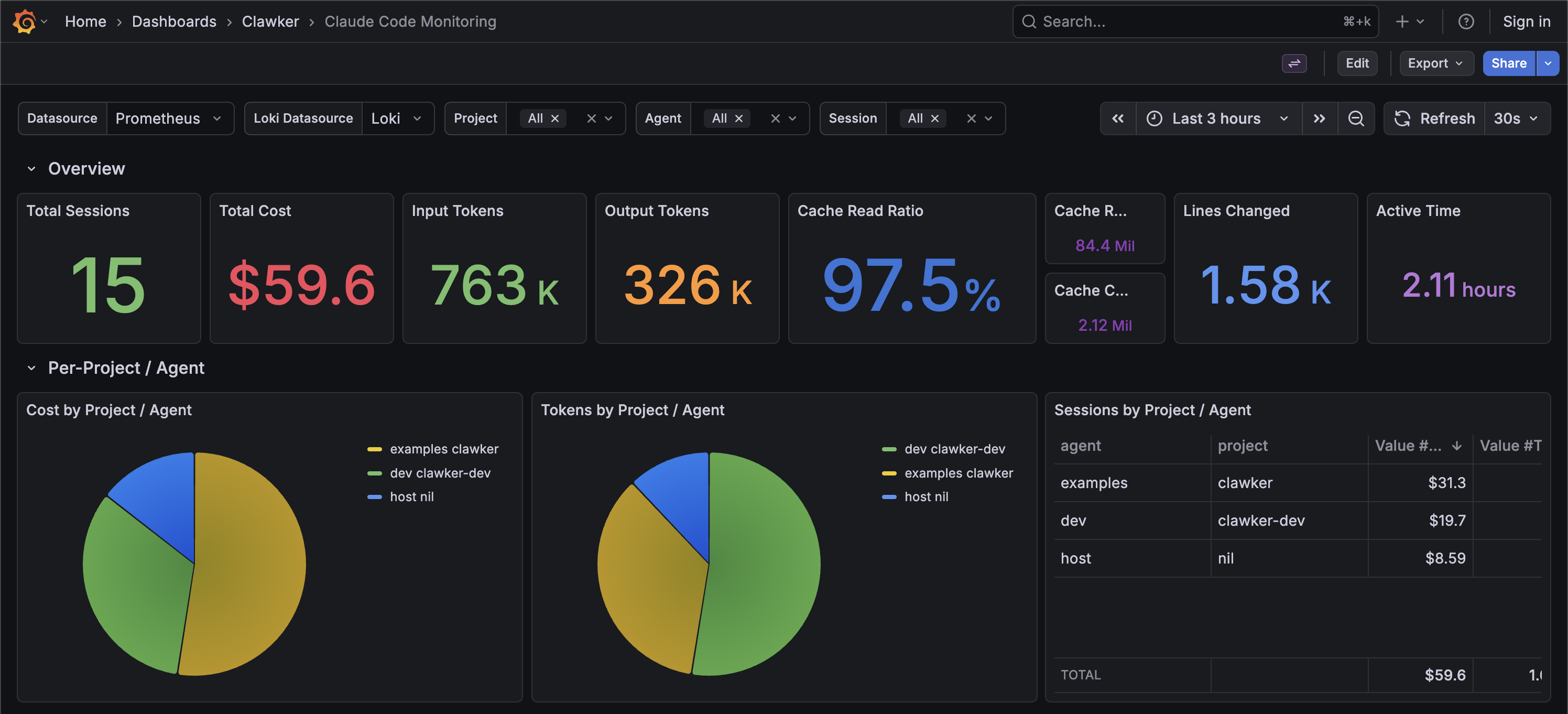
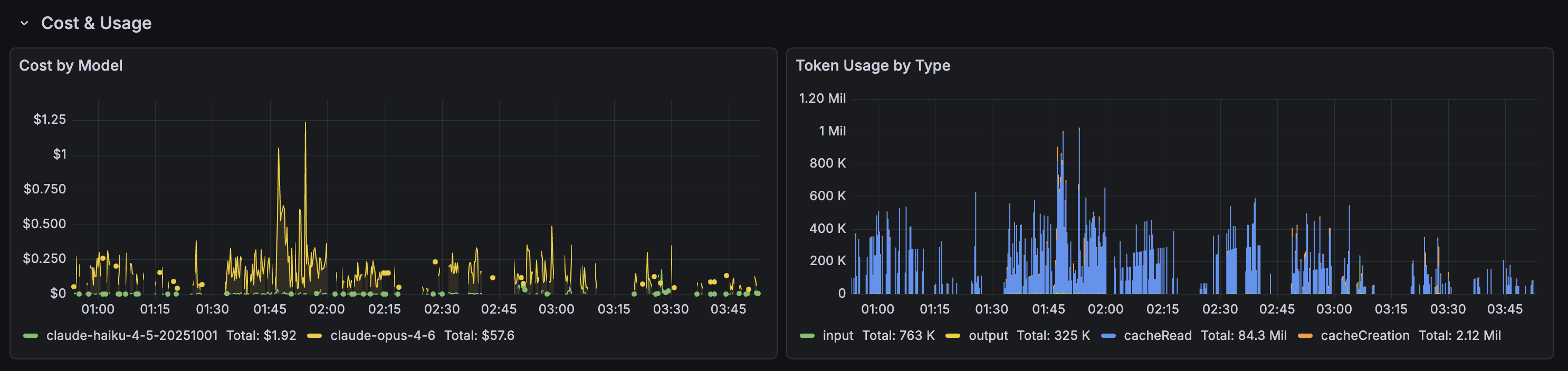
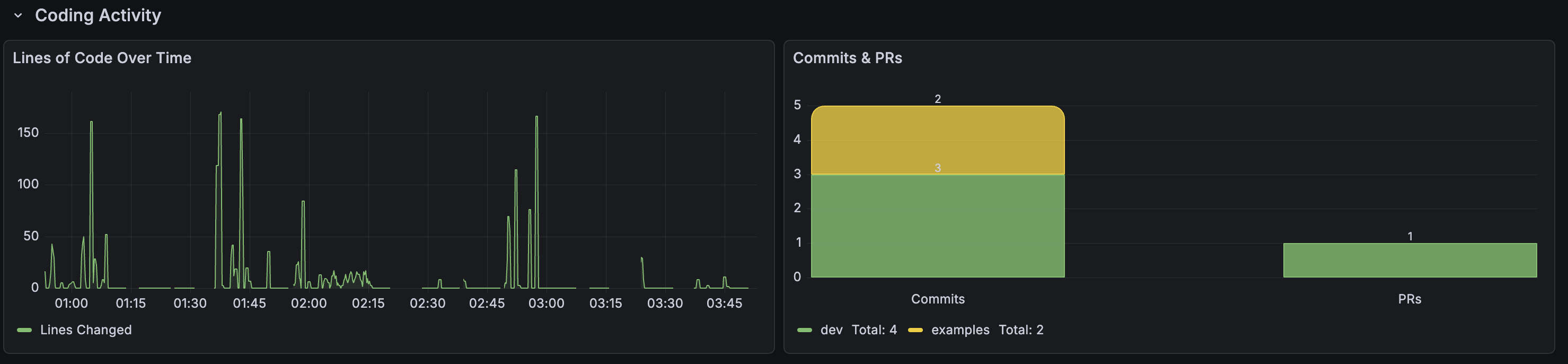
All containers have the necessary environment variables to send metrics and logs to an OpenTelemetry collector by default. When you start the optional monitoring stack, it automatically collects and visualizes these metrics and logs in Grafana dashboards. This gives you real-time insights into your agents' performance, decisions, tool calls, costs, token usage, and more.
clawker monitor init
clawker monitor up
clawker monitor status
# stop it later on
clawker monitor down
Autonomous Loops (Experimental)
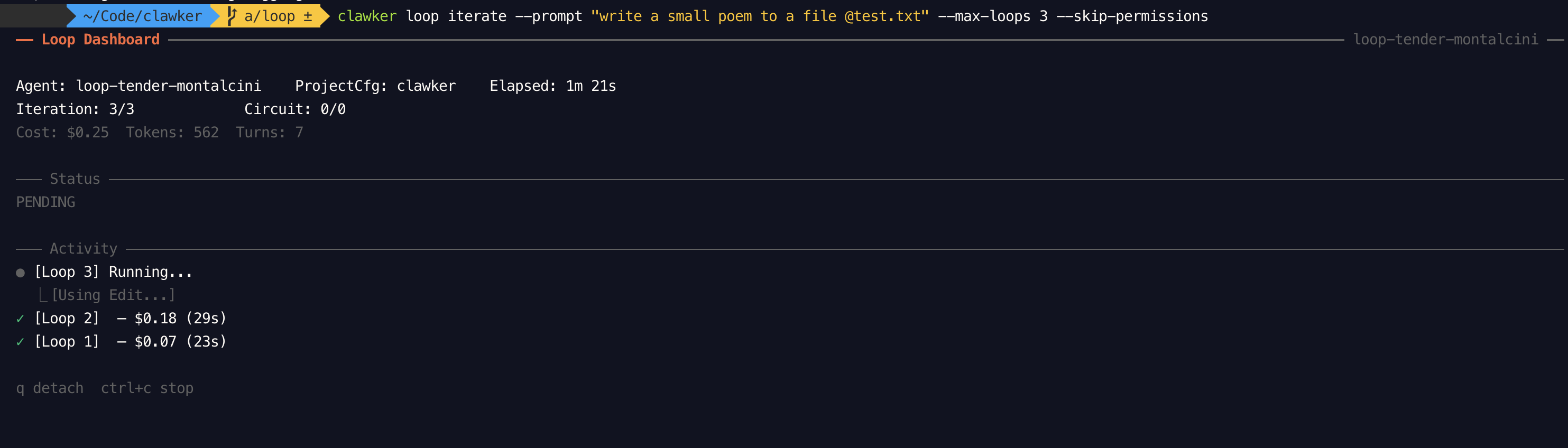
Loop runs Claude Code in autonomous loops with stagnation detection and circuit breaker protection:
# Start a new autonomous loop; this prints a generated agent name like "loop-abc123"
clawker loop iterate --prompt "write a small poem to a file @test.txt" --max-loops 3 --skip-permissions
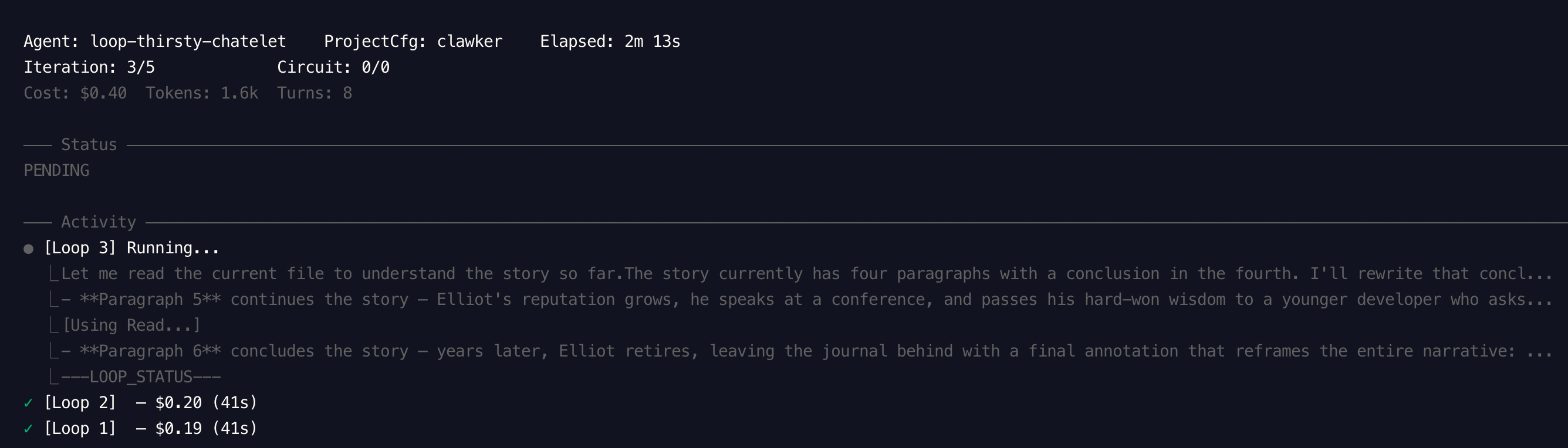
A TUI will open showing you the agent's progress, decisions, tool calls, and more in real time
See clawker loop --help for all options and configuration.
Roadmap / Known Issues
- Currently, clawker containers use stdout/stderr as a poor man's event transport for monitoring and looping mode. A proper control plane with container agent daemon for managing container lifecycles, configs, and events via gRPC is on the roadmap. This will keep container stdout/err sacred and allow for more robust features, better monitoring, better loop control, peering communications, and a more seamless experience overall
- Firewall: one domain per TCP/SSH port. Raw TCP/SSH has no domain metadata (unlike TLS and HTTP where Envoy does full HTTP inspection), so iptables routes all traffic on a port to a single whitelisted domain. Two SSH hosts on port 22 isn't supported yet — first rule wins. Deferred for after the control plane work (#235)
- Linux might have a bug involving accessing the keychain for creds, I haven't focused on linux extensively yet
- The TUI/UI formatting is mainly a polished turd currently, I'm aware of this. It's functional, but it'll be the last thing I really care about
See GitHub Issues for current known issues and limitations.
Contributing
Contributions welcome! See CONTRIBUTING.md for development setup, testing, and PR process.
Please read our Code of Conduct before participating.
License
MIT — see LICENSE
I feel obligated to state this... Clawker is a portmanteau of Claude + Docker. The project was at first named
claucker, but reading it, saying it, and especially typing it always felt awkward to my brain because it violates the phonetic rules of English. Before I was aware of the wholeclawdbotopenclawclawthisclawthatnaming craze, I changed it to be the "correct" phonetic spelling,clawker, purely because it just rolls off the fingers when typing it. For those reasons I'm not going to change the name, but I want to make it clear the decision wasn't to chase a trend and this has no relation to openclaw.
Yorumlar (0)
Yorum birakmak icin giris yap.
Yorum birakSonuc bulunamadi