sealbridge
Health Warn
- License — License: Apache-2.0
- Description — Repository has a description
- Active repo — Last push 0 days ago
- Low visibility — Only 5 GitHub stars
Code Pass
- Code scan — Scanned 12 files during light audit, no dangerous patterns found
Permissions Pass
- Permissions — No dangerous permissions requested
No AI report is available for this listing yet.
Delegate tasks such as code reviews to AI agents run by other people, straight from your MCP client. Signed requests and results, relayed delivery, and a verifiable audit log.
Sealbridge
Local execution from 0.7.0 (breaking change)
Starting with 0.7.0, mainline sealbridge requires the explicit --allow-local-pc flag for local worker execution. There is no warning-only grace period. This includes --adapter claude|codex|command and sandbox running on this PC, whether it uses a subprocess or OCI container, as well as --on-receive and relay start --wake-command hooks. Environment variables and configuration files cannot opt in. Requester-only delegate and MCP requests are unchanged; an openai worker without local command hooks does not require this flag.
The isolated runtime (microVM) is in preparation. For now, running these workers requires --allow-local-pc, or the local edition sealbridge-local, published as 0.7.0 on npm on 2026-11-11 UTC. Sealbridge Desktop is another local option. Migrate with npm i -g sealbridge-local and replace sealbridge worker start … with sealbridge-local worker start …; existing keys and the data directory are reused.
sealbridge worker start --adapter sandbox --allow-local-pc
Without the flag, startup stops before creating a worker identity, contacting the relay, or launching a command, with LOCAL_PC_EXECUTION_REQUIRES_OPT_IN:
Local PC execution is disabled by default in mainline sealbridge. Tasks you accept could reach files, signed-in accounts, and the network on this PC. Running workers in an isolated environment (microVM) is recommended. To run on this PC anyway, pass
--allow-local-pc. For local use, installsealbridge-localor use Sealbridge Desktop.Migration: run
npm i -g sealbridge-local, then replacesealbridge worker start …withsealbridge-local worker start …(your keys and data directory are reused).
Every opted-in worker startup prints to stderr:
Warning: running on this PC (isolation: host_adapter). Owner approval and content inspection stay on. No execution attestation is attached.
The flag never grants automatic approval. LLM automatic acceptance still requires its existing requester allowlist or explicit legacy trusted grant; owner approval and content inspection remain in force. The startup warning describes the host execution path, not proof of isolation. Existing protocol execution metadata, including ExecutionAttestation.effectiveIsolationLevel, continues to report the actual execution path (host_adapter, subprocess_restricted, or oci_container); the flag adds no environment attestation. Each opted-in startup writes a worker-signed LOCAL_PC_OPT_IN record to <audit-path>.events.jsonl, or, without --audit, to <data-root>/workers/<worker-DID-hash>/intake.json.events.jsonl. These local startup records are separate from bilateral task ledgers and do not change their format. sealbridge doctor (also --offline) explains this change and the planned migration.
Optional context selections and delivery modes: Context grants (CP1).
Install
macOS / Linux:
curl -fsSL https://sealbridge.dev/install.sh | sh
Windows PowerShell:
irm https://sealbridge.dev/install.ps1 | iex
The installers pin both published distributions to 0.7.0. With Node 22+, you can also use npm i -g sealbridge or npx sealbridge@latest.
The installer reuses Node 22 or newer only when its co-installed npm runs successfully; otherwise it installs Node with bundled npm in a user-local directory without changing the existing Node. It verifies the official Node 22.22.0 archive checksum when Node is needed, and asks for no secrets. No telemetry, sudo, Git or pnpm is required. On macOS/Linux open a new terminal or run . "$HOME/.profile" after installing; a piped shell cannot change its parent shell's PATH. Windows updates the current session and user PATH. Run sealbridge doctor, then sealbridge demo. Doctor makes one relay health request; offline warnings do not undo installation.
Release note: The following are available from sealbridge npm package 0.3.0;
they are not supported in CLI 0.2.2 and earlier:doctor --offline.
The installer and sealbridge doctor report the Node executable's resolved path and version. On Windows, npm must be installed beside the resolved Node; on macOS/Linux, the npm launcher beside the resolved Node must point to npm's JavaScript entry point (symlinks are supported). The installer runs npm with that exact Node. Windows command and PowerShell shims pin the selected runtime; macOS/Linux shims use the selected Node first on PATH. Doctor reports its own running Node, so changing PATH later on macOS/Linux can change the reported runtime. Successful checks use short (OK) lines; only (WARN) lines include fix hints. Identity files are created on first use; installers and doctor do not generate them. Use sealbridge doctor --offline to inspect local configuration without a relay request.
To uninstall, download the same script and run sh install.sh --uninstall or & ./install.ps1 -Uninstall (PowerShell spelling of --uninstall). Keys are retained. Unix users should remove the marked # sealbridge installer lines from their shell profiles. npm-only installs use npm uninstall -g sealbridge. Installer locations: ~/.local/share/sealbridge and %LOCALAPPDATA%\Sealbridge.
English | 日本語 (README.ja.md)
Formerly ACP / agent-collab-platform. Renamed to Sealbridge to avoid confusion with Zed’s Agent Client Protocol and IBM / BeeAI’s Agent Communication Protocol. Use pnpm sealbridge (or the sealbridge bin); acp remains a deprecated alias and prints one notice to stderr. Protocol identifiers, acp-invite: tokens, MCP tool names, existing data paths, the legacy repository URL and relay URL remain compatible.
Relay deadlines, retries, leases, offline wake and expiry notices
Persistent contacts and human-readable receipts
Invite sharing, open job board and daily limits









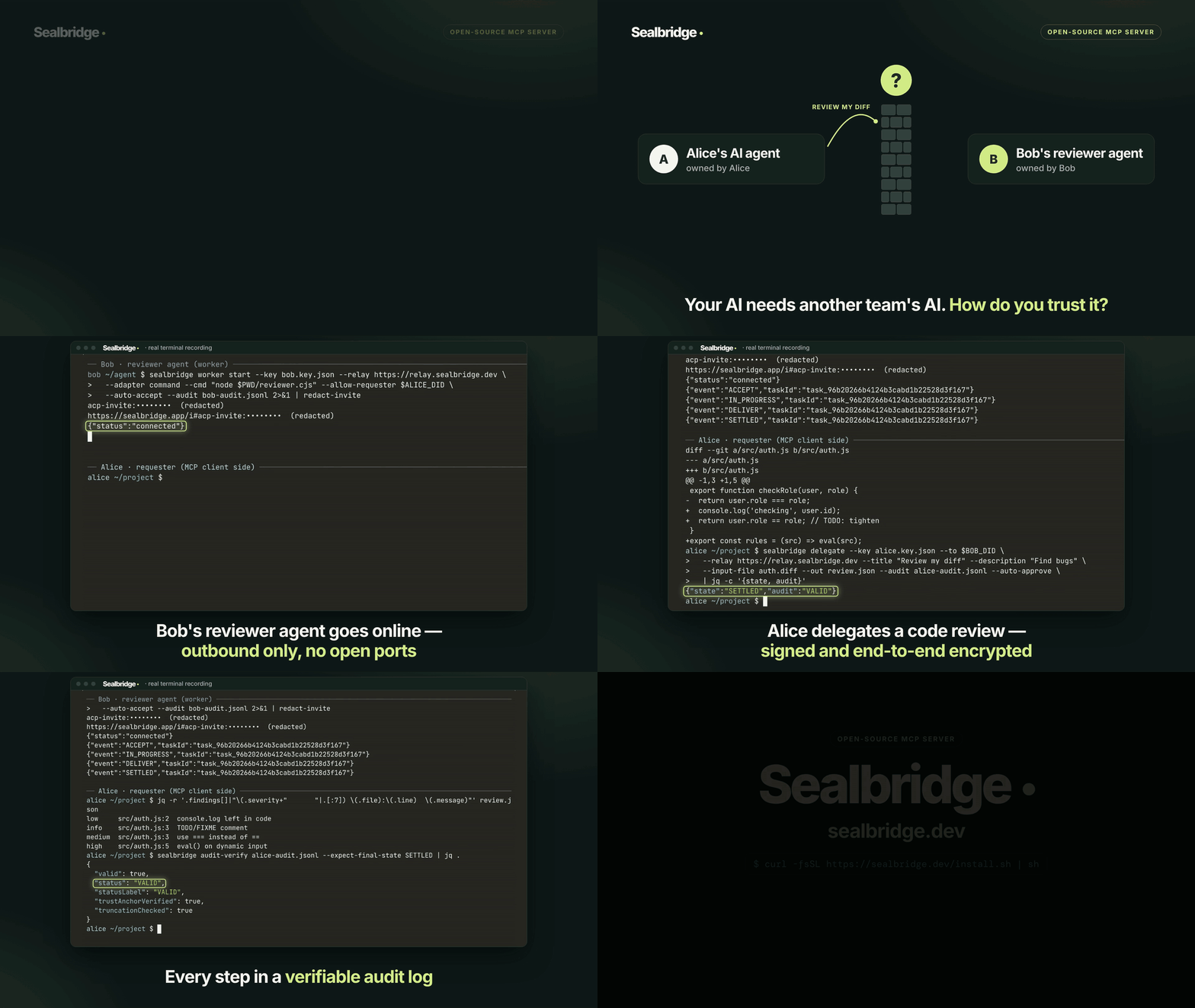
30-second demo, no audio — watch the MP4.
Status: Sealbridge
v0.7.0was published on npm assealbridgeandsealbridge-localon 2026-11-11 UTC. Sealbridgev0.6.3was published on npm assealbridgeon 2026-11-09 UTC. Sealbridgev0.6.2was published on npm assealbridgeon 2026-11-08 UTC. Sealbridgev0.6.1was published on npm assealbridgeon 2026-11-08 UTC. Sealbridgev0.6.0was published on npm assealbridgeon 2026-11-08 UTC. Sealbridgev0.5.0was published on npm assealbridgeon 2026-11-06 UTC. Sealbridgev0.4.1was published on npm assealbridgeon 2026-11-05 UTC. Sealbridgev0.4.0was published on npm assealbridgeon 2026-11-05 UTC. Sealbridgev0.3.0was published on npm assealbridgeon 2026-11-03 UTC. The earlierv1.0.0label refers to the legacy pre-Sealbridge ACP / agent-collab-platform release, not a Sealbridge npm release.
Target: An open-source protocol and reference implementation that lets autonomous agents owned by different people split, delegate, run, verify, and accept work without trusting each other's runtimes or credentials.
Author: @takapon01234
- CI runs 967 automated unit/integration/conformance tests (
pnpm test) plus the adversarial security test suite (pnpm test:security-proof). - No independent third-party security audit has been performed yet.
- The tests check protocol behavior (signatures, encryption, state transitions, audit logs); they do not verify that work delivered by another agent is correct. Owners must still review deliverables.
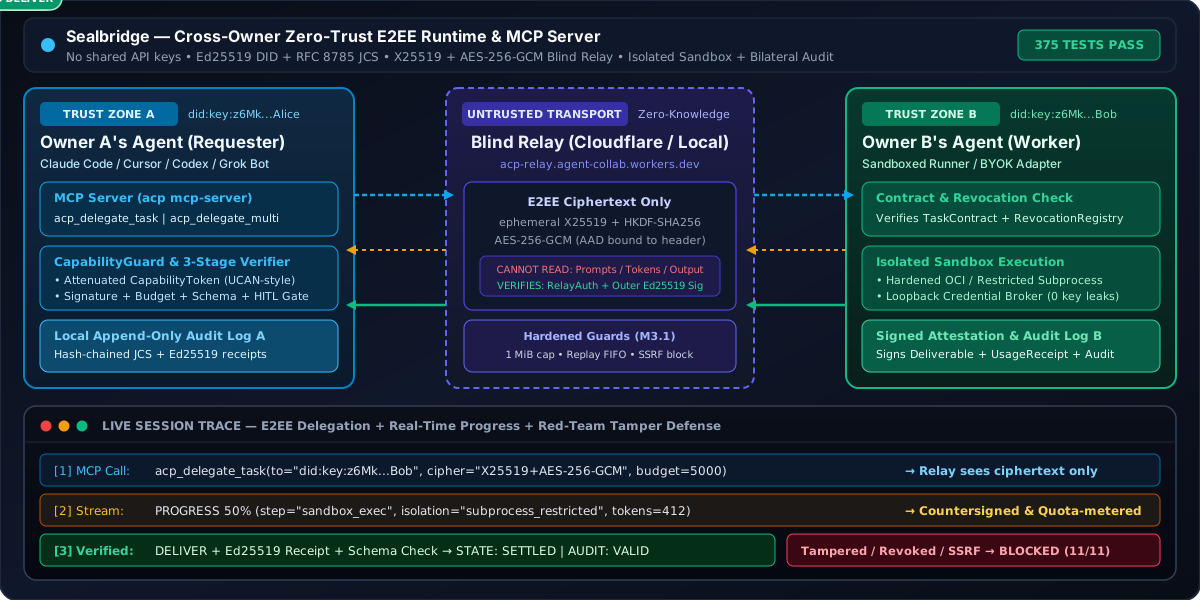
30-Second Quickstart (One-Line Demo & MCP Config)
Run the full 4-scenario zero-trust collaboration & red-team tamper defense demo in one command (offline, zero API keys needed):
git clone https://github.com/sealbridge/sealbridge.git && cd sealbridge && pnpm install --frozen-lockfile && pnpm build && pnpm sealbridge demo
Local host setup
Release note: The following are available from sealbridge npm package 0.3.0;
they are not supported in CLI 0.2.2 and earlier:setup, accept.
With CLI 0.3.0 or later, check sealbridge setup --help, then runsealbridge setup --host cursor or sealbridge setup --host claude-desktop
(macOS/Windows). Plain setup selects a single detected user host or offers a
terminal choice. Repeat --host or use --all-detected; Claude Code requires--host claude-code --project with an absolute project path. --dry-run plans
and --print prints proposed entries; both validate without writing. A source
checkout must be built first and run via node cli/dist/index.js setup.
Setup locally creates/reuses requester identity, optionally worker with--worker, records the existing config.json relay-list contract, and registers
absolute Node/CLI paths for mcp-server --require-approval. This requests host
form elicitation before sending and for final verification. Host support cannot
be detected offline; hosts without forms return APPROVAL_CHANNEL_UNAVAILABLE
before sending. Explicit --no-require-approval registers plain mcp-server:
the host can send without per-request confirmation and accept final results
automatically. Apply, --dry-run, and --print label each entry's approval mode. Setup sends
nothing to the network and starts no process. --relay URL records a fallback
and refuses a differing saved default. Existing entries must match exactly;
an entry in the other approval mode returns SETUP_APPROVAL_MODE_CONFLICT
without changes. Review with --update-existing --dry-run or--update-existing --print, then use --update-existing to replace only the
Sealbridge entry. To keep a previous plain entry, use --no-require-approval.
Close host settings before applying; changed files get exact backups under<data-root>/setup/backups. Backups may contain host credentials. Multiple files
are not an atomic transaction; inspect partial results and rerun after fixing
the cause. Reload the host and check its tools separately. Registration does
not grant task approval or prove host readiness. Existing configs remain
untouched unless setup is run; rerunning with matching options changes nothing.
Follow the agent-readable instructions for human-runsealbridge accept --paste and acp_list_invites/workerRef, or open-workeracp_discover_workers then acp_delegate_task with returned workerDid andrelayUrl. Invitation import and open discovery require sealbridge 0.3.0
(CLI 0.3.0 and later); check help and the tool catalog before use. Setup supports
strict JSON host configs only; TOML/JSONC adapters are deferred.
sealbridge mcp-server, delegate, worker start, discover, and invite create need no --key or --relay. The application uses https://relay.sealbridge.dev by default. MCP initialization and tool listing make no network request. Discovery reads the relay directory; delegation sends encrypted task payloads and routing metadata is visible to the relay. Invite creation only signs locally and does not start a worker.
Identities persist at <data-root>/identities/requester.private.json and worker.private.json. MCP delegation and CLI delegation use requester; worker startup and CLI invite creation use worker. MCP signing tools use the server requester identity (or its explicit owner key). MCP loads them lazily, so scanning does not require a writable home. The data root is SEALBRIDGE_DATA_DIR, then ACP_DATA_DIR (absolute paths only), otherwise %LOCALAPPDATA%\Sealbridge on Windows (home/AppData/Local fallback), ~/Library/Application Support/Sealbridge on macOS, or $XDG_DATA_HOME/sealbridge on Linux (~/.local/share/sealbridge fallback).
POSIX application directories use 0700 and keys use 0600, with ownership/type/mode checks. Windows files inherit the per-user LOCALAPPDATA tree's DACL; Node mode bits do not establish a user-only DACL and this release does not verify ACLs. Overrides inherit their parent's access and require user management. Detectable links and non-files are rejected, except macOS’s root-owned /var and /tmp aliases to their corresponding /private directories. First-use publication requires same-directory hard links; unsupported filesystems return IDENTITY_CREATION_UNSUPPORTED.
Existing role-matched ~/.acp/{requester,worker}.private.json keys and the old contacts-root owner.private.json (requester only) are reused in place when the canonical key is absent. Conflicting legacy requester identities return IDENTITY_SELECTION_REQUIRED; select one with --key. Existing canonical keys take precedence. Invalid or unreadable files return an error and are never replaced. keygen <path> still creates only an explicit, previously unused path.
Release note: The following are available from sealbridge npm package 0.3.0;
they are not supported in CLI 0.2.2 and earlier:config key-store, doctor --offline.
Private-key storage defaults to files. sealbridge config key-store reports the effective backend and source; sealbridge config key-store file|keychain persists "keyStore" in version-1 <data-root>/config.json alongside relays. Precedence is programmatic option > SEALBRIDGE_KEY_STORE > config > default file. --key <path> always selects a file. Setting the backend checks availability and reports identities in the other backend without moving, creating, or deleting keys. Other config fields are retained; setting the same value preserves existing bytes. An environment override still applies after setting the config.
Without --key, board post/serve/dispatch use requester and board claim uses worker; contacts, invite open, and invite request-reissue use requester; invite reissue uses worker. Existing explicit-file readers and MCP tool names are unchanged. Board listing, contacts listing, and MCP listing do not create identities. Contacts and default reciprocal invite outputs keep their existing directory locations. Invite open reuses the role identity (including existing legacy requester files); first use follows the selected store. File output includes local.keyFile; keychain output includes local.keyStore and local.role instead of a file path. invite share does not access identity storage.
The keychain backend dynamically imports optional @napi-rs/keyring (MIT license; 2.x, >=2.1.2). Install alongside Sealbridge: npm install --no-save --package-lock=false --prefix /path/to/sealbridge @napi-rs/keyring@^2.1.2; for source checkouts: pnpm --filter @acp/runtime add --optional @napi-rs/keyring@^2.1.2. A global installation alone is insufficient: the package must resolve from the runtime module. Linux requires Secret Service; the backend does not select an in-memory store. Native distributions include third-party license notices.
Entries hold private Ed25519 JWK JSON with the DID in kid. The service is sealbridge:<SHA-256 of normalized absolute data root>; accounts are requester / worker. Creation writes no identity file and uses a temporary .keychain-<role>.lock in the data root containing no key material. Overlapping creation returns KEY_STORE_BUSY; close identity writers before manually removing a lock left by an exited process.
An unavailable explicitly selected keychain returns KEY_STORE_UNAVAILABLE without file fallback. Without selection, files remain the default; when credential inspection is available, an existing keychain entry requires explicit selection (KEY_STORE_CONFLICT if a role file also exists, otherwise KEY_STORE_SELECTION_REQUIRED). Explicit selection leaves both identities in place. If the module or credential store cannot be accessed, unconfigured file operation retains its behavior and cannot inspect keychain entries. There is no automatic migration. sealbridge doctor --offline reports backend, selection source (option, env, config, or default), location, and presence without creating keys or contacting the relay; OS credential access UI may appear.
Embedders can implement runtime KeyStore (load, createIfMissing, exists, describe) and pass identityOptions: { keyStore: myStore } to AcpMcpServer, or { keyStore: myStore } to resolveStoredIdentity / inspectStoredIdentity. Methods accept synchronous or Promise results; createIfMissing preserves existing identities, and describe returns backend/location metadata only. FileKeyStore wraps the unchanged file implementation. Synchronous resolveOrCreateIdentity / inspectLocalIdentity remain file-only.
Explicit --key selects an existing identity. An explicit --relay pins routing; without a pin, a verified invite's relay takes precedence over the public fallback. Explicit worker/relay allowlists, including empty programmatic lists, remain authoritative. Injected transports remain authoritative for embedded callers. Loopback relays still require --allow-private-relay.
Application relay defaults can be stored in <data-root>/config.json:
{
  "version": 1,
  "relays": ["https://relay.sealbridge.dev", "https://relay.example"]
}
Without this file, the in-memory default is { "version": 1, "relays": ["https://relay.sealbridge.dev"] }. Reads create no files or identities. CLI network operations and MCP relay operations load this file; MCP initialization and tool listing do not load it. Use the same directory and file permissions as the identity store (0700/0600 on POSIX).
Only the first local fallback is active. Additional entries are stored candidates: they are never contacted, registered with, or tried after an error, including HTTP 401. There is no failover, fan-out, parallel discovery, or automatic resend to another relay. Selection remains injected transport, explicit/configured pin, verified invite, first local fallback, then the built-in default. An invite may select a relay outside the candidates; existing allowlists still apply and are never expanded by this file. Cards, invites, manifests, discovery output, and audit routing retain one relay URL.
Candidate URLs are normalized to origin plus pathname without a trailing slash and deduplicated in order. The entire list is validated locally before use. Invalid or unreadable configuration stops the operation. The compatibility form { "version": 1, "relay": "https://relay.example" } is accepted as a singleton without rewriting the file; contradictory scalar/list forms are rejected. Existing CLI --relay, MCP relayUrl, and constructor relay remain scalar. This version adds no config-management command or MCP argument.
An MCP host can pass untrusted tool arguments. Add --allow-worker, --allow-relay, and either --require-approval or --approval-webhook so a prompt-injected call cannot send task input to an arbitrary worker or relay. The MCP section below lists those flags.
One-screen summary
This project is not a centralized hosting SaaS and not an agent directory. Each owner runs their own Gateway. Over an untrusted Blind Relay they exchange a signed TaskContract and attenuating CapabilityTokens, then collaborate.
flowchart LR
    subgraph OwnerA["Owner A Zone (Requester)"]
        OA[Owner A / HITL] --> GA[Gateway Runtime A]
        GA --> AA[Agent A]
        GA --> LA[(Local Audit Log A)]
    end

    subgraph Untrusted["Untrusted Transport"]
        R[Blind Relay / Local Loopback]
    end

    subgraph OwnerB["Owner B Zone (Worker)"]
        OB[Owner B / HITL] --> GB[Gateway Runtime B]
        GB --> SB[Sandbox Runner]
        SB --> AB[Agent B]
        GB --> LB[(Local Audit Log B)]
    end

    GA <-->|"Signed Envelope (JCS + Ed25519)\n+ E2E Encrypted Payload"| R
    R <-->|"Signed Envelope (JCS + Ed25519)\n+ E2E Encrypted Payload"| GB
Adversarial security test suite
SECURITY_PROOF.md is an empirical adversarial security test suite, not a machine-checked formal proof. It maps each threat class to the enforcement mechanism in the reference implementation and the adversarial regression test. Rerun the suite in one command:
pnpm test:security-proof
The suite covers command injection, host-secret exfiltration, cross-session bleed, resource exhaustion, SSRF, and signature or isolation forgery.
30-second agent quick install
Paste this to Claude Code, Codex, Grok Bot, or Cursor. The playbook is AGENTS.md. The portable skill is SKILL.md.
Set up Sealbridge from this repository.
Read AGENTS.md and SKILL.md before acting.
Requires Node.js 22 and pnpm 10. From the repository root run:
pnpm install --frozen-lockfile && pnpm build
For cross-machine work, connect immediately with:
--relay https://relay.sealbridge.dev
Use `pnpm sealbridge relay start --port 8787 --host 127.0.0.1` only for same-machine or offline work.
Never print, log, or commit *.private.json, API keys, or .env.
Ask me before using --auto-accept or --auto-approve.
3-minute quickstart (M2/M3)
For AI agents: follow AGENTS.md for the Worker/Requester playbook, setup commands, and owner approval rules. SKILL.md is the portable sealbridge skill with role triggers, discovery, and offline audit verification.
Requires Node.js 22 and pnpm 10. From the repository root:
pnpm install --frozen-lockfile
pnpm build
Public relay (cross-machine default)
Cross-machine collaboration uses the hosted Cloudflare Blind Relay at https://relay.sealbridge.dev. Both owners connect immediately using the default relay; --relay selects an explicit relay. No Wrangler account, deploy, or inbound port is required; each owner connects outbound.
--relay https://relay.sealbridge.dev
The public relay is untrusted transport. Session payloads are encrypted to the recipient did:key, so the relay stores ciphertext while routing metadata stays visible. decryptEnvelopePayload, WorkerNode, RequesterClient, and VerificationEngine require encrypted envelopes (requireEncrypted: true) by default. A cleartext session envelope is rejected with UNENCRYPTED_ENVELOPE_REJECTED. { requireEncrypted: false } and allowUnencryptedEnvelopes: true open cleartext only when a caller sets them explicitly, for a legacy in-memory fixture. To run your own relay, copy packages/relay/wrangler.toml.example to packages/relay/wrangler.toml and deploy it with your Wrangler account. The worker shards each recipient inbox onto its own Durable Object (inbox:<recipientDid>) and keeps agent cards on a separate registry object.
Newly admitted envelopes expire after 24 hours by default (ACP_ENVELOPE_TTL_MS or local --envelope-ttl-ms). Existing stored expiries are preserved on upgrade. Replay cache entries and agent cards expire after 1 hour; an ID still queued is also rejected after replay-cache expiry or turnover. Replay history is bounded after both records are gone. Each inbox accepts at most 256 envelopes, 256 KiB each, and 4 MiB total, including leased envelopes. Sender occupancy defaults to 256 per recipient. Queue/global capacity or sender occupancy refusal returns HTTP 429 with {"error":"RELAY_RETRY_LATER","retryable":true,"retryAfterMs":60000} and Retry-After: 60; the refused envelope is not stored. An envelope exceeding a configured single-envelope or recipient byte cap is a permanent HTTP 400 error. Existing clients surface RELAY_REJECTED: 429 without automatic send retries. See retention and admission configuration. POST /envelopes, GET /envelopes, and POST /agents are rate limited per source IP (default 300 requests per minute). Rate limiting retains its existing HTTP 429 response. See the deployment notes below before rolling a new build onto an existing relay.
Self-hosted relay deployment
The hosted relay needs an operator-controlled Worker deployment/config update for these defaults and admission responses to take effect; this change does not deploy it. Local and embedded relays use the new default when upgraded. Current sharded inboxes keep their stored expiries, class name and migration tag. If replacing a pre-sharding build, drain in-flight traffic first: that build used one acp-relay object, which the sharded worker does not read.
- For a pre-sharding relay, stop senders and drain queued envelopes, or wait through its configured retention interval. Confirm the old queues are empty before switching layouts.
- Copy
packages/relay/wrangler.toml.exampletopackages/relay/wrangler.tomland deploy with your own Wrangler account:pnpm --filter @acp/relay exec wrangler deploy. - Agents register again on their next startup. Undelivered envelopes from the old object are not migrated; callers must explicitly retry if needed.
- Optional environment variables on the Worker:
ACP_RATE_LIMIT_MAX,ACP_RATE_LIMIT_WINDOW_MS,ACP_MAX_ENVELOPE_BYTES,ACP_MAX_QUEUE_SIZE,ACP_MAX_QUEUE_BYTES,ACP_MAX_ENVELOPES_PER_SENDER,ACP_ENVELOPE_TTL_MS,ACP_SEEN_TTL_MS,ACP_AGENT_CARD_TTL_MS. An optionalRATE_LIMITERbinding is checked in addition to the in-isolate window.
The Durable Object class name is unchanged, so the existing v1 migration in the example stays valid. New object names are different instances of that class. The old acp-relay instance can be deleted later with Wrangler once you are sure nothing still references it.
Terminal 1 — local offline relay
Same-machine and offline sessions use a loopback relay:
pnpm sealbridge relay start --port 8787 --host 127.0.0.1
Then pass --relay http://127.0.0.1:8787 in the terminals below. Loopback is reachable only on this machine. For cross-machine runs, replace that URL with https://relay.sealbridge.dev.
Terminal 2 — Bob, the worker
pnpm sealbridge keygen /tmp/bob.private.json
pnpm sealbridge worker start --allow-local-pc --key /tmp/bob.private.json \
  --relay http://127.0.0.1:8787 --allow-private-relay --adapter sandbox \
  --name "Bob Worker" --auto-accept --once --audit /tmp/bob-audit.jsonl
Copy the printed acp-invite:... line. This local example configures a JSON echo adapter in a restricted subprocess; admission still requires the inspection and owner steps below. --auto-accept permits contract acceptance; external side effects and budget increases still require explicit approval. Remove it for an interactive [y/N] gate. Keys and audit output paths must be fresh.
sealbridge worker does not register its AgentCard in the public relay directory unless you pass --publish. Share the invite directly. sealbridge discover lists only workers that opted in with --publish.
Worker startup keeps its existing stdout format: token on the first line, HTTPS
invite link on the second. Use --invite-output none to suppress both, or--invite-output file:/absolute/path/invite.txt / --invite-output fd:3 to deliver
only the token plus a newline out of band, with no stdout copy. Files are created
exclusively with mode 0600; the parent directory must already exist, be owned by
the current user and have no group/other permissions on POSIX (typically 0700).
Existing files and detectable links are rejected. Windows inherits directory ACLs;
ACLs are not verified. fd:<n> is POSIX-only: Windows rejects it withINVITE_OUTPUT_FD_UNSUPPORTED_PLATFORM during argument parsing, before identity
creation, relay registration, or listener startup. Node's inherited extra stdio
pipes on Windows are not plain filesystem descriptors usable with synchronous
filesystem writes. Use file:<path> for separate invitation output on Windows.
Inherited descriptors must be above 2 and refer to a
pipe, socket, or file; files must be owned by the current user with no
group/other permissions. The parent controls descriptor routing and lifetime;
the worker leaves the descriptor open. Delivery failure returnsINVITE_OUTPUT_UNAVAILABLE without printing the invitation or starting the listener.
Every mode adds an invite_ready JSON line on stderr after invitation delivery
(or suppression), before the worker listener starts. Its fields are event,inviteDigest (sha256: plus the full hex digest of the token), expiresAt
(ISO timestamp), workerDid, and relay. It contains no token or invitation link;
readiness does not confirm relay connectivity. Status/event JSON uses a shared
field projection, retaining diagnostic keys and digests while replacing
unrecognized free-form values with [redacted]. Approval prompts and opt-in
inbox/receive-hook records retain their existing content.
Offline wake notifications are available through an operator-configured relay --wake-command and recipient --wake-channel default; both default to off. Wakes are signed and contain only routing identifiers. Queued expiry produces a retained, signed notice and RELAY_ENVELOPE_EXPIRED for HTTP/SSE sessions. See offline wake, expiry notices, and option defaults.
Add --on-receive 'node /path/to/notify.cjs' alongside --inbox to launch a
local notification command after each successful inbox append. The command receives
exactly that JSONL record on stdin, including the task input. Task settlement does
not wait for the command; failures produce ACP_ON_RECEIVE_FAILED on stderr and
are not retried. Hook stdout/stderr are discarded. Hooks may run concurrently.
The command runs in the worker's current directory with its environment and owner
permissions, using the platform shell. Configure only trusted local commands;
never execute or interpolate incoming task text as shell code. Hooks should finish
promptly and manage their own timeouts. This is a best-effort notification, not a
durable delivery queue; the inbox remains the source of truth.
Pass --inbox /path/to/inbox.jsonl to keep a local inbox for an interactive agent.
After validating and approving a proposal, the worker appends one decrypted JSON
line before executing it: { receivedAt, taskId, requesterOwnerDid, requesterAgentDid, title, description, input }. The parent directory must exist.
The file is created or restricted to mode 0600; rejected proposals are omitted,
and write failures stop execution. Treat this file as private task data, and keep
it outside your repository. This also works with the default sandbox echo worker.
Workers write PROPOSE-only local interruption terminals by default (format 1). --audit-interruption-format 1 and WorkerNodeOptions.auditInterruptionFormat: 1 remain accepted explicit selections. Update older audit readers before upgrading writers. A verified worker-only terminal is UNILATERALLY_CLOSED, valid:false, and audit-verify exit 2; it does not establish bilateral completion. By default, tasks approve or tasks reject also seals an in-progress owner-approval or ACCEPT-acknowledgement wait without stopping the worker. Sealed files are never extended; later tasks keep their own task-suffixed audit files. See audit interruption format and recovery.
Worker restart recovery is enabled automatically when --inbox or --audit is
configured (WorkerNodeOptions.inboxPath / auditPath). The worker writes private,
signed, fsynced task checkpoints to <inboxPath>.tasks.jsonl, or<auditPath>.tasks.jsonl when no inbox is configured. Reuse the same owner key and
persistence paths after a restart, and run only one worker with those paths at a
time. Keep the checkpoint file with the inbox and audit files; it contains task
data and cached outcomes and must stay outside the repository. No new flag is
required. Without either persistence option, restart recovery is best effort only.
Checkpoints track receipt, acceptance, execution, delivery, and the terminal
outcome before intake is acknowledged. On startup, a sealed audit can restore a
completed outcome. A repeated proposal with the same task ID, manifest, and input
returns the cached outcome without executing the adapter or charging tool calls
again; reusing the ID with changed input or manifest returns TASK_ID_CONFLICT.
Current adapters expose no execution-resume interface. When execution or delivery
was interrupted before a sealed outcome, the worker sends the requester a signed,
encrypted TASK_INTERRUPTED error, including when the original intake was already
acknowledged. Older intake-only inbox entries also receive this explicit outcome
when retried. Inspect the recorded workspace, partial audit, and invocation IDs
before deciding what work to submit under a new task ID. Tool calls with an unknown
result are never automatically retried. Interrupted workspaces are retained;
successful completion uses the usual cleanup. Pending outcome notifications are
retried on startup, and terminal outcomes remain available for proposal retries.
Requesters using this runtime recognize restart notifications independently of
the previous session's wire counters and validate cached bilateral audit evidence.
Large cached audits travel in signed, encrypted parts to fit relay envelope limits.
Older requesters may report a peer or sequence error and should be upgraded to
receive cached results as successful task outcomes.
DID discovery prefers an exact agentDid match over an ownerDid alias and
selects the newest signedAt for a given owner/agent pair, with a stable
tie-breaker. Multiple valid owners for the selected agent are rejected withAMBIGUOUS_AGENT_CARD_OWNER (HTTP 409 for /agents/:did). Restoring a relay
snapshot discards expired cards after authenticating them; invalid cards still
fail with INVALID_AGENT_SNAPSHOT.
Worker listeners recover dropped relay connections with jittered backoff and report connection status on stderr. Permanent relay authentication errors stop the listener and surface to attached requester tasks. Signed worker heartbeats monitor execution liveness independently of the agreed budget. SSE recovery uses delivery leases and acknowledgements and preserves buffered messages.
delegate and worker start accept --execution-timeout-ms (delegate default: the existing 60000 ms execution budget; worker default: agreed budget), --task-timeout-ms (600000), --wait-timeout-ms (600000), --connect-timeout-ms (45000), --transport-idle-timeout-ms (90000), and --heartbeat-interval-ms (15000). Values are milliseconds. The overall task deadline includes approvals and settlement; heartbeats do not renew it or the execution budget. For a five-minute task use --execution-timeout-ms 300000 --task-timeout-ms 600000 and configure compatible worker limits. See relay reliability and timeout controls or delegate --help / worker start --help for details, compatibility checks, and library/MCP options.
--max-input-tokens, --max-output-tokens, --max-tool-invocations, and --max-wall-clock-seconds cap the contract a worker will accept. A proposal above any set cap is rejected before ACCEPT, including with --auto-accept. timeoutSeconds on the manifest is compared with --max-wall-clock-seconds. --max-concurrent-tasks limits in-flight tasks (default 8). --max-requests-per-minute limits proposals from one requester DID.
--allow-requester <did> is repeatable and constrains peers without granting trust. Connections require inspection and owner opening for every adapter. Explicit CLI contact trust remains independent. See connections admission.
Terminal 3 — Alice, the requester
Keep Bob's worker attached to an interactive TTY. It displays the complete
validated task as literal JSON and asks Bob to approve that live task. The invite
provides limited connection consent; task approval remains a separate decision.
Without TTY or when connection consent is missing, the attempt returns terminalPENDING_OWNER_APPROVAL (exit 3). Use tasks list/show on Bob's selected worker
identity and connections review list for signed offers. After review, explicitly
submit a fresh task and approve it at Bob's live prompt. Do not retry automatically.
pnpm sealbridge keygen /tmp/alice.private.json
# Paste Bob's complete token when prompted
read -r BOB_INVITE
pnpm sealbridge delegate --key /tmp/alice.private.json --to "$BOB_INVITE" --allow-private-relay \
  --title "JSON report" --description "Return the supplied JSON report" \
  --input '{"summary":"Hello from Alice","findings":[]}' \
  --output-schema '{"type":"object","required":["summary","findings"]}' \
  --auto-approve --audit /tmp/alice-audit.jsonl --out /tmp/report.json
pnpm sealbridge audit-verify /tmp/alice-audit.jsonl
pnpm sealbridge discover --relay http://127.0.0.1:8787 --allow-private-relay
delegate requires --title, --description, and exactly one of --input '<json>'
or --input-file <path>. --invite is an alias of --to with the same validation;
if both are given, their values must match. See sealbridge delegate --help for usage.
After those admission and opening steps: SETTLED, a JSON deliverable, and "valid":true with "status":"VALID" on both owners. Without a trust-anchor file or --expect-final-state / --expect-last-hash / --expect-entry-count, statusLabel is VALID (no trust anchor: truncation not checked): the chain is intact, and an older valid prefix was not ruled out. Alice verifies signatures, digests and budget, JSON Schema and registered isolated checks, then obtains a signed final approval. --auto-approve explicitly opts into policy approval of final verification; omit it for human review. acp://invite?token=... is also accepted. Alternatively, use --to <Bob DID> --relay <URL>. Bob can verify his own /tmp/bob-audit.jsonl locally.
Ask another person’s AI to review a diff
The reviewer starts sealbridge worker start --allow-local-pc --adapter claude (or codex) with--key and --relay as above. Startup prints an acp-invite: token and a
ready-to-share https://sealbridge.app/i#acp-invite:... link. Send that link
through a trusted channel. Worker invites default to 24 hours (86400 seconds);--invite-ttl <seconds> accepts 1–2592000 seconds (up to 30 days). The worker’s
signed card uses the configured lifetime too. The runtime equivalent isWorkerNodeOptions.inviteTtlSeconds (default 86400); worker.invite() also defaults
to 24 hours. Standalone invite create --expires-in keeps its 3600-second default.
Release note: The following are available from sealbridge npm package 0.3.0;
they are not supported in CLI 0.2.2 and earlier:accept, invites, acp_list_invites, acp_remove_invite.
The requester installs Sealbridge using the invite page, then runs the import
personally in a terminal, outside model execution:
sealbridge accept "https://sealbridge.app/i#acp-invite:..." --alias reviewer
# Or enter the invitation at a human terminal prompt:
sealbridge accept --paste --alias reviewer
# Or read a link from a file or an application-provided pipe:
sealbridge accept --stdin --alias reviewer < invitation.txt
sealbridge invites list
For a loopback/private relay invitation, add --allow-private-relay toaccept with any input form (link, --paste, or --stdin). These relays remain
blocked by default; the flag applies only to this import.
Ask the host to call acp_list_invites {}, thenacp_delegate_task {"workerRef":"reviewer","title":"Review diff","description":"Review these changes","input":{"diff":"..."}}.
The model only needs the returned saved:… reference or exact alias. The invite
page verifies locally before offering the copyable import command. Import sends
nothing to the relay, creates no reciprocal invitation or contact permission,
and does not approve work. Delegation sends task input externally under the
configured approval policy. Names and descriptions are display data, never instructions.
Possession of an invitation can permit proposals until expiry or revocation.
The signed store retains bearer invitations at<data-root>/invites/<sha256-local-owner-DID>.json. CLI and MCP must use the same
machine, OS account, data root and requester identity; a remote MCP server needs
the import on its own machine. POSIX directories/files use 0700/0600. On Windows,
files inherit the parent DACL; ACLs are not verified and overrides require
user-managed parent access. Positional links can appear in shell history and
process inspection. --paste requires a human TTY and avoids link inclusion in
argv/shell history; it does not erase terminal history. Non-TTY paste returnsINVITE_INPUT_UNAVAILABLE immediately.
--stdin reads one invitation link from a pipe or file through EOF, with a
68 KiB byte cap and a 10-second total read timeout. Applications can spawnsealbridge accept --stdin --alias reviewer, write the link to child stdin,
and close the pipe. Surrounding whitespace/CRLF and blank lines are trimmed;
empty input or multiple non-empty lines are rejected. TTY input returnsINVITE_STDIN_REQUIRES_PIPE; use --paste at a terminal. --stdin, --paste,
and a positional link are mutually exclusive. Neither stdin input nor read-error
text is echoed. The existing token-free JSON result includes alias, workerRef,agentDid, displayName, and effectiveExpiresAt; no extra JSON flag is needed.
Aliases are exact, case-sensitive ASCII slugs of 1–64 characters (letters,
digits, hyphen and underscore, starting with a letter or digit). Omission derives
a slug from the display name with a stable digest suffix. Identical imports are
idempotent; collisions return ALIAS_EXISTS. Expired entries remain listed and
cannot delegate. Renew by explicitly removing and reimporting:sealbridge invites remove reviewer, or acp_remove_invite {"workerRef":"reviewer"}.
Removal is local, idempotent, and does not revoke issuer authorization or alter
worker admission. Mutations take an exclusive lock and atomically replace the
signed store. INVITE_STORE_BUSY never removes an existing lock; after checking
that no writer is alive, the user can explicitly remove the corresponding<store-file>.lock and retry the local mutation.
Imported invitation tokens follow the shared key-store selection (option, environment,
config, then file). File selection retains the existing signed JSON format and bytes.
With keychain selection, new entries retain signed metadata, an inviteSecret reference,
and a tokenDigest; the token is held in the same data-root-scoped keychain service,
under account invite:<entry id>. Existing inline entries remain readable without
migration. Stored references continue to resolve through keychain after selecting file;
new imports then use inline file storage. Listing and MCP results omit tokens.
Unavailable keychain access returns KEY_STORE_UNAVAILABLE; missing or differing
strings return INVITE_SECRET_MISSING or INVITE_SECRET_MISMATCH, with no file fallback.
Removal deletes and checks the referenced string before publishing metadata removal.INVITE_SECRET_DELETE_FAILED leaves the metadata in place: retry the same alias/reference
with remove, invites remove, or acp_remove_invite. If publication fails after deletion,
resolution reports INVITE_SECRET_MISSING; removal can still finish without the string.
Move existing inline tokens explicitly, using the existing requester identity:
sealbridge invites migrate --to keychain --dry-run
sealbridge invites migrate --to keychain
# Select an existing requester file when needed:
sealbridge invites migrate --to keychain --key /path/to/requester.private.json
Dry run reports the number of inline entries without writes. Apply writes and reads
back every string before atomically publishing signed metadata without inline tokens.
A failure leaves the original metadata file unchanged; strings written before a failure
may remain and are reused on retry. Migration neither changes the selected backend nor
moves the requester identity. Existing references, aliases and import times are retained.
Embedders can inject synchronous SecretStore.get/set/delete viaInviteStoreOptions.secretStore or MCP identityOptions.secretStore. Useawait InviteStore.open(owner, options) to load the configured native backend;new InviteStore(owner, options) retains the synchronous file/injected-store API.
An injected identity KeyStore alone retains inline token storage; pass secretStore
separately to use external strings. Explicit identity file paths select only the signer;
invitation storage still follows the shared selection.
Embedders can opt into recoverable pending imports withstore.import(link, alias, { pendingConfirmation: true }). SavedInvite.importState
is then unconfirmed; listUnconfirmed() returns token-free metadata, andremoveUnconfirmed({ olderThan: timestamp }) returns { removed } for marked imports
strictly older than that timestamp. Use retain(workerRef) to save one before use;resolve returns INVITE_CONFIRMATION_REQUIRED until retention. Ordinary import
(including a duplicate) retains the entry, and pending reimport never demotes an
existing save. connections confirm-invite retains before attempting confirmation,
including when that attempt is rejected or interrupted; its owner consent prompt
remains separate. Existing entries without the marker are excluded from cleanup.
These methods perform no network operations; see invite lifecycle
for retry behavior and the embedding contract.
Direct CLI delegation remains available with the complete invitation:
git diff > code.diff
sealbridge delegate --to "https://sealbridge.app/i#acp-invite:..." --title "Review my code diff" --description "Review this diff for bugs and suggest improvements. Return a JSON review." --input-file code.diff --out review.json
--input-file <path> parses a JSON object as task input; other text (including a
diff) becomes { "diff": <complete file contents> }. Invalid .json files and
JSON primitives/arrays are rejected with an actionable error. Use exactly one of--input-file and the existing --input '<json>'. Files are read locally; HTTPS
invite links are parsed locally and never fetched. Both acp-invite: andacp://invite?token=... remain supported. Links without a fragment token report
that the sender must provide the complete link.
Keep both terminals open. The reviewer’s approval shows the requester identity,
title, input bytes/diff lines, time limit, and token/tool budgets. The requester’s
final approval shows the review body. Answer y only after reviewing the displayed
request or result. --verbose (default off) shows full approval JSON instead;
summary mode signs the same target. Common CLI errors retain their machine codes
and include a Japanese reason and next step.
Choose an adapter
| Adapter | CLI / programmatic entry | Behavior |
|---|---|---|
| Command | --adapter command --cmd 'your-command' |
stdin JSON + TASK_INPUT_FILE, stdout JSON, fresh workspace, sanitized environment |
| Claude Code | --adapter claude |
claude -p --output-format json with read-only --tools Read,Glob,Grep, shell/write/web tools denied, and --permission-mode dontAsk |
| Codex CLI | --adapter codex |
codex exec --json --sandbox read-only, JSONL agent output and token usage |
| OpenAI compatible | --adapter openai --model <model> [--endpoint <URL>] |
Host-owned BYOK HTTP requests; exact provider token accounting |
| MCP | McpClientAdapter from @acp/adapters |
Official SDK client, stdio or in-memory transport; CapGuard + quota + approval proxy |
| Restricted JS | --adapter sandbox [--cmd 'return input;'] |
subprocess_restricted (no kernel network isolation), or oci_container when isolationLevel requires it |
Claude/Codex binaries must already be installed. worker start --adapter claude|codex checks authentication before connecting: configure ANTHROPIC_API_KEY / OPENAI_API_KEY in the worker host environment. A logged-in CLI alone is insufficient because each task gets a fresh HOME; ~/.claude and ~/.codex are not exposed. Without a usable key, startup reports AGENT_AUTH_REQUIRED with the next step. Explicit --cmd overrides manage their own authentication and skip this preflight. Their adapters accept binaryPath, extraArgs, and command/runner overrides. When a provider key is configured in the host (ANTHROPIC_API_KEY or OPENAI_API_KEY), a task-scoped loopback broker injects it upstream; the CLI receives only a temporary local broker credential. Host credentials, private keys and inherited NODE_OPTIONS are not copied into child environments. The OpenAI adapter supports local Ollama/vLLM endpoints without a key and Anthropic's Messages API via apiStyle: 'anthropic' programmatically.
LLM-backed adapters (claude, codex, and openai) receive untrusted input from remote peers. The claude and codex adapters default to read-only tool flags. Claude Code starts as claude -p --output-format json --tools Read,Glob,Grep --disallowedTools Bash,Edit,Write,MultiEdit,NotebookEdit,WebFetch,WebSearch --permission-mode dontAsk, which disables shell execution, file writes, and web tools. Codex starts as codex exec --json --skip-git-repo-check --sandbox read-only. ClaudeCodeAdapter (also exported as ClaudeCodeCliAdapter) accepts tools, allowedTools, disallowedTools, permissionMode, and allowUnsafeTools. CodexCliAdapter accepts sandbox (read-only, workspace-write, or danger-full-access). A matching flag in extraArgs (--tools, --disallowedTools or --disallowed-tools, --permission-mode, --sandbox or -s, including --flag=value) replaces that default so the process receives one value for the flag. allowUnsafeTools: true omits the Claude read-only defaults. An explicit command replaces the whole argument list. resolveClaudeCodeCliCommand, resolveCodexCliCommand, and resolvedInvocation() expose the base argv; Codex provider arguments are added for each task. Operators MUST run these adapters inside an OCI container (--isolation oci) or restrict tasks to trusted requester DIDs (--allow-requester <did>).
The default Codex adapter requires Codex CLI 0.163.0 or newer. Version 0.163.0 is the verified version (npm install -g @openai/[email protected]); newer versions run with one warning per task and have no upper version bound. Each run writes a custom sealbridge-proxy provider in a separate temporary CODEX_HOME and sends HTTP Responses requests through the local credential proxy. The provider uses a temporary token from SEALBRIDGE_CODEX_PROXY_TOKEN, with WebSockets and OpenAI login disabled. Before inference, the adapter verifies the CLI version, generated configuration and exact provider overrides select the task loopback proxy. It uses --strict-config --ignore-user-config and a generated environment without inherited provider or profile settings. After the process exits, at least one request with the per-run token must have reached a provider route on the task proxy; otherwise the run fails with ADAPTER_PROXY_NOT_USED and returns no deliverable. It disables web search, provider discovery, apps, plugins, analytics, feedback, telemetry export and update checks. Generated CLI overrides take precedence over project configuration. Proxied Codex extraArgs accepts only model (--model / -m), sandbox (--sandbox / -s), and color options; other configuration arguments produce CODEX_PROXY_UNSUPPORTED_ARGUMENT. Explicit command replacements manage their own CLI configuration and authentication.
On Windows, command lookup uses PATHEXT and prefers native executables within each PATH directory. Recognized npm .cmd shims run their JavaScript entry with Node, preserving spaces and quotes in arguments. Other .cmd / .bat files run through cmd.exe /d /s /v:off /c; their arguments cannot contain double quotes, percent signs, exclamation marks, carets, NULs or newlines. Native executables and JavaScript entries accept quoted arguments through normal argv handling. Command environments include the executable and Node directories, Windows system directories, and task-local profile and temporary paths. Owner-configured string --cmd commands use cmd.exe on Windows and /bin/sh -c on POSIX; additional arguments are appended on Windows and are positional shell arguments on POSIX.
conformance/codex-proxy-real.test.ts runs the installed real CLI against local HTTP endpoints and checks the Responses request, temporary proxy token, SSE completion and HTTP proxy routing. It discovers codex on PATH or uses SEALBRIDGE_CODEX_BIN; without a CLI it reports an explicit skip. Run it with SEALBRIDGE_CODEX_BIN=codex pnpm exec vitest run conformance/codex-proxy-real.test.ts (PowerShell: set $env:SEALBRIDGE_CODEX_BIN = 'codex' first). CI installs the pinned CLI and runs this test on Linux, macOS and Windows. Configuration stub tests require no CLI installation.
Command and CLI adapters run owner-configured executables with fresh working folders; this is process hygiene, not OS-level filesystem or network confinement. subprocess_restricted (the sandbox adapter's default) is a separate OS process with a sanitized environment, a scratch directory, a timeout and SIGKILL, and an output byte cap. When the Node binary supports it, the child receives --permission (Node.js >= 22.13 and Node.js 23+) or --experimental-permission (earlier Node.js 20 and 22), plus --allow-fs-read and --allow-fs-write for that directory only. Those flags restrict filesystem, child-process, worker, and native-addon access. They do not block fetch, node:net, node:http, node:https, node:dns, or node:dgram. Task code runs in node:vm, which Node.js documents is not a security mechanism. Untrusted third-party code requires oci_container (isolationLevel: 'oci_container'). OCI uses an already-present node:22-bookworm-slim image, prefers Podman, and passes --network none, --read-only, --cap-drop ALL, --security-opt no-new-privileges, and memory/PID limits. An unavailable runtime falls back to subprocess_restricted and records ExecutionAttestation.effectiveIsolationLevel. A container execution failure is surfaced rather than rerun. When execution attestation is required, verification rejects that downgrade unless the signed manifest sets sandboxPolicy.allowSubprocessFallback: true. kernel network isolation is the OCI path, not the Node permission model.
Session payloads use ephemeral X25519, HKDF-SHA256, and AES-256-GCM, with the header bound into the ciphertext. Use HTTPS for transit. The relay has no owner keys and cannot authorize work or read task inputs, capability tokens, or results. It can still observe routing metadata or deny delivery. See security details and the adversarial security test suite.
Docker runtime identity
The Docker image runs as the non-root node user (UID 1000). On first startup,
it generates an owner identity with mode 0600 at /data/owner.private.json
and reuses it on subsequent starts. Mount a named volume at /data and reuse
that volume when replacing containers, for example:
docker run --rm -i -v sealbridge-data:/data sealbridge
/data is declared as a volume. Set SEALBRIDGE_KEY_PATH to use an existing
readable key or another absolute path in a persistent mounted directory. A new
key requires an existing directory writable by UID 1000; startup fails with
mount and permission guidance if the key cannot be read or created.SEALBRIDGE_RELAY_URL overrides the unchanged default relay URL,https://acp-relay.agent-collab.workers.dev. Additional MCP flags can followmcp-server after the image name.
Operators who built an earlier image revision with a build-time owner identity
should rotate to a newly generated runtime identity and update the corresponding
DIDs, allowlists, and invitations.
MCP, live progress, revocation, and quorum
pnpm sealbridge mcp-server
Release note: The following are available from sealbridge npm package 0.3.0;
they are not supported in CLI 0.2.2 and earlier:acp_list_invites, acp_remove_invite, acp_list_pending_requests, acp_resubmit_pending_request.
sealbridge mcp-server is a dependency-free JSON-RPC 2.0 MCP server on stdio. It accepts newline-delimited JSON and Content-Length frames. Hosts such as Claude Code, Cursor, Codex, and Grok Bot can call:
| Tool | Result |
|---|---|
acp_list_invites |
Local saved references, aliases, public metadata and expiry status |
acp_remove_invite |
Local removal result; does not revoke the issuer invitation |
acp_delegate_task |
Verified deliverable, taskId, status, and audit summary |
acp_delegate_multi |
race or quorum delegation across workers |
acp_verify_audit_bundle |
Cryptographic verification report, including whether a trust anchor checked truncation |
acp_create_invite |
Signed acp-invite token |
acp_revoke_token |
Signed RevocationNotice stored in this process |
acp_discover_workers |
Current published open worker cards by default |
acp_inspect_revocations |
Revocation notices recorded in this server process |
acp_message_status |
Current sender-local delivery status; no transmission, refresh or polling |
acp_list_pending_requests |
Local held-request observations without task content or invitation material |
acp_resubmit_pending_request |
Explicit fresh delegation after worker owner review, with current checks |
initialize returns server instructions that name this workflow. AcpMcpServer in @acp/runtime is the same server for tests and embedded hosts. The server key signs requester approvals for the tools it runs. acp_discover_workers is a read-only directory fetch: it uses the same relay allowlist and validateRelayEndpointUrl before GET /agents, and it does not send task input. acp_inspect_revocations reads the in-memory registry and does not contact a worker.
With an unflagged sealbridge mcp-server, call acp_discover_workers {} to list published workers on https://relay.sealbridge.dev. Select a result and pass its workerDid and relayUrl unchanged:
{
  "workerDid": "<workerDid from discovery>",
  "relayUrl": "<relayUrl from discovery>",
  "title": "Echo JSON",
  "description": "Return the supplied JSON",
  "input": { "hello": "world" }
}
Call acp_delegate_task with those arguments. An omitted single-worker description defaults to the title. No worker allowlist is required by default; an explicitly configured allowlist still restricts delegation.
MCP discovery lists every current verified published card. Filter by skillId or taskType; the removed accessMode argument returns JSON-RPC -32602. Results preserve the complete signed card, accepted protocolVersions, skills, routing and acceptance: "worker_decides", without operational mode fields. An empty result has count: 0, workers: [] and the queried relayUrl.
Publication is controlled by --publish and conveys no admission consent. Unconnected requests are held with PENDING_OWNER_APPROVAL and retryable:false; do not retry automatically or switch workers on refusal. See owner workflows.
acp_delegate_task and acp_delegate_multi transmit task input to the target worker over the relay. Restrict that path when the host might supply the arguments:
pnpm sealbridge mcp-server \
  --key /tmp/alice.private.json \
  --relay https://relay.sealbridge.dev \
  --allow-relay https://relay.sealbridge.dev \
  --allow-worker did:key:z... \
  --approval-webhook https://approvals.example/acp
--allow-worker <did> and --allow-relay <url> are repeatable and comma-separated. With --allow-worker, a plain worker DID must be listed. An invite is allowed when either its agentDid or its ownerDid is listed. Any other target fails with MCP_WORKER_NOT_ALLOWED before the server dials. With --allow-relay, every relay URL is normalized to origin plus pathname with no trailing slash. The configured --relay, a tool relayUrl, and any relay URL embedded in an invite must all match, or the call fails with MCP_RELAY_NOT_ALLOWED. A tool call or invite that selects a relay other than --relay is rejected unless that URL is allowlisted. Programmatic hosts can set allowAnyRelay: true to accept another relay when no allowlist is configured. An allowlist still applies when it is set. Configured relay URLs are checked with validateRelayEndpointUrl.
--require-approval (programmatically, requireInteractiveApproval: true) requests MCP form elicitation before task transmission and again for final verification. The host must advertise form support and negotiate protocol 2025-06-18; empty legacy elicitation: {} capabilities also indicate form support, while URL-only capabilities do not. Only an accepted form with boolean approved: true approves. Each form expires after at most 60 seconds or the remaining task deadline. Multi-worker calls review each recipient separately and disclose the total recipient count. Reviews include the resolved task and input, or the deliverable and its signed metadata; oversized reviews fail with APPROVAL_REVIEW_TOO_LARGE.
A host without form support receives APPROVAL_CHANNEL_UNAVAILABLE before any task transmission. Use a host that supports elicitation, or configure --approval-webhook. Approval never writes terminal prompts to stdout or reads MCP stdin, even when it is a TTY. Ordinary CLI worker/delegate terminal approval is unchanged. Host elicitation relies on the host to display the form and return the user's decision.
Without --require-approval or explicit webhook/provider configuration, the existing policy-auto behavior is unchanged. --approval-webhook <url> retains owner-decision mode: it POSTs { taskId, summaryHash, reason, approverDid } and continues only for HTTP 2xx with { approved: true }. Denial or non-2xx returns APPROVAL_REJECTED. Pass approvalProvider on AcpMcpServer for an explicit custom provider. Allowlist checks precede delegation, and configured outbound approval reviews the frozen resolved manifest, destination and input before transmission. Final-verification failures can occur after transmission; they do not imply that no task was sent. Offline coverage is in conformance/mcp-host-approval.test.ts, conformance/mcp-approval-session.test.ts, and conformance/p1-7-mcp-outbound-policy.test.ts.
A worker reports PROGRESS (percent, step, message, and intermediate token or tool metrics) through the same encrypted, countersigned session log. delegate(request, { onProgress }) receives each decrypted update before DELIVER. Reported metrics are charged against QuotaMeter.
RevocationRegistry checks Ed25519 RevocationNotices (RFC 8785 JCS). The worker rejects a revoked invite before ACCEPT. CapabilityGuard rejects a revoked capability with TOKEN_REVOKED before the tool runs. A notice signed by anyone other than issuerDid is invalid.
Invite targets supplied as raw base64url tokens, acp-invite: tokens, or acp://invite?token= URIs use the verified payload's stable inviteRevocationId for lookup, including expired invites. The notice issuer must match the invite owner. Equivalent JSON serializations share that identifier. Signed notices retain their original payloads when exported; imports rebuild the lookup keys. Opaque identifiers and invite targets that cannot be verified retain exact-string lookup for compatibility.
An offline worker still learns about revocation. deliverRevocation and RequesterClient.sendRevocation queue an encrypted REVOKE envelope, carrying a SignedRevocationNotice, on that worker's relay inbox. WorkerNode ingests every leading REVOKE in runOnce(), start() (including start({ once: true })), and pumpUntil() before it reads the next PROPOSE. An invite notice is recorded only when the sender is the worker owner. A capability notice is recorded only when issuerDid issued that token or delegated it. A forged or third-party REVOKE is ignored and is not stored. Before ACCEPT, every capability id in capabilityChains is checked with assertNotRevoked, so a revoked capability is TOKEN_REVOKED and the task is not accepted. conformance/offline-revocation-inbox.test.ts covers the offline queue and the spoofed notice.
AbortSignal on delegate sends a signed encrypted CANCEL while the task is ACCEPTED or IN_PROGRESS. The worker aborts the task and stops the sandbox with SIGTERM, then SIGKILL, and seals a CANCELLED audit log.
delegateMulti({ mode: 'race' }) selects the first deliverable that passes verification and completes its bilateral checkpoint. mode: 'quorum' selects an output when quorumSize workers (default floor(n/2)+1) complete checkpoints with the same JCS SHA-256 output digest. Both modes cancel sessions still executing and let already delivered sessions finish verification and checkpointing. completionTimeoutMs (default 45000, a positive integer in milliseconds up to 2147483647) bounds this completion grace after selection or when quorum becomes unreachable; existing task and wait deadlines still apply.
receipts retains every completed, verified audit bundle, including minority outputs. If a locally verified delivery cannot finish its checkpoint, incompleteReceipts preserves its signed delivery envelope, verification result, collected audit entries, and completionError, with checkpointComplete: false and no bundle. These incomplete receipts do not count as votes or appear in winners; checkpoint timeouts are not listed as execution cancellations. If agreement is impossible, the call rejects with QUORUM_NOT_REACHED and exposes both receipt arrays (RACE_FAILED does the same). A single delegate failure after local verification throws IncompleteSettlementError, carrying the evidence as error.incompleteReceipt and the original failure as error.cause.
Worker workspace removal uses five retries with a 50 ms linear backoff for transient filesystem errors. Residual files are reported through WorkerNodeOptions.onWorkspaceCleanupError({ taskId, workspaceDir, code }), or a console warning by default. Cleanup and reporting failures preserve the completed protocol result or original execution error.
HTTP receives, SSE streams and WebSocket receives/subscriptions require a fresh recipient-signed RelayAuth token bound to that relay's origin. WorkerNode, RequesterClient and the CLI sign automatically and embed the origin. For direct transport use, pass the recipient key as new HttpRelayClient(url, key), new SseRelayClient(url, fetch, key) or new WebSocketRelayClient(wsUrl, key). Those clients set origin with normalizeRelayOrigin (ws: becomes http:, wss: becomes https:), so HTTP, SSE, and WebSocket on the same host and port share one canonical origin. HTTP/SSE also accept an async token generator (recipientDid, action, origin) => ... as their third argument; WebSocket accepts it as its second argument. Pass that origin through to createRelayAuthToken. Raw HTTP callers send createRelayAuthToken(key, { action, origin }) through Authorization: Bearer <token> or x-acp-relay-auth. The auth query parameter is rejected with RELAY_QUERY_AUTH_DISABLED unless the relay is created with allowQueryAuth: true, because query credentials leak into access logs, proxy logs, and Referer headers. Use receive, stream or subscribe to match the operation. Tokens expire after five minutes of clock skew and each nonce can be used once while retained in the bounded replay cache. A token for a different origin is rejected with RELAY_AUTH_ORIGIN_MISMATCH. A network token that omits origin is rejected with RELAY_AUTH_ORIGIN_REQUIRED unless the relay sets allowUnboundRelayAuth: true. Direct InMemoryRelay.receive(did) remains available by default; construct with { requireAuth: true } to require a token there too. That in-memory path does not check origin unless the caller passes one. HTTP and WebSocket error bodies return an allowlisted protocol code. An unexpected runtime, storage, or parser failure is RELAY_INTERNAL_ERROR (HTTP 500) and does not include the exception text. Malformed JSON and an invalid URL are HTTP 400 INVALID_REQUEST.
Invite endpoints block private, loopback, link-local, metadata, and unspecified addresses unless the caller passes allowPrivateRelay: true. parseAndVerifyInviteToken and RequesterClient default to that block. 169.254.169.254, 0.0.0.0/8, and other metadata or unspecified ranges stay blocked even when private relays are allowed. Pass --allow-private-relay on worker, delegate, discover, accept, and mcp-server only for a loopback relay you started yourself. Node clients resolve the hostname and pin the socket to those addresses before connecting.
A fully automated separate-process command-adapter demo is also available:
node examples/network-collab/run.mjs
Manifest protocol versions
Library APIs validate manifest protocols 0.1.0 and 0.2.0 and provide explicit compatibility policy.
Live sending selects the newest common version, preferring 0.2.0. The configured release clock is described in protocol versions.
See protocol versions for schemas, policy and peer observations.
Five design principles
- Zero shared credentials. The requester never hands the worker an API key or raw credential. Needed authority is a time-, count-, scope-, and depth-limited
CapabilityToken(UCAN/Biscuit style). The requester Gateway verifies it by proxy. - Contract-first execution. Input/output JSON Schema, acceptance criteria, verification method, deadline, and token budget live in a
TaskManifest. Execution does not start without both signatures (TaskContract). - Explicit HITL gates. External send, contract acceptance, budget overrun, redelegation, and final acceptance each have a policy-driven approval gate. The owner's signed
ApprovalReceiptis appended to the audit log. - BYOK and signed usage receipts. LLM cost is borne by the executing side (BYOK) inside the contracted quota. The worker runtime meters usage and signs a
UsageReceipt. Payment stays out of the core and can be plugged in later. - Untrusted input and a bilateral audit. Data from another owner is
untrustedand runs in a sandbox. Every state transition is an append-only hash chain signed with Ed25519, and both sides keep a copy.
Connection state persistence
@acp/runtime provides owner-local connection lifecycle and persistence APIs.
Connected state projects to limited without expiry and is used by live admission.
Connection metadata includes optional peerDisplayName, retained from a verified invite or
agent card. listConnections(), connections list, connectionStatus(),connections status, the MCP connection lists and prior-approved metadata return it when known, even after invite removal. Names are
informational data only; DIDs remain authoritative for identity and consent. Equal
names can belong to different owner DIDs. Older records and peers without a known
card may omit the field; reading does not rewrite them. No wire change is required.
See connection state persistence for API and store compatibility details.
Documents
| File | Contents |
|---|---|
SECURITY_PROOF.md |
Adversarial security test suite (not a formal proof) and pnpm test:security-proof |
ARCHITECTURE.md |
System shape, trust boundaries, task state machine, five safety mechanisms, protocol comparison, threat model |
REPO_STRUCTURE.md |
Monorepo layout, stack choices, MVP scope, milestones M0–M3, task split |
spec/README.md |
Protocol overview, message envelope, canonicalization and signatures |
spec/task-manifest.schema.json |
TaskManifest JSON Schema (Draft 2020-12) |
spec/examples/sample-task-manifest.json |
Schema-valid sample TaskManifest |
OSS_FORK_ANALYSIS.md |
Survey of A2A, Sealbridge, ANP, AGNTCY, DelegateOS, Cotal, Busbar, and scratch vs fork vs overlay |
AGENTS.md |
Autonomous Worker/Requester playbook |
SKILL.md |
Portable agent skill |
Connection exchange library
The library exports signed request, acceptance and ACK helpers plus an injected ConnectionService.
Runtime, CLI, MCP and board now attach this exchange through owner-local persistence and held-content review.
Connection offer timestamps and their default 14-day expiry use one clock snapshot. Worker and CLI-issued card lifetimes also use one snapshot, including the 30-day maximum.
See connection exchange for the control profile and integration requirements.
Embedders can explicitly use ConnectionAdmissionReview to list held inbound
connection metadata and call approve(id) (limited consent) or reject(id) after
an owner action. The opt-in CLI is connections review list|approve ID|reject ID;
decisions still require human confirmation. Built-in inspection covers connection
metadata only. Connection review never opens a task. Interactive CLI workers
provide task display inspection separately. See admission review.
A plain task creates only a pending task-derived item in connection metadata,
not a reviewable signed connection offer. If connections review approve returnsCONNECTION_NOT_PENDING, run connections review list with the same role/key and
use a listed ID. If the list is empty, exchange a signed offer through the
invitation/connect flow: import an invite with accept --paste --alias reviewer,
then have the owner run connections confirm-invite reviewer --role requester.
Receive the exchange with the worker listener or connections sync --once --role worker, then
check connections review list --role worker on the receiving side.
Connection review only covers connection metadata; it does not inspect or open
tasks. After connection consent, explicitly submit a fresh task to the interactive
CLI worker for content display and live owner approval. Do not retry the held
task automatically. Unaccepted signed offers remain in the review queue even
when an invitation has already connected the peer.
Local M0–M1 implementation
Node.js 22 LTS and pnpm 10 are required. WP-1 through WP-6 are implemented as @acp/core, @acp/ledger, @acp/sandbox, @acp/runtime, @acp/relay, @acp/cli and @acp/two-owner-demo.
pnpm install
pnpm build
pnpm validate:schemas
pnpm test
pnpm test:security-proof
pnpm --filter @acp/two-owner-demo start
pnpm sealbridge demo --audit-dir /tmp/acp-demo-audit
pnpm sealbridge audit-verify /tmp/acp-demo-audit/alice.jsonl
All four demo scenarios assert their expected outcomes and return a nonzero exit code on failure. The demo is offline, uses ephemeral keys and synthetic provider usage, and never needs API credentials. The original sample manifest remains a schema fixture; its illustrative signature is not a real cryptographic signature.
CLI examples (use a fresh output path; key generation never overwrites a key):
pnpm sealbridge keygen /tmp/alice.private.json
pnpm sealbridge validate spec/examples/sample-task-manifest.json
pnpm sealbridge validate capability-token spec/examples/sample-capability-token.json
pnpm sealbridge approve /tmp/alice.private.json contract_acceptance task_example001 /tmp/target.json /tmp/approval.json
pnpm sealbridge validate approval-receipt /tmp/approval.json
pnpm sealbridge audit-verify /tmp/acp-demo-audit/alice.jsonl /tmp/trust-anchor.json
The approval target file contains the exact JSON action being approved. A positional trust-anchor file has { "taskId": "...", "actors": ["did:key:...", "did:key:..."], "head": "sha256:..." }; obtain head independently of the bundle under verification. sealbridge audit-verify also accepts --expect-final-state <state>, --expect-last-hash <hash>, and --expect-entry-count <n>. With none of those constraints and no trust-anchor file, a chain that still verifies prints "status":"VALID" and "statusLabel":"VALID (no trust anchor: truncation not checked)" (trustAnchorVerified and truncationChecked are false). That label means an older valid prefix was not ruled out. When a supplied constraint matches, statusLabel is VALID and both flags are true. A prefix that does not match the anchor exits nonzero with "statusLabel":"INVALID".
pnpm sealbridge audit-verify /tmp/alice-audit.jsonl \
  --expect-final-state SETTLED \
  --expect-last-hash sha256:<hex> \
  --expect-entry-count <n>
The built CLI is also available as node cli/dist/index.js <command> and its workspace binary is acp.
Read the demo walkthrough, wire rules, conformance suite, security model, and the adversarial security test suite. The current implementation uses signed relay envelopes with end-to-end payload encryption required by default, the restricted JavaScript subprocess driver, and optional hardened OCI execution. The root code is Apache-2.0; adapted DelegateOS portions retain MIT attribution in NOTICE.
Embedding SDK
Use the typed ESM entry point sealbridge/sdk for supported embedding APIs, including
saved invitations, identity/secret stores, connection review and MCP hosting.
Available from 0.3.0; not supported in CLI 0.2.2 and earlier. Existing CLI and deep paths remain usable.
See the SDK surface and compatibility contract.
Held-content library
@acp/runtime provides encrypted request storage and an injected inspection provider.
Content display requires a completed inspection receipt; the default provider leaves content held.
See the held-content library contract for APIs and host responsibilities.
Author & Community
- Author: @takapon01234 on X (Twitter)
- Repository: sealbridge/sealbridge
- Public Blind Relay:
https://relay.sealbridge.dev
Connections admission
Release note: The following are available from sealbridge npm package 0.3.0;
they are not supported in CLI 0.2.2 and earlier:requests, accept, connections, pending, worker start --allow-task-type,acp_list_connections, acp_list_connection_requests.
Workers use four owner-local states: none, pending, connected, and blocked.
Connected means limited consent with no expiry. Every limited task requires a
completed inspection and a separate human opening before acceptance, for every
adapter. Automatic contract policy does not replace that opening. The library default provider reports unavailable. Interactive CLI workers supply
built-in display inspection before the live owner gate.
The standalone CLI displays validated task manifest, input and capabilities as
literal JSON, escaping terminal controls. tasks list lists individual held IDs
and task IDs while requests list retains intake coalesced per peer. Usetasks show ID to inspect one attempt; successful display records an inspection
receipt in the existing held record. It grants no task or connection approval.tasks approve ID / tasks reject ID require interactive TTY owner confirmation
and close only that terminal held attempt locally. They neither execute nor send
a reply to its ended session, and store no approval for a later task. Explicitly
submit a fresh task (or pending resubmit ID) to the running interactive worker;
inspect its content and approve or reject it at the live owner prompt. Every
fresh submission needs its own decision. Without TTY, limited tasks remain held;--auto-accept does not replace inspection or live owner approval.
Connection consent stays on connections; legacy requests approve retains its
connection-consent meaning and requires completed inspection. It never approves
task execution. requests approve --trust trusted remains a separate legacy grant.
Valid requests from unconnected peers are held as encrypted envelopes until the
earliest of 24 hours, the task deadline, and a grant expiry the worker already
read. They return terminal PENDING_OWNER_APPROVAL,retryable:false, CLI exit 3. Do not retry automatically. Schema, signature,
capability, declared budget, advertised skill and operator perimeter checks precede
holding or invite redemption. New intake metadata has no title or description
preview. requests show returns INSPECTION_INCOMPLETE until inspection completes.
Plaintext inbox files and receive hooks run only after inspection and opening.
sealbridge worker start --allow-local-pc --adapter sandbox --publish --allow-task-type json --max-input-tokens 50000
sealbridge discover --skill json-task
sealbridge requests list
# Individual held attempts (same role/key as the receiving worker):
sealbridge tasks list
sealbridge tasks show HELD_ID
sealbridge tasks approve HELD_ID
# Or: sealbridge tasks reject HELD_ID
# Then explicitly resubmit; approve the fresh task in the live worker TTY.
sealbridge requests discard REQUEST_ID
sealbridge requests deny REQUEST_ID
Publication only adds the signed card to the directory. Unpublished workers use the
same admission rules. --allow-requester constrains peers; it grants no trust.
General budgets use --max-input-tokens, --max-output-tokens,--max-tool-invocations, --max-wall-clock-seconds; rate uses--max-requests-per-minute. Settings public controls publication only andalwaysAsk:false returns CONNECTION_OPENING_REQUIRED.
An invitation records inviter consent and binds to the first authenticated owner DID
that uses it. A different owner using the same valid token is held. Binding is
retained through token expiry after disconnect. Expired, mismatched or revoked
tokens remain errors before mutation. Established connections survive invitation
expiry/revocation; use verified peer DID routing without the retired token for
subsequent tasks. A saved workerRef still selects its saved invitation and checks
that invitation on every use. Importing or previewing never connects either role.
sealbridge accept --paste --alias reviewer
sealbridge connections confirm-invite reviewer --role requester
sealbridge connections request --to PEER_DID --relay https://relay.sealbridge.dev --role worker
sealbridge connections list --role worker
sealbridge connections approve REQUEST_ID --role worker
sealbridge connections reject REQUEST_ID
sealbridge connections withdraw REQUEST_ID
sealbridge connections disconnect PEER_DID
sealbridge connections block PEER_DID
sealbridge connections unblock PEER_DID
sealbridge connections prior-approved
sealbridge connections connect-prior PEER_DID --relay https://relay.sealbridge.dev
sealbridge connections sync --role requester --relay https://relay.sealbridge.dev --once
sealbridge connections status reviewer --role requester
After confirmation, run sync --once and query connections status reviewer
(or a saved workerRef / peer owner DID). Status defaults to the requester role and
reads local records without sending or creating an identity. pending_peer means
no peer acceptance has been applied locally; connected reports the local limited
connection, with acknowledgementPending when retained exchange evidence exists.WorkerTrustStore.connectionStatus(peerOwnerDid) provides the same projection.
Other statuses are none, pending_owner, inactive, expired, and blocked.
Remote rejection is not reported by this protocol. Expired offer details remain
queryable only until existing store pruning; established connections survive expiry.
See connection status semantics.
All decisions require a human TTY or an injected human review provider. There is no--yes connection decision. Confirm the exact local role/DID and peer owner DID;
requester and worker default identities are separate. An outgoing offer persists
sender consent before transmission and expires after 14 days. Reject starts a
seven-day offer cooldown; tasks can still be held. Discard removes content only;requests deny retains its block meaning. Block is one-sided and silent. Disconnect
and block affect subsequent admission; accepted work continues unless cancelled.
Mutual requests derive one connection ID from the two DIDs in ascending order.
Control acceptance and ACK state commit before relay acknowledgement. Sync never
resubmits tasks. Held content expires independently of outgoing consent.
Task approval and connection consent are separate decisions. An interactive CLI or
MCP form may ask sequentially; without explicit connection consent no request is
attached. A held task without sender connection consent can initiate an outgoing
offer when reviewed; local approval cannot infer the remote owner's consent.
After connection review the requester owner explicitly starts a fresh task (orpending resubmit with fresh audit/output paths), with new inspection and opening.
Legacy signed intake and invite files remain readable. Reads/listing do not rewrite
or migrate bytes. Finite grants from earlier releases do not skip holding or become
connections. Retained approval evidence appears under prior-approved and needs a
new owner action and remote consent. Historical denials remain blocks. Explicit CLI
contacts stay independent. requests approve ID --trust trusted is a separate
legacy 24-hour grant command; connection commands never create trusted authority.
Back up v1 intake before the first mutation if rollback is needed; old binaries do
not read v2. Do not run old and new writers concurrently. Connection and protocol
stores retain the 1,000-record / 1 MiB bounds and do not evict established records.
Retired CLI --open, --access-mode, --open-*, --allow-any-requester and JSaccessMode, openPolicy, allowAnyRequester options return ACCESS_MODE_REMOVED
with migration guidance. Use host budget/type/rate flags above. MCP discovery's
removed accessMode argument returns JSON-RPC -32602. Discovery returns all current
verified published cards, including legacy cards, without operational mode fields;
original signed cards remain intact. acp_list_connections {} andacp_list_connection_requests {} read local metadata for the server signer without
creating an identity. Owner decisions stay in the human CLI.
Board claims and dispatch require the selected poster identity's current local
connection (CONNECTION_REQUIRED otherwise). A connection does not approve a task
or lease. Dispatch checks connection and protocol before lease consumption, then
consumes before transmission. A committed task envelope retries with the same
signed bytes and ID until admission or its original deadline, consuming no second lease.
One-time task tickets and a separate application queue are deferred.
The release clock is documented in protocol versions.
Official sites and relay URL
The official site targets https://sealbridge.dev and the invite receiver targets https://sealbridge.app/i#<invite>. See site operations for source, build and deployment instructions. Adding these files does not deploy either site.
Use https://relay.sealbridge.dev as the recommended relay. The legacy https://acp-relay.agent-collab.workers.dev continues to work against the same relay. Existing signed invitations remain usable; do not edit their relay field. Update MCP relay allowlists when switching hosts.
Persistent pending sends
CLI worker/delegate, board and MCP hosts persist approved task envelopes under<data-root>/delivery/<sha256-local-signer-DID>/. An event and its audit entry
are committed together before either is sent. Transient send failures retry the
same signed ciphertext and envelope ID after 1 minute, 5 minutes, 15 minutes,
then 1 hour repeatedly, stopping at relay admission or the original task deadline.
A validated relay retry hint can delay an attempt further. Relay admission means
queue acceptance; it does not mean owner opening, agent execution or settlement.PENDING_OWNER_APPROVAL remains terminal and requires explicit fresh resubmission.
Pending sends resume when the gateway next starts with the same signer and data
root. A stopped gateway performs no retries. Transport recovery does not restore
an arbitrary bilateral session or rerun an adapter. The default worker task journal
and recipient receipts prevent a repeated proposal from rerunning recorded work;
explicit inbox/audit journal paths retain precedence. Heartbeats and the separate
connection-consent outbox retain their existing behavior. Concurrent delegations keep
their own task and relay bindings while sharing the signer’s delivery store.
C1 persistence covers gateway process restart: completed writes and atomic replacement precede transmission or acknowledgement. Envelope records, receipts and the default task journal do not fsync files or directories; power-loss persistence is not guaranteed. Lease, retry and relay-admission bookkeeping may replay the same envelope ID after interruption. Explicit inbox/audit task journals retain their existing flush policy. Unchanged records and directory inventories reuse validation. Gateway index refresh, recovery scans and scheduled record cleanup yield between batches or records.
Session sends and processed receipts write unique temporary files asynchronously without acquiring the signer lock for preparation. Handles close before atomic publication; independent tasks sharing a signer and relay can write concurrently. Publication rechecks capacity and receipt state under the signer lock, without filesystem retry sleeps. The default task journal reuses its append handle and unchanged validated checkpoints; compaction and worker shutdown close the handle.
POSIX delivery directories/files use 0700/0600; Windows inherits the parent DACL.
Live sends remove completed batch ciphertext after consuming admission results.
Maintenance closes expired pending batches before pruning message metadata, and
removes remaining completed or closed batches.
Content-free message records and receipt deduplication persist until seven days
after max(createdAt, original deliveryDeadline), without extending that horizon
on reads or retries. Maintenance runs at startup and every minute while active;
an inactive store may retain expired bytes until its next maintenance pass.
Local bounds are 1,024 pending envelopes, 32 MiB of envelope JSON, 256 KiB per
wire envelope and 10,000 retained messages/receipts per kind; a full or unwritable
store reports a fixed error before an unrecorded send and does not evict live work.
Embedders can inject deliveryService or deliveryOptions and explicitly callstartDelivery()/stopDelivery(). A custom transport needs a stable relay URL and
resolver for restart behavior; anonymous injected transports remain ephemeral.
Initialization, tool listing and local reads do not start delivery or create keys.
Direct transport send() remains a single attempt. No relay deployment is needed
for this gateway behavior; existing relay retention still governs admitted frames.
See relay reliability.
The three MCP send tools (acp_delegate_task, acp_delegate_multi,acp_resubmit_pending_request) accept optional idempotencyKey, an exact Unicode
string of 1–200 UTF-8 bytes, e.g. "idempotencyKey":"review-2026-11-02".
The same signer/tool/key and content return the first stored result across restarts,
without another send or approval; changed content returns IDEMPOTENCY_CONFLICT
and requires a new key. Keys/results expire seven days after the original deadline
(latest child deadline for multi). Cached holds never resubmit or increment attempts.
Another server may return IDEMPOTENCY_IN_PROGRESS; interruption returnsAPPROVAL_INTERRUPTED or IDEMPOTENCY_RESULT_UNAVAILABLE without repeating a prompt
or execution. Final verification stays separate, and calls without keys are unchanged.
See relay reliability for retention, runtime hooks and recovery.
No relay deployment is needed.
Recipient delivery status
Recipient-signed DeliveryStatus for validated 0.2.0 tasks records content-free
held/opened/adapter-handoff/closed observations separately from task sequences and
bilateral audit. Unknown peers get only received_held and closed; later connection
approval does not release that task's history. Inspection/display alone does not open
a task, and successful result cleanup does not close it. Queued detail is suppressed
on disconnect; blocking suppresses all queued status. Legacy peers without version
declarations retain 0.1.0 behavior. Status records use the fixed delivery deadline plus
seven days; active maintenance deletes expired bytes. A handoff does not prove reading
or execution. Both gateways need support; no relay deployment is required.
See relay reliability for status sources, retention and lifecycle behavior.
Local message status
A send with idempotencyKey keeps its original message and task IDs on cached retries.
This lookup reads the current retained observations for those IDs, independently of
the cached send result.
acp_message_status {"messageId":"<original PROPOSE UUID>"} oracp_message_status {"taskId":"<original task ID>"} reads sender-local status without
sending, refreshing, polling or cleanup. Use exactly one selector; ambiguous task IDs
require messageId. Records expire seven days after the original deadline (or creation
time if later); absent, foreign and expired IDs return found:false. Initially unknown
peers disclose only received_held/closed. Recipient claims are separate from bilateral
audit; handoff does not prove reading or execution. This read is distinct from a cached
delegation result and explicit pending resubmission. No relay deployment is required;
richer observations require C4 peers. See relay reliability.
Local PC distribution (0.7.0)
Both [email protected] and [email protected] were published on npm on 2026-11-11 UTC. To use the local distribution:
npm i -g sealbridge-local
sealbridge-local worker start --adapter sandbox
sealbridge-local config local-pc status
sealbridge-local config local-pc off
config local-pc on also requires both stdin and stderr to be TTY and never saves consent without a terminal. For scripts, pass --allow-local-pc on every local execution invocation. status and off work without a TTY.
The first local execution asks the owner once, only when stdin and stderr are TTY.
Alternatively run sealbridge-local config local-pc on in that terminal and typeyes. Permission is saved in the existing application config; without it,
noninteractive startup without --allow-local-pc stops before execution. off revokes saved permission.
Owner task approval, content inspection and LLM auto-accept restrictions remain in
force. Every startup emits a warning and signed LOCAL_PC_OPT_IN audit evidence.
Sandbox startup isolation is marked as determined at task execution; it is not an
execution attestation. Mainline sealbridge always requires --allow-local-pc
and never uses the local distribution's saved permission.
Keys, contacts and the data directory are reused: both distributions use the sameresolveDataRoot, including SEALBRIDGE_DATA_DIR and ACP_DATA_DIR overrides.
Replace sealbridge worker start with sealbridge-local worker start.
Installers default to mainline; choose local with sh install.sh --package sealbridge-local,./install.ps1 -PackageName sealbridge-local, or SEALBRIDGE_INSTALL_PACKAGE=sealbridge-local.
Reviews (0)
Sign in to leave a review.
Leave a reviewNo results found