tatum
Health Warn
- License — License: Apache-2.0
- Description — Repository has a description
- Active repo — Last push 0 days ago
- Low visibility — Only 5 GitHub stars
Code Pass
- Code scan — Scanned 12 files during light audit, no dangerous patterns found
Permissions Pass
- Permissions — No dangerous permissions requested
No AI report is available for this listing yet.
Rust synth engine with a strict .synth DSL, WASM and CLI
tatum
Music as text. Write a song like code, hear every save on the next bar, play it live.




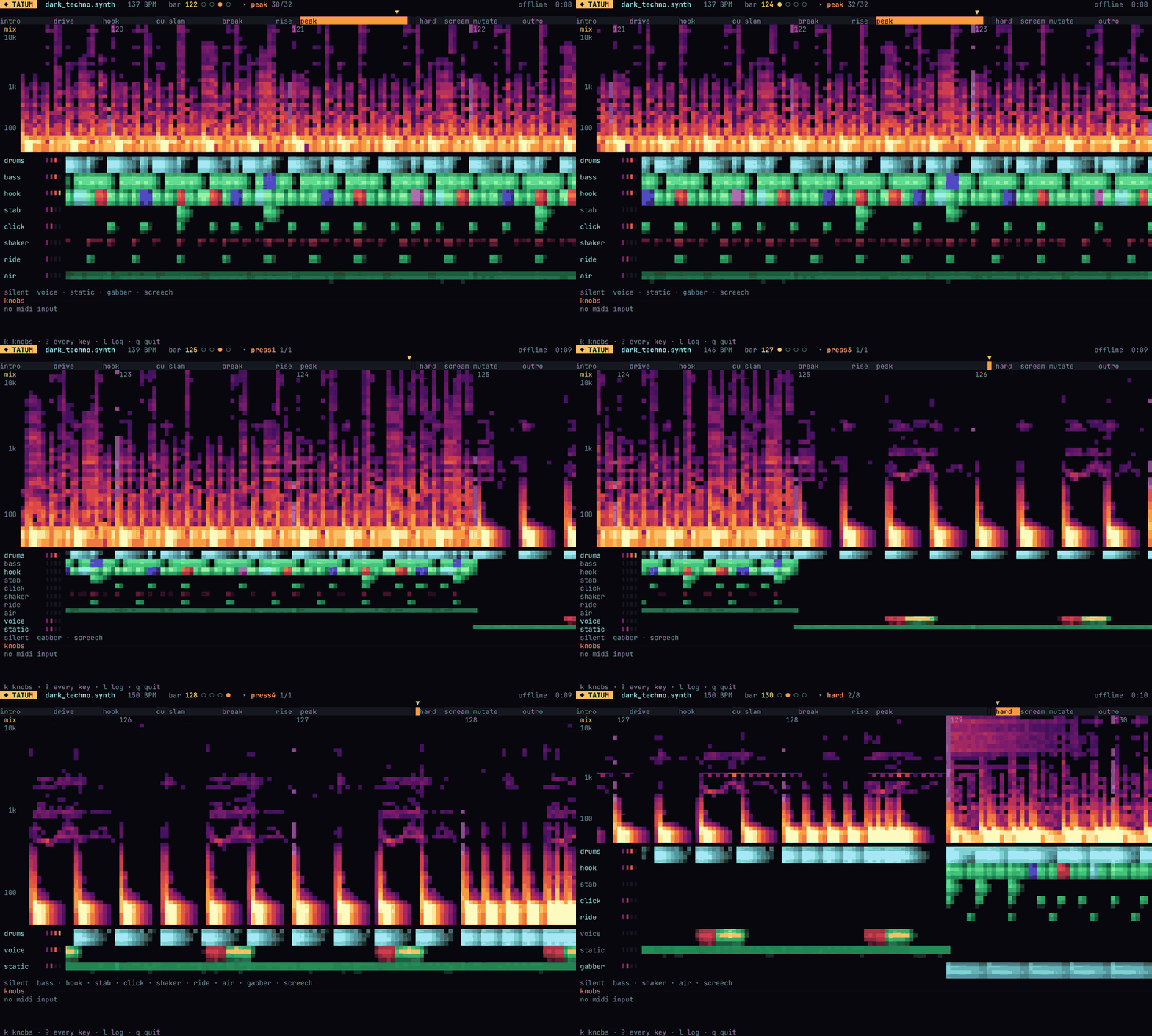
A track in a DAW lives in a project file nobody can read. In tatum a song is a page of
text: the instruments, the patterns, the scenes and the order they come in, in a.synth file you can read top to bottom, diff, review and keep in git.
Write it in your editor and leave tatum watch running beside it. Every save plays on
the next bar: a changed value at once, a new pattern or a new instrument handed over
with every tail still ringing. A save that does not compile is reported with its line
and a suggestion, and the last good version keeps playing, so the music never stops
while you think.
When it is ready to leave the editor, it goes on stage. A set is a folder of steps,
each the whole rig at a moment. A pad moves to the next one on the next phrase, the
knobs of a MIDI controller ride the parameters, and the live screen shows what every
track is doing. When something sounds wrong, tatum debug pulls the mix apart, part by
part, to find where.
Why "tatum"
A tatum is the smallest regular pulse a listener hears in a piece of music: the
finest grid its notes fall on. The word was coined by Jeff Bilmes in 1993, from
temporal atom, in honour of the jazz pianist Art Tatum, whose runs were so fast
and so even that they seemed to divide time finer than anyone else.
That grid is where this project lives. A tatum pattern is a row of steps, sixteen to a
bar of 4/4, and every note, every hit, every slide and every parameter lock lands on
one of them. The engine counts in tatums, swing bends them, and the live session waits
for the next bar line, a multiple of them, to swap in what you saved.
What is in it
- A language that checks your music the way a compiler checks code. Errors carry
their line and a suggestion; design warnings catch what compiles but will not sound
the way it reads, such as a breakdown louder than its drop. - A synthesizer in Rust,
no_stdand with no dependencies. Four Volca-style
instruments (acid bass, 4-op FM, poly keys, drum machine) plus instruments built from
nodes, a 16-step sequencer with swing, ties, slides, an arpeggiator and parameter
locks, insert and send effects, and every song leaving at the same loudness. - Live coding.
watchhot-swaps each save on the next bar; patterns transform
TidalCycles-style (rev,fast 2,every 4 rev,degrade 30%) from the text or
from a key. - Live sets and a controller. A set is a folder of steps, played with tempo ramps
and DJ-style blends; amidiblock maps knobs, keys and pads to the song. - Tools that listen.
renderreports the mix section by section,debugrenders
every part apart with spectrograms and finds clicks and mud,auditmeasures every
note for what is not its harmonics, andanalyzeandcomparemeasure a record you
want to sound like -- its kick's note, sweep and decay, its spectrum and density --
and say what in your file to change to get there. - A sound designer.
tatum designopens one instrument in the browser: a knob for
every argument, the sound in a loop as they turn, its pitch and level drawn over
time against a record's averaged kick, and Save into asounds/library that songsuse. - Everywhere. A CLI, the browser through WASM, and an MCP server so an AI can write
songs with the compiler in the loop.
A song
Two instruments, two patterns, two tracks and two scenes: an acid line over a kick,
the filter opening as the drop goes on.
tempo 126
scale A minor
sidechain 0.4

module beats kit { kick_level 1.0 }
module bass acid {
    cutoff 400hz
    resonance 80%
    glide 0.18
}

pattern beat {
    kick:  X - - -  X - - -  X - - -  X - - -
    hat:   - - x -  - - x -  - - x -  - - x -
}
pattern line {
    1.2  ~1.2  -  1.2   ~5.2  -  ~7.1  -
    1.2  -     -  ~3.2  ~1.2  -  5.1   ~1.2
}

track drums { play beat using kit out > master }
track acid  { play line using acid level 0.6 delay_send 0.2 out > saturate(0.4) > master }

scene intro { track drums { play beat using kit } }
scene drop {
    auto acid cutoff 0.2 > 0.6
    track drums { play beat using kit }
    track acid  { play line using acid }
}
arrange { intro x4  drop x8 }
Getting started
You need Rust (stable). On Linux, audio output needs ALSA headers
(sudo apt install libasound2-dev); the WASM build needs the wasm32-unknown-unknown
target and, for a browser bundle, wasm-pack.
cargo run -p tatum-cli -- check examples/acid_arp.synth
cargo run -p tatum-cli -- render examples/acid_arp.synth -o acid_arp.wav
cargo run -p tatum-cli -- params bass
cargo run --release -p tatum-cli -- play examples/acid_arp.synth
cargo run --release -p tatum-cli -- watch live.synth     # re-evaluates on every save
cargo run --release -p tatum-cli -- watch live.synth --tui   # the same, full screen
cargo run --release -p tatum-cli -- debug examples/acid_arp.synth --solo acid
What the CLI does
| command | what it does |
|---|---|
check |
compile a song and report errors and design warnings, without sound |
render |
render a song to a WAV, with a report of the mix |
play, watch |
play a song live; watch swaps in each save on the next bar, and a save that does not compile is reported while the last good version keeps playing |
debug |
render every part apart, with spectrograms and a report of clicks and mud, bar by bar |
audit |
measure every note of every tonal track for what is not its harmonics |
analyze, compare |
measure a record you want to sound like; compare your song with it and say what to change |
set |
render, check, gate and play a live set |
tui-shot |
a picture of the live screen at any second |
params, fmt |
the parameter reference; knob positions rewritten in their units |
play, watch and set play read MIDI: a midi block puts the song on a controller,
knobs and faders on its parameters (cc 74 > acid cutoff), the keys on a track, the
pads on drums. Every flag is in docs/CLI.md.
The live screen
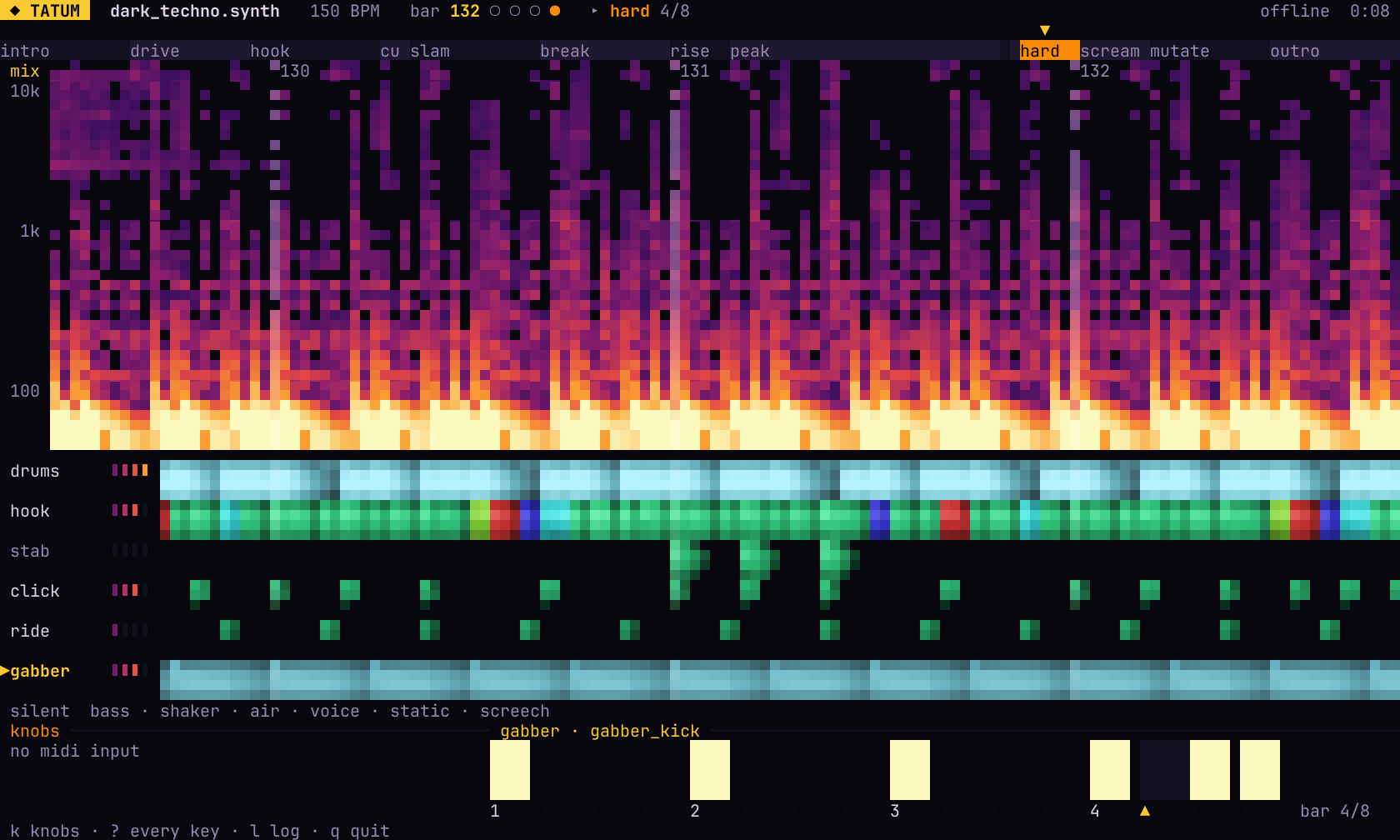
--tui runs play, watch and set play full screen, for half a terminal with the
editor in the other half: the bar and the scene, the arrangement or the set's steps, the
mix as a scrolling spectrogram, a lane per track, the chosen track's pattern, the knobs
as they turn, and a save that did not compile, in red, until one does. Its keys mute,
solo and transform the tracks, writing the words into the file (rev, fast 2,every 4 rev), and put knobs on them. See docs/TUI.md.
Finding a noise
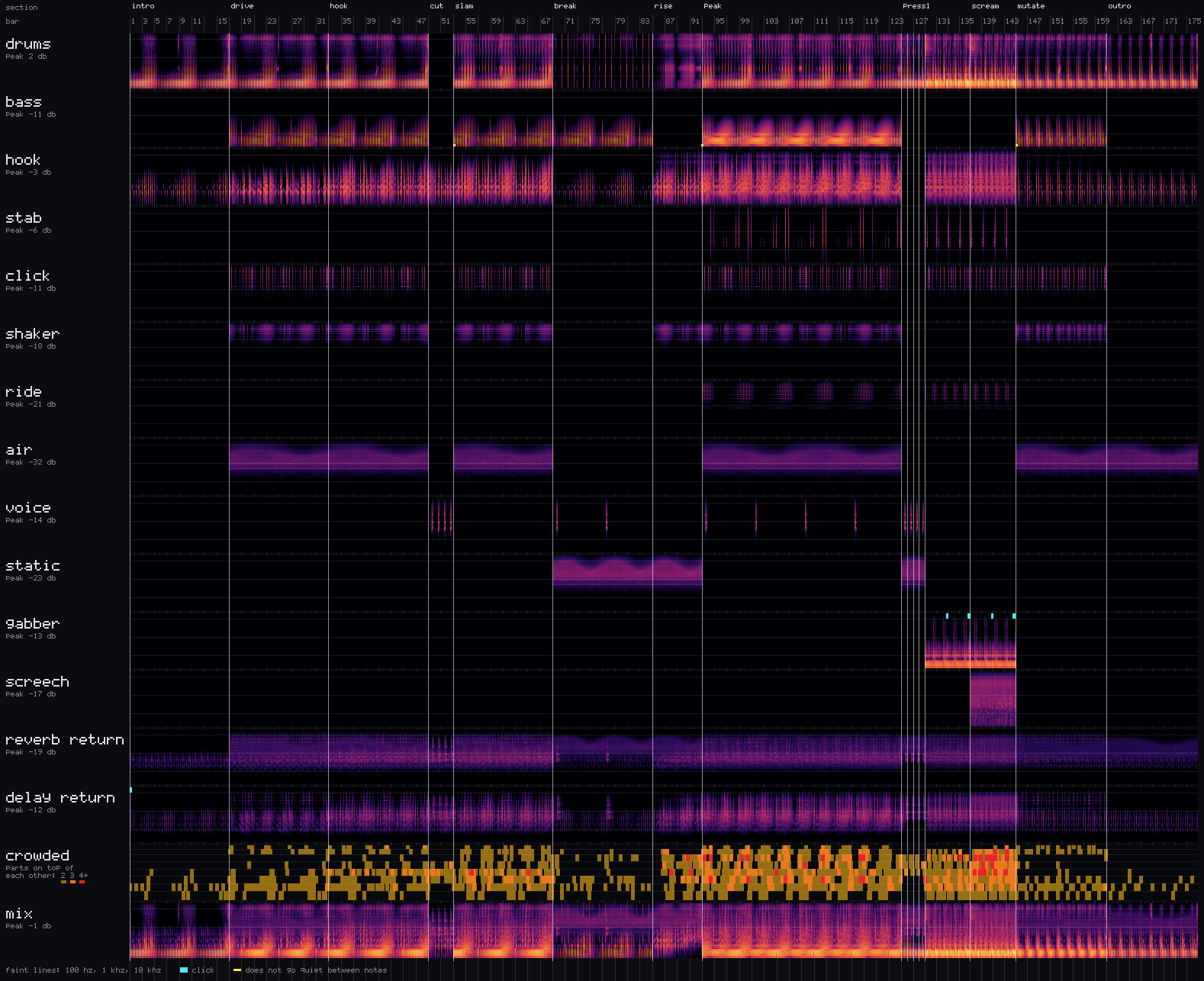
tatum debug renders once with every part kept apart and stacks them on one time axis
over the mix, with the sections on top, the clicks marked and a strip where three or
more parts pile up on the same range.
Where to go next
docs/DSL.md: the language reference.docs/CLI.md: every command and its flags.docs/TUI.md: the live screen, its keys, and pictures of it.docs/MIX.md: how to read whatrenderandauditreport.docs/HARDWARE.md: what a song asks of a machine, and which Raspberry Pi or microcontroller can play it.docs/PARAMS.md: every module parameter (generated bytatum params).docs/MCP.md: the MCP server that lets Claude write songs with the compiler in the loop.docs/design/live-engine.md: what it takes to play the engine live, measured; the design of the live session.examples/: songs across genres; each one compiles and renders.examples/rigs/: rigs, not songs — a full instrument with every optional voice atlevel 0and every effect atwet=0, waiting to be faded in. A set is built on one.- Editors: syntax highlighting for Zed in
zed-tatum, on the tree-sitter grammar in
tree-sitter-tatum. sets/: live sets. A directory of numbered.synthfiles, each the whole rig at a
moment, walked the way it is played (hot swaps, blends, tempo ramps) bytatum set renderand played live bytatum set play, a key or a pad moving to the next step on the next phrase.
Workspace: core (engine, DSL, registry), cli, debug (the analysis behind tatum debug), mcp, wasm (browser bindings; wasm/examples/worklet/ runs them in an
AudioWorklet).
License
Licensed under either of Apache License, Version 2.0 or
MIT license at your option. Unless you explicitly state otherwise, any
contribution you submit for inclusion in this project, as defined in the Apache-2.0
license, shall be dual licensed as above, without any additional terms or conditions.
Reviews (0)
Sign in to leave a review.
Leave a reviewNo results found