okf
Health Pass
- License — License: Apache-2.0
- Description — Repository has a description
- Active repo — Last push 0 days ago
- Community trust — 131 GitHub stars
Code Pass
- Code scan — Scanned 12 files during light audit, no dangerous patterns found
Permissions Pass
- Permissions — No dangerous permissions requested
No AI report is available for this listing yet.
OKF (Open Knowledge Format): durable, structured memory for AI agents. This ecosystem includes: Agent Skills, MCP, Interactive Graph, TUI, CLI, Docker, and the Claude Code plugin to author, validate, consume, and maintain portable knowledge bundles - 100% local.
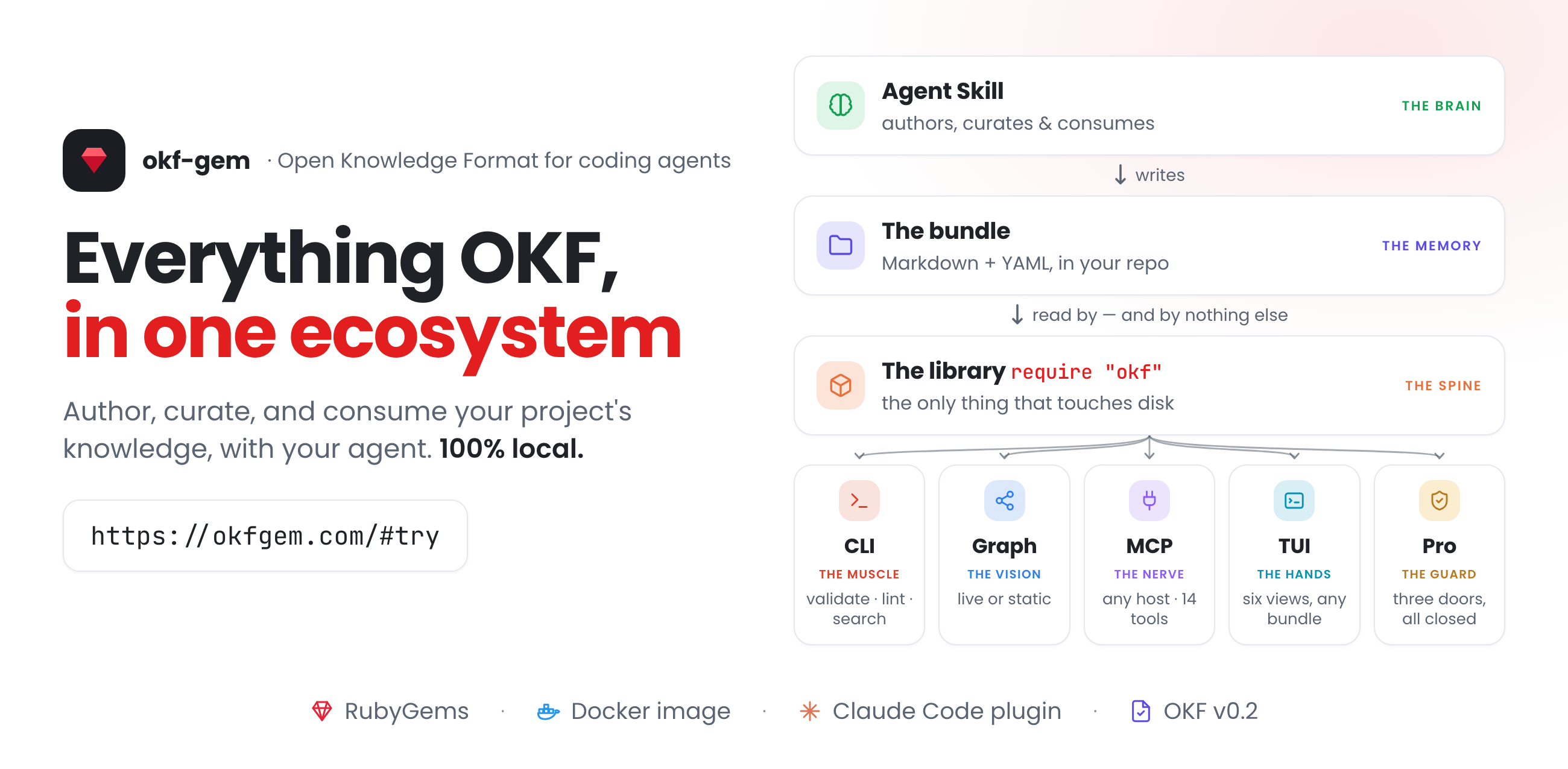







Site · Docs · Live demo · Claude plugin · Docker image
Your coding agent works out how your system fits together — why the service
exists, what the metric actually measures, which line of the schema is
load-bearing — and then the session ends and all of it is gone. Next session it
works the same things out again, from the same code, and reaches slightly
different conclusions.
okf gives that reasoning somewhere to live. Plain Markdown files in your
repo, next to the code they explain, written and kept current by the agent
itself rather than by you.
It adds nothing to your stack. No database, no service, no new place to keep
knowledge — just files, reviewed in the same pull request as the code. If you
stop using okf tomorrow, everything it wrote is still Markdown your team can
read.
See it in sixty seconds
This repository documents itself in OKF, so you can walk a real bundle before
installing anything:
gem install okf
git clone https://github.com/serradura/okf && cd okf
okf server .okf          # the whole ecosystem as an interactive graph
No Ruby on the machine? The published image runs the same commands —
docker.okfgem.com. Or skip the clone entirely and
open demo.okfgem.com.
Why it doesn't rot
Notes decay because keeping them current is a separate act from doing the work.
Here it isn't:
- The agent writes it, not you. An Agent Skill ships with the gem, so
curation happens inside the work rather than after it. - Drift is a failing build.
okf validateandokf lintreturn exit codes,
so a stale or malformed bundle breaks CI the same way a broken test does. - The agent reads only what it needs.
okf indexreads the map andokf searchpulls the handful of files a task touches, so the knowledge
outgrows the context window instead of filling it.
How it compares
Knowledge already has several homes near an agent, and each holds something
different. None of the others is built for curated, durable team knowledge:
| OKF bundle (this) | CLAUDE.md / AGENTS.md |
Agent auto-memory | Wiki / Notion | |
|---|---|---|---|---|
| Holds | curated team knowledge | standing instructions | what one agent picked up | human docs |
| Versioned with the code | ✅ | ✅ | ❌ | ❌ |
| Portable across agents | ✅ plain Markdown + YAML | ⚠️ per-harness conventions | ❌ per-agent store | ⚠️ export needed |
| Typed and queryable | ✅ frontmatter + graph | ❌ prose | ❌ | ⚠️ partially |
| Reviewed in PRs | ✅ | ✅ | ❌ implicit | ⚠️ rarely |
| Scales past one context window | ✅ progressive disclosure ( okf index + search) |
❌ loaded whole | ⚠️ partially | n/a |
| Checked by tooling | ✅ exit codes for CI ( okf validate + lint) |
❌ | ❌ | ❌ |
The last two rows are this gem's job.
OKF is an open, vendor-neutral format (Google Cloud, 2026). This
repository is a complete implementation of it — skill, CLI, library, graph and
MCP server — distributed as a gem, a Docker image, and a Claude Code plugin.
What a bundle looks like
A bundle is just a directory; each concept is one Markdown file whose path is its
id. This repo documents itself in OKF, so the tree below is real:
.okf/
├── index.md                       # progressive-disclosure map (root carries okf_version)
├── log.md                         # ISO-dated change history, newest first
├── overview.md
├── gems/okf-mcp.md                # one concept = one file
├── decisions/monorepo-layout.md
└── format/frontmatter.md
The only hard requirement is YAML frontmatter with a non-empty type; everything
else is optional and tolerated when missing. A concept reads as below — this is
the real capabilities/graph-server.md from the baseline gem's own bundle,gems/okf/.okf/, with its body trimmed:
---
type: Capability
title: Interactive graph server (server)
description: A self-contained HTML knowledge graph — served over HTTP as a mountable Rack app, one bundle or many behind a hub, or written to a single static file.
resource: gems/okf/lib/okf/server/app.rb
tags: [server, graph, rack, diagram]
generated:
  by: human:maintainer
  at: 2026-08-13T12:00:00Z
---

# Overview

`okf server` boots an interactive view of the [graph](../model/graph.md) …
The .okf/ above is the ecosystem's map — a concept per gem, per plugin
item, per skill — and each gem carries its own bundle beside its code. Clone the
repo and run okf server .okf to browse the map as an interactive graph, orokf server gems/okf/.okf for the baseline gem's.
Trust, provenance, and lifecycle — OKF v0.2
Knowledge written continuously by agents raises questions a static corpus never
had to answer: who wrote this, who checked it, is it still current? OKF v0.2
makes them frontmatter — generated (who produced the content, and when),verified (who confirmed it, deriving the trust tier every surface shows:
unverified · machine-confirmed · human-reviewed), sources with per-claim
footnote attribution, status, and stale_after — and this gem reads all of
it: as catalog columns and --status/--trust filters,
as the graph page's third visual channel, and as
lint's provenance, attestation and
migration findings. Every family is optional, and a v0.1 bundle keeps reading
forever — two lint findings tell you exactly what a migration would change,
and never fail you for not having done it.
The whole ecosystem
One install carries the whole workflow, and that is the point:
- an Agent Skill, so your agent writes and curates the knowledge instead of you;
- a CLI and Ruby library, so it stays correct: validated, linted, and searchable in milliseconds;
- a Graph, so anyone can see the shape of what the team knows, live or as one static file you can host anywhere.
Three sibling gems extend that same command rather than adding another one:
okf mcp(okf-mcp) serves your bundles to any MCP host — fourteen read tools, over stdio or Streamable HTTP;okf tui(okf-tui) reads one bundle or every registered one, in a full-screen terminal UI;okf pro(okf-pro) writes an agent's knowledge repository — bundle, hooks, pre-commit, CI, skill — and then enforces it at three doors.
gem install okf-pro and you type okf pro. Packaging multiplies; the
interface does not, and a sibling ships no second binary to learn.
How the pieces fit together
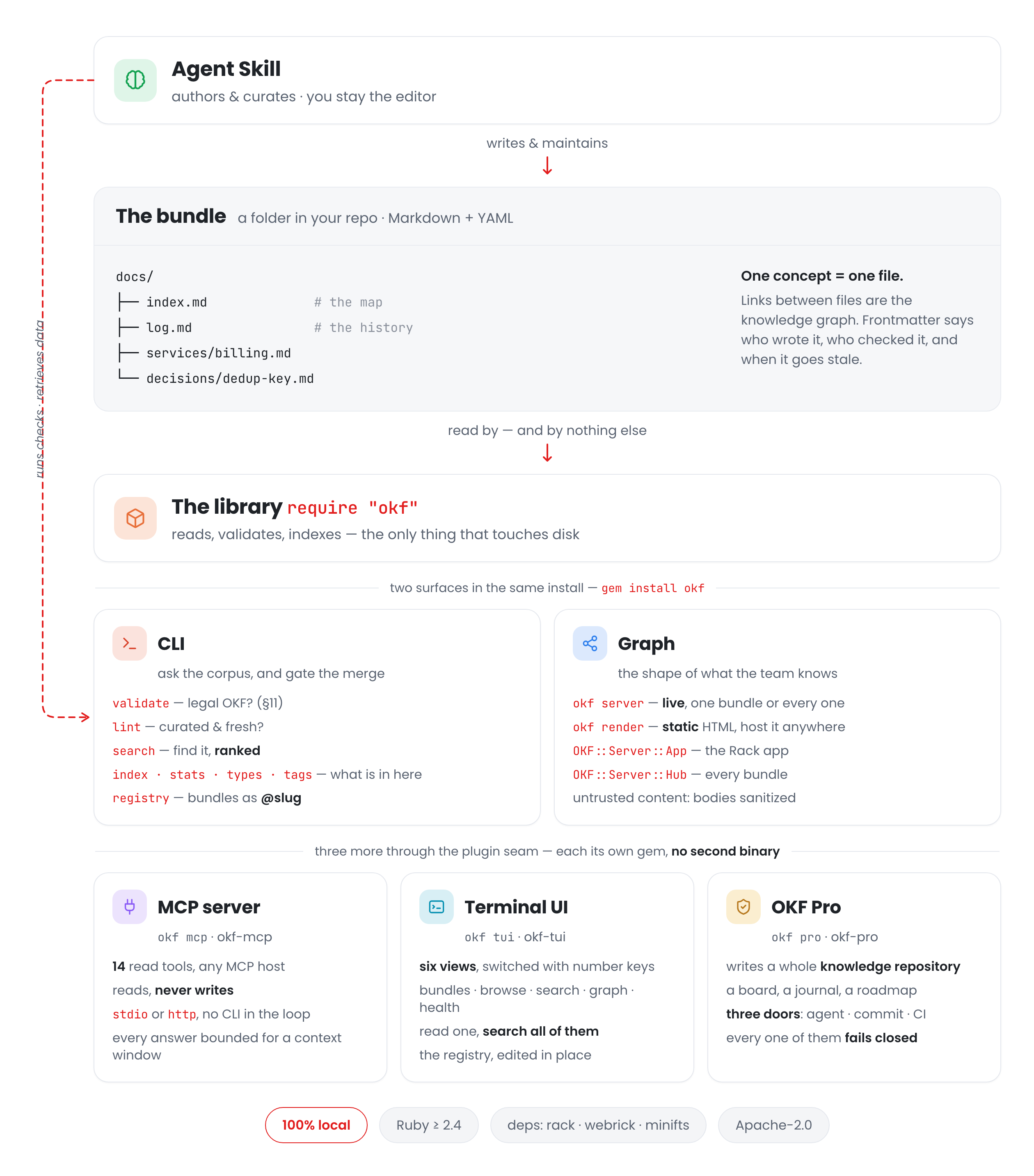
The picture is the baseline gem — the kernel, and the CLI, Graph and MCP
surfaces over it. okf tui and okf pro arrive through the same plugin seam,
and every door is listed in
What is in this repository.
[!TIP]
Browse this repository as knowledge, not just docs. This README is the
front door; the depth lives in the five OKF bundles it carries. Start at the
ecosystem map — the gems, the plugin,
the skills, the decisions and the
format itself — then open a gem's own bundle for its code:gems/okf/.okf/. Runokf server .okfto walk the map as an
interactive graph, orokf search @all <term>to reach every bundle at once.
It installs on the Ruby your OS already ships — every Ruby since 2.4, three
small dependencies, no native extension and no build step — so there is nothing
to provision and nothing to keep up to date. The
design constraints that hold that line are enforced by
tests on every supported Ruby.
What is in this repository
Every top-level name is a boundary, and the whole menu is one row each. A
directory under gems/ is a gem, named for the gem it ships; everything else at
the root is named for what it is.
| Door | What lives there |
|---|---|
gems/okf/ |
the okf gem — the agent skill, the CLI and library, ranked search, the graph. Everything above describes this one |
gems/okf-mcp/ |
okf mcp — the MCP server over the same kernel: 14 read tools, any MCP host |
gems/okf-tui/ |
okf tui — the full-screen terminal UI, over one bundle or every registered one |
gems/okf-pro/ |
okf pro — writes an agent's knowledge repository, then enforces it at three doors |
plugin/ |
the Claude Code plugin: that skill, /okf:gem, and a post-edit curation hook |
.claude-plugin/ |
the marketplace manifest — this repository is its own marketplace |
skills/ |
the skills a generic installer reads: okf, and okf-principles |
resources/ |
copy-paste recipes — today, CI that validates and lints your bundles on every push |
.okf/ |
the ecosystem map: a concept per gem, per plugin item, per skill — plus the decisions and the format |
.okf-registry.json |
every bundle in this tree, addressable as @slug from anywhere in it |
Dockerfile |
builds the published image from gems/okf/, from a root build context |
.github/ |
the CI workflows, and the images this page renders |
.claude/ |
one line, pointing Claude Code at AGENTS.md |
The graph
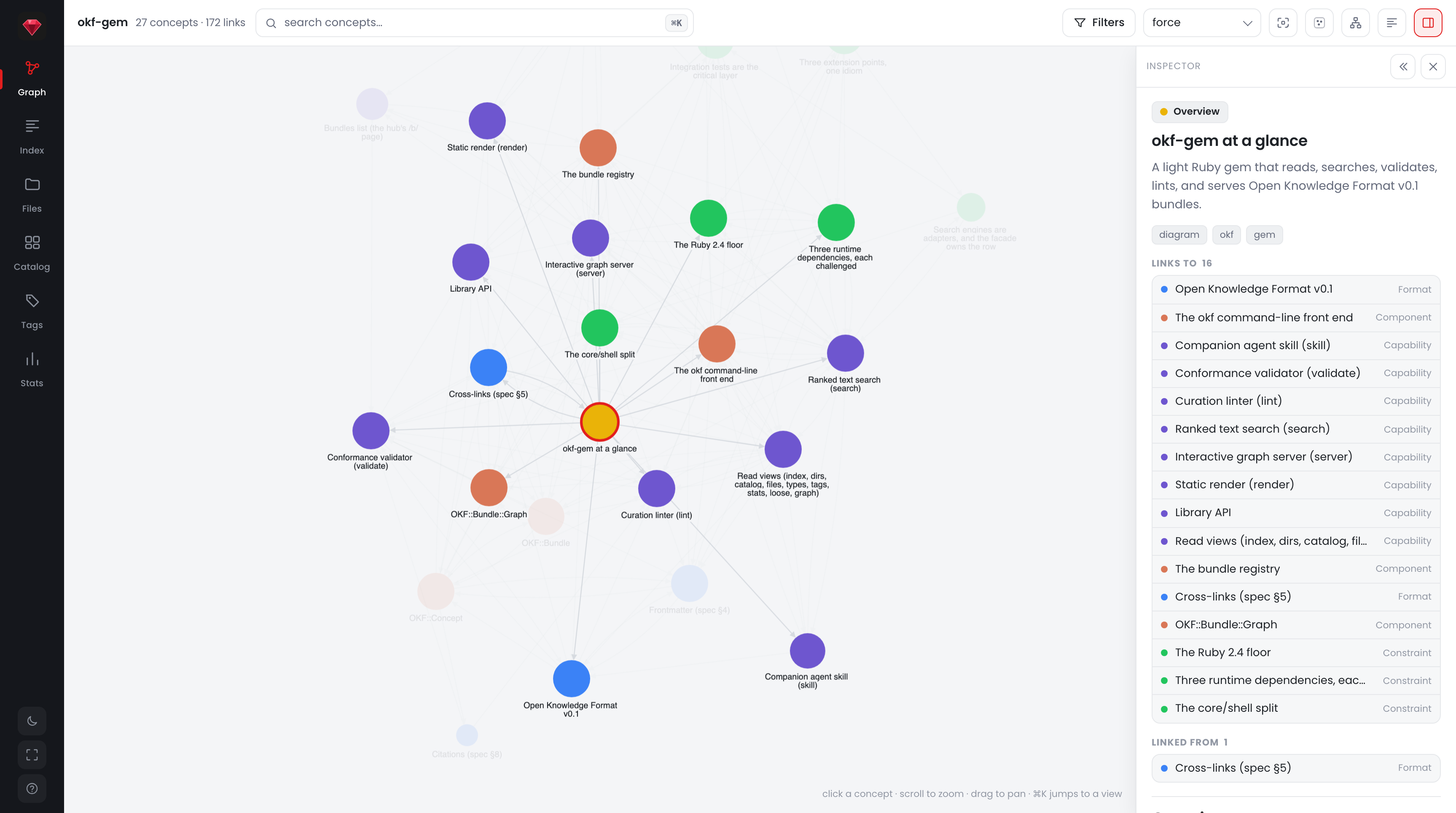
The graph server on this repo's own .okf bundle, with the overview
concept selected. Try it live at
demo.okfgem.com.
What the page does, and how okf render bakes the same thing into one static
file: gems/okf/README.md.
Claude Code plugin
This repository doubles as a Claude Code plugin marketplace, so the whole
toolchain installs with two commands inside Claude Code:
/plugin marketplace add serradura/okf
/plugin install okf@okfgem
The plugin carries three pieces: the okf skill;/okf:gem, a front door that hands its arguments to the skill unchanged (no
arguments: it orients on your bundle and recommends the next move, never
auto-runs); and a curation hook that runs okf validate + okf lint after
every edit inside a bundle and returns the findings as context. The checks are
the CLI's own, so the feedback is deterministic.
The hook stays silent outside bundles, and it is config-free to switch off:OKF_CURATE_DISABLED=1 turns it off, OKF_CURATE_QUIET=1 keeps the findings
without the install suggestion, and an <!-- okf-disable --> comment skips one
file.
Prefer no plugin? gem install okf && okf skill .claude installs the skill
alone, and the skill itself instructs the agent to run the same checks after
editing a bundle.
The skill, without the gem
Without the gem, any agent that reads SKILL.md installs it straight from
this repository:
npx skills add serradura/okf                          # choose from the list
npx skills add serradura/okf --skill okf -a codex     # or name skill and agent
That path installs a generated copy — rake skill:sync writes it from the same
canonical tree the gem ships, and the build fails on any drift — so it tracks
this repository rather than the okf on your machine. okf-principles sits
beside it: the five structural principles the format implies, written to be
pointed at any instruction artifact rather than at a bundle.
Extending okf, and running it safely
Publish a gem named okf-* carrying an okf/plugin.rb and installing it is the
whole installation: your verb answers to okf and behaves like a built-in.
Nothing an addon registers can displace one, and a broken addon is skipped rather
than taking the CLI down. The three siblings above arrive exactly this way —okf-mcp, okf-tui and okf-pro each ship an okf/plugin.rb and no
executable of their own — and none of them needs a line of the baseline to know
it exists. Yours would be the fourth, on the same terms.
Contract and threat model:
extension points.
The graph page treats a bundle as untrusted content: inlined data is escaped, and
every concept body is sanitized before it reaches the DOM, so a script hidden in
Markdown is stripped rather than run. It still loads libraries from a CDN, so
treat an unfamiliar bundle the way you would treat any document from a source you
do not know. Full write-up:
server trust boundary.
Development
From the repo root — plain rake, there is no root Gemfile:
rake              # every gem's default task (tests + RuboCop), then the repo-level lint
rake test         # every gem's test suite
rake okf          # validate + lint every registered .okf bundle
rake serve        # browse this project's own bundle as a graph
From any gem's directory, for work on that gem — cd gems/okf-mcp, cd gems/okf-tui or cd gems/okf-pro follows the same three commands, and each has
its own README and CI job. From gems/okf, for work on the baseline itself:
cd gems/okf
bin/setup               # install dependencies
bundle exec rake        # tests + RuboCop (what CI runs)
bundle exec rake test   # just the test suite
ruby -Ilib exe/okf validate <dir>   # run the CLI from a checkout
The suite runs on every supported Ruby; to check the 2.4 floor locally, from the
repo root:
docker run --rm -v "$PWD":/src:ro ruby:2.4 bash -c \
  "cp -a /src /build && cd /build/gems/okf && rm -f Gemfile.lock && bundle install --quiet && bundle exec rake test"
The graph page has its own suite in a real browser (bundle exec rake browser:setup, then rake test:browser, both from gems/okf/). See
AGENTS.md for the maintainer guide.
Contributing
Bug reports and pull requests are welcome on GitHub at
https://github.com/serradura/okf. This project is intended to be a safe,
welcoming space for collaboration, and contributors are expected to adhere to
the code of conduct.
License
The gem is available as open source under the terms of the
Apache License 2.0 (seeLICENSE.txt). The Open Knowledge Format specification bundled with the skill
is authored by Google Cloud Platform and included under its own Apache-2.0
license, Copyright (c) Google LLC. See NOTICE andokf/lib/okf/skill/reference/APACHE-2.0.txt.
okf-skills by Marco Boffo, a Python
OKF toolkit for Claude Code with a feature-rich interactive graph view, was an
early inspiration for this gem's Claude Code plugin and for the knowledge-as-code
comparison in How it compares. okf takes a different shape: a Ruby-native
gem built around the okf CLI and an embeddable library.
Reviews (0)
Sign in to leave a review.
Leave a reviewNo results found