Deep-Matter-Chem-Skills
Health Uyari
- License — License: MIT
- Description — Repository has a description
- Active repo — Last push 0 days ago
- Low visibility — Only 5 GitHub stars
Code Gecti
- Code scan — Scanned 9 files during light audit, no dangerous patterns found
Permissions Gecti
- Permissions — No dangerous permissions requested
Bu listing icin henuz AI raporu yok.
Reference-audited AI coding-agent skill library for computational chemistry, materials modeling, atomistic simulation, scientific ML, and related workflows.
Deep Matter Chem Skills
A production-oriented library of domain-grounded skills for AI coding agents working across computational chemistry, materials science, atomistic simulation, scientific machine learning, continuum modeling, and related research domains.
Each skill captures method assumptions, selection guidance, practical workflows, failure diagnostics, validation requirements, and connections to adjacent skills.
Browse Skills • Quickstart • Use with AI Agents • Contribute
Repository at a Glance
| Current catalog | Active pillars | Browse |
|---|---|---|
| 55 skills | 15 pillars | Open the generated catalog |
Latest reference-audited release: v0.2, containing 52 production-usable support skills.
| Repository check | Status |
|---|---|
| Structural validation | Passing for the current catalog |
| Internal cross-references | Zero broken skill links |
| Reference and DOI audit | Completed for the 52-skill v0.2 release snapshot |
| Expert review | Ongoing; all skills currently remain at draft maturity |
Quality tiers and maturity labelsThis library supports scientific workflow design, implementation, debugging, and review. It does not replace domain expertise, convergence testing, experimental validation, or final scientific judgment.
| Term | Meaning |
|---|---|
| production-usable support skill | Structurally complete, internally linked, and ready to support Claude Code, Codex, or manual workflows. |
| validated skill | Independently reviewed by a domain expert and promoted beyond draft. No skills have reached this tier yet. |
The current draft tier means required sections, metadata, workflows, failure modes, and references are present, while independent expert review remains open. [EXPERT REVIEW NEEDED] markers identify claims that require additional scrutiny.
Who This Is For
This repository is intended for:
- Computational chemists and materials scientists using AI coding agents for DFT, MD, thermodynamics, or electrochemistry workflows.
- Atomistic simulation researchers working with LAMMPS, GROMACS, VASP, Quantum ESPRESSO, CP2K, AiiDA, or related tools.
- Scientific ML researchers building ML interatomic potentials, PINNs, surrogate models, or active-learning pipelines.
- Data scientists working with materials databases, featurization pipelines, or reproducibility workflows.
- Domain reviewers who can confirm, improve, or correct technical claims.
- Contributors who want to add new skills, improve existing ones, verify references, or expand the roadmap.
Quickstart
git clone https://github.com/SFETNI/Deep-Matter-Chem-Skills.git
cd Deep-Matter-Chem-Skills

# Regenerate the skill catalog
python scripts/generate_catalog.py

# Check all internal cross-references
python scripts/check_crossrefs.py

# Validate a single skill
python scripts/validate_skills.py skills/electronic-structure/vasp-workflow/SKILL.md

# Validate all skills
for f in $(find skills -name "SKILL.md" | sort); do
    python scripts/validate_skills.py "$f" || exit 1
done
How to Use These Skills with AI Coding Agents
Skills are plain Markdown files. Use them by loading the relevant SKILL.md files into the context of Claude Code, Codex, or another coding agent before asking the agent to generate, review, or debug workflow code.
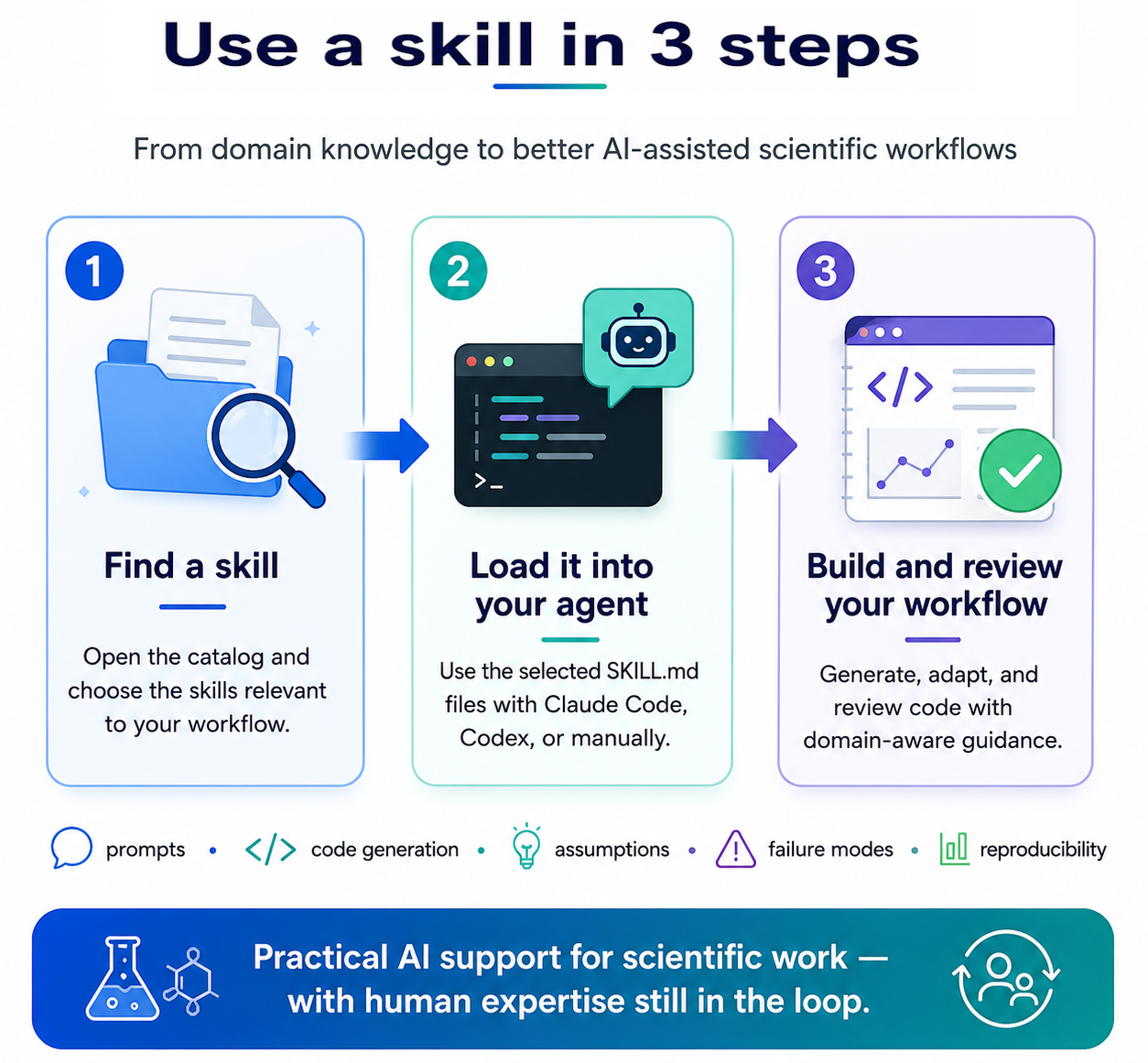
Claude Code
Open Claude Code in the repository root and ask it to read the relevant skills before working.
Example prompt:
Read skills/electronic-structure/vasp-workflow/SKILL.md and any linked prerequisite skills.
Use them as support material for workflow design and code generation.
Do not treat them as final authority.
Preserve [EXPERT REVIEW NEEDED] markers and flag assumptions that require domain review.
For repository edits, ask Claude Code to run the validation scripts before committing:
After editing, run generate_catalog.py, check_crossrefs.py, and validate all changed skills.
Report files changed, validation status, catalog count, and cross-reference status.
Codex or Other Coding Agents
Open the repository in the agent workspace and explicitly point the agent to the relevant skills.
Example prompt:
Before writing code, inspect:
- skills/ml-interatomic-potentials/mace-training/SKILL.md
- skills/ml-interatomic-potentials/mlp-validation/SKILL.md
- skills/scientific-data/reproducibility-workflow/SKILL.md
Use these skills as implementation guidance.
Report any assumptions, uncertain claims, and required validation steps.
For changes to the repository, require the agent to report:
- Changed files.
- Validation commands run.
- Catalog count.
- Cross-reference status.
- Any new
[EXPERT REVIEW NEEDED]markers. - Any references added or corrected.
Manual Use Without an Agent
- Open docs/skills-catalog.md.
- Identify the skills relevant to your workflow.
- Read the relevant
SKILL.mdfiles. - Use the workflows, failure modes, best practices, and references as structured checklists.
- Check assumptions and parameter choices against your system, software version, and domain requirements.
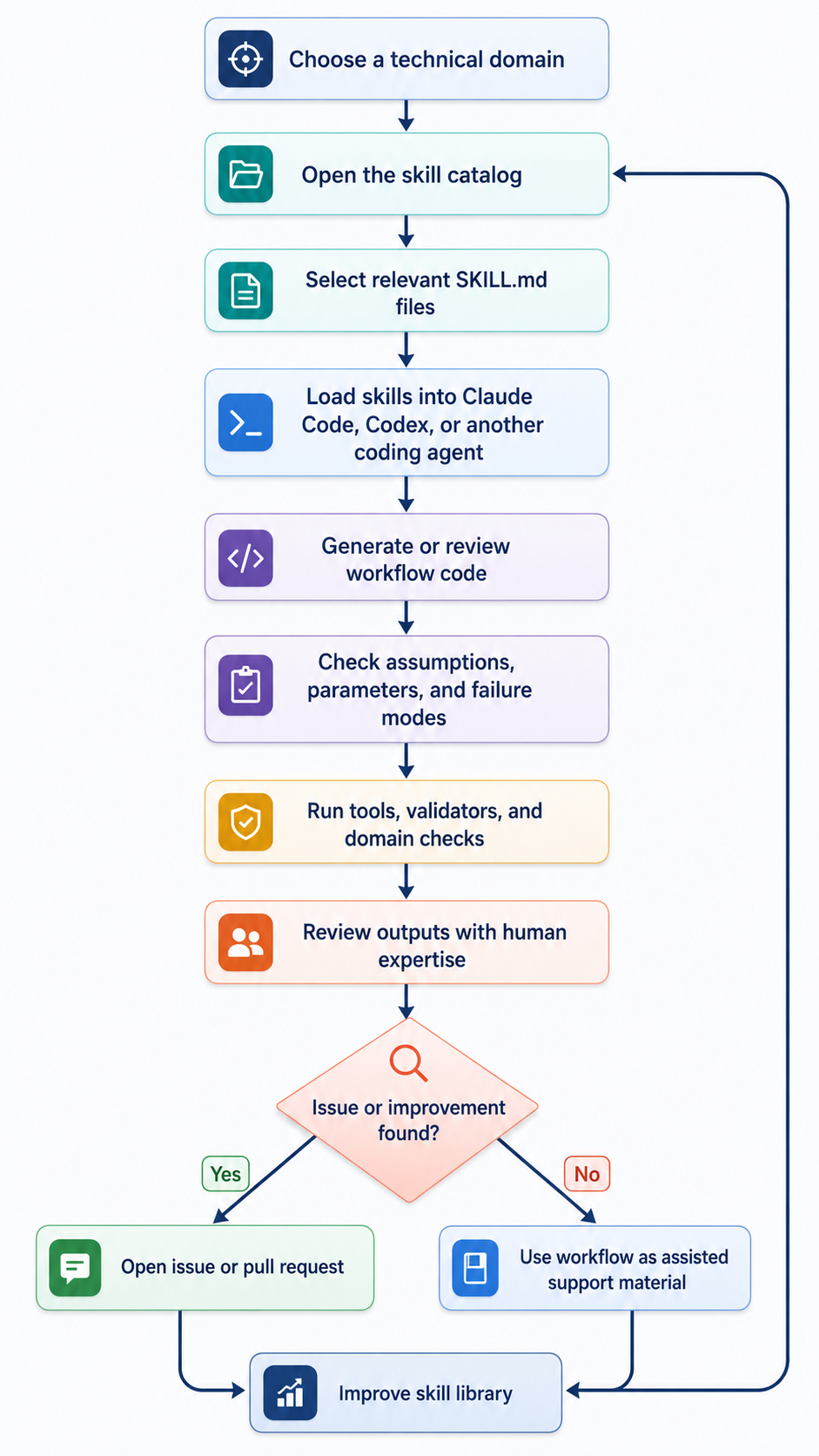
The skills support reasoning, implementation, review, and diagnostics. They do not replace expert judgment, physical validation, convergence testing, or experimental confirmation.
Pillars Currently Covered
| Pillar | Skills | Domain coverage |
|---|---|---|
electronic-structure |
11 | VASP, Quantum ESPRESSO, CP2K, AiiDA, DFT convergence, phonons, surfaces, defects, high-throughput DFT, EOS fitting |
atomistic-md |
9 | GROMACS, LAMMPS, force fields, equilibration, free energy, enhanced sampling, coarse-grained MD, reactive MD |
ml-interatomic-potentials |
8 | MACE, NequIP, universal potentials, fine-tuning, active learning, validation, uncertainty, LAMMPS deployment |
scientific-data |
6 | ASE, pymatgen, materials databases, featurization, visualization, reproducibility |
geometric-deep-learning |
3 | Crystal GNNs, molecular GNNs, MatGL/M3GNet |
surrogate-active-learning |
3 | Gaussian processes, Bayesian optimization, surrogate validation |
scientific-ml |
2 | PINNs, small-data ML |
electrochemistry-corrosion |
2 | Battery materials workflows, corrosion and electrochemistry |
cheminformatics |
3 | Molecular featurization, molecular datasets |
thermodynamics-calphad |
1 | CALPHAD workflows |
sustainability-lca |
1 | Materials life-cycle assessment |
phase-field-microstructure |
1 | Cahn-Hilliard and Allen-Cahn workflows with FiPy |
continuum-modeling |
3 | FEM multiphysics |
computational-chemistry |
1 | Molecular quantum chemistry workflows with ORCA, xTB, TDDFT |
generative-matter |
1 | Crystal diffusion generative models, including MatterGen and DiffCSP |
Skill Catalog
The full catalog is available at docs/skills-catalog.md.
The catalog is generated automatically and lists every skill with its pillar, maturity, tools, GPU requirement, and estimated runtime.
Regenerate after adding or modifying skills:
python scripts/generate_catalog.py
Maturity Model
Skills use five internal maturity labels:
planned → stub → draft → validated → flagship
The current release uses draft as the entry-level production-support tier. In this repository, draft means:
- the skill is structurally complete;
- required sections and metadata are present;
- workflows, failure modes, and references are included;
- internal links resolve;
- the skill remains open to independent expert review.
draft does not mean the skill is unusable. It means the skill has not yet been promoted through documented external review.
See docs/maturity-model.md for promotion criteria and tier definitions.
Review Status
The repository is intentionally transparent about review status.
| Review surface | Current status |
|---|---|
| Structural validation | Passing for the current catalog |
| Internal cross-references | Zero broken skill links |
| Catalog generation | Generated from the current skill tree |
| Expert review | Ongoing; community review welcome |
| Reference and DOI audit | Completed for v0.2; corrections still welcome |
| Maturity promotions | No skills promoted beyond draft yet |
Many skills intentionally contain [EXPERT REVIEW NEEDED] markers. These markers identify parameter choices, software-version details, reference-sensitive claims, and domain-specific recommendations that benefit from additional expert review.
The project owner has reviewed selected skills in areas aligned with his expertise, including materials modeling, atomistic simulation, phase-field methods, FEM, CALPHAD, electrochemistry/corrosion, sustainability, and scientific ML workflows. Other skills remain open for specialist review.
Quality Checks
Three scripts cover the main verification surface:
| Script | What it checks |
|---|---|
scripts/validate_skills.py |
Schema, required sections, heading names, and front-matter fields |
scripts/generate_catalog.py |
Renders all skills to docs/skills-catalog.md |
scripts/check_crossrefs.py |
Confirms all internal SKILL.md links resolve to existing files |
Recommended checks before committing:
python scripts/generate_catalog.py
python scripts/check_crossrefs.py
for f in $(find skills -name "SKILL.md" | sort); do
    python scripts/validate_skills.py "$f" || exit 1
done
Reference Integrity
Citation and DOI metadata are part of the review surface.
If a reference title, DOI, author list, year, journal, or landing page does not match what is claimed in a skill, report it using the GitHub issue template for broken references:
Useful reports include:
- skill path;
- exact reference text;
- DOI or URL currently listed;
- expected paper title or authors;
- actual page opened;
- whether the reference supports a technical claim.
Roadmap
The v0.2 reference-audited release contains 52 skills. Development continues beyond that release snapshot, and the longer-term roadmap targets approximately 100+ skills across additional computational and materials-science domains.
Priority expansion areas include:
| Direction | Likely additions |
|---|---|
| Computational chemistry | Multireference methods, reaction path workflows, solvation models, NMR and spectroscopy |
| Cheminformatics | Reaction informatics, SMILES/SMARTS workflows, retrosynthesis tools |
| Reaction thermodynamics and kinetics | Cantera workflows, microkinetic modeling, TST/RRKM |
| Electrochemistry and catalysis | Electrocatalysis descriptors, Butler-Volmer workflows, explicit-solvent DFT |
| Continuum mechanics | Plasticity, fatigue, creep, fracture mechanics, homogenization |
| Process modeling and sustainability | LCA integration, TEA workflows, process simulation |
| Generative matter | Molecule generation, inverse design, property-conditioned generation |
| Scientific ML and operator learning | DeepONet, Fourier neural operators, graph-based surrogates |
| Experimental-data integration | EXAFS, XRD, PDF, experimental featurization pipelines |
| Materials informatics | High-throughput screening, feature importance, Pareto-front analysis |
Planned roadmap areas may be mentioned in prose before they exist as skills. Internal SKILL.md links should point only to skills that already exist in the repository.
Contributing
Contributions are welcome.
Useful contributions include:
- new skills in covered or uncovered pillars;
- improvements to workflows, examples, or failure-mode tables;
- corrections to numerical claims, convergence thresholds, or tool defaults;
- DOI and reference title corrections;
- expert reviews of skills containing
[EXPERT REVIEW NEEDED]markers; - roadmap suggestions and domain coverage proposals;
- validation, catalog, or tooling improvements.
GitHub issue templates and a pull request template are available. See CONTRIBUTING.md for contribution rules, skill authoring requirements, and the review process.
Release and Launch Notes
Release preparation materials are available in:
These documents describe the release checks, launch workflow, and post-launch priorities.
License
See LICENSE.
Yorumlar (0)
Yorum birakmak icin giris yap.
Yorum birakSonuc bulunamadi