shaders
Health Gecti
- License — License: MIT
- Description — Repository has a description
- Active repo — Last push 0 days ago
- Community trust — 1389 GitHub stars
Code Basarisiz
- rm -rf — Recursive force deletion command in packages/core/package.json
Permissions Gecti
- Permissions — No dangerous permissions requested
Bu listing icin henuz AI raporu yok.
WebGPU components for React, Vue, Svelte, Solid, JS & Framer
Shaders
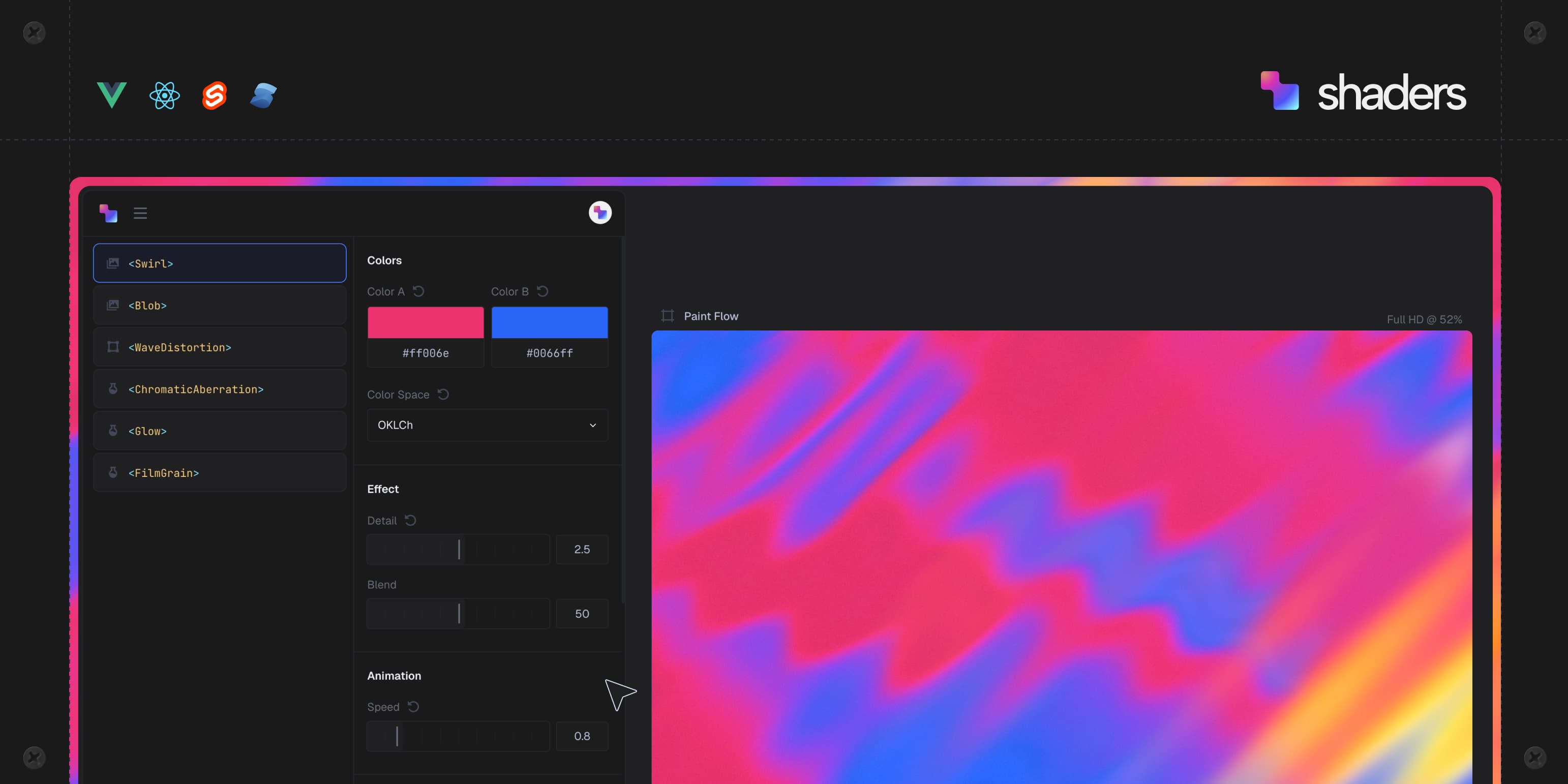
WebGPU effects as components
for React, Vue, Svelte, Solid and JavaScript


npm install shaders
Table of Contents
- Why Shaders?
- 🧩 Components
- 🎨 Design visually, export code
- ⌨️ CLI
- 🤖 Using Shaders with AI
- ⚡️ Shaders Pro
- 🧪 Build your own component
- 👩🏻⚖️ License
- 💎 Contribute
Why Shaders?
- Real WebGPU, declarative API: 200+ effects you drop in as components. Gradients, noise, glass, metal, light, distortions, transitions, blurs, cursor effects. Nest them, blend them, mask them.
- A design editor that writes your code: design on an infinite canvas at shaders.com, then export the exact component tree for your framework. Free.
- Every framework, one package: first-class React, Vue, Svelte, Solid and JavaScript entries, with the same props everywhere.
- Production-ready: TypeScript, extensively optimized, typed props with reactive updates, SSR safe. Used on thousands of websites by 16,000+ design engineers.
🧩 Components
Every effect is a component. <Shader> renders the canvas; its children are layers, evaluated top to bottom and blended on the GPU.
React
import { Shader, LinearGradient, CursorTrail } from 'shaders/react'

<Shader className="w-full h-64">
  <LinearGradient colorA="#0f172a" colorB="#7c3aed" />
  <CursorTrail />
</Shader>
Get started with Shaders for React.
Vue
<script setup>
import { Shader, LinearGradient, CursorTrail } from 'shaders/vue'
</script>

<template>
  <Shader class="w-full h-64">
    <LinearGradient colorA="#0f172a" colorB="#7c3aed" />
    <CursorTrail />
  </Shader>
</template>
Get started with Shaders for Vue.
Svelte
<script>
  import { Shader, LinearGradient, CursorTrail } from 'shaders/svelte'
</script>

<Shader class="w-full h-64">
  <LinearGradient colorA="#0f172a" colorB="#7c3aed" />
  <CursorTrail />
</Shader>
Get started with Shaders for Svelte.
Solid
import { Shader, LinearGradient, CursorTrail } from 'shaders/solid'

<Shader class="w-full h-64">
  <LinearGradient colorA="#0f172a" colorB="#7c3aed" />
  <CursorTrail />
</Shader>
Get started with Shaders for Solid.
JavaScript
import { createShader } from 'shaders/js'

await createShader(document.getElementById('my-shader'), {
  components: [
    { type: 'LinearGradient', props: { colorA: '#0f172a', colorB: '#7c3aed' } },
    { type: 'CursorTrail' },
  ],
})
Get started with Shaders for JavaScript.
Browse all 200+ components, each with a live preview and every prop documented.
🎨 Design visually, export code
Most people don't write their effects by hand. They design them.
The design editor at shaders.com is an infinite canvas where you stack components, tune every prop with real controls, drive props from the cursor or a timeline, and see the result live. When it looks right, Export Code gives you the component tree in your framework, ready to paste.
Design and export are free with an account. Your work is saved as projects you can come back to.
⌨️ CLI
The CLI connects a codebase to your Shaders account, so the effects you design land in your project as real component files and stay in sync.
npx shaders connect        # link this codebase to a Shaders project
npx shaders install        # pick shaders from that project; writes component files
npx shaders update         # pull in what you changed in the editor
It detects your framework, writes to your components folder, and records what it installed in a lock file. Nothing to install globally.
Read the CLI guide.
🤖 Using Shaders with AI
Give your coding agent the same tools you have:
- MCP server:
npx shaders@latest install-mcpconfigures Claude Code, Cursor, Codex, Windsurf, Copilot and others. Your agent can find, install and edit the shaders you design. Works on any account, free included. MCP guide. - llms.txt: shaders.com/llms.txt indexes every docs page, and shaders.com/llms-full.txt carries the full component reference with props, defaults and ranges.
⚡️ Shaders Pro
Everything above is free. Pro adds the library and the workflow around it:
- 1,000+ production-ready presets, organised into collections
- 55+ website sections, complete and ready to drop in
- HD video and image rendering without a watermark
- One-click install inside Framer with the Framer plugin
- Unlimited version history in the editor
- Pro presets through the CLI and MCP
- Exclusive Discord role and channel, priority support, all future updates
🧪 Build your own component
If you need a brand new component, you can write one. A component is a plain object passed to defineShader: a name, its props, and what to draw at each pixel. Mount it with <CustomShader> like any other component.
import { defineShader, wgsl, transformColor, transformPosition } from 'shaders/std'

export const Halo = defineShader({
  name: 'Halo',
  props: {
    color: { default: '#ffd166', transform: transformColor },
    center: { default: { x: 0.5, y: 0.5 }, transform: transformPosition },
    radius: { default: 0.6 },
  },
  paint: wgsl`
    let d = length((uv - center) * vec2f(aspect, 1.0)) / radius;
    return vec4f(color.rgb, 1.0 - smoothstep(0.8, 1.0, d));
  `,
})
The guide covers both ways to write the pixel part: composing it from the std primitives (experimental) or writing WGSL directly (stable). Custom Components · Primitives reference
👩🏻⚖️ License
- The engine, every component and the framework bindings in this repository and the
shadersnpm package are MIT licensed. - The design editor, presets, sections and other platform features at shaders.com are separate from this package and have their own terms.
💎 Contribute
Issues and pull requests are welcome. View the contributing guide before starting, and for anything more than a bug fix, open an issue to discuss it before the PR.
The engine lives in packages/core, with one folder per component under src/shaders/. The framework packages are generated from it.
pnpm install
pnpm lib:build   # build every package (regenerates the registry and framework components)
pnpm test        # the engine's test suite
Say hello on Discord.
Shaders © Shader Effects, Inc.
Yorumlar (0)
Yorum birakmak icin giris yap.
Yorum birakSonuc bulunamadi