shaderera
Health Uyari
- License — License: MIT
- Description — Repository has a description
- Active repo — Last push 0 days ago
- Low visibility — Only 6 GitHub stars
Code Gecti
- Code scan — Scanned 12 files during light audit, no dangerous patterns found
Permissions Gecti
- Permissions — No dangerous permissions requested
Bu listing icin henuz AI raporu yok.
The programmable era of ads. Video made in code for experts and their AI agents: a film is render(t). Determinism checks, H.264/ProRes rendering, review and per-placement delivery, with an MCP server and agent skills.
Shaderera
The programmable era of ads.

Shaderera makes 2D/3D hybrid video in code, for people who write code and the AI agents they work
with. A film is render(t): a function from time to a frame. You draw with whatever you like:
Canvas2D, three.js, raw WebGPU, a DOM page (HTML, CSS, React), footage, your own shaders. Code is
the source of truth. There is no scene format, timeline file or house style to learn.
Shaderera does the production work around your code:
- checks that the same
talways gives the same frame, in two orders, before anything renders; - renders H.264 or ProRes through ffmpeg, on several hosts at once or across machines;
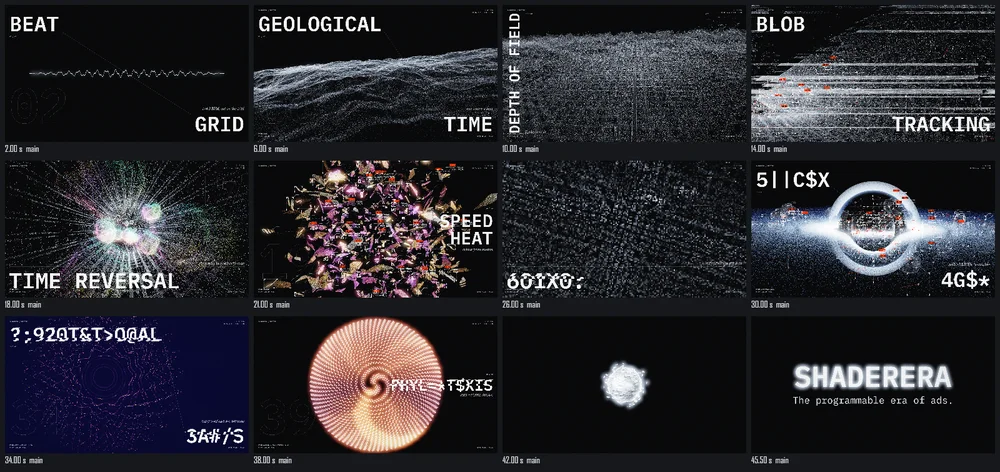
- shows any moment as a still, a contact sheet or an enlarged detail, so an agent can look;
- reviews the film: blank frames, end hold, text fit and overlap, glyphs, copy, safe areas;
- delivers campaign batches per placement (Reels, YouTube, CTV, broadcast, DOOH), checked
against each spec; - keeps revisions and frozen render jobs, so a render can be repeated exactly.
 |
 |
 |
| MATTER, opening film. One body of particles, no cuts: every transition is a morph, and the cut lands on the beat because the beat is a function of t. | P(DOOM), lyric video. Swiss type on paper; words assemble from particles and leave as dust, each set on the voice. | WALLLOOM, product loop. A frame-swap configurator rebuilt as a film: pictures, mats, moulding and shadow, one order after another. |
Up close, three moments of MATTER. Millions of points and live data overlays, and every one of
them a pure function of t: scrub back and the same frame comes back.
 |
 |
 |
| Time reversal. A burst of particles, the future played backwards. | Speed heat. Shards coloured by their own speed, each tracked with a live ID, position and velocity. | Accretion disk. 2,096,704 points at 60 fps, the same frame every time. |
Quick start
You need Node.js 24 or newer and ffmpeg on the PATH.
Chrome is needed only for the browser host (DOM and WebGPU in a page). npx shaderera doctor
says what your machine has and lacks.
With an AI coding agent
Claude Code: install the Claude Code plugin.
claude plugin marketplace add shaderera/shaderera
claude plugin install shaderera@shaderera
To get new versions on their own, turn on auto-update in /plugin → Marketplaces →
shaderera. The skills are /shaderera:shaderera and /shaderera:shaderera-plugins, and
Claude also picks them up when you ask for a film.
Codex, Cursor, Gemini CLI, OpenCode and other agents with skills: add the skills.
npx skills add shaderera/shaderera # this project only; add -g for every project
In a project, it writes the skills to .agents/skills/, a .claude/skills link to them andskills-lock.json. With -g they are installed once for every project instead.
Or copy the install prompt into any agent that can run a terminal. It checks
Node.js and ffmpeg, installing only what is missing and only with tools the machine already has.
Then it installs the skills, starts a film project, and gives the agent its MCP server.
Then ask for the film in your own words, with the brief:
Using the shaderera skill, make a 15-second 9:16 teaser for our running shoe: the shoe turns
once on a dark set, the line "Built for the last mile" lands on the beat ofassets/track.wav,
and the logo holds for the last 2 seconds. Run check, show me a contact sheet, then render.
The agent starts or finds the project, writes render(t) in src/, runs npx shaderera check after each edit, looks at stills, and reports what it could not verify by looking. Every
command takes --json and returns one envelope with ok, an exit code and findings that carryt, file:line and a box, so an agent can act on them.
Give the agent eyes. The MCP server renders frames as images, inspects state and traces a
pixel back to the line of code that drew it. The Claude Code plugin declares it, and a new
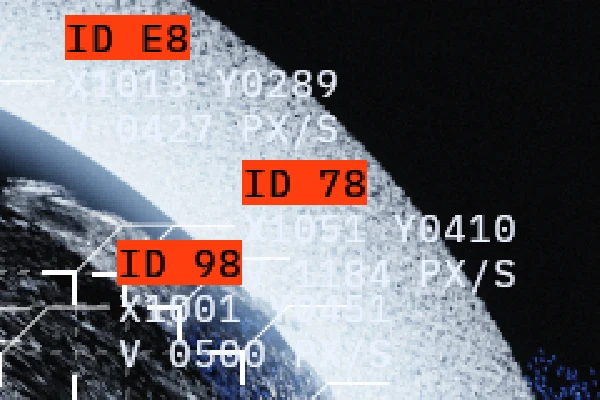
project's .mcp.json names it. In another agent, add a stdio MCP server with the commandnpx -y shaderera mcp (docs/mcp.md). The CLI shows the same things: a contact sheet of any moments, and a detail
enlarged by whole pixels, so an agent can judge an edge, not just the code.
 |
  |
npx shaderera still 2 6 10 14 18 21 26 30 34 38 42 45.5 --sheet |
npx shaderera still 30 --region 1090,220,240,160 --scale 4 |
By hand
npx create-shaderera@latest my-film
cd my-film
npm install
npx shaderera check              # the same t gives the same state and pixels
npx shaderera still 0 5 --sheet  # stills of t = 0 s and 5 s, and a contact sheet
npx shaderera render             # out/my-film.mp4
The film is render(t) in src/composition.ts. It starts empty: every frame is your code. The
starting project is 1920×1080 at 60 fps, 10 s long, seed 1 (shaderera.json), and itsrender(t) clears a black frame on the GPU (host.gpu). Any renderer works; the example in
How it works is Canvas2D.
Every new project is also set up for an agent: AGENTS.md (and CLAUDE.md, which points to
it) says how to work there, AUTHORING.md is the workflow, guides/ holds short guides (sound,
typography, formats, 3D products, photos, logos, review, revisions, fast-compiling shaders), and.mcp.json names the MCP server. The skills are not copied in: install them once, with the Claude Code plugin ornpx skills add (above).
Skills
| Skill | What it does |
|---|---|
shaderera |
starts or finds a project, runs the edit → check → look loop, sets up MCP, reviews, renders and delivers |
shaderera-plugins |
searches, adds and removes plugins, and publishes a piece of a film; used when you ask for plugins, or when a check says a required package plugin is missing |
They come from plugins/shaderera/, and there is one copy on a machine:
the Claude Code plugin's, or the one npx skills add writes. A new project holds none, so an
update reaches every project. The skills never pick a look for
your film. They add plumbing on their own (music analysis, three.js on the host's GPU, image
decoding), because that carries no taste, and looks, motion and sound design only when you ask.
Plugins
Plugins are code that earlier films proved, like npm for clips. add copies a plugin's source
into your project, where it becomes your code to change. Shaderera's own plugins are built frompackages/plugins/, MIT, named <category>-<thing>:audio-beat-clock, camera-keyframes, format-safe-areas, render-three-host,text-glitch-titles, look-screen-passes, four fonts, and more.
shaderera reads Shaderera's own at https://shaderera.com/r unless you point it elsewhere. In a
film:
npx shaderera search "beat sync"
npx shaderera add audio-beat-clock
A team keeps its own plugins in a folder, or at the URL it is served at: pass--site <dir|url>. To fill a folder with the official plugins, from a clone of this repository afterpnpm install:
for d in packages/plugins/*/; do [ -f "$d/shaderera.item.json" ] && node apps/cli/bin/shaderera.js publish "$d" --site <folder>; done
All of it is in docs/plugins.md. To write a plugin, for the official ones or
for a library of your own, see docs/plugin-guide.md.
Share and fork
share sends a film to shaderera.com, where it plays in the viewer's browser; fork copies a
shared film into a new folder as an ordinary project:
npx shaderera login                      # sign in with GitHub (or --token <token>)
npx shaderera share --dry-run            # what a share would send, and any limit it breaks
npx shaderera share                      # a new film, then new versions of it
npx shaderera fork https://shaderera.com/film/<film> my-film
They run only when called and send only the project's files, as a revision holds them, never a
file that holds secrets (.env, .npmrc, .dev.vars, keys, …, and a .mcp.json that names
any server but Shaderera's own), and the film's web player, which share builds on your machine
(docs/player.md). share prints what it will send and asks first (--yes
off a terminal). It needs a licence, package.json's license: a new project is UNLICENSED
(all rights reserved) until you choose one, such as MIT. shaderera.com takes at most 32 MiB a
file and 64 MiB a version.
They talk to the films API at https://api.shaderera.com (--api <origin> or SHADERERA_API
names another) and name film pages on https://shaderera.com (--site, SHADERERA_SITE). All
of it is in
docs/cli.md.
npx shaderera studio opens the studio, a page on shaderera.com that previews, renders and shares
the project on your machine through a local bridge on 127.0.0.1
(docs/studio.md). The code and renders stay on your machine until you share;
the page reports usage counts, never code (npx shaderera telemetry off). An agent runsnpx shaderera studio --json in the background and gives you the address it prints.
How it works
A source module exports open. It gets the manifest and the host's I/O, and returns render(t)
and, if you want, inspect(t): the state at t as JSON, which check, review and agents read.
The starting project clears a frame on the GPU; any renderer works, and this example is
Canvas2D.
import type { Open } from '@shaderera/core'

const open: Open = async ({ manifest, io }) => {
  const canvas = io.canvas(manifest.width, manifest.height)
  const ctx = canvas.getContext('2d') as OffscreenCanvasRenderingContext2D
  const title = { id: 'title', text: 'Hello', x: 160, y: 300, size: 64 }
  ctx.font = `${title.size}px sans-serif`
  // A text run's box is [x, y, width, height] in frame pixels; review reads text only with one.
  const box = [title.x, title.y - title.size, ctx.measureText(title.text).width, title.size * 1.25]
  return {
    async render(t) {
      ctx.clearRect(0, 0, canvas.width, canvas.height)
      ctx.globalAlpha = Math.min(1, t)
      ctx.fillText(title.text, title.x, title.y)
      return { color: canvas }
    },
    async inspect(t) {
      return { title: { ...title, box, opacity: Math.min(1, t) } }
    },
  }
}
export default open
shaderera.json holds the size, frame rate, duration, params and variants (cutdowns, other
formats). A host runs the source: the Node host by default, or Chrome for a DOM or WebGPU page.
The film's code runs in its own process, which may not write files or start programs unless you
pass --trusted. A frame is layers (pixels, GPU textures, depth); the host composites them and
hands ffmpeg the result.
Commands
| Command | What it does |
|---|---|
shaderera check |
renders sampled t twice in two orders and compares state and pixels |
shaderera still <t>… |
stills of any moment, a contact sheet (--sheet), a detail (--region, --scale) |
shaderera inspect <t> |
the state at t; --track <path> reads it as a curve |
shaderera render |
an mp4 or a ProRes mov; --job renders a frozen job |
shaderera review |
frames, a contact sheet and technical checks against requirements.json |
shaderera deliver |
a campaign batch: variants × locales × placements, each checked |
shaderera plan / assemble |
a job split into chunks that any machine renders, then joined; plan --status says which are done |
shaderera reexport |
a job's sound on a delivered file's own picture, or its captions, with no frame rendered |
shaderera bake |
run a bake's command and stamp the frames it made outside the host |
shaderera handoff <job> |
the frozen project, the job and how to reproduce it |
shaderera save / versions / undo / restore / diff / job |
revisions and render jobs |
shaderera doctor |
what this machine has and lacks |
shaderera mcp |
the same operations as MCP tools over stdio |
shaderera search / info / add / remove / publish |
plugins (docs/plugins.md) |
shaderera login / whoami / logout / share / fork |
send a film to shaderera.com, and fork one from there |
shaderera studio / telemetry |
the local bridge of the studio page on shaderera.com, and its usage counts |
Every flag is in docs/cli.md, and the MCP tools are in docs/mcp.md.
Documentation
docs/ is the reference: the protocol, determinism, delivery, the CLI and MCP,
and one page per technology (Canvas2D, three.js, WebGPU, DOM, Glyph). An installed project has
the same docs in node_modules/shaderera/docs/. Terms are defined in GLOSSARY.md,
and decisions are recorded in docs/adr/.
Packages
| Package | Path | What |
|---|---|---|
shaderera |
apps/cli |
the CLI, the Node and browser hosts, and the MCP server |
@shaderera/core |
packages/core |
the protocol types and small helpers that work in any host |
create-shaderera |
packages/create-shaderera |
starts a project |
| — | packages/plugins |
the official plugins (not on npm; publish them to a folder) |
| — | plugins/shaderera |
the agent skills and the Claude Code plugin (MIT) |
Develop
git clone https://github.com/shaderera/shaderera.git
cd shaderera
pnpm install
pnpm build
pnpm lint
pnpm typecheck
pnpm test       # the fast tests, about ten seconds: run them all the time
pnpm test:all   # the fast and the slow tests: before a pull request
io.image's decoder is Rust compiled to WASM (apps/cli/wasm/image/, ADR 0028), committed built
as apps/cli/src/runner/image-wasm.ts, so building the packages needs no Rust. After a change to
the crate, rebuild it with pnpm --filter shaderera build:wasm (Rust and thewasm32-unknown-unknown target).
pnpm install warns Ignored build scripts: esbuild, webgpu and suggests pnpm approve-builds.
That is expected: the tests pass without approving them (webgpu's script only clears a macOS
download flag).
The fast tests are the *.test.ts files. The slow ones, *.it.ts (pnpm test:slow, which builds@shaderera/core and the CLI first), launch Chrome, Dawn, ffmpeg or the CLI as a child. They
need ffmpeg, a GPU and Chrome: the ffmpeg tests skip without ffmpeg, but the GPU and
browser-host tests fail without a GPU and Chrome (CHROME names another Chrome).apps/cli/src/node/packed.it.ts also packs the CLI and core and installs them with npm, so it
needs npm's registry. A test that needs none of them goes in a *.test.ts file.
The root pnpm test, test:slow and test:all point the temp folder at one of the run's own and
fail if a test left a shaderera-* folder in it. A CLI test makes its temp folder with tempDir
(apps/cli/src/fixtures/temp.ts), which removes it after the test, and runs a command with cli
(apps/cli/src/fixtures/cli.ts), in its own process: one test starts bin/shaderera.js as a
child.
CLAUDE.md is the short guide for agents working on this repository..claude/skills/ holds third-party engineering skills copied for contributors' agents (ponytail
and mattpocock/skills, listed in .claude/skills/SOURCES.md);npx skills add does not offer them. Issues are on
GitHub.
Licence
MIT, all of it: the engine, create-shaderera, the plugins and the skills.
Use it for anything, including inside a product you sell. What you make with Shaderera is
yours. The name and logo are not part of the MIT licence: see TRADEMARKS.md.
The font plugins are under the SIL Open Font License; see docs/licences.md.
Yorumlar (0)
Yorum birakmak icin giris yap.
Yorum birakSonuc bulunamadi