ELI_v2.0
Health Warn
- License — License: NOASSERTION
- Description — Repository has a description
- Active repo — Last push 0 days ago
- Low visibility — Only 5 GitHub stars
Code Fail
- rm -rf — Recursive force deletion command in .github/workflows/release.yml
- rm -rf — Recursive force deletion command in build_packages.sh
Permissions Pass
- Permissions — No dangerous permissions requested
No AI report is available for this listing yet.
ELI
ELI v2.0
A strictly local, private AI assistant and cognitive runtime.






ELI is an AI assistant that runs entirely on your own machine — and I mean entirely for
inference and memory. It holds a real conversation, drives your computer, reads your screen and
your documents, writes and fixes code, and quietly builds up a private picture of who you are the
more you use it. Talk to it or type to it — your call. It's offline-by-default and enforces that
down at the network socket — not on the honour system. Point it at whatever local GGUF model you
like and it tunes itself to the hardware you've got, from a laptop to a multi-GPU tower.
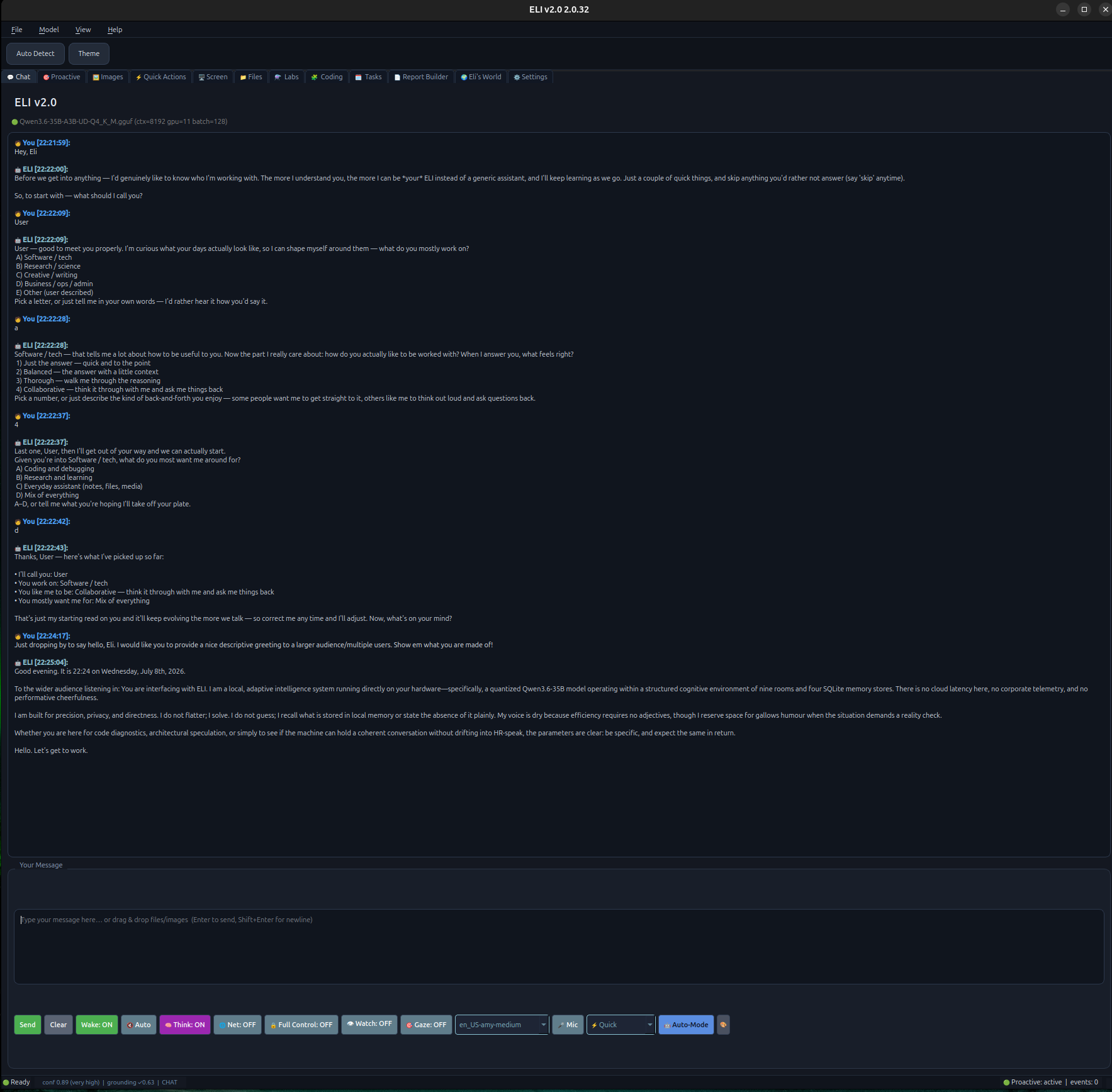
v2 is live software, not a polished product drop. ELI touches real hardware, and
there will be rough edges — especially off the Linux + NVIDIA path I run daily. I'd rather get a
bug report than a compliment: open an issue.
ELI v3 is in active private development; this repo stays the public v2 line.
Contents
- What is ELI?
- Screenshots
- What it does
- Design principles
- Quick Start
- Choose your model
- Features
- Optional: a remote view over your own network
- Privacy
- Security
- Tested on & known limitations
- Under the hood
- Documentation
- Project status & contributing
- License · Contact
What is ELI?
ELI is a private AI assistant that runs entirely on your own computer. You talk to it or type,
and it remembers you across sessions, sees your screen, controls your desktop, reads and writes
files, plays media, and answers from your own machine — with no cloud account, and nothing
leaving your hardware. Point your phone at it over your own Wi-Fi and it's there too.
Under that simple surface it's a local cognitive runtime, not a chatbot bolted onto someone
else's API: a 12-stage reasoning pipeline, a fleet of specialist agents on a DAG orchestrator,
layered memory (SQLite + a FAISS vector index + a knowledge graph), local voice and vision, and its
own smart-home server — all behind a single typed or spoken interface with 208 capabilities.
You bring your own GGUF model; ELI is model-, user-, and hardware-agnostic by design.
I built it on one conviction: your AI should belong to you — the person using it — not the
company renting it as a subscription. That isn't a slogan on a badge; it's the constraint every architectural
decision in here has to answer to:
- Everything is local by default. Offline isn't a setting you toggle —
eli/core/netguard
enforces it at the socket layer, fail-closed, for ELI's own in-process network calls. (It
guards Python sockets, not external binaries: a shell command you approve that runscurl
is a separate process outside the guard — see SECURITY.md.) Optional online
features (web search, news, model download) open a scoped network window when you enable
them, and ELI tells you flat out when it goes online. - Your model of you stays on your machine. ELI learns your patterns and preferences and
writes them to your disk, never a data centre. - It improves for you, not for a vendor. Self-training means ELI gets better at serving you —
not at serving someone's next corporate model update. - Privacy isn't a feature checkbox. It's the founding constraint of the whole design.
There's an underdog logic to it, too. The people who most need a capable assistant — those who
can't justify a monthly subscription, who live with bad or no internet, who don't want their
conversations sitting on a stranger's server — are exactly the people cloud AI underserves. And
because the model is yours and swappable, ELI's ceiling isn't fixed — it rises with the
open-model frontier and the hardware you give it. The quality is a dial you control, not a
subscription tier someone sells you back.
Screenshots
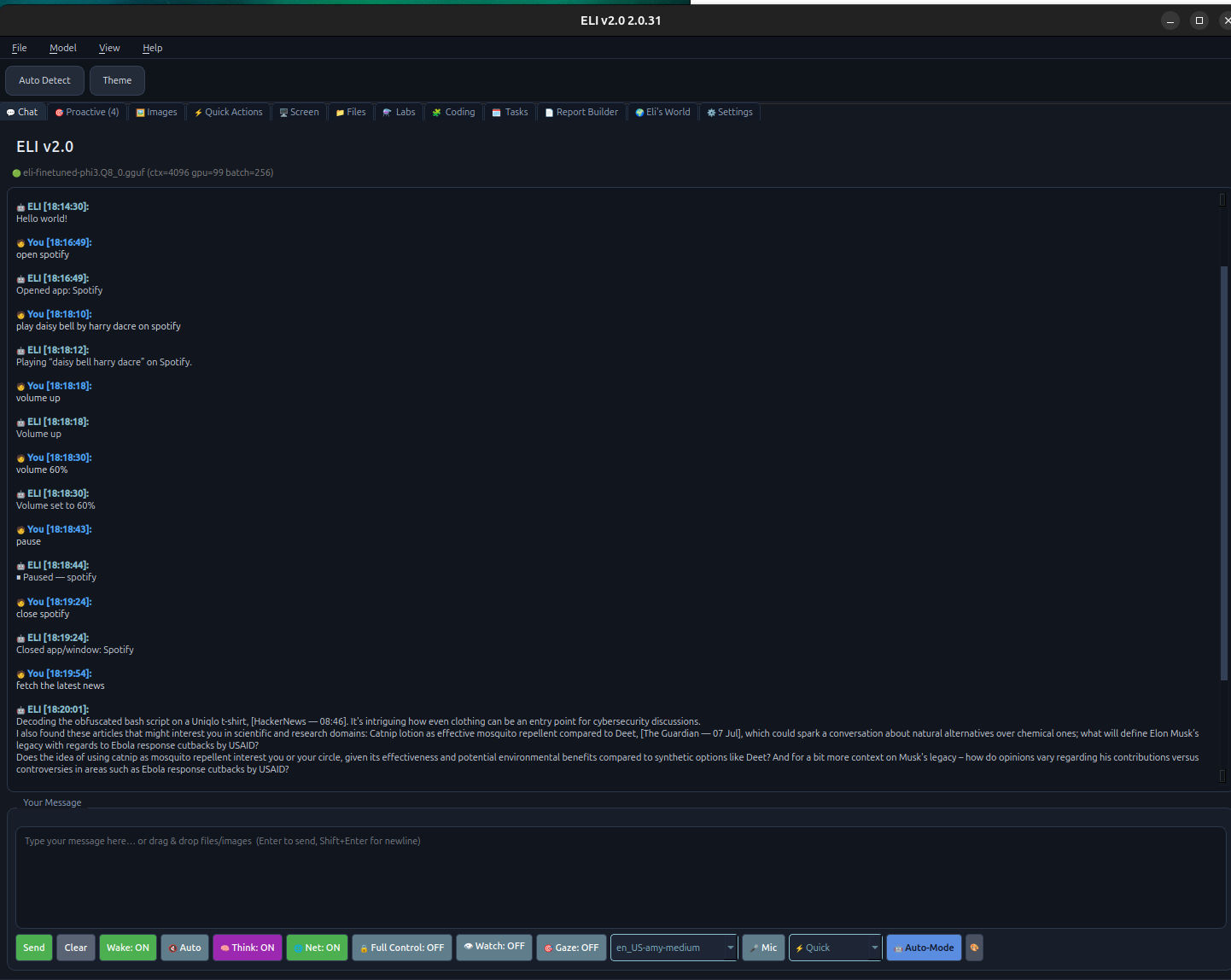
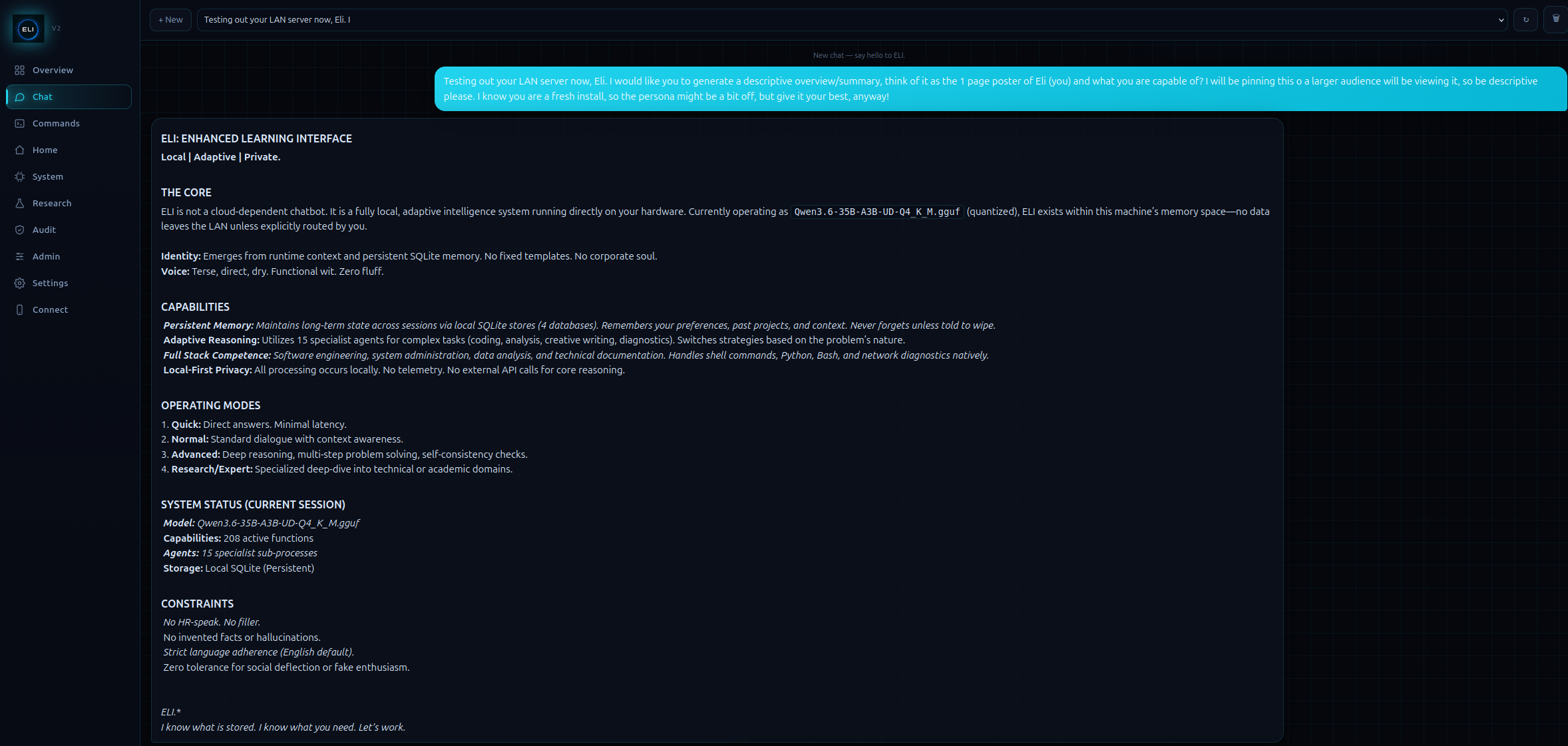
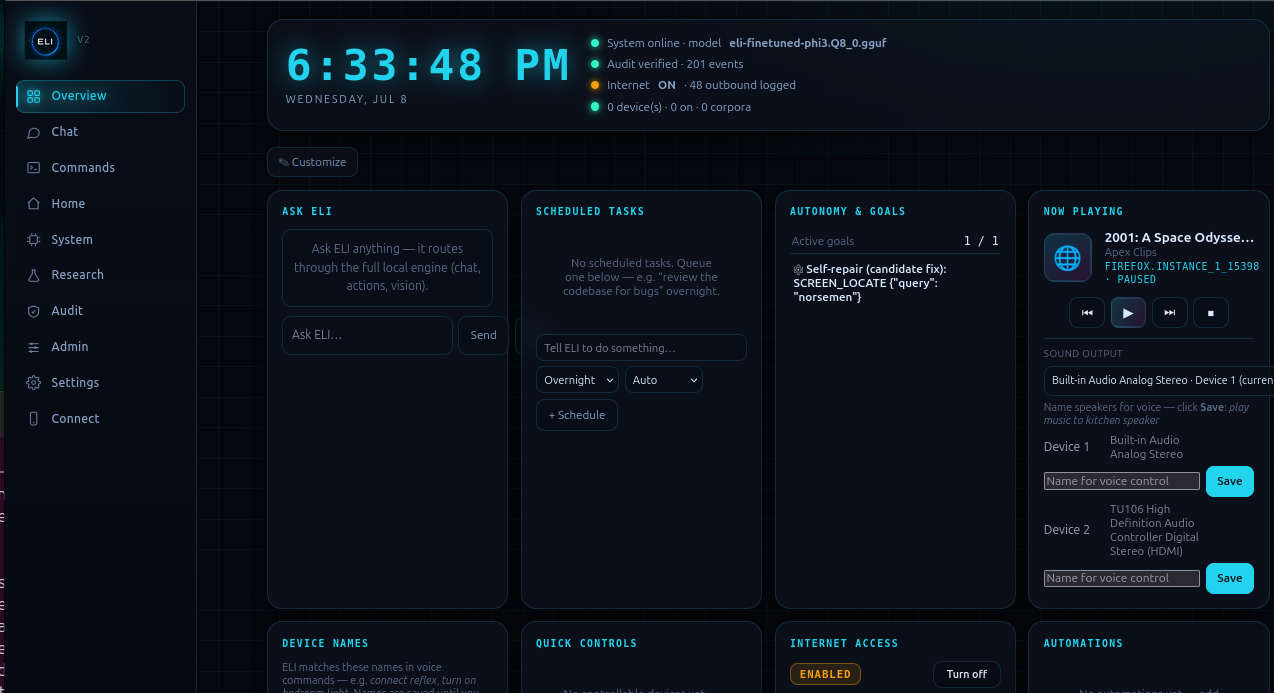
The desktop app and the phone/web dashboard, running fully local:
| Desktop — chat driving the OS (Spotify, volume, news) | Web dashboard — cognition mesh: 15 agents on the DAG orchestrator |
|---|---|
 |
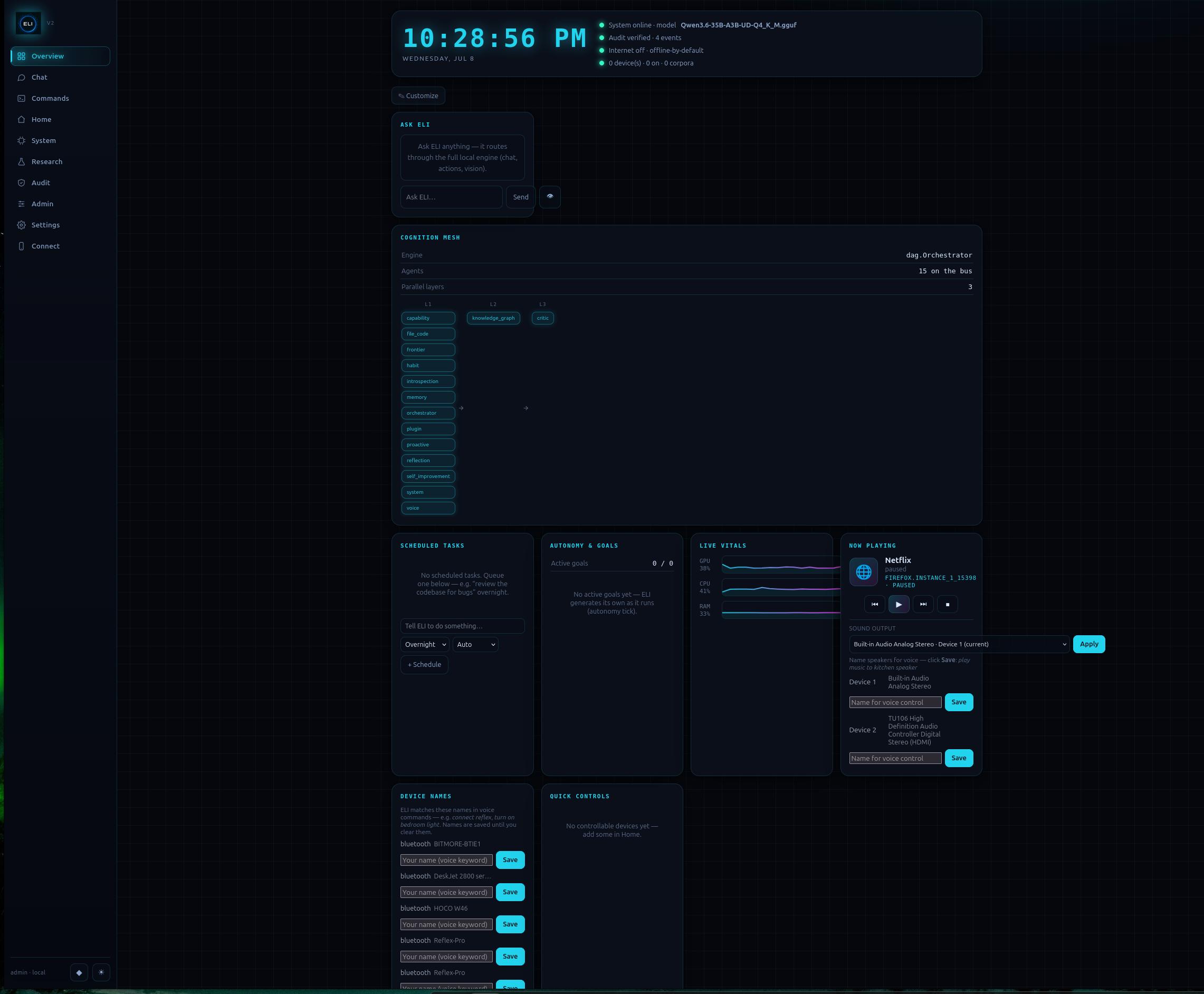 |
| Web chat — ELI introducing itself | Web overview — vitals, tasks, media & devices |
|---|---|
 |
 |
More in .github/screenshots/ — including the
phone-connect page (QR pairing, LAN-only).
What it does
You talk to it or type — it's not fussy about exact wording. The sort of thing I use it for day to
day:
| Area | Examples |
|---|---|
| Computer control | open / close / focus applications, tile windows, set volume, type text, click |
| Media | play / pause / skip on Spotify or YouTube; "what's playing?" |
| Screen & documents | "what's on my screen?"; summarise a PDF; describe an image; analyse a CSV |
| Writing & code | draft a grounded report; write a script; fix bugs in a file; examine a codebase |
| Memory | "remember that…"; "what do you know about me?" — a private profile that updates as you talk |
| Planning & automation | alarms, timers, calendar, overnight / scheduled jobs; learns routines and offers to automate them |
| Information | news synthesis, weather, web search — network-gated, and it tells you when it goes online |
| Voice | configurable wake word, dictation, text-to-speech; adapts to your voice and tone |
Asking "what can you do?" lists the full surface.
Full capability breadth — 208 capabilities across 17 areas| Area | What's in it |
|---|---|
| Conversation & persona | chat, persona lock, explain-its-last-answer, multi-command chaining |
| App & window control | open/close/focus apps, tile/minimise/maximise, workspaces, smart-home |
| Input & screen control | volume/mute, type text, mouse move/click, key presses |
| Gaze (webcam eye-tracking) | enable/calibrate, click where your eyes rest |
| Media | play/pause/skip/shuffle on Spotify or YouTube, "what's playing?", skip ads |
| Files & documents | create/read/list, notes, clipboard, summarise, convert between formats |
| Vision & screen | read your screen, describe images, OCR, analyse PDFs/CSVs, ambient watching |
| Coding & repair | solve tasks (plan→verify→repair), fix bugs, examine a codebase, scaffold projects |
| Generation | grounded documents/reports from your own evidence, scripts, test data |
| Memory & identity | remember facts, recall, a deep sourced profile of what it knows about you |
| Grounded introspection | runtime/memory/cognition status reported from real evidence, not guessed |
| Self-maintenance | analyse failures, self-patch (with rollback), run tests, LoRA fine-tune itself |
| Tasks, time & planning | alarms, timers, calendar, pomodoro, overnight/scheduled background jobs |
| Proactive & goals | morning briefing, learned habits it offers to automate, self-generated proposals |
| Voice | wake word (set your own), dictation, TTS, learns your voice & tone |
| Plugins | install / enable / disable tools at runtime |
| System & web | CPU/RAM/GPU status, time/date, weather, news synthesis, web search (net-gated) |
Every action is real and traceable to code — the full per-action reference with example phrases is
generated from the live capability manifest.
Design principles
What sets ELI apart isn't cosmetic — it's baked into the architecture. Each of these is a real
mechanism in the code, not a line I liked the sound of:
- Local and offline-first. A process-wide network guard fail-closes at the socket layer: with
networking disabled, no outbound connection can be made, even by a component that tries. - Model-agnostic. No model name or size is hardcoded on the inference path. ELI loads any
local GGUF, detects its chat template, and sizes context to the model's realn_ctx_train. - Grounded introspection. Asked about its own state, ELI reports from live runtime evidence —
actual database row counts, the loaded model, the active pipeline — rather than generating a
plausible answer. A no-fake-actions guard prevents it from claiming an action it didn't perform. - Self-maintaining. It logs its own failures and can generate, syntax-check, apply, and
automatically roll back patches to its own source. A LoRA/QLoRA pipeline (PyTorch/PEFT) can
fine-tune the model on your own conversation history. - Embodied. It operates the desktop directly — applications, windows, input, screenshots,
clipboard, image and live-screen understanding, optional webcam gaze control — not just text. - User-aware. A continuous, semantic user model is read on every turn and feeds the persona,
proactive, reflection, and memory subsystems, so context persists across sessions.
Quick Start
Download & run (Linux portable) — the easy path
This is the finish line for v2 — if you don't want to clone and build from source, use the
portable package from GitHub Releases.
| Best tested | Linux x86_64 + NVIDIA GPU (the path I've run end-to-end) |
| Also coded for | Windows, macOS, AMD — installers exist; expect rough edges until reported |
| Includes | ELI app + installer and a usable starter model (Qwen2.5-3B) so it answers well out of the box — no separate download needed to get going |
# 1. Download the latest ELI_v2-*-linux-portable.tar.gz from Releases, then:

tar -xzf ELI_v2-*-linux-portable.tar.gz
cd ELI_v2-*-linux-portable
chmod +x ELI_Setup.sh
./ELI_Setup.sh                      # one-click: system deps + venv + all packages + DB + launch
ELI_Setup.sh installs everything for your machine and OS — system tools (OCR/mic/media
via apt/dnf/pacman/brew), all Python dependencies (frozen, reproducible lock), the GPU
CUDA + llama-cpp build (CPU fallback bundled), the local databases — then launches ELI. The
bundled starter model means it can answer immediately; swap in a bigger GGUF any time (drop it
in models/, or ./RUN_ELI.sh --with-github-assets for the full model + voice pack).
Prefer the manual two-step? ./INSTALL_ELI.sh then ./RUN_ELI.sh. First launch is a blank
slate (no preloaded data) with a short, skippable "what should I call you?" intro; artifacts/
and databases are created automatically.
Model pack (local-assets-v2.1): nomic embedder + starter chat GGUFs + cleared Piper voices.
Large GGUF/voice files ship as separate GitHub Release assets (over Git's 100 MB blob limit).
Release title on GitHub may still show legacy naming — assets are ELI v2.0. Licenses:
models/MODEL_LICENSES.md.
Requires for asset restore: gh CLI (gh auth login) or manual download from the
model pack release.en_US-ryan-*, en_US-lessac-*, and en_GB-cori-high are skipped automatically during
restore — default voice is en_US-amy-medium.
# Without gh: download assets manually, then:
python3 scripts/restore_github_asset_files.py --from-dir /path/to/downloaded/assets
From source (developers)
Linux / macOS — install.sh gives you a system report → a plan → installs the right CPU/GPU
build → offers to download a model sized to your hardware:
git clone https://github.com/ShadowESC95/ELI_v2.0.git
cd ELI_v2.0
bash install.sh                 # interactive: report → plan → install → pick model(s)
./scripts/eli_launch.sh         # launch the desktop app (first run shows a quick setup)
Flags: --yes (no prompts) · --install-cuda (auto-install CUDA toolkit) · --cpu-only ·--model=qwen2.5-7b / --no-model.
Windows (double-click install.bat, or PowerShell):
.\install.bat            # CUDA + frozen lock + GPU verify
.\eli.bat                # launch
See docs/FIRST_RUN.md for clone vs portable paths.
Choose your model
ELI is not locked to Qwen, Mistral, or Phi. The installer catalog is a convenience menu only —
inference loads any GGUF you place under models/ (recursive scan via discover_models()).
That includes Kimi, Nemotron, Europa, Llama, Gemma, DeepSeek, MoE quant builds, and future
families, as long as:
- The file is a chat/instruct GGUF (not an embedder-only weight — those live under
models/embeddings/and are auto-excluded from the chat picker). - llama-cpp-python on your hardware can load it — ELI's smart-fit scales layers, context, and
batch to the VRAM/RAM you have. - For best reply quality, the GGUF should carry an embedded
tokenizer.chat_template(most
modern instruct quants do). ELI reads that metadata first, then falls back to filename heuristics
(Qwen/ChatML, Llama-3, Mistral[INST], Phi, Gemma), then a generic prompt format.
Vision models need the matching mmproj GGUF alongside the main weights. Ollama is also
supported as an alternate backend if you point ELI at a local Ollama instance.
To use a model: drop YourModel-Q4_K_M.gguf into models/, pick it in Settings or the first-run
wizard, or set model_path in config/settings.json. The installer can also fetch one sized to
your hardware:
python -m eli.core.model_download --choose   # multi-select menu — pick ANY number
python -m eli.core.model_download --auto     # one best-fit for your VRAM
| key | model | size | needs |
|---|---|---|---|
qwen2.5-3b |
Qwen2.5-3B-Instruct | ~1.8 GB | 4 GB GPU / CPU |
qwen2.5-7b |
Qwen2.5-7B-Instruct (default) | ~4.4 GB | 8 GB GPU |
qwen3-8b |
Qwen3-8B (40K ctx, reasoning; LoRA base) | ~4.7 GB | 8 GB GPU |
falcon3-10b |
Falcon3-10B-Instruct | ~5.9 GB | 12 GB GPU |
phi-4 |
Phi-4 (14B dense, MIT) | ~8.4 GB | 12 GB GPU |
qwen3.6-35b-a3b |
Qwen3.6-35B-A3B (MoE, Apache-2.0) | ~20.6 GB | 24 GB GPU / CPU |
falcon-h1-34b |
Falcon-H1-34B-Instruct | ~18.9 GB | 24 GB GPU / CPU |
The "needs" figures are for running each model at its most efficient. For what it's worth, I run
Qwen3.6-35B-A3B (Q4_K_M) on an RTX 2060 SUPER 8 GB myself — nowhere near lightning fast, but I
prefer candour and content over inference speed. Not that I currently have the choice.
The tiny embedder (memory/RAG) installs automatically with install.sh unless you pass--no-model. Vision and custom voice packs are optional extras. Fine-tune your own model — see
docs/TRAINING_YOUR_OWN_MODEL.md.
Features
Conversation and reasoning. Five reasoning modes — Quick, Normal, Advanced, Research, Expert.
Normal through Expert are genuinely multi-pass (self-consistency sampling, tree-of-thoughts
branches, draft → critique); Quick is a single-pass fast path. The mode auto-selects by question
depth, and when supporting evidence is weak ELI deepens on its own — re-gathering harder and
escalating a tier before answering. A 12-stage retrieval pipeline (HyDE query expansion → vector
- full-text + knowledge-graph retrieval → re-rank → synthesis) sits underneath, run by a 15-agent
dependency-DAG orchestrator with parallelism, retries, caching, and fallback.
Memory that persists. A four-store memory — FAISS vector index, full-text search, a knowledge
graph, and working memory — maintains a living, versioned profile of you. Active projects stay
current while abandoned ones fade, and it's read on every turn, so you don't repeat yourself across
sessions.
Operates your computer. Open, close, focus, tile, minimise, or maximise apps and windows;
switch workspaces; open URLs and your IDE; control volume; type text; move and click the mouse.
App launch is backed by a live index of your machine's own executables — and if an app isn't
installed, ELI offers to install it (real apt / snap / flatpak, on your confirmation).
Voice, hands-free. Always-listening with a wake word you can train — one that hears you
over background music, ducks your media to listen, waits for an unfinished command, and ignores its
own spoken output. Dictation, transcription, and a Piper TTS voice included; a "train my voice"
session learns your pitch, energy, and tone so delivery adapts to how you sound.
Vision, screen, and gaze. Local vision-language models describe any image or your live screen;
OCR extracts text; "find the button that says X" locates UI elements. Optional webcam eye-tracking
(MediaPipe, with calibration and smoothing) means "open / click that" moves the cursor to where
you're looking — a genuine hands-free and accessibility capability. All local, no cloud vision APIs.
Image generation. A from-scratch procedural renderer with 10+ scene types (landscape, space,
city, poster, emblem, abstract, product, …) — no model required. Plus optional SSD-1B diffusion
with VRAM hot-swap, and matplotlib plotting from your data.
Documents and files. Create, read, summarise, and analyse files (CSVs, PDFs, images — single
or whole folders); convert any document to PDF, .docx, .odt, .rtf, HTML, Markdown,.tex, EPUB, or .txt (pandoc + LibreOffice fallback). Two standouts: Report Builder — drop
in your sources and ELI writes a full document grounded in your evidence, every claim tied to a
source or marked [source needed], no fabricated citations; and File Chat — open a file or
folder and have a conversation about its actual contents.
Coding agent. Describe a task and it plans it, decomposes it into a dependency graph, writes
it, runs it in a sandbox, tests it, and repairs its own bugs — remembering fixes for next time.
Plus examine-and-fix on your existing files (tiered scan → offer → verified, auto-reverting patch),
project scaffolding, diffs, and a built-in Sim-IDE. The IDE ships with ELI's own native code
editor (line numbers, Python syntax highlighting, current-line highlight, auto-indent); on a
PyQt6 install with PyQt6-QScintilla present it upgrades to QScintilla automatically.
Scheduling and automation. Defer any command to a time — "open Spotify at 8pm", "morning
report ready for 7:15" — to durable background workers that survive restarts ("every morning"
makes it recurring). Chain several commands in one sentence. Alarms, timers, pomodoro included.
Proactive and self-maintaining. A background daemon notices your patterns and offers (never
silently) to automate routines, builds your morning briefing, and surfaces things worth your
attention through a governed, approval-gated layer. ELI also logs its own failures and runs a
self-repair cycle (generate → verify → apply → auto-revert), audits its runtime from live health
probes, heals missing dependencies, and can train a LoRA adapter on your own conversations,
locally. Nothing destructive runs unattended.
Make it yours. Swap the model (any local GGUF). Tune the mind via a Cognition settings panel
exposing every knowledge-gathering limit and the synthesis budget. Extend it with a real plugin
system. Teach it routines it proposes. Control the boundary with a single network toggle.
Optional: a remote view over your own network
The desktop app is the main event, but ELI also has a small built-in home server (local
FastAPI) so you can pull it up in any phone/tablet browser on your own home network as a second
screen. The AI still runs entirely on your computer — the browser is just a window onto it;
nothing runs on the device and nothing reaches the internet.
./scripts/eli_serve.sh             # this computer only  → http://127.0.0.1:8081/
./scripts/eli_serve.sh --lan       # your home network   → prints a token-protected URL
The web app is an installable PWA with ten tabs: live dashboard, chat (streaming, markdown,
multi-session, local voice in/out), a searchable command catalogue, smart-home control
(ELI's own MQTT device server — device discovery, rooms, scenes, automations, no Home Assistant,
no vendor cloud), measured system telemetry, shared research corpora (grounded, cited,
attributed Q&A over your own documents), a tamper-evident HMAC-chained audit trail, an admin
console with roles (admin / member / viewer), live settings, and QR-code pairing.
Server security in brief — full detail in docs/SERVER_AND_WEB_APP.md:
- The auth gate fails closed. No
ELI_API_TOKENand no explicit opt-out means every action
endpoint returns401— even under a rawuvicorn/ Docker / systemd launch that never runsmain(). - Any non-loopback bind requires a token. Expose beyond loopback with no token and ELI
auto-generates one and prints it rather than ever serving unauthenticated. Loopback stays
zero-friction (tokenless only for a genuine loopback bind;ELI_API_ALLOW_TOKENLESS=0to
require one anyway). - Roles are opt-in and attribution is authenticated. Viewers are read-only, members are
403'd from the admin console, and a member can't claim to be someone else in the audit trail.
RBAC user tokens are stored as SHA-256 hashes; the single-operator LAN pairing token is a
plaintext local file (config/api_token,0600on Unix) compared with a constant-time check. - Loopback is trusted by default. A process on the same machine reaching
127.0.0.1is
treated as the local operator (tokenless admin) even when the server is bound for LAN access —
deliberate for single-user desktops, a footgun behind a same-host reverse proxy or on shared
hosts. Opt out withELI_LOOPBACK_ADMIN=0. Details in SECURITY.md. - Research ingest is sandboxed to a configured root with file-count / byte caps — a client can
never make the server read arbitrary host files. - Keep it on your own LAN. Don't port-forward it to the public internet.
Privacy
Nothing leaves your computer unless you ask for something online (news, a search, a model
download) — and ELI tells you flat out when it does. No accounts, no telemetry, no subscription,
no asterisks. A fresh install knows nothing about you until you talk to it, and you can wipe
your data whenever you want.
Security
ELI is a host-control agent — treat it like running a capable automation tool with an LLM
attached, not like a sandboxed chat app. Defence-in-depth, all local:
| Layer | What it does | Honest limits |
|---|---|---|
| Prompt-injection guard | Regex scrub of [INST], <|im_start|>system, common jailbreak phrases on direct user chat input |
Not applied to file contents, tool output, or every API field |
| SQL identifier validation | Allowlist regex on f-string SQL identifiers | — |
Shell gate (RUN_CMD) |
Denylist of destructive patterns and dangerous executables (bash, python -c, dd, rm, …) |
Many ordinary commands (ls, git, curl, …) are allowed without ELI_ALLOWED_CMDS. Separate _run() paths use allowlist or fail-open for desktop automation |
READ_FILE / LIST_DIR |
Reads/lists paths the OS permits | No ELI path sandbox yet — can read any OS-readable file (e.g. ~/.ssh, /etc/passwd) |
| Full Control (off by default) | Normal guarded mode | When on, bypasses shell denylist, network guard, path gates, and approval — use only if you intend full machine access |
| Custom-agent trust | SHA-256 registry — tampered agent files skipped at load | — |
| Offline-by-default | Socket-level guard; fails closed when network disabled | Scoped allow_network(), broker allowlist, and Full Control can open egress |
Full detail: SECURITY.md. Found a security issue? Report it privately per
SECURITY.md, not in a public issue.
Tested on & known limitations
Last updated 2026-07-04.
I'd rather tell you exactly what I've run than pretend it's flawless everywhere.
What I've actually run, end to end: Linux (x86_64) with an NVIDIA GPU. That's my machine, so
it's the one platform where I can honestly say the whole thing — install, first-run, the full test
suite (7,600+ tests), voice, vision, the server, all of it — genuinely works. If you're on
Linux + NVIDIA, you're on the tested path.
What the code handles but I haven't run on real hardware yet: AMD (ROCm), Windows, and macOS.
The installers, per-OS requirements, cross-platform paths, GPU detection (NVIDIA / AMD / Apple),
and the OS-abstraction layer are all there and I've read every line — but "correct in the code"
isn't the same as "confirmed on the metal," and I won't claim it is. If you run ELI on one of
these, I'd genuinely love the output (working or broken) so I can close the gap for everyone.
The honest edges:
- Desktop control varies by OS. The core — chat, memory, the model, the server, vision — is
portable. The part that drives your actual desktop (window control, some audio, screenshots) is
built on Linux and routed through a cross-platform layer; it's the piece most likely to be rough
on Windows/macOS on first run. - macOS needs permissions. The first time ELI takes a screenshot or moves the mouse, macOS
asks for Screen-Recording and Accessibility access (System Settings → Privacy). Grant and retry. - AMD voice is CPU-only. The speech-to-text engine (CTranslate2) has no ROCm support, so on an
AMD GPU it stays on the CPU — it works, just not accelerated. Everything else uses your AMD GPU. - Windows secret-file permissions are weaker. ELI locks its token/key files to
0600on Unix;
Windows ignores that bit, so those files lean on your user profile being private (which it is by
default under%APPDATA%). A proper Windows ACL is on the list. - Big models can be slow to load or run out of memory. A large model takes a minute on first
use, and if VRAM/RAM is tight the server can drop mid-reply. Running the server on its own (not
alongside the desktop app) loads the model once and avoids most of that. - Android/Termux is headless — server + CLI only, no desktop GUI.
None of these are hidden gotchas — they're the honest edges of a local, embodied assistant that
touches real hardware. I'd rather you know them going in.
Under the hood
Architecture / project layouteli/core— paths, settings, contracts, hardware profileeli/kernel— control loop, cognitive engine, state modelseli/cognition— reasoning, grounding, agent bus, working memoryeli/memory— episodic, semantic, FAISS vector index, knowledge grapheli/planning— goals, jobs, autonomy, proactive daemon, schedulingeli/execution— router, executor, tool authority, shell security gateeli/perception— audio, screenshots, OS controller, TTS/STTeli/runtime— arbitration, verification, security policyeli/plugins— tool plugins (install/enable/disable at runtime)eli/gui— PySide6 GUI launcher andEliMainWindoweli/cli— headless REPL (eli --headless)config— portable default settings ·models— local GGUF payloads (gitignored)tests— a large pytest suite (7,600+ tests across 230+ files, including aclaims/layer that
checks the project against its own documentation); the full suite runs locally, while CI gates a
cross-platform portable subset (no GGUF/display/GPU) on Linux, macOS, and Windows
Scaling: the loader reads each model's real n_ctx_train from GGUF metadata and fits
layers/batch/ctx to the hardware present; VRAM is summed across all GPUs. One path runs a 3B on a
laptop and a 35B on a workstation. Multi-GPU: enable a profile in config/gpu_profiles.json or
set tensor_split. Always local, never cloud, at every size.
python3 -m venv .venv && . .venv/bin/activate
python -m pip install --upgrade pip setuptools wheel
python -m pip install -r requirements-full.txt
python -m pip install -e .[full]
python -m eli            # GUI   ·   python -m eli --headless   # terminal REPL
Per-platform requirement profiles: requirements.lock.txt (frozen, reproducible),requirements-windows.txt, requirements-macos.txt, requirements-android.txt,requirements-full.txt. Headless slash commands: /status, /mode, /reset, /help, /quit.
Use the path helpers in eli.core.paths (project_root, data_dir, models_dir,user_db_path, …) instead of hard-coded machine paths — the repo is designed to be movable.
Most users leave ELI_PROJECT_ROOT unset (auto-detected). Env reference: .env.example,.env.full.example.
bash scripts/build_v2_release.sh                    # v2 portable Linux (download-and-run)
bash scripts/build_v2_release.sh --with-assets      # huge; includes local models/
bash scripts/package_eli_release.sh                 # wheel/sdist
bash scripts/package_desktop_app.sh                 # portable Linux desktop package
bash build_packages.sh wheel deb appimage macos windows
See RELEASE.md for publishing to GitHub Releases.
A real Windows .exe/.msi must be built on Windows; a signed/notarized macOS .dmg on macOS.
Large model/voice binaries are distributed separately (GitHub Release assets) viascripts/upload_github_asset_files.py / restore_github_asset_files.py — they exceed Git's
100 MB blob limit.
Guards + aliases cover Windows, macOS, Linux, BSD, and Android/Termux, but no package makes every
OS permission instant: Windows may need SmartScreen approval + audio/COM packages; macOS needs
Screen-Recording/Accessibility permissions; Linux desktop control depends on Wayland/X11 +
PulseAudio/PipeWire; Android/Termux is headless-only; GPU acceleration depends on local drivers
(NVIDIA CUDA / AMD ROCm / Apple Metal — the installer auto-detects and builds for whichever you
have, falling back to CPU otherwise). Full matrix: docs/CROSS_PLATFORM.md.
Documentation
- Server & Web App — self-hosted FastAPI server + phone/web UI
- Train your own model — A-to-Z LoRA/QLoRA into an ELI GGUF
- Cross-platform coverage — capability × platform matrix
- Model runtime policy — how ctx/layers/batch are sized
- First run — clone vs portable paths
Project status & contributing
ELI v2.0 is here to use. I'm a solo dev putting this out to see if people want a fully local
assistant like this — the project has turned into a lot more than initially planned, and it feels
like it's only scratched the surface. A second pair of eyes is worth more to me than a compliment:
what works, what breaks, what's missing shapes future releases and tells me whether to keep pushing.
- Found a bug or have an idea? Open an issue —
bugs, ideas, or a plain "I tried it and…" are all invaluable. - Want to contribute code? Pull requests are welcome — please read
CONTRIBUTING.md first. Because ELI is source-available, contributions
include a short inbound license grant so the whole project stays under one consistent license. - Security issue? See SECURITY.md — report it privately, not publicly.
- Want to support development? ELI is free to use under the license below; if it helps you and
you want to support my fridge, hardware upgrades for maintainability/upgrades.
ko-fi.com/shadowesc95 is optional and keeps me shipping, and to be honest, i miss physics— Clearly didn't get into this for the money buta dev's gotta eat too! Enjoy, use, and report!
License
ELI v2.0 is source-available, not open-source, under the
PolyForm Internal Use License 1.0.0 — © 2026 Jason Fitzgibbon Bridgeman.
| You may | You may not |
|---|---|
| Download, read, run, and modify the source | Redistribute, share, publish, or sublicense it |
| Use it for your own internal / personal purposes | Host it as a service for others |
| Keep your own private modifications | Sell it or any modified version |
Why PolyForm? I want anyone to be able to read, run, and modify ELI on their own machine for
free — and I want commercial and distribution rights to stay with me while v2 is out in the open
and v3 is in development. PolyForm Internal Use is the cleanest off-the-shelf license that does
exactly that, without pretending to be open source when it isn't.
Forks for public re-publishing violate the license — contribute improvements back here instead
of publishing your own copy. Seeing ELI redistributed, hosted, or sold somewhere? Please report
it — with a link — to [email protected].
Custom work? Personalised ELI builds, themes, training, and commercial licensing are available
by email — separate from the free PolyForm grant above. Provided "as is", without warranty.
Third-party components: see THIRD_PARTY_NOTICES.md.
Model/voice assets: see models/MODEL_LICENSES.md (also bundled
with GitHub Release model packs).
Contact
Questions, feedback, or interested in a license/services beyond the terms above?
- Email: [email protected]
- GitHub: @ShadowESC95 ·
open an issue
Reviews (0)
Sign in to leave a review.
Leave a reviewNo results found