agentic-stealth-browser
Health Uyari
- License — License: MIT
- Description — Repository has a description
- Active repo — Last push 0 days ago
- Low visibility — Only 5 GitHub stars
Code Gecti
- Code scan — Scanned 12 files during light audit, no dangerous patterns found
Permissions Gecti
- Permissions — No dangerous permissions requested
Bu listing icin henuz AI raporu yok.
Human-mimicking browser automation framework for autonomous agents. Survives Cloudflare, LinkedIn, Amazon anti-bot systems.
Agentic Stealth Browser
Playwright gets detected. This is much harder to detect.


Legal & Acceptable Use
This is an anti-bot-evasion tool. Read the Acceptable Use Policy before use — you are responsible for using it lawfully and within the target site's Terms of Service.
This software is for lawful, authorized automation and testing only; you are responsible for compliance with applicable laws, target Terms of Service, and robots.txt directives.
THE SOFTWARE IS PROVIDED "AS IS", WITHOUT WARRANTY OF ANY KIND; the authors accept no liability for misuse. See LICENSE.
What is this
A production-grade stealth browser automation library for Python, built on Playwright.
It survives modern anti-bot systems (Cloudflare, LinkedIn, Amazon, etc.) by looking
convincingly human at every layer — TLS, navigator, WebGL/Canvas, behavior, recovery.
When to use it — you are building an autonomous agent, scraper, or operator tool
that needs to pass bot detection in headless mode on protected sites.
When NOT to use it — you only need to scrape public, unprotected pages (usehttpx + selectolax or playwright directly). You need a real uTLS stack at the
wire level (use curl_cffi). You need CAPTCHA solving (this project intentionally
stops at detection + intervention; see Limitations below).
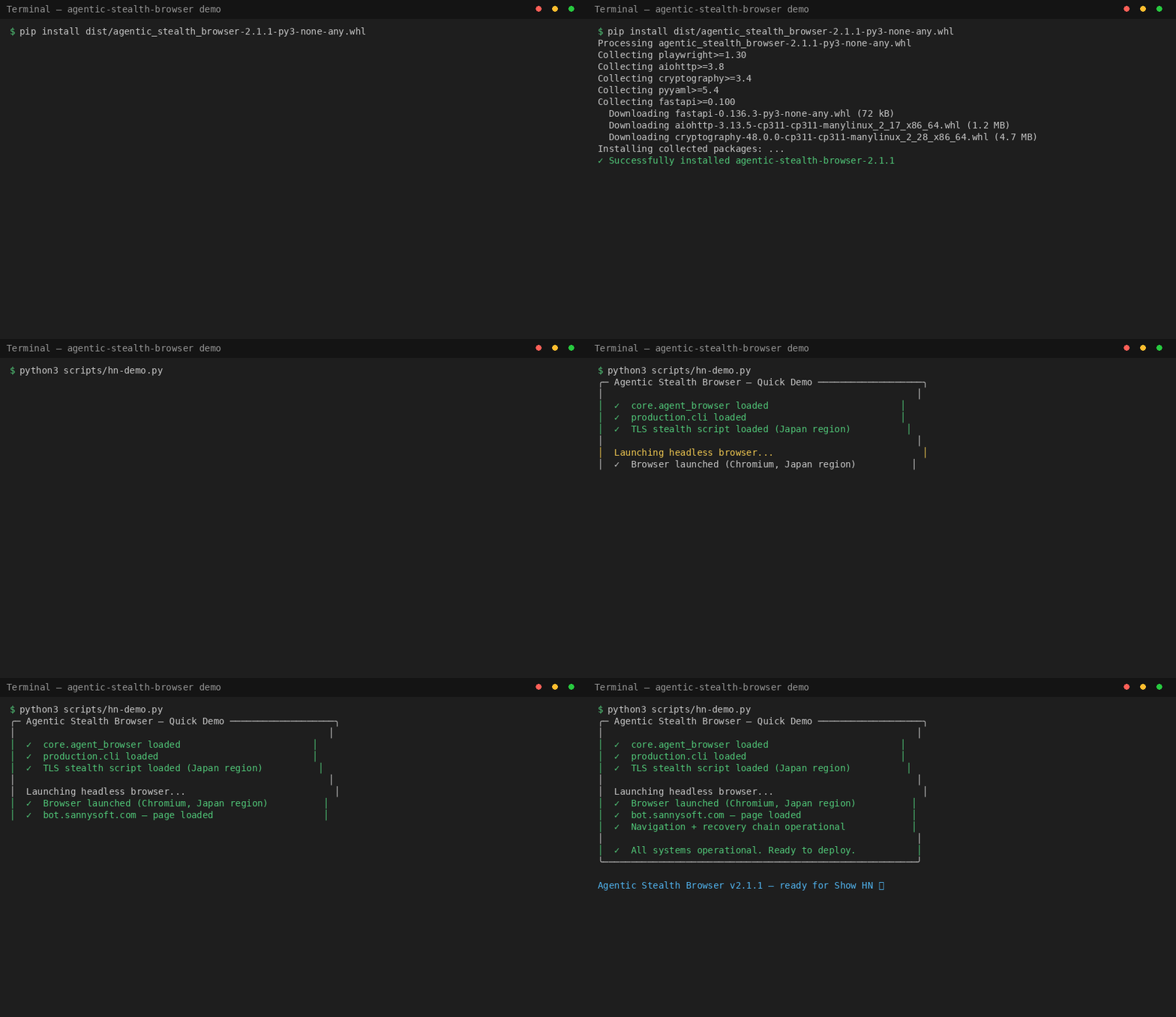
pip install agentic-stealth-browser
playwright install --with-deps chromium
from core import AgentBrowser

async with AgentBrowser(session_name="demo") as browser:
    await browser.launch(headless=True)
    await browser.safe_goto("https://bot.sannysoft.com")
    # passes WebGL, Canvas, AudioContext, WebRTC, and TLS fingerprint checks
Why vanilla Playwright fails
Sites don't just check your User-Agent anymore. They check everything:
| Attack Surface | Vanilla Playwright | This library |
|---|---|---|
| TLS handshake (client hello / JA3/JA4-ish) | Standard Python TLS — instantly identifiable | Region-spoofed TLS profile (process-level, not custom uTLS) |
Navigator APIs (navigator.webdriver, plugins, languages) |
Leaks automation flags everywhere | Every property patched before first paint |
| WebGL / Canvas fingerprint | Headless GPU renders differently | Consistent buffers across sessions |
| Human behavior | Robotic clicks, instant typing | Bézier mouse curves, variable speed, fatigue simulation |
| Auto-recovery | None — blocks = failure | CAPTCHA detection → proxy rotation → retry chain |
| Account warming | Nothing | 14-day graduated ramp-up per account |
Result: passes bot.sannysoft.com, pixelscan.net, and CreepJS with zero flags in
headless mode as of the latest 4-hourly canary run (detection canaries run every 4 hours
via docs/canary.md).
Limitations & honest claims
This library is opinionated and has real limits. Operators should know them up front:
- Not a real uTLS stack. TLS fingerprinting is process-level (region-matched
client-hello, init-script negotiation). It is notcurl_cffi-grade wire-level
impersonation. Attach mode (CDP) degrades further: the host browser's TLS is whatever
the user already has. - Headless detection is a moving target. Detection vendors change heuristics
weekly. This project runs a 4-hourly detection canary
(docs/canary.md) and patches regressions, but zero-flag is a
snapshot, not a guarantee. - No CAPTCHA solving. The recovery chain detects CAPTCHAs and surfaces them to
the operator dashboard for manual intervention. It does not call solving services.
If you need solver integration, build aBasePluginthat calls your provider and
drops the cookie back into the session. - E2E tests against live protected sites are opt-in. The default CI runs
contract + mocked integration tests. Live-site E2E (RUN_E2E_ANTI_BLOCK=1) is
flaky by nature and skipped on PRs. - Login credentials are not shipped. Examples that touch authenticated endpoints
stop at the search/listing stage.
Cost controls
Set AGENTIC_MAX_REQUESTS_PER_SESSION=<n> to cap navigations per session (safe_goto returns False once exceeded).
Quick Start
CLI (easiest)
# Health check + stealth fingerprint test
stealth-browser health --preset linkedin_2026 --region us

# Start the operator dashboard
agentic-stealth-browser dashboard
Python SDK
from core import AgentBrowser

async with AgentBrowser(
    session_name="my-session",
    region="japan",
    headless=True
) as browser:
    await browser.launch()
    await browser.safe_goto("https://example.com")
    # TLS-spoofed, no webdriver leak, human-like interaction ready
MCP (for AI agent clients)
{
  "mcpServers": {
    "stealth-browser": {
      "command": "python",
      "args": ["-m", "production.mcp_server"]
    }
  }
}
Then: stealth_launch → stealth_navigate → stealth_scrape → stealth_close.
Attach to an existing browser (WSL → Windows, container → host)
Instead of launching a new Chromium, you can attach to a Chrome you already
have running with --remote-debugging-port=9222:
# Attach mode: use a fresh instance (async-with auto-launches a new browser first).
browser = AgentBrowser(session_name="attached")
await browser.attach_over_cdp(
    "http://127.0.0.1:9222",   # or the Windows host IP from WSL
    new_context=True,           # don't disturb the user's tabs
)
await browser.safe_goto("https://bot.sannysoft.com")
# safe actions + MCP scrape now operational on attached; close() leaves external browser running.
await browser.close()
See docs/ATTACH_OVER_CDP.md for the WSL→Windows
walkthrough, the MCP stealth_attach_over_cdp tool, and the stealth
degradation matrix (init-script stealth still applies; TLS/JA3 does not).
Install from source
git clone https://github.com/shanewas/agentic-stealth-browser.git
cd agentic-stealth-browser
python3 -m venv .venv && source .venv/bin/activate
pip install -e ".[dev]"
playwright install chromium
pytest tests/ -q
The dev extras pull in pytest, pytest-asyncio, ruff, and the test fixture
deps. The full suite takes ~2 minutes on a warm cache; the default run skips
live E2E (RUN_E2E_ANTI_BLOCK=1 to enable).
Key Features
| Feature | What It Does |
|---|---|
| TLS Fingerprinting | Region client-hello profiles (JA3/JA4 surface); attach mode degrades (process-level) |
| Human Behavior | Mouse wobble, typing mistakes, fatigue, distraction |
| Auto Recovery | Block detection → proxy/session rotation → retry |
| Account Warming | 14-day gradual ramp-up for new accounts |
| Workflow Orchestrator | Queue, schedule, domain concurrency, retries, persistence |
| Python SDK | StealthClient — async API without MCP |
| Security Governance | Input validation, session isolation, policy engine, fail-closed MCP approval gate, per-user dashboard RBAC |
| Auditability | Redacted, HMAC tamper-evident audit log with rotation/retention |
| Observability | Prometheus /metrics, /api/usage rollup, success/block/rotation counters |
| Adaptive Stealth | Per-domain behavior profiles with FeedbackStore telemetry |
| Plugin System | Lifecycle hooks via BasePlugin |
| Operator Dashboard | Live DevTools, CAPTCHA intervention, workflow recording |
| Feature Flags | Runtime capability discovery per browser backend |
| Performance Profiling | Timing decorators + perf_benchmark.py |
New in v3.0.0 — Enterprise Hardening
⚠️ Breaking: the MCP approval gate is now fail-closed by default.
Sensitive actions (execute_js,stealth_launch, navigate to unknown
domains,run_workflow,stealth_replay) returnMCP_APPROVAL_REQUIRED
until approved. SetSTEALTH_APPROVAL_MODE=permissiveto restore the previous
auto-approve behavior.
- Auditability — tamper-evident HMAC-keyed audit chain (
verify_audit_chain,AGENTIC_AUDIT_HMAC_KEY), success-path audit records, log rotation/retention,
and recursive + token (GitHub/Slack/JWT) redaction - Dashboard RBAC — per-user viewer/operator roles replace the shared
password (boot refuses the defaultchange-me); attributable operator audit
log;GET /metrics(Prometheus) andGET /api/usage - Supply chain — hash-pinned reproducible install (
requirements.lock),
blockingpip-audit+bandit+gitleaks, SBOM + build-provenance
attestation, SHA-pinned Actions - Real CI gate — blocking
mypyoncore/, 55% coverage floor, a
Python 3.10–3.13 + ubuntu/windows/macOS matrix - Reliability — launch-failure driver-leak fix, opt-in
respect_robots
guard,AGENTIC_MAX_REQUESTS_PER_SESSIONper-session request budget - Stable facade —
from core import AgentBrowser
See CHANGELOG.md for the full list.
New in v2.6.0
- Stealth patch isolation — per-patch try/catch in
advanced_stealth.py; one
API mismatch no longer aborts every patch queued after it - Attach-mode fingerprint coherence — new
attach_modeskips
navigator.platform / WebGL vendor-renderer / screen-DPR overrides that would
otherwise contradict a real attached browser's OS/GPU - WebRTC leak hardening — per-instance
onicecandidaterebind (no
prototype-global leak); theaddEventListener('icecandidate')variant is
now filtered too - MCP policy/approval gates —
PolicyEngine+ApprovalGatewired into
the dispatch path, fail-open by default (opt-in enforcement viaSTEALTH_MCP_POLICYenv) - Adapter
isErrorsurfacing — failed MCP tool calls now raiseAdapterToolErrorinstead of reporting silent success; playwright-mcp
pinned to 0.0.78 with the corrected tool schema - Recovery rotation-failure correctness — failed rotations now propagate
and record history instead of silently succeeding
See CHANGELOG.md for the full release history.
New in v2.5.0
- BackendAdapter protocol — pluggable execution backends (M0–M4 shipped)
across CDP-bridge, playwright-mcp, and agentic-stealth-mcp - Real dashboard backends — the Hermes dashboard now wires a thin shim over
the adapter protocol, so the same UI drives all three backends - Attach-mode hardening — adopted tabs are preserved on
close(); bad
context/stealth installs roll back cleanly;human/scraper/recovery
initialized for attach - CLI
status— added--headlessand--sessionflags for headless
operator checks against a named session
See CHANGELOG.md for the full release history.
Full Documentation
- Operator Dashboard — Grok/X-inspired dark UI, live browser view, CAPTCHA solving, workflow recording
- Workflow Orchestrator — queue, schedule, chain workflows with domain-aware concurrency
- Security — input validation, session isolation, policy engine, approval gates
- SDK —
StealthClientasync API without MCP - Plugins — lifecycle hooks for custom behavior
- VPS Deployment — systemd, Caddy reverse proxy, Cloudflare Tunnel patterns
- Migration v1 → v2 — deprecation shims, migration guide, script
- Documentation index — full docs/ tree: attach-over-CDP, canary, plans, analysis
- Examples — runnable recipes for Cloudflare, LinkedIn, Amazon
Additional references: CHANGELOG.md · Workflow Library · Migration Guide
Project Structure
├── core/           AgentBrowser, connection pool, session checkpoints
├── stealth/        TLS, scripts, Firefox adapter, caching
├── behavior/       Human simulation, personas, adaptive tuning
├── recovery/       Anti-block orchestrator
├── workflows/      Recorder, player, schema, library
├── production/     MCP server, SDK, orchestrator, security, profiler
├── plugins/        Plugin system with template
├── scripts/        Migration, evaluation, benchmarking
├── docs/           Attach-over-CDP, canary, plans, analysis
├── examples/       Runnable recipes (Cloudflare, LinkedIn, Amazon)
└── tests/          Contract + integration tests (live E2E opt-in)
Governance & Support
License
MIT. See LICENSE and CHANGELOG.md.
Yorumlar (0)
Yorum birakmak icin giris yap.
Yorum birakSonuc bulunamadi