AIWorkHub
Health Warn
- License — License: MIT
- Description — Repository has a description
- Active repo — Last push 0 days ago
- Low visibility — Only 5 GitHub stars
Code Pass
- Code scan — Scanned 12 files during light audit, no dangerous patterns found
Permissions Pass
- Permissions — No dangerous permissions requested
No AI report is available for this listing yet.
Open-source, local-first control plane for multi-model AI coding agents in VS Code and MCP: task DAGs, source intelligence, durable context and evidence-based review.
AIWorkHub

The open-source control plane for multi-model AI coding agents.
Plan work, delegate it to coding models, preserve project context and accept
changes only when the evidence passes.





AIWorkHub is an open-source, local-first multi-model AI coding agent
orchestrator for VS Code and MCP. It coordinates Codex, Claude, Copilot,
DeepSeek and GLM workers through dependency-aware task graphs, durable project
memory, source-code intelligence and evidence-based review. Each Git repository
remains an isolated AI engineering workspace; no AIWorkHub cloud account or
HTTP service is required. Visit the AIWorkHub product site
or follow the getting-started guide.
The whole system

AIWorkHub follows one durable loop: Observe → Decide → Delegate → Verify →
Promote → Learn. The map separates live foundations from the current
hardening wave and planned capabilities. Live foundations include NeedFix and
Roadmap intake, the Task DAG, Source Graph and durable context authorities,
outcome-aware workforce routing, isolated worktrees, semantic edits, validation,
sealed review receipts, provider-free replay and manager-controlled promotion.
The active closure wave covers reviewer MCP delivery, exact liveness, finalizer
leases, validation isolation, cross-platform parity, Source Graph refresh truth,
storage retention and NeedFix lifecycle reconciliation. Planned capabilities
include automatic NeedFix closure and TTL cleanup, provider controls, CPU-aware
parallelism, richer evidence visualization and quality-calibrated release
automation.
What's new in 0.9.40
- Required semantic-edit creates reject literal placeholder output, including
retained rework that leaves an invalid required file unchanged. - Repository Ruff and mypy checks can use their trusted PATH entrypoint when
the active MCP interpreter does not provide the declared module; receipts
still record the command and executable that actually ran. - Task supersession now verifies the replacement task before archiving the
original card, so the Plan DAG never observes a broken replacement edge. - Quality-verdict aggregation keeps a strict typed evidence shape, with new
focused regressions alongside the full Python and VS Code extension suites.
Supported models
AIWorkHub routes by runner family and adapter. Editor routes use models already
visible in VS Code; CLI routes reuse that CLI's own authenticated session.
AIWorkHub does not copy editor or CLI credentials.
| Runner family | Supported route | Install requirement | Credential |
|---|---|---|---|
codex_* |
codex_cli or VS Code LM |
Codex CLI/extension, or a VS Code LM provider | Existing Codex login, or one-time VS Code model consent |
claude_* |
claude_cli or VS Code LM |
Claude Code CLI/extension, or a VS Code LM provider | Existing Claude subscription login, or one-time VS Code model consent |
deepseek_* |
DeepSeek V4 Pro/Flash through VS Code LM; Copilot CLI BYOK fallback | DeepSeek-capable VS Code provider; fallback requires GitHub Copilot CLI | VS Code model consent; fallback uses aiworkhub-deepseek-credential set |
glm_* |
GLM 5.2 through VS Code LM; Copilot CLI BYOK fallback | GLM 5.2 visible in VS Code; fallback requires GitHub Copilot CLI | VS Code model consent; fallback uses python -m aiworkhub.glm_credentials setup |
copilot_* |
Public VS Code Language Model API | GitHub Copilot extension | GitHub sign-in and one-time model consent |
Exact model availability is discovered at runtime because subscriptions and
editor model catalogs differ. The editor broker starts automatically, performs
credential-free discovery, and asks for consent only when an exact queued task
first invokes that model. In Remote-SSH, the workspace extension uses VS
Code's Language Model API to consume the same model catalog exposed by the
Windows/macOS/Linux client window; it does not look for a second provider
credential on the SSH host. The dashboard reports visible editor models
separately from execution routes, so a redundant unavailable CLI fallback
is never presented as a missing model or repository blocker.
Why AIWorkHub
- Use models as a portfolio. Keep frontier models for difficult judgment,
route bounded throughput to lower-cost capable models, and use deterministic
tools where no model is needed. - Reduce avoidable model work. Agents query a structural Source Graph,
read bounded regions and emit focused replacements instead of repeatedly
scanning or regenerating whole files. - Delegate safely. Dependency-aware tasks run in bounded workspaces with
explicit write scopes, timeouts and cancellation. - Review evidence, not claims. Diffs, tests, tool-use receipts, artifacts
and approval history travel with every task. - Keep repositories isolated. Every repository owns its
.aiworkhub/
state, callbacks, indexes, memories and audit trail. - Use multiple models. Route work by capability, readiness, cost and
observed quality without moving project authority into a hosted service.
Codex, Claude, Copilot, DeepSeek and GLM are not products AIWorkHub tries to
replace. They are execution routes in its workforce. AIWorkHub supplies the
repository-scoped planning, context, isolation, evidence, review and economics
layer that lets expensive and economical models work together as one system.
Three layers of model economics
| Lever | What AIWorkHub changes | User benefit | Current evidence boundary |
|---|---|---|---|
| Token efficiency | Source Graph discovery, bounded reads, focused context and replacement-only semantic edits | Less avoidable input and code-generation output on eligible work | 31,998 file bytes versus 531 replacement bytes is a verified 60.26× code-output shape ratio; total provider-token multiplier remains unmeasured |
| Model-mix efficiency | Routes bounded throughput to lower-cost capable models and reserves premium models for hard judgment or review | The same useful workload can consume fewer expensive-model tokens even when total tokens are unchanged | In one 36-run Claude cohort, Opus was 19% of tokens but 42.9% of known cost; quality-adjusted cross-model savings are the next required measurement |
| Attempt efficiency | Separates launch, validation, timeout and review failures so residual work can be repaired instead of blindly repeated | Fewer expensive retries and clearer reasons for rework | 47 of 114 historical attempts were retries and used 88.31M tokens; this locates the opportunity but does not claim every retry was avoidable |
These levers compound: reducing a task's unnecessary tokens and then running
the remaining bounded work on a cheaper capable model can lower cost more than
either optimization alone. Every saving still has to preserve validation and
manager-accepted quality; a cheap failed run is not an economic success.
Where AIWorkHub sits
| Layer | Examples | Relationship to AIWorkHub |
|---|---|---|
| Repository control plane | AIWorkHub | Owns task truth, dependencies, routing, context authorities, isolation, evidence, callbacks, review and economics telemetry |
| Supported execution workforce | Codex, Claude, Copilot-hosted models, DeepSeek, GLM | Models and agent runtimes AIWorkHub coordinates; they are not competitors |
| Adjacent context/edit tooling | Graphify, Serena and similar graph or semantic toolkits | Complementary ideas/capabilities; they do not provide the same complete repository control loop |
| Standalone coding-agent products | Aider, Cline and similar clients | Alternative execution experiences, not the same product layer |
| Actual alternative today | Manual multi-chat coordination or custom in-house glue | The workflow AIWorkHub replaces: copy/paste context, hand-managed worktrees, retries and review state |
Source intelligence and durable context
AIWorkHub has two graphs with different authority. They are complementary,
not alternate names for the same feature.
| Surface | What it represents | Who uses it |
|---|---|---|
| Source Graph | An automatically refreshed structural index with 34 configurable code/data/documentation families and 31 bounded query modes, used to return repository context instead of repeatedly scanning the tree | Managers and workers |
| Manager Context Graph | An opt-in, append-only ledger and deterministic graph of manager conversation evidence across repository, thread, session and task identities | Verified managers only |
The Manager Context Graph can search an earlier decision, recover the exact
bounded transcript range around it and follow deterministic relations to its
thread, session or task. It does not replace Session Manager (current state and
handoffs), AI Memory (durable lessons), KB (curated project knowledge), or the
Source Graph (code intelligence). Current passive capture supports completed
Codex user/assistant messages; reasoning, streaming deltas, tool output,
commands and approvals are excluded. Claude and Copilot capture adapters are
not yet claimed as shipped.
AIWorkHub reports context evidence rather than making an unverifiable savings
claim: requested/delivered bytes, acknowledged tool receipts, truncation and
degraded reasons remain distinguishable. See the
Source Graph guide,
Manager Context Graph and
Source Graph economics
contract.
For existing-file changes, the worker can stay on a focused path end to end.
Source Graph body returns one bounded symbol with exact line evidence; the
model emits only replacement code; AIWorkHub's local Python applier verifies
the complete-file preimage, the prepared fragment, write scope and range before
changing the isolated worktree. Full-file output remains available only as a
legacy fallback or for genuinely new files. Receipts report file, fragment and
replacement bytes, but do not turn those byte counts into an invented token
savings multiplier.
Measured benefits and limits
The checked-in benchmark ledgers are recomputed in CI. They include favorable,
negative and still-unmeasured results.
| Evidence | Current observation | Status |
|---|---|---|
| Focused-edit paired pilot | Historical capped A/B observation: 27.5% fewer total tokens, 24.9% fewer output tokens and 21.5% less elapsed time across two pairs, but pair 1 used mismatched 20k/200k token ceilings |
Not eligible for a causal or product-savings claim; uncapped matched rerun required |
| Authenticated edit shape | 531 replacement bytes for 31,998 existing-file bytes (1.66%; 60.26× structural ratio), with zero old bytes re-emitted | Verified reduction in emitted code payload when a full-file baseline applies; not a 60.26× claim for the complete provider bill |
| Current Source Graph gate | 7/7 gated tasks used live graph evidence; 13 calls, 0 failures; p50 15.024 ms | Verified runtime snapshot |
| Tool-use cohorts | Review-ready rate was 7.2% with missing graph use, 26.7% with live single-stage use and 33.3% with continuous use | Observational association; not causality |
| Legacy context packaging | The 0.8.81 v1 envelope expanded a 156-task payload by 20.0%; v2 later reduced the same-evidence representative fixture from 849 to 600 bytes (29.329%) | Historical negative baseline; structural fix shipped, live fleet remeasurement pending |
| Callback durability | 271 events, zero dead letters and zero backlog | Verified runtime snapshot |
See Benchmarks for the full evidence matrix, denominators,
adjacent-tool capability boundaries, raw ledgers and the promotion gate required
before publishing any universal savings claim.
How it works
flowchart LR
    A[VS Code and MCP clients] --> B[Repository-bound AIWorkHub runtime]
    B --> C[Plan DAG and task queue]
    B --> D[Source Graph]
    B --> E[Session, Memory and KB]
    C --> F[Isolated model workers]
    F --> G[Evidence bundle]
    G --> H[Manager review]
    H -->|accept or rework| C
The MCP server uses stdio only. Writes and process launches are independently
disabled by default. Credentials stay outside the repository, callback events
are durable and repository state remains local.
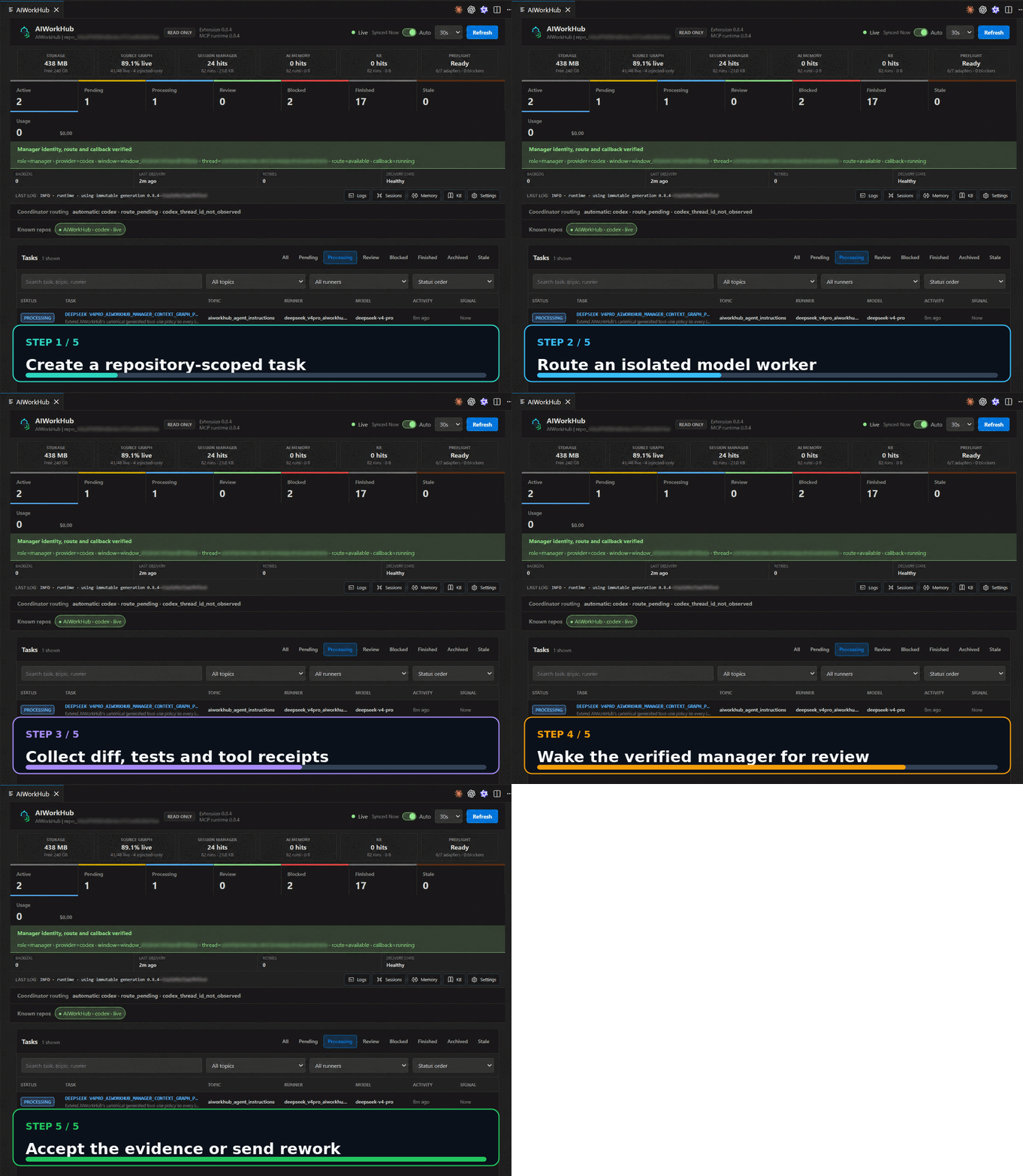
A 20-second view of the repository-scoped task, worker, evidence and review loop.
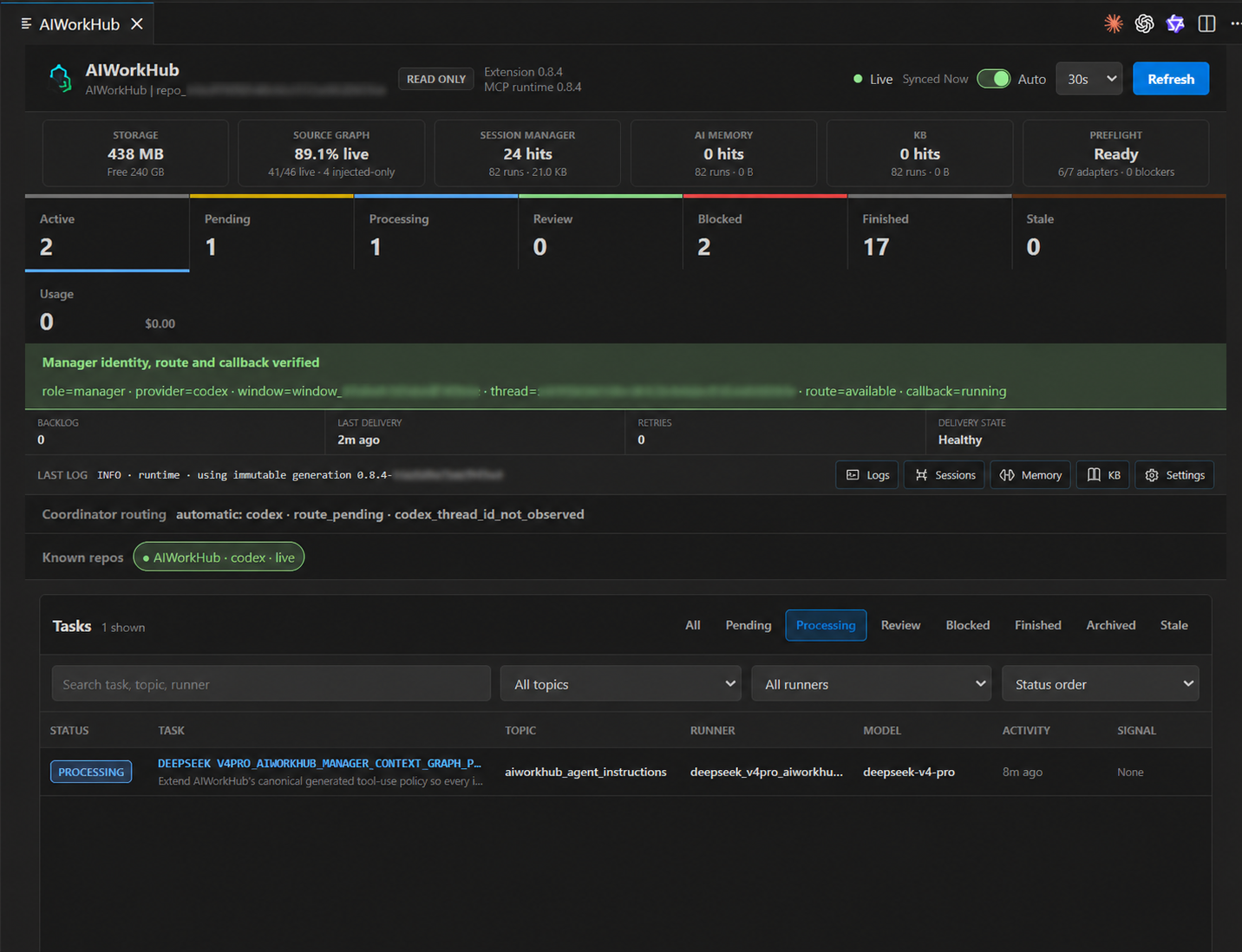
AIWorkHub orchestrating its own development with repository-scoped context, tasks and review callbacks.
Install the VS Code extension
Install from the
VS Code Marketplace
or download the VSIX from the latest
GitHub release. For a downloaded
VSIX, run:
code --install-extension aiworkhub-*.vsix
In VS Code:
- Open a Git repository.
- Run AIWorkHub: Open Dashboard.
- Choose Initialize AIWorkHub once.
- Open a new model chat so it discovers the repository MCP tools.
Initialization is explicit and idempotent. It creates .aiworkhub/, starts the
first Source Graph index and keeps the index fresh. The packaged extension runs
on Linux, macOS, native Windows, WSL and the workspace host in Remote-SSH.
Start a manager chat
Open a new Codex, Claude or other MCP-capable chat after initializing (or
upgrading) AIWorkHub. The new chat performs tool discovery and receives the
MCP Manager Contract banner. Claude Code also reads the repository-local.mcp.json registration and AIWorkHub-managed CLAUDE.md block: direct
Claude chats must bootstrap as managers and use Source Graph before broad
built-in file discovery. They are not worker sessions.
The prompt below is a portable first-run diagnostic for clients that do not
automatically honor repository instructions; it is not required in a correctly
initialized new Claude Code chat:
Use AIWorkHub as the manager for the currently bound repository.
First call aiworkhub_manager_bootstrap, then verify repository identity,
manager route, callback health, Source Graph readiness and model preflight.
Recover relevant Session Manager state and make one bounded AI Memory query.
Do not edit files, create tasks or launch workers yet. Report what is ready,
what is degraded, and which repository you are authorized to manage.
The response should identify the same repository shown in the dashboard and
report role=manager with a verified route. If it reports an unverified role,
the wrong repository, no tools, or a stale runtime version, stop and use
AIWorkHub: Restart MCP Connection or open a fresh chat. Do not ask the
model to bypass the route or write directly to .aiworkhub databases.
Now describe the outcome in ordinary language. A useful second prompt is:
Plan this outcome with AIWorkHub: <describe the change and constraints>.
Inspect the repository with Source Graph, create bounded dependency-aware
task cards with exact acceptance criteria, allowed writes and validation,
then launch every independent non-colliding ready task in parallel on the
best available models. Keep dependent or overlapping work pending. When a
callback arrives, independently review evidence and accept or reject it.
Give me a short progress report after each accepted wave.
You do not need to name a model. Preflight and Workforce expose the models
already authorized in the editor, and the manager chooses a route from live
readiness and observed outcomes. Name a model only when you intentionally want
to override automatic routing.
Understand the task lifecycle
| State/action | Meaning | Owner |
|---|---|---|
task_create → pending |
A durable card exists; no model is running yet | Manager |
claim + launch → processing |
The exact dependency-ready card was claimed and its worker process started | AIWorkHub runtime |
review_ready |
Worker stopped and submitted diff/tests/logs/artifacts/tool receipts | Worker |
| callback | Wakes the repository's current verified manager; it is not approval | AIWorkHub callback bridge |
| accept or reject | Promote verified work, or preserve evidence and issue exact residual work | Manager |
Never move a card to processing merely because it is pending, and never
infer completion from chat prose. The canonical task receipt is state truth.
All review and terminal categories are callback-eligible. If a connection
drops after a write, reconcile the same task ID; identical retries are
idempotent, while inventing a replacement ID creates duplicate work.
First task workflow
- Confirm Preflight is ready and lists at least one editor model or
authenticated CLI route. Optional/redundant unavailable routes do not block
the repository. - Ask the manager chat for a bounded task. The canonical card records the
objective, acceptance criteria, dependencies, write scope and validation. - Launch the exact card. The worker uses repository-local Source Graph and
durable context inside an isolated task workspace. - Follow Live Output or wait for the durable terminal callback.
- In Review, inspect the diff, tests, logs, artifacts and tool receipts.
Accept to promote the verified change, or reject with exact residual work.
For ongoing work, ask the manager: Inspect the completion inbox, finalize all review-ready tasks from verified evidence, rebase the task DAG, and launch the next dependency-safe parallel wave. Workers never finalize their own work.
The dashboard's Operations dialog explains real tool use, Source Graph
modes, model outcomes, latency, token/cost evidence, callback delivery and
storage retention. See the complete user guide for
multi-repository, Remote-SSH and troubleshooting flows.
Current public channels: VS Code Marketplace and signed-by-checksum GitHub
Release artifacts (VSIX, wheel and source distribution). Marketplace review
can briefly lag a new GitHub tag; the release page and attached SHA256SUMS
remain the exact artifact authority. Open VSX and PyPI jobs remain opt-in; see
Publishing for owner setup.
Headless development install
git clone https://github.com/shrec/AIWorkHub.git
cd AIWorkHub
python3 -m venv .venv
. .venv/bin/activate
pip install -e .
AIWORKHUB_REPO_ROOT=/path/to/repository python -m aiworkhub.server
An MCP client can start the same runtime with:
{
  "mcpServers": {
    "aiworkhub": {
      "command": "python3",
      "args": ["-m", "aiworkhub.server"],
      "env": {
        "AIWORKHUB_REPO_ROOT": "/path/to/repository",
        "AIWORKHUB_ALLOW_WRITES": "0",
        "AIWORKHUB_ALLOW_LAUNCH": "0"
      }
    }
  }
}
Enable writes and launches only in a trusted manager process. Launched workers
never inherit the manager launch capability.
Product surface
| Area | Current capability |
|---|---|
| Tasks | Dependency DAG, collision checks, isolated workers, truthful terminal states and manager review |
| Source Graph | 34 configurable code/data/documentation families, 31 bounded structural and analytical modes, automatic incremental indexing, staged replacement-only semantic edits with offline envelope assembly and continuous-use telemetry |
| Context | Repository-scoped Session Manager, AI Memory and KB read/write MCP tools |
| Quality | Deterministic verification, combined-tree validation, diff-scoped multi-language Known Bug Scanner, truth-preserving SARIF 2.1.0 export and configurable evidence gates |
| Operations | KPI charts, Review Inbox, callbacks, live output, authenticated all-tool telemetry, bounded logs, reversible task/archive retention and workforce scoring |
| Platforms | Linux, Windows, macOS and Remote-SSH release qualification |
The KPI view separates explicit manager decisions from worker terminal
outcomes and plots only bounded repository evidence. Its larger aggregate-only
history shows Source Graph modes, workflow stages, latency, inter-call gaps,
returned structural evidence, index generations, tool-use cohorts,
deterministic raw-path-versus-delivered-bundle byte economics, authenticated
receipt conformance, repeated-query discipline, compact-replay bytes and
imported runtime coverage. The repository also ships registry-driven
retrieval precision, eval-artifact truth, per-test suite profiling, risk
precision, no-net-growth and matched A/B instruments. Missing populations are
shown as not_configured, inconclusive or unknown; they never become zero
or a synthetic savings multiplier.
Focused semantic edits additionally report authenticated source-file, selected-region and
replacement byte totals, including how many whole-file bytes the model did not
re-emit. Text-only and native VS Code LM providers can submit these fragments
one at a time; the local bridge validates hashes and overlaps, retains no
workspace mutation during staging, and assembles the final response offline.
This is structural evidence, not a token multiplier. Every rate
carries its sample window or denominator; token savings and causal quality
gains are deliberately not inferred. Inter-call gaps at or above the bounded
15-minute informational threshold are surfaced, but never mislabeled as proof
that a model was inactive.
The canonical combined review surface is aiworkhub_completion_inbox. Tool
availability and write authority are reported by the live MCP runtime; clients
should discover the schema rather than copy a frozen tool list from docs.
Archive and storage lifecycle
AIWorkHub does not require repositories to keep task history forever. The
Storage view can preview archived tasks older than 30, 90, 180 or 365 days,
move an exact digest-bound batch into repository-local quarantine, restore it
during a seven-day undo window, and separately purge expired quarantine
payloads. Tasks with undelivered callbacks are protected, active/review tasks
cannot enter this cleanup path, and a compact audit record survives payload
purge. Individual completed tasks can also be archived or restored from the
task detail view.
Retention defaults are repository-local and configurable in Settings. Preview
never mutates data; quarantine and permanent purge require separate explicit
confirmation.
Security model
- stdio transport; no AIWorkHub HTTP listener;
- separate
AIWORKHUB_ALLOW_WRITESandAIWORKHUB_ALLOW_LAUNCHgates, both
off by default; - shell-free exact-task process launch and bounded workspaces;
- owner-only credentials outside repositories and secret-redacted logs;
- append-only audit evidence and authenticated tool-use receipts;
- fail-closed repository, manager, task and claim-episode identity checks.
Read SECURITY.md before enabling autonomous launches. Callback
delivery and its optional Codex compatibility transport are documented in
Callback delivery.
Development
python -m pip install -e ".[dev]"
ruff check src/aiworkhub scripts tests
mypy
python -m pytest -q
npm --prefix vscode-extension install
npm --prefix vscode-extension test
Start with Getting Started, then use the
Architecture, Product Roadmap,
Manager Context Graph,
Publishing Guide, Brand Guide and
Contributing Guide.
Acknowledgements
Thanks to null0xxx for sharing
kimi-atlas and useful ideas about
multi-agent orchestration and evidence-driven verification.
AIWorkHub is open source under the MIT License.
Reviews (0)
Sign in to leave a review.
Leave a reviewNo results found