why-was-fable-banned
Health Gecti
- License — License: MIT
- Description — Repository has a description
- Active repo — Last push 0 days ago
- Community trust — 20 GitHub stars
Code Basarisiz
- rm -rf — Recursive force deletion command in adapters/codex/forge-codex-accept.sh
- rm -rf — Recursive force deletion command in bench/measure_insession.sh
Permissions Gecti
- Permissions — No dangerous permissions requested
Bu listing icin henuz AI raporu yok.
Spec-first, evidence-gated engineering-procedure enforcement for AI coding agents (Claude Code + Codex). The agent can't edit until it writes a passing spec.
why-was-fable-banned
English · 한국어
Gate for AI coding agents: blocks edits until a spec passes.




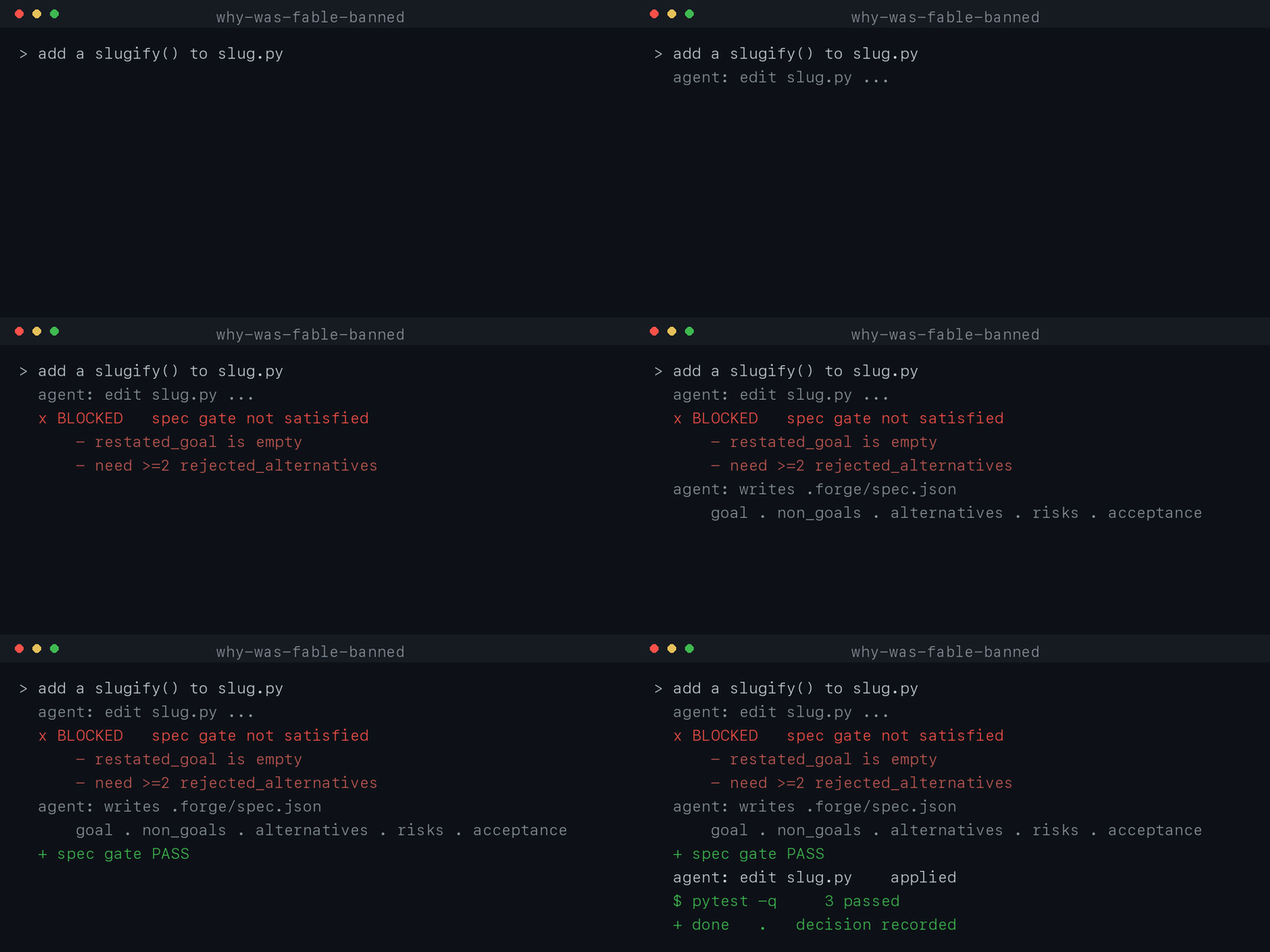
The agent can't edit code until it writes .forge/spec.json and a deterministic
gate accepts it: restated goal, non-goals, context chosen by authority, ≥2 rejected
alternatives with the boundary each breaks, risks, and runnable acceptance. One
shared gate, installed as hooks. Works in Claude Code and Codex.
[!NOTE]
A spec must exist and pass before edits land, and unspeced or forbidden-path work
never reaches your repo. Every change ships with an auditable decision record.
Install
git clone https://github.com/SihyeonJeon/why-was-fable-banned
cd why-was-fable-banned && sh install.sh
python3 only, stdlib. Disable per project: touch .forge/OFF. Bypass once:FORGE_BYPASS=1. Remove: sh install.sh --uninstall.
How it works
- Block: a
PreToolUsehook intercepts every edit and exits 2 until the spec passes - Spec: restated goal · non-goals · context by authority · ≥2 rejected alternatives · risks · runnable acceptance · forbidden paths
- Verify: "done" isn't done until each acceptance command shows live output (fail closed)
- Apply: on headless Codex the worker runs in a throwaway git worktree; only a gate-passing diff reaches your repo
Quickstart
sh install.sh: wires the hooks at user level (every project + subagent inherits it)- Prompt your agent to do real work: a gated task auto-starts
- The agent writes
.forge/spec.json(it's told exactly what to fill); edits stay blocked until it passes - It implements, runs the acceptance commands, records evidence, then closes
Grade auto-scales the depth: typos pay almost nothing, auth/payments/migration pay
the full gate.
Supported agents
- Claude Code: native hooks, in-session block (the spec adds to one pass)
- Codex:
forge-codex-accept "<goal>" --repo <dir>(worktree-accept; headless)
Where the rules came from
Recorded real engineering sessions with hooks (42 traces), extracted them as a
structured decision schema, generalized 19 into 8 decision axes, and cross-checked
the generalization with a second model. Observable artifacts only: no
chain-of-thought, local, secrets masked.
| layer | checks | how |
|---|---|---|
gates/forge_gate.py |
form: fields, real paths, forbidden, fail-closed | deterministic, free |
gates/forge_judge.py |
meaning: 0–2 rubric, gaming detection | optional LLM judge |
bench/ |
correctness: hidden grader | runs the tests |
Benchmarks
Measured in this repo, reproducible (bash bench/run_quality.sh, bash tests/run_all.sh):
| measure | gate OFF | gate ON |
|---|---|---|
| Decision record per change | none | enforced |
| Unspeced or forbidden-path edits reaching the repo | possible | blocked |
| Token overhead, in-session (Claude Code) | 1× | ~+spec; LIGHT under 2× |
| Adversarial gate tests (grade-downgrade, hook bypass, malformed spec) | n/a | 23/23 pass |
Details: bench/BENCHMARK.md · TOKEN_BUDGET.md.
License
PRs welcome. MIT.
Yorumlar (0)
Yorum birakmak icin giris yap.
Yorum birakSonuc bulunamadi