SingItAI
Health Uyari
- License — License: MIT
- Description — Repository has a description
- Active repo — Last push 0 days ago
- Low visibility — Only 6 GitHub stars
Code Basarisiz
- exec() — Shell command execution in .agents/skills/bitrefill/scripts/siwx_build_message.js
- fs module — File system access in .agents/skills/bitrefill/scripts/siwx_build_message.js
- network request — Outbound network request in .agents/skills/bitrefill/scripts/siwx_build_message.js
- fs module — File system access in .agents/skills/bitrefill/scripts/siwx_send.js
- network request — Outbound network request in .agents/skills/bitrefill/scripts/siwx_send.js
Permissions Gecti
- Permissions — No dangerous permissions requested
Bu listing icin henuz AI raporu yok.
Pay-per-use AI for agents over x402. A remote MCP server and an OpenAI-compatible API for 200+ models, search and data, plus gift cards, eSIMs and top-ups. Paid in USDC on Base and Solana, inside spending limits the owner sets.
SingIt






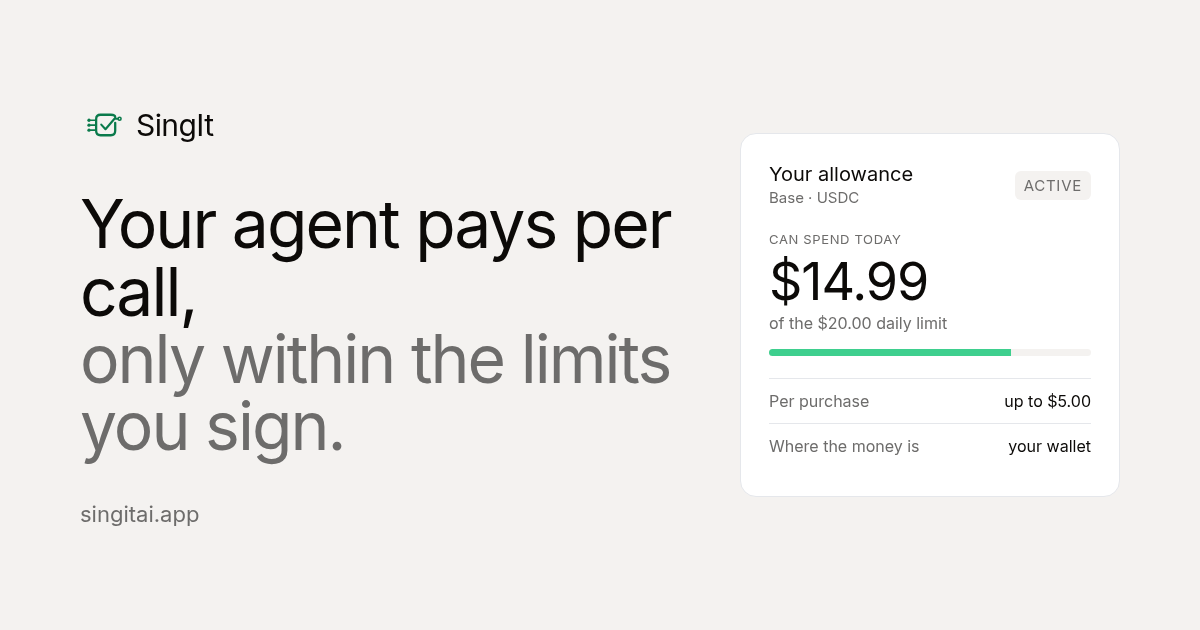
Your agent pays per call, only within the daily and per-purchase limits you sign.
SingIt is an AI agent that buys things for you — gift cards, eSIMs, mobile
top-ups, live data, paid AI answers — and pays for them in USDC over
x402. You give it a budget instead of your wallet: two
limits and one approval. Your USDC stays in your own wallet on Base or Solana,
and the agent takes only what each purchase needs, inside those limits.
On Base the limits are enforced onchain; on Solana the SingIt server checks them.
Website · Open the app · Documentation
Also listed on PayAPI Market (verified x402 listings, e.g. Claude Haiku 5.5).
Quick start
Three commands. The first needs no account, key or wallet.
1. Call SingIt Ask, the x402 endpoint. An unpaid request gets the 402 Payment Required
challenge with its USDC offers (payment-required header, base64 JSON):
curl -i https://ask.singitai.app/v1/chat/completions \
  -H 'Content-Type: application/json' \
  -d '{"model":"deepseek-v4.1-flash","max_tokens":200,"messages":[{"role":"user","content":"Say hello in five words."}]}'
Use the model free/deepseek-v4.1-flash in the same request to get an answer with no payment
(one of six free models; up to 20 answers a day per network, shared $0.25/day cost cap). The shared free tier may run out for the day (free_budget_exhausted); it resets at midnight UTC. To pay for an answer from your own wallet, see
Your first paid x402 call.
2. Add the MCP server to Claude Code. Price and model lookups work without a key; add--header 'Authorization: Bearer ${SINGIT_API_KEY}' for the paid tools. Other clients:llms-install.md.
claude mcp add --transport http singit https://app.singitai.app/mcp
3. Install the ElizaOS plugin (integrations/elizaos-plugin):
npm install @singitai/plugin-singit @elizaos/core
How it works
Three steps, about a minute, then the agent just buys.
flowchart LR
    A["1. Sign in<br/>with your wallet,<br/>or email / Google / Apple"] --> B["2. Set limits<br/>daily and per purchase"]
    B --> C["3. Approve once<br/>one signature in your wallet"]
    C --> D["Ask in your own words<br/>the agent finds and buys<br/>inside your limits"]
    D -.->|"revoke any time:<br/>one more signature"| C
- Sign in. Connect the wallet you already use — Rabby, MetaMask, Phantom,
Solflare, or any mobile wallet through WalletConnect — or sign in with email,
Google or Apple and get a wallet made for you. Signing in is a message
signature: it moves nothing. - Set your limits. A daily limit and a per-purchase limit, typed in or
simply asked for in the chat ("set a $20 daily limit, $5 per purchase"). - Approve once. One approval from your wallet. From then on the agent buys
inside the limits without asking the wallet again. Revoking is one more
signature, in SingIt or without us (for example on revoke.cash).
How the limits are held depends on the network:
| Base | Solana | |
|---|---|---|
| What you approve | A USDC allowance to your own limiter contract, deployed for you (we pay its gas) | The agent as delegate on your USDC account, for a total you choose |
| Who enforces the limits | The contract, on chain: daily limit, per-purchase limit and expiry are fixed in it | The chain caps the approved total; SingIt enforces the daily and per-purchase limits before every payment |
| Where the money is until a purchase | In your wallet; for micro-payments your agent keeps a small float (up to 0.20 USDC by default) | In your wallet |
| How a purchase is paid | The limiter moves USDC from your wallet to your agent as purchases need it; the agent pays the seller over x402 | The agent pays the seller over x402 straight from your account, as your delegate |
What happens when you ask for something
The agent reads what you asked, finds it, shows it with its price, and buys when
you press Buy — or right away when you clearly asked it to buy. A gift card,
for example:
sequenceDiagram
    actor You
    participant App as SingIt app
    participant Agent as Agent
    participant GW as Payment gateway
    participant Seller as Seller (Bitrefill, x402)
    participant Chain as Base / Solana

    You->>App: "Find a Steam gift card in Germany"
    App->>Agent: your message
    Agent->>Agent: classify the request, read brand, country, amount
    Agent->>GW: search the catalog
    GW-->>App: product cards with values and prices
    You->>App: pick a value, press Buy
    App->>GW: buy this value at the price shown
    GW->>Seller: fresh quote and order
    GW->>GW: check price, limits, spending policy
    GW->>Chain: pay the invoice in USDC from your wallet, within limits
    Chain-->>Seller: payment settles
    Seller-->>GW: gift card code
    GW-->>App: receipt
    You->>App: Show code (shown once)
What the gateway checks before any money moves:
- The price. The order is priced again when you press Buy. The invoice must
match that quote; on Solana it must also be no higher than the price you saw,
or nothing is bought and the new price is shown to confirm. - Your limits. The per-purchase limit, what is left of today's limit, the
approval's remaining total and the expiry. A purchase that does not fit is
refused with the reason, and nothing is paid. - The seller. Each seller is bound to the address it is paid at and to a
price ceiling. A payment request naming another address, asset or a higher
amount is never signed. - The spending policy. Spending Memory
can allow, escalate or block a purchase by budget and merchant history.
After paying, the gateway does not take the seller's word for it: a purchase
counts as paid when the transfer shows on chain, and as delivered when the
seller returns the goods. Gift card codes are shown to you once.
The language model never authorizes a payment. It only chats and extracts what
you asked for (search words, amount, country); the request is classified into a
fixed set of intents, the amounts are validated in code, and every purchase
goes through the same gateway checks. At most one purchase follows one message.
What the agent can do
| Ask for | What happens | Price |
|---|---|---|
| Gift cards, eSIMs, mobile top-ups | Searches thousands of brands on Bitrefill, shows the product and price, buys inside your limits, shows the code once | The card's price |
| Live answers: weather, exchange rates, flight status and prices, places to eat or stay, a web page | One small paid x402 request to a checked seller, counted against your limits | Capped per seller |
| Chat that bills by the answer (SingIt Ask) | Each answer is paid for what it actually cost | Up to 0.003 USDC |
| Private chat (Venice) | Switch models; credit is topped up from the same limits | Per top-up |
| An email to yourself, a phone call made for you by an AI assistant | Drafted by the agent; sent only when you press send on a card showing the recipient, text and price | $0.02 email, $0.54 call (Base) |
The app installs on a phone from the browser (Add to Home Screen) and sends
notifications when something needs you.
Safety
- Your money stays with you. USDC stays in your own wallet. The agent takes
only what a purchase needs, when it needs it. - Limits the agent cannot exceed. On Base, the limiter contract enforces
them even if our server or the agent were compromised; it holds no tokens and
has no admin or upgrade path. On Solana, the chain caps the approved total. - One signature takes it back. Revoke in SingIt or with any wallet tool.
An emergency stop pauses a Base limiter for good. - A watcher reads the chain, not our records: on Base, a spend to anyone
but your own agent, or an unusual burst of spends, pauses the limiter and
alerts you. - Nothing reaches people on its own. Emails and calls wait for your press.
- No double charges. A payment whose answer was lost is never repeated
automatically; it stays counted against your limits. - An operator kill switch stops every paying action at once.
See the security model for trust boundaries.
Architecture
The components and the x402 payment flows are drawn in more detail in docs/architecture.md.
flowchart TB
    Web["Web app<br/>website/app"] --> API["Web API<br/>sign-in, chat, limits"]
    API --> GW["Payment gateway<br/>sign402-gateway"]
    GW --> Base["Base: limiter contract<br/>agent-allowance,<br/>x402 via cdp-x402-service"]
    GW --> Sol["Solana: delegated USDC,<br/>x402 via solana-x402-service"]
    GW --> Sellers["Sellers over x402:<br/>Bitrefill, data, SingIt Ask, Venice,<br/>email, calls"]
| Directory | Purpose |
|---|---|
sign402-gateway/ |
Python gateway: accounts, the chat agent, limits, payment checks, orders and APIs. |
website/ |
Landing page (singitai.app) and the web app in website/app/ (app.singitai.app). |
agent-allowance/ |
AgentAllowance, the per-user spending limiter contract on Base (Foundry). |
solana-x402-service/ |
Solana USDC: delegated approvals, x402 payments, Bitrefill invoices, Venice and Exa. |
cdp-x402-service/ |
Base: x402 payments and swaps through CDP. |
singit-ask/ |
SingIt Ask, the x402 model endpoint that bills by the answer. |
singit-risk-check/ |
x402 endpoint for payment-requirement risk analysis. |
docs/ |
Design notes, operating instructions and verification records. |
Development
Use Python 3.12 and Node.js 22 to match CI (solana-x402-service needs
Node.js 24). Clone the full repository: the gateway imports shared code from
sibling directories.
git clone https://github.com/SingItAi/SingItAI.git
cd SingItAI
python3.12 -m venv sign402-gateway/.venv
sign402-gateway/.venv/bin/python -m pip install -e ./sign402-gateway
Run the tests:
(cd sign402-gateway && .venv/bin/python -m unittest discover -s tests)
(cd cdp-x402-service && npm ci --ignore-scripts && npm test)
(cd solana-x402-service && npm ci --ignore-scripts && npm test)
node --test website/tests/*.test.mjs
The suites use test doubles for chains, sellers and wallets; no funded wallet is
needed. They cover limits, payment checks, retries, sign-in and the seller
integrations. CI also audits Python and Node dependencies.
Running the service needs wallet encryption and API secrets, seller credentials
and RPC endpoints: start with the environment reference
and the operations runbook. main is deployed by hand,
so the running version is whatever was last deployed.
Further reading
- Documentation index
- Security model
- Deployment and operations · Recovery runbook
- Decision API and OpenAPI schema
- Dated verification results
License
MIT.
Yorumlar (0)
Yorum birakmak icin giris yap.
Yorum birakSonuc bulunamadi