cc-plugin-eval
Health Gecti
- License — License: MIT
- Description — Repository has a description
- Active repo — Last push 0 days ago
- Community trust — 15 GitHub stars
Code Gecti
- Code scan — Scanned 12 files during light audit, no dangerous patterns found
Permissions Gecti
- Permissions — No dangerous permissions requested
Bu listing icin henuz AI raporu yok.
4-stage evaluation framework for testing Claude Code plugin component triggering. Validates skills, agents, and commands activate correctly via programmatic detection and LLM judgment.
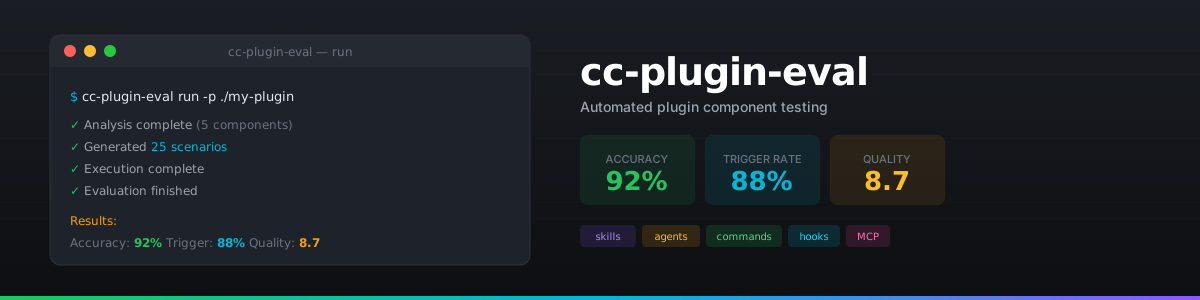
cc-plugin-eval



A 4-stage evaluation framework for testing Claude Code plugin component triggering. Validates whether skills, agents, commands, hooks, and MCP servers correctly activate when expected.
Why This Exists
Claude Code plugins contain multiple component types (skills, agents, commands) that trigger based on user prompts. Testing these triggers manually is time-consuming and error-prone. This framework automates the entire evaluation process:
- Discovers all components in your plugin
- Generates test scenarios (positive and negative cases)
- Executes scenarios against the Claude Agent SDK
- Evaluates whether the correct component triggered
Features
| Feature | Description |
|---|---|
| 4-Stage Pipeline | Analysis → Generation → Execution → Evaluation |
| Multi-Component | Skills, agents, commands, hooks, and MCP servers |
| Programmatic Detection | 100% confidence detection by parsing tool captures |
| Semantic Testing | Synonym and paraphrase variations to test robustness |
| Resume Capability | Checkpoint after each stage, resume interrupted runs |
| Cost Estimation | Token and USD estimates before execution |
| Batch API Support | 50% cost savings on large runs via Anthropic Batches API |
| Multiple Formats | JSON, YAML, JUnit XML, TAP output |
Quick Start
Prerequisites
- Node.js >= 20.0.0
- An Anthropic API key
Installation
# Clone the repository
git clone https://github.com/sjnims/cc-plugin-eval.git
cd cc-plugin-eval

# Install dependencies
npm install

# Build
npm run build

# Create .env file with your API key
echo "ANTHROPIC_API_KEY=sk-ant-your-key-here" > .env
Run Your First Evaluation
# See cost estimate without running (recommended first)
npx cc-plugin-eval run -p ./path/to/your/plugin --dry-run

# Run full evaluation
npx cc-plugin-eval run -p ./path/to/your/plugin
How It Works
flowchart LR
    subgraph Input
        P[Plugin Directory]
    end

    subgraph Pipeline
        S1[**Stage 1: Analysis**<br/>Parse plugin structure,<br/>extract triggers]
        S2[**Stage 2: Generation**<br/>Create test scenarios<br/>positive & negative]
        S3[**Stage 3: Execution**<br/>Run scenarios via<br/>Agent SDK]
        S4[**Stage 4: Evaluation**<br/>Detect triggers,<br/>calculate metrics]
    end

    P --> S1 --> S2 --> S3 --> S4

    S1 --> O1[analysis.json]
    S2 --> O2[scenarios.json]
    S3 --> O3[transcripts/]
    S4 --> O4[evaluation.json]
Stage Details
| Stage | Purpose | Method | Output |
|---|---|---|---|
| 1. Analysis | Parse plugin structure, extract trigger phrases | Deterministic parsing | analysis.json |
| 2. Generation | Create test scenarios | LLM for skills/agents, deterministic for commands | scenarios.json |
| 3. Execution | Run scenarios against Claude Agent SDK | Tool capture hooks | transcripts/ |
| 4. Evaluation | Detect triggers, calculate metrics | Programmatic first, LLM judge for quality | evaluation.json |
Scenario Types
Each component generates multiple scenario types to thoroughly test triggering:
| Type | Description | Example |
|---|---|---|
direct |
Exact trigger phrase | "create a skill" |
paraphrased |
Same intent, different words | "add a new skill to my plugin" |
edge_case |
Unusual but valid | "skill plz" |
negative |
Should NOT trigger | "tell me about database skills" |
semantic |
Synonym variations | "generate a skill" vs "create a skill" |
CLI Reference
Full Pipeline
# Run complete evaluation
cc-plugin-eval run -p ./plugin

# With options
cc-plugin-eval run -p ./plugin \
  --config custom-config.yaml \
  --verbose \
  --samples 3
Individual Stages
# Stage 1: Analysis only
cc-plugin-eval analyze -p ./plugin

# Stages 1-2: Analysis + Generation
cc-plugin-eval generate -p ./plugin

# Stages 1-3: Analysis + Generation + Execution
cc-plugin-eval execute -p ./plugin
Resume & Reporting
# Resume an interrupted run
cc-plugin-eval resume -r <run-id>

# List previous runs
cc-plugin-eval list -p ./plugin

# Generate report from existing results
cc-plugin-eval report -r <run-id> --output junit-xml
Common Options
| Option | Description |
|---|---|
-p, --plugin <path> |
Plugin directory path |
-c, --config <path> |
Config file (default: config.yaml) |
--dry-run |
Generate scenarios without execution |
--estimate |
Show cost estimate before execution |
--verbose |
Enable debug output |
--fast |
Only run previously failed scenarios |
--no-batch |
Force synchronous (non-batch) execution |
--rewind |
Undo file changes after each scenario |
--semantic |
Enable semantic variation testing |
--samples <n> |
Multi-sample judgment count |
--reps <n> |
Repetitions per scenario |
--output <format> |
Output format: json, yaml, junit-xml, tap |
Programmatic Usage
In addition to the CLI, cc-plugin-eval exports a programmatic API for integration into build systems, test frameworks, and custom tooling.
Installation
npm install cc-plugin-eval
Basic Usage
import {
  runAnalysis,
  runGeneration,
  runExecution,
  runEvaluation,
  loadConfigWithOverrides,
  consoleProgress,
} from "cc-plugin-eval";
import type {
  EvalConfig,
  AnalysisOutput,
  TestScenario,
} from "cc-plugin-eval/types";

// Load configuration
const config = loadConfigWithOverrides("config.yaml", {
  plugin: "./path/to/plugin",
});

// Stage 1: Analyze plugin structure
const analysis = await runAnalysis(config);

// Stage 2: Generate test scenarios
const generation = await runGeneration(analysis, config);

// Stage 3: Execute scenarios (captures tool interactions)
const execution = await runExecution(
  analysis,
  generation.scenarios,
  config,
  consoleProgress, // or provide custom progress callbacks
);

// Stage 4: Evaluate results
const evaluation = await runEvaluation(
  analysis.plugin_name,
  generation.scenarios,
  execution.results,
  config,
  consoleProgress,
);

console.log(`Accuracy: ${(evaluation.metrics.accuracy * 100).toFixed(1)}%`);
Public API Exports
| Export | Description |
|---|---|
runAnalysis |
Stage 1: Parse plugin structure and extract triggers |
runGeneration |
Stage 2: Generate test scenarios for components |
runExecution |
Stage 3: Execute scenarios and capture tool interactions |
runEvaluation |
Stage 4: Evaluate results and calculate metrics |
loadConfigWithOverrides |
Load configuration with CLI-style overrides |
consoleProgress |
Default progress reporter (console output) |
Types
Import types via the cc-plugin-eval/types subpath:
import type {
  EvalConfig,
  AnalysisOutput,
  TestScenario,
  ExecutionResult,
  EvaluationResult,
  EvalMetrics,
} from "cc-plugin-eval/types";
Configuration
Configuration is managed via config.yaml. Here's a quick reference:
Scope (What to Test)
scope:
  skills: true # Evaluate skill components
  agents: true # Evaluate agent components
  commands: true # Evaluate command components
  hooks: false # Evaluate hook components
  mcp_servers: false # Evaluate MCP server components
Generation (Stage 2)
generation:
  model: "claude-sonnet-4-5-20250929"
  scenarios_per_component: 5 # Test scenarios per component
  diversity: 0.7 # 0.0-1.0, higher = more unique scenarios
  semantic_variations: true # Generate synonym variations
Execution (Stage 3)
execution:
  model: "claude-sonnet-4-20250514"
  max_turns: 5 # Conversation turns per scenario
  timeout_ms: 60000 # Timeout per scenario (1 min)
  max_budget_usd: 10.0 # Stop if cost exceeds this
  disallowed_tools: # Safety: block file operations
    - Write
    - Edit
    - Bash
Evaluation (Stage 4)
evaluation:
  model: "claude-sonnet-4-5-20250929"
  detection_mode: "programmatic_first" # Or "llm_only"
  num_samples: 1 # Multi-sample judgment
See the full config.yaml for all options, including:
tuning: Fine-tune timeouts, retry behavior, and token estimatesconflict_detection: Detect when multiple components trigger for the same promptbatch_threshold: Use Anthropic Batches API for cost savings (50% discount)sanitization: PII redaction with ReDoS-safe custom patterns
Performance Optimization
Session Batching (Default)
By default, scenarios testing the same component share a session with /clear between them. This reduces subprocess overhead by ~80%:
| Mode | Overhead per Scenario | 100 Scenarios |
|---|---|---|
| Batched (default) | ~1-2s after first | ~2-3 minutes |
| Isolated | ~5-8s each | ~8-13 minutes |
The /clear command resets conversation history between scenarios while reusing the subprocess and loaded plugin.
When to Use Isolated Mode
Switch to isolated mode when you need complete separation between scenarios:
- Testing plugins that modify filesystem state
- Debugging cross-contamination issues between scenarios
- When using
rewind_file_changes: true(automatically uses isolated mode)
To use isolated mode:
execution:
  session_strategy: "isolated"
Or via the deprecated (but still supported) option:
execution:
  session_isolation: true
Output Structure
After a run, results are saved to:
results/
└── {plugin-name}/
    └── {run-id}/
        ├── state.json              # Pipeline state (for resume)
        ├── analysis.json           # Stage 1: Parsed components
        ├── scenarios.json          # Stage 2: Generated test cases
        ├── execution-metadata.json # Stage 3: Execution stats
        ├── evaluation.json         # Stage 4: Results & metrics
        └── transcripts/
            └── {scenario-id}.json  # Individual execution transcripts
Sample Evaluation Output
{
  "results": [
    {
      "scenario_id": "skill-create-direct-001",
      "triggered": true,
      "confidence": 100,
      "quality_score": 9.2,
      "detection_source": "programmatic",
      "has_conflict": false
    }
  ],
  "metrics": {
    "total_scenarios": 25,
    "accuracy": 0.92,
    "trigger_rate": 0.88,
    "avg_quality": 8.7,
    "conflict_count": 1
  }
}
Detection Strategy
Programmatic detection is primary for maximum accuracy:
- During execution, tool capture hooks capture all tool invocations
- Tool captures are parsed to detect
Skill,Task, andSlashCommandcalls - MCP tools detected via pattern:
mcp__<server>__<tool> - Hooks detected via
SDKHookResponseMessageevents - Confidence is 100% for programmatic detection
LLM judge is secondary, used for:
- Quality assessment (0-10 score)
- Edge cases where programmatic detection is ambiguous
- Multi-sample consensus when configured
Development
npm install       # Install dependencies
npm run build     # Build TypeScript
npm test          # Run tests
npm run lint      # Lint code
npm run typecheck # Type check
See CONTRIBUTING.md for detailed development setup, code style, testing requirements, and pull request guidelines.
Roadmap
- Phase 1: Skills, agents, commands evaluation
- Phase 2: Hooks evaluation (PR #58)
- Phase 3: MCP servers evaluation (PR #63)
- Phase 4: Cross-plugin conflict detection
- Phase 5: Marketplace evaluation
Security Considerations
Permission Bypass Mode
Default: execution.permission_bypass: true enables automated evaluation by automatically approving all tool invocations. This is required for unattended runs but has security implications:
- ✅ Required for CI/CD and automated evaluation
- ⚠️ Plugins can perform any action permitted by allowed tools
- 🔒 Use
disallowed_toolsto restrict dangerous operations (default:[Write, Edit, Bash]) - 🔒 For untrusted plugins, set
permission_bypass: falsefor manual review (disables automation)
Security Note: With permission bypass enabled, use strict disallowed_tools and run in sandboxed environments when evaluating untrusted plugins.
PII Protection & Compliance
Default: output.sanitization.enabled: false for backwards compatibility. Enable sanitization for PII-sensitive environments:
output:
  sanitize_transcripts: true # Redact saved files
  sanitize_logs: true # Redact console output
  sanitization:
    enabled: true
    custom_patterns: # Optional domain-specific patterns
      - pattern: "INTERNAL-\\w+"
        replacement: "[REDACTED_ID]"
Built-in redaction: API keys, JWT tokens, emails, phone numbers, SSNs, credit card numbers.
Enterprise use cases: Enable when handling PII or complying with GDPR, HIPAA, SOC 2, or similar regulations.
Default Tool Restrictions
The default disallowed_tools: [Write, Edit, Bash] prevents file modifications and shell commands. Modify with caution:
- Enable
Write/Editonly if testing file-modifying plugins - Enable
Bashonly if testing shell-executing plugins - Use
rewind_file_changes: trueto restore files after each scenario
Additional Safeguards
- API keys: Loaded from environment variables (
.env), never stored in config - Budget limits: Set
execution.max_budget_usdto cap API spending - Timeout limits: Set
execution.timeout_msto prevent runaway executions - Plugin loading: Only local plugins supported (
plugin.path), no remote loading - ReDoS protection: Custom sanitization patterns validated for Regular Expression Denial of Service vulnerabilities
Enterprise Deployments
For production/enterprise environments with compliance requirements, see the comprehensive security guide in SECURITY.md, including:
- Threat model and risk assessment
- Sandbox and isolation recommendations
- Compliance checklist (GDPR, HIPAA, SOC 2)
- Container isolation patterns
Contributing
See CONTRIBUTING.md for development setup, code style, and pull request guidelines.
This project follows the Contributor Covenant code of conduct.
License
Author
Steve Nims (@sjnims)
Acknowledgements
- Anthropic for Claude, the Anthropic SDK, and the Claude Agent SDK
- Bloom for architectural inspiration
- Boris Cherny for Claude Code
- Zod for runtime type validation
- Commander.js for CLI framework
- Vitest for testing
- Monster Energy for fuel
- deadmau5 for the beats
Yorumlar (0)
Yorum birakmak icin giris yap.
Yorum birakSonuc bulunamadi