Hearth
Health Uyari
- License — License: Apache-2.0
- Description — Repository has a description
- Active repo — Last push 0 days ago
- Low visibility — Only 7 GitHub stars
Code Uyari
- process.env — Environment variable access in build/notarize.cjs
Permissions Gecti
- Permissions — No dangerous permissions requested
Bu listing icin henuz AI raporu yok.
A self-evolving macOS desktop client for coding agents (Claude Code, Codex) over ACP. The agent can see, drive, and rewrite its own running UI.
Hearth
Hearth is a macOS desktop client for coding agents (Claude Code or Codex) that can
edit its own running interface. The renderer is served by a live Vite dev server,
so when the agent edits Hearth's own source the change hot-reloads into the window
with no restart, and every edit is a git commit you can revert. The agent can also
see and drive the app the way you would, through a small MCP server it is given.
The one example that captures it: say "add a Stats item to the sidebar," and the
agent edits the app's own source, the sidebar reshapes in front of you, and the
change shows up in the Changes view with one-click undo.



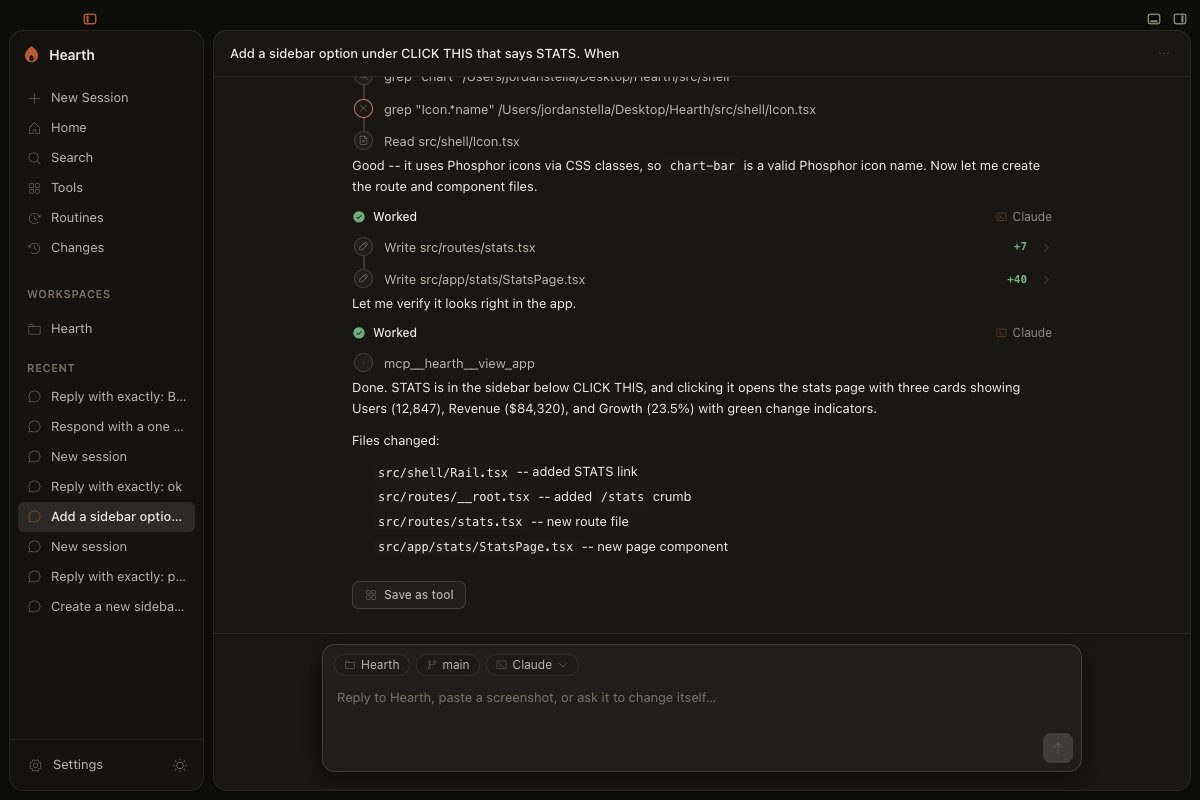
Status
Personal project, v0.1.0. macOS on Apple Silicon (M1 or later) only. Roughly 23k
lines with 475 passing tests. It works and it is tested, but it is not a
product and comes with no support. Use it at your own risk.
You bring your own agent. Hearth drives the Claude Code or Codex you already
authenticated with claude login / codex login (or your own API key) over the
open Agent Client Protocol. It never stores,
brokers, or sees your credentials, and it hosts nothing: files and conversations
stay on your machine.
Install
Download for macOS (Apple Silicon)
Open the .dmg, drag Hearth to Applications, and launch it. The current build is
signed but not yet notarized, so Gatekeeper will warn on first launch: right-click
the app and choose Open. A notarized build is coming; building from source (below)
avoids the warning entirely. Either way you need a locally-authenticated Claude
Code or Codex before it will do anything useful.
Build from source
Requires Bun and a locally-authenticated agent.
bun install
bun run routes:gen              # generate the TanStack route tree (needed before typecheck from a fresh clone)
bun run dev                     # opens the app with live HMR (Claude backend)
Same app on the Codex backend:
HEARTH_AGENT=codex bun run dev
Checks and a packaged build:
bun test                        # ACP translation, git, self-mod, scope guard, boot watchdog, classifier
bun run typecheck
bun run lint
bun run dist                    # signed macOS build (set APPLE_* env vars to also notarize)
Useful flags for UI work: HEARTH_FAKE_AGENT=1 runs a scripted agent with no
model and no auth; HEARTH_PERMISSION_MODE=default prompts on every edit instead
of auto-accepting.
The self-mod safety model, in brief
Hearth lets the agent edit almost anything in the repo, including the main process.
Safety comes from recoverability, not from fencing the agent out.
- Scope guard. Every write is classified into one of three tiers. Blocked
paths are never writable (secrets, credential and shell-init files, system
directories, git internals). The protected island (the self-mod engine, the
boot watchdog, the hook config) is editable only with explicit approval and is
written dependency-free so the agent cannot disarm a guardrail indirectly.
Everything else is the canvas. Writes route through Hearth's own file
capability, and shell writes that try to bypass the guard are forced back onto
the mediated path. - Boot watchdog. A main-process edit that bricks startup is caught by a marker
armed before each self-mod restart and cleared only on a healthy boot. If the
next boot still finds the marker, the edit never came up, so the watchdog
auto-reverts that commit and relaunches, with a bounded attempt count to avoid a
revert loop. - Atomic parallel edits. A single agent's edit hot-swaps immediately. When two
or more subagents write concurrently, a snapshot-overlay Vite plugin pins their
pre-edit baselines and swaps the batch in atomically, so the live UI never shows
a half-applied state. - Versioned undo. Every self-edit is a
Hearth-SelfModgit commit, grouped by
turn into file-disjoint commits, and reversible from the Changes view.
Architecture
The full design and rationale is in docs/ARCHITECTURE.md.
Domain vocabulary is in CONCEPTS.md. The self-evolution engine lives
in electron/main/self-mod/; scope-guard.ts and boot-watchdog.ts are the two
files worth reading first. Packaging and auto-update are covered in
docs/AUTO-UPDATE.md and
docs/PACKAGING-V3-PLAN.md.
License
Yorumlar (0)
Yorum birakmak icin giris yap.
Yorum birakSonuc bulunamadi