cap-evolve
Health Pass
- License — License: Apache-2.0
- Description — Repository has a description
- Active repo — Last push 0 days ago
- Community trust — 13 GitHub stars
Code Pass
- Code scan — Scanned 12 files during light audit, no dangerous patterns found
Permissions Pass
- Permissions — No dangerous permissions requested
No AI report is available for this listing yet.
Optimize any AI agent’s skills, tools/MCP, and prompts against your own evals.

cap-evolve
watch capability evolve

-orange)

-success)


cap-evolve improves an AI agent's prompts, tools, and skills by learning from failed
evaluation traces.
You bring the agent and the eval you already have. cap-evolve runs the loop — evaluate →
diagnose the failures → propose an edit → keep it only if it beats a held-out split by a
significant margin → commit — and reports one honest number. It optimizes what your agent
reads, not its weights.
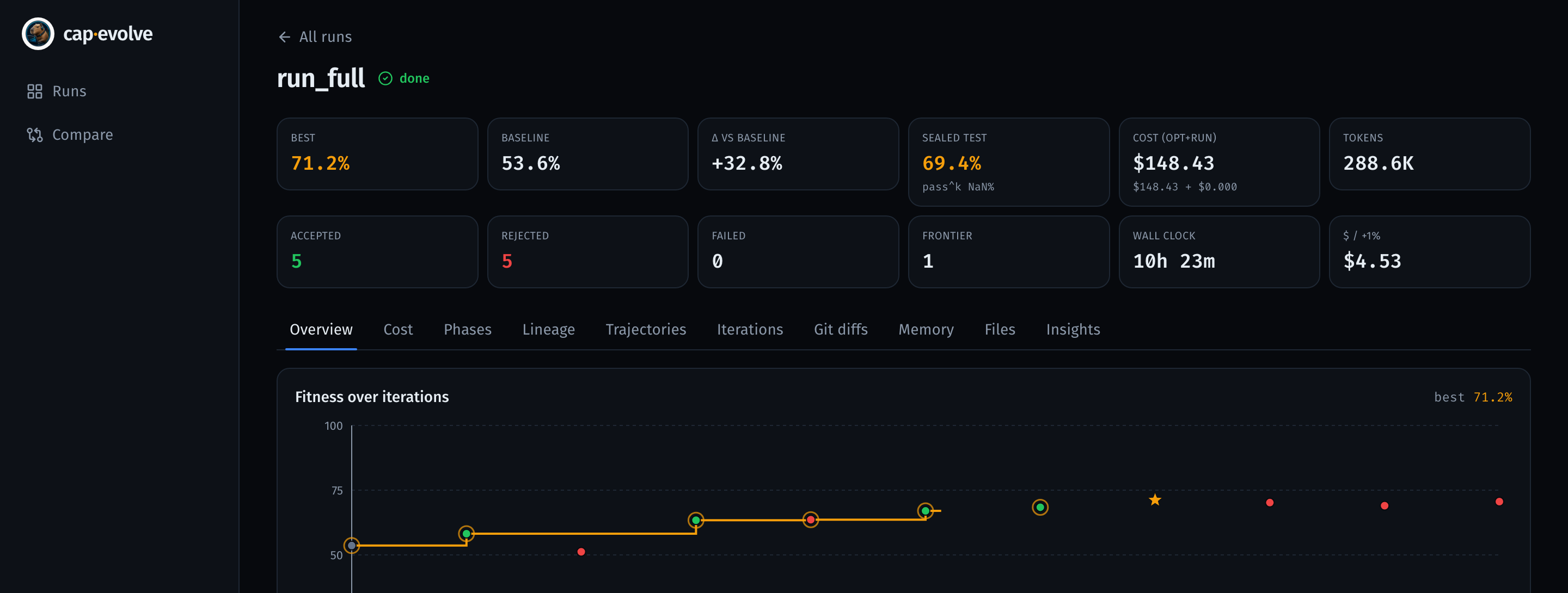
A real τ²-bench airline run in the live dashboard — baseline → best, accepted vs rejected candidates, cost, and the fitness stair.
Quickstart · Documentation · Examples · Results · Contributing
Why cap-evolve
- Optimize more than prompts. System prompts, executable tool code, MCP tool
surfaces, and whole skill packages — pick one or several and optimize them jointly. - Learn from real agent failures. Every iteration reads full trajectories and per-task
causal feedback (which task ids a prior edit broke and fixed), so edits are large and
don't regress the wins. - Keep evaluation honest. Acceptance is a val-only significance gate (Δ > k·SE); the
test split is sealed and scored exactly once. Both live in the core, not in editable docs. - Inspect every change. Each candidate is a git commit; the dashboard shows costs,
timing, diffs, lineage, and a tasks × iterations pass/fail heatmap.
Try it in two minutes — no API key required
toy_calc is a deterministic stand-in agent that only answers correctly when its system
prompt contains a [CALC] marker. The mock optimizer adds it, so the score provably
rises — no model is called.
git clone https://github.com/skillberry-ai/cap-evolve.git
cd cap-evolve

python3 -m venv .venv && source .venv/bin/activate
pip install ./core                 # package: cap-evolve-core · CLI: cap-evolve · zero runtime deps

bash examples/toy_calc/run.sh
Expected — the seed prompt scores 0.0 on val; the optimized prompt is gate-accepted and
scores 1.0 on the sealed test split:
baseline_val 0.0 -> test_reward 1.0 (gate-accepted, test sealed) + dashboard.html
Open the printed dashboard.html in any browser. Full walkthrough:
Getting started.
Choose your path
| Path | Use it when | Start |
|---|---|---|
| Claude Code plugin | You use Claude Code and want slash commands + honesty hooks | claude --plugin-dir ./plugins/cap-evolve then follow RUN.md |
| Another coding-agent host | Codex, Gemini, opencode, Cursor, Droid, Copilot, Kimi, Pi, Antigravity, openclaw, IBM Bob, bare | ./install.sh --host <name> then follow RUN.md |
| Manual adapter + CLI | You want to wire the adapter yourself and drive cap-evolve directly |
Optimize your own agent |
Each path shares the same core install and the same honesty guarantees. Full setup,
credentials, and the optional dashboard: Installation.
What can cap-evolve optimize?
| Capability | What the optimizer may change |
|---|---|
| System prompts | Rewrite / consolidate / add rules, examples, output contracts — never drop a needed rule |
| Tool implementations | Edit tool code for deterministic enforcement; add/wrap/swap tools (never bare-remove) |
| MCP tool surfaces | Safe edits only — tool docs, in-description examples, and which tools are exposed |
| Skill packages | An Agent Skill dir — SKILL.md bodies, references, and executable scripts |
Combine them, e.g. [system-prompt, tools]. See Architecture.
Results
Numbers are cross-checked against committed run artifacts; each is labeled fit metric
(no holdout) or held-out (test scored once on ids the optimizer never saw). Full detail,
models, task/trial counts, commits, and costs: docs/RESULTS.md.
| Benchmark | Split | Baseline → Optimized | Gain |
|---|---|---|---|
| toy_calc (zero-API) | sealed test | 0.0 → 1.0 |
deterministic proof |
| τ²-bench airline (policy + tools) | val — fit metric | 0.536 → 0.712 |
+0.176 / +32.8% |
| τ²-bench airline, held-out 30/10/10 | sealed test | 30.0 → 47.5 |
+17.5 pp / +58.3% |
| SkillsBench (skill package) | sealed test (held-out) | 0.556 → 0.667 |
+0.111 / +20.0% |
Not an apples-to-apples leaderboard. For how the held-out τ²-bench result sits next to
external tool-optimization work (EvoTool on the
original τ-Bench, and Evolutionary Context Search), with defined criteria and caveats, see
docs/COMPARISON.md.
How it works
flowchart LR
    A[Prompt, tools, MCP, or skills] --> B[Run evaluation]
    B --> C[Diagnose failures]
    C --> D[Generate candidate]
    D --> E[Validation gate]
    E -->|Accepted| F[Git-versioned best candidate]
    E -->|Rejected| C
    F --> G[Final evaluation and report]
Each iteration receives the current best capability, its failed trajectories, per-task
impact (what previous edits broke and fixed), and the history of previous attempts. It
proposes one bold, multi-part candidate, evaluates it on val, and records whether the gate
accepted it. The pipeline is
intake → implement-and-check → baseline → algorithm → finalize → report; the exact
optimizer-context files, run-dir layout, and honesty guarantees are in
Architecture and Honest evaluation.
Use it with your own agent
Wire one small adapter — three required methods (plus optional hooks):
tasks(split)                   -> list[Task]   # your eval cases for 'train'|'val'|'test'|'all'
run_target(task, ctx, *, seed) -> Rollout      # run your agent with the candidate LIVE as ctx
score(task, rollout)           -> Score        # reward in [0,1] + feedback (never leak the gold)
Everything else — splits, trials, gating, pass^k, the sealed test, memory, and the
dashboard — is provided by the core. Two ways to get there:
- Let your coding agent build it — open the agent you already use at the repo root and
tell it to followRUN.md. It runsintake, asks for anything missing, writes
the adapter, passescap-evolve check, then runs the loop. - Do it yourself — implement the adapter and drive the CLI.
Both are walked through in docs/OPTIMIZE_YOUR_OWN.md;
the contract is in docs/ADAPTER_CONTRACT.md. For common
cases, don't write an adapter from scratch — copy a ready-made
adapter template (JSONL, HuggingFace, tau2-bench, SWE-bench,
SkillsBench) and switch providers with a one-line env change:
docs/ADAPTER_TEMPLATES.md.
Examples
| Example | What it shows | Needs | Run |
|---|---|---|---|
toy_calc |
The full loop, deterministically | nothing | bash examples/toy_calc/run.sh |
tau2_airline |
Onboard a real benchmark from one prompt; optimize policy + tool code | RITS creds, Claude Code | bash examples/tau2_airline/setup.sh && bash examples/tau2_airline/run.sh |
skillsbench |
Optimize a skill package; agent runs in Docker | Docker, uv, Claude creds |
bash examples/skillsbench/setup.sh && bash examples/skillsbench/run.sh |
Each example's paste-to-agent brief is its PROMPT.md, its narrative is DEMO.md, and its
committed run is under run_full/. See the full interactive dashboard for the tau2 run with
no backend: cd examples/tau2_airline/run_full/ui && python3 -m http.server 8000. Reproduce
from zero: tau2 · SkillsBench.
Documentation
| Document | Use it when |
|---|---|
| Site (home) | You want the interactive site — hero, results, and doc navigation in one place |
| Getting started | You want your first successful run |
| Installation | You need host-specific setup, credentials, or the dashboard |
| Optimize your own agent | You want to integrate your agent or benchmark |
| Adapter templates | You want a copy-and-run adapter (JSONL, HuggingFace, tau2, SWE-bench, SkillsBench) |
| Adapter contract | You are implementing an adapter |
| Architecture | You want to understand the pipeline and optimizer context |
| Honest evaluation | You need details on splits, gates, and sealing |
| Results | You want the full experiments and artifacts |
| Comparison | You want positioning vs other tools and external results |
| Extending cap-evolve | You are adding a capability, optimizer, or algorithm |
| Troubleshooting | Installation or a run failed |
| Roadmap | You want planned work |
| How-to guides | You want a specific harness + benchmark recipe |
Project status and support
Beta (0.x). Contributions welcome — see CONTRIBUTING.md and the
Code of Conduct. Report security issues via SECURITY.md.
Changes are tracked in CHANGELOG.md.
Citation
@software{cap-evolve,
  title  = {cap-evolve: a skills-native, host-agnostic harness for honestly
            optimizing AI-agent capabilities},
  year   = {2026},
  note   = {https://github.com/skillberry-ai/cap-evolve}
}
Acknowledgements. cap-evolve includes no third-party code — the gepa andskillopt skills are independent implementations of the GEPA (arXiv:2507.19457) and
SkillOpt (arXiv:2605.23904) papers, and it draws on ideas from DSPy and Anthropic's
Agent Skills standard. The bundled example uses
tau2-bench (MIT). Full citations:
docs/sources.bib.
License
Apache-2.0.
Reviews (0)
Sign in to leave a review.
Leave a reviewNo results found