xskill
Health Gecti
- License — License: MIT
- Description — Repository has a description
- Active repo — Last push 0 days ago
- Community trust — 29 GitHub stars
Code Basarisiz
- rm -rf — Recursive force deletion command in scripts/capture_openclaw_fixture/run_capture.sh
Permissions Gecti
- Permissions — No dangerous permissions requested
Bu listing icin henuz AI raporu yok.
Self-evolving skills lib for coding agents




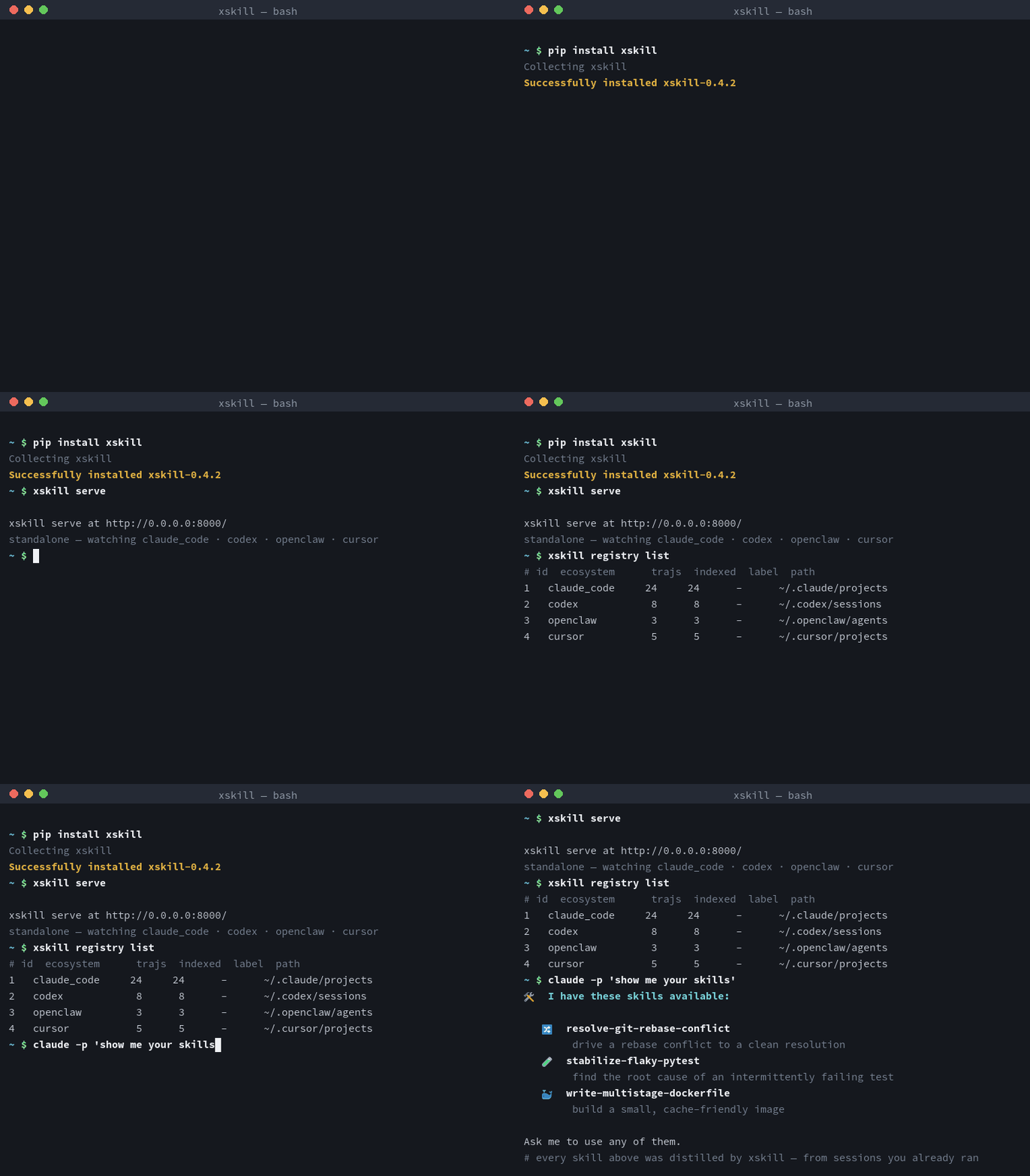
News
- 2026-05-23 — Officially open-source,
v0.5.0released: team mode (client-server), trajectory redaction, Python 3.9 support, nogitbinary needed at runtime. See the release notes. - 2026-05-20 — MIT-licensed open source; on PyPI:
pip install xskill. - 2026-05-12 — Claude Code, Codex, OpenCode supported; OpenClaw and Cursor connected.
What problem it solves
Your coding agent re-derives the same solution every time it bumps into a familiar problem. You either re-explain it, or hand-maintain a prompt library that quietly rots when no one is looking.
With xskill running, that work goes away:
- Patterns that actually worked get distilled into Skill files your agent loads automatically.
- The library grows itself as you keep using your agent — no review queue, no one curating "best practices."
- When you edit a Skill by hand, xskill picks up your edit immediately and learns from it.
- A new Skill version only replaces the old one if it measurably serves users better (UX-driven evolution, not naive LLM self-grading).
Get started
pip install xskill          # Python 3.9+
xskill serve                # writes ~/.xskill/config.yaml, then exits
Open ~/.xskill/config.yaml and fill in two model endpoints:
skill_dir: ~/.xskill/skill

llm:
  base_url: https://api.deepseek.com
  model:    deepseek-v4-flash
  api_key:  YOUR_KEY

embedding:
  base_url: https://api.deepseek.com
  model:    deepseek-embedding
  api_key:  YOUR_KEY
  dim:      0
Run xskill serve again — it auto-detects every supported agent on your machine (Claude Code, Codex, OpenCode, OpenClaw, Cursor) and starts watching. To also index an archive of older trajectories:
xskill registry add /path/to/trajectories
Team mode: the killer use case
The way xskill really wants to be deployed in an organization is team mode: one machine is the server, everyone else joins as a thin client, and the whole team works against the same evolving Skill library.
xskill serve --server                        # prints a join token
xskill connect <host:port> --token <token>
- Silently distill your top performers. When one person solves something in their own work, the rest of the team gets that solution automatically — nobody has to write it down. (Capability democratized.)
- Any coding workflow plugs in. Codex, Claude Code, Cursor IDE — pick whatever; everyone joins the same library, synced across tools.
- Trajectories stay private. Sessions are redacted before upload; agent privacy built in.
- A/B-driven evolution. A Skill change is measured per person before it spreads — the more people in the team, the faster and sharper the evolution.
- Experts can teach manually. When an expert edits a Skill locally, the change is pulled into the server as
user-staging/<client_id>and feeds the next round of evolution.
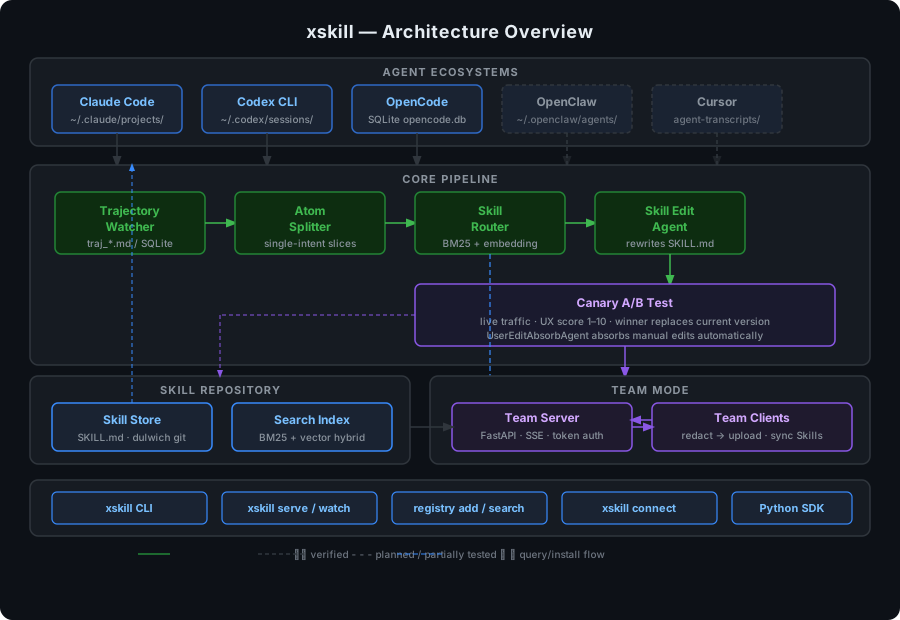
Architecture
How it works
A few narrow LLM agents do the work. One splits a trajectory into single-intent Atoms; one routes each Atom to a Skill; one rewrites the SKILL.md once a Skill has enough material; one A/B-tests new versions on live traffic and keeps the winner. Every Skill is its own git repository, so every change is versioned and reversible. Details: docs/agent.md.
Works with your agents
| Agent | Status | Trajectory ingest | Skill install |
|---|---|---|---|
| Claude Code | ✅ verified | auto-detects ~/.claude/projects/ |
symlink → ~/.claude/skills/<name>/ |
| Codex CLI | ✅ verified | auto-detects ~/.codex/sessions/ |
symlink → ~/.agents/skills/<name>/ |
| OpenCode | ✅ verified | SQLite ~/.local/share/opencode/opencode.db |
symlink → ~/.agents/skills/<name>/ |
| OpenClaw | 🟡 implemented, not well tested | auto-detects ~/.openclaw/agents/ |
copy → ~/.agents/skills/<name>/ |
| Cursor | 🟡 implemented, not well tested | auto-detects ~/.cursor/projects/*/agent-transcripts/ |
symlink → ~/.cursor/skills/<name>/ |
| Any other agent | manual | SDK: xskill.adapters.submit_trajectory |
copy or symlink the SKILL.md directory |
Concepts
| Term | Meaning |
|---|---|
| Trajectory | One agent run — the transcript of a session. Stored as traj_*.md. |
| Atom | The smallest single-intent slice of a trajectory. Routing happens at this level. |
| Skill | A SKILL.md plus optional scripts, in its own versioned git directory. |
| Canary | A live-traffic A/B test of the current Skill against a new candidate. |
| UX score | How well a Skill served the user on a given Atom, scored 1–10 from the interaction itself. The canary keeps whichever version scores higher. |
Roadmap
- More agent adapters — Trae, Goose, OpenHands, Aider
- More mature user profiling and recommendation
- Native MCP server interface (Skills exposed as tools)
- Web UI for browsing the library and viewing canary stats
- Skill marketplace — import / export portable bundles
- Multi-tenant libraries (per-team
skill_dir)
License
Yorumlar (0)
Yorum birakmak icin giris yap.
Yorum birakSonuc bulunamadi