cc-enforcer
Health Warn
- License — License: MIT
- Description — Repository has a description
- Active repo — Last push 0 days ago
- Low visibility — Only 5 GitHub stars
Code Fail
- rm -rf — Recursive force deletion command in hooks/scripts/bash_guard.py
Permissions Pass
- Permissions — No dangerous permissions requested
No AI report is available for this listing yet.
Rules your coding agent physically cannot ignore. Claude Code hooks that DENY the tool call and BLOCK the reply - stopping reactive patches, guessed citations, and premature 'done' claims. Also works as an LLM-agnostic rule pack.
cc-enforcer
Rules your coding agent physically cannot ignore.
A Claude Code plugin — and an LLM-agnostic rule pack — that stops reactive
patching, guessed citations, surface-level "fixes" and premature "done" claims
by intercepting the agent's own tool calls, not by asking it nicely.



1 · What it is
Every "be rigorous" instruction you put in a prompt shares one flaw: the model
decides whether to follow it. Under pressure — a long session, a compacted
context, a failing test at 2am — it decides not to, and tells you it did.
cc-enforcer moves the important half of that contract out of the prompt and
into the harness. Claude Code hooks run before each tool call and before
each reply is allowed to end. A violation returns a real deny / block
verdict, so the agent cannot reason, apologise, or "just this once" its way past
it.
Twelve rules. Eight of them backed by a hook. Zero dependencies, standard
library only, and every guard fails open — a bug in the discipline can never
brick your agent.
2 · The problem it targets
LLM coding agents (Claude Code, Cursor, Copilot, Cline, Aider…) fail in
predictable, nameable ways. Each row is a behaviour this plugin was built to
make impossible rather than discouraged:
| Lazy pattern | What it looks like in practice | Answer |
|---|---|---|
| Reactive patching | Sees a bug, wraps it in try/except, declares done. |
rule 03 + 09, PreToolUse DENY |
| Guessed citations | Cites files, line numbers or APIs that do not exist. | rule 01 + 05, Stop layer (b)/(g) |
| Keyword-search-only | Greps once, edits, never reads the surrounding architecture. | rule 04 + 08, PreToolUse DENY |
| Memory dependence | Acts on stale recollection instead of re-reading the file. | rule 04 + 08, read-before-edit gate |
| Root-cause bypass | sleep for races, --no-verify for hooks, swallowed exceptions. |
rule 03, PreToolUse(Bash) DENY |
| Half-finished work | Stops at "should work", leaves TODOs, skips the whole flow. | rule 07, Stop layer (d) |
| Premature done-claim | "Fixed" without re-running the failing case or comparing evidence. | rule 06, Stop layers (a)/(c) |
| Stale references | Changes a symbol; leaves its docs, tests and translations behind. | rule 12, Stop layer (i) |
Effect goal: an agent that either does the disciplined thing or visibly
fails to — never one that quietly skips a step and reports success.
3 · Features and scope
Feature 1 — Twelve rules as a portable contract
The reasoning contract, as plain Markdown in rules/. Roughly half
are backed by a hook; the rest are text-level discipline the Stop gate grades
indirectly.
| # | Rule | What it demands | Enforcement |
|---|---|---|---|
| 01 | Verify, don't guess | Every claim about a file, API, version, error or citation is checked in the same turn it is written. "I don't know" beats a confident wrong answer. | soft + Stop (b)(g) |
| 02 | Systematic, not reactive | Answer seven questions before editing: architecture, responsibility, root cause, plan, ripple, risk, global validity. | soft (graded by (e)) |
| 03 | Root cause, not symptom | Climb the causal chain — symptom site → propagation path → origin — until the answer is a mechanism. Stopping early is legal only if you name the true origin and say why. | Bash DENY + soft |
| 04 | Read fully, not keywords | Grep locates; understanding requires the whole file plus its callers. | Edit/Write DENY |
| 05 | Cite traceable sources | file:line for code, URL/DOI for literature, command + output for runtime claims. |
soft |
| 06 | Verify convergence | Re-trigger the original symptom, exercise boundary and negative cases, run existing tests, answer four self-quiz questions. Check 2b: "no regression" must be a per-item set diff, never a matching total. | Stop (a)(c) |
| 07 | Task fidelity | Decompose the user's request into checkable sub-items; every modifier word they used ("all", "strict", "mandatory") must land as a hard action, not a doc line. | Stop (d) |
| 08 | Read before edit, think before write | Full read going in; root cause / architecture / impact stated coming out. | DENY + Stop (e) |
| 09 | Systematic modification | One root cause, one unified fix — sweep the whole class, never N patches. Suppression markers need an adjacent why. | DENY ×2 + Stop (f) |
| 10 | No non-essential hardcoding | Secrets, tokens, private keys and credentials-in-URLs never become source literals. | Edit/Write DENY |
| 11 | No non-essential path dependency | No C:\Users\… / /home/you/ / $HOME baked into code; derive paths at runtime. |
Edit/Write DENY |
| 12 | Repo-wide sync | An edit is done only when every reference to it — docs, tests, downstream code, translations — is co-updated or explicitly verified current. | Stop (i), opt-in |
Full text: rules/ · index: docs/RULES.md
Feature 2 — Hard gates at the tool boundary (PreToolUse → DENY)
These refuse the call outright. Every one ships a named escape hatch, so they
are bypassable by saying why, never by accident.
| Gate | Triggers on | Escape hatch |
|---|---|---|
| Read-before-edit | Editing a file that exists on disk but was never opened this session. | Read it; or register a SHA-256-verified read. |
| Suppression markers | # noqa, # type: ignore, @ts-ignore, @ts-expect-error, eslint-disable, time.sleep(…) workarounds. |
Adjacent why-comment (English or Chinese), or fix the cause. |
Bare try/except: pass |
An exception handler whose body is just pass — detected across lines, comments in between included. |
Same why-comment hatch. |
| Hardcoded secrets | Secret-named literal, PEM private-key header, AKIA…, ghp_… / xox… / AIza…, user:pass@host URLs. |
Env var, marked placeholder, or why-comment. |
| Machine-specific paths | C:\Users\…, /home/<user>/, /Users/<user>/, $HOME, %USERPROFILE%, quoted ~/…. |
Derive at runtime, or why-comment. Prose docs and lockfiles exempt. |
| Rolling patches | The 4th small edit (< 200 chars and ≤ 10 lines) to one file with no systematic rewrite in between. | One rewrite of ≥ 50 lines / ≥ 1500 chars / ≥ 30% of that file. Net reductions and version bumps are never counted at all — see §5. |
| Dangerous shell | --no-verify, --no-gpg-sign, git push --force (not --force-with-lease), chmod 777, git rebase --skip, --break-system-packages, rm -rf on / $HOME ~. |
Fix the hook failure / permission / conflict instead. |
| Your own edicts | Any regex you registered as a must edict. |
Only you can relax it. |
Feature 3 — The done-claim gate (Stop → BLOCK, nine layers)
The Stop hook reads the reply the agent is about to finish with. If it contains
a completion claim, nine layers grade it. Layers (e)(f)(g)(i) apply only to
turns that actually edited a file.
| Layer | Rule | Blocks when the reply… |
|---|---|---|
| (a) | 06 | claims done with no evidence — no command, no output, no counts. |
| (b) | 01 | pairs a done-claim with a first-person hedge (I think, probably, maybe, 我觉得, 应该是). Bare should and 通常 are deliberately not hedges — they are ordinary technical prose. |
| (c) | 06 | shows evidence but never answers the four convergence questions. |
| (d) | 07 | passes convergence but never reconciles against the user's original request. |
| (e) | 08 | edited a file without surfacing ≥ 3 of root cause / architecture / solution / impact / risk. |
| (f) | 09 | edited a file without the root cause + impact + solution triplet. |
| (g) | 01+06 | says "I edited X" while X's mtime on disk is unchanged. |
| (h) | — | has no tldr, or a tldr item longer than 160 display columns. |
| (i) | 12 | tripped a project sync-gate group with no co-update and no sync-check: line. |
Grace is per layer (v0.29): the layer that just blocked is forgiven on the
next attempt — you can never be blocked twice for the same row — but a
different layer you are still violating will still fire. Escalation is bounded
by the layer count, and any clean reply resets it.
Feature 4 — Imperial Edicts: your own hard rules
Most "custom rules" features are just more text in a prompt. Here your rule
becomes a regex a hook matches against the literal content of every Edit, Write
and Bash call before it lands:
/cc-enforcer:edict add E01 "no mongoose, use prisma" --must \
    --deny-edit 'from ["'"'"']mongoose["'"'"']' \
    --deny-bash 'npm\s+(i|install)\s+mongoose'
- Two severities, mechanically different.
must+ a regex →PreToolUse
DENY naming the edict id.should→ reminder text only, never denies. - Two scopes.
.claude/cc-enforcer/edicts.toml(project — commit it so the
team shares the red line) or~/.claude/cc-enforcer/edicts.toml(--global). - Hot-reloaded — the loader re-reads on every hook event, so you can iterate
on a regex mid-session. - Re-injected every turn, so compaction cannot quietly drop your rules.
- Ordered after the built-ins by design: an edict can add restrictions,
never subtract them. - Fails safe, not quiet: an unparseable severity falls back to
must, and a
malformed edict drops itself with a stderr diagnostic instead of blocking work.
Details: docs/EDICTS.md
Feature 5 — What you invoke yourself
6 slash commands, one subagent, two auto-triggered skills:
| Surface | What it does |
|---|---|
/cc-enforcer:checklist |
Prints the 8-section checklist (pre-edit → post-edit → convergence → fidelity → read/think → systematic → TL;DR → repo sync). Its patch-marker item is a closed set synchronised with the hook's real constant, so you cannot tick every box and still get denied. |
/cc-enforcer:verify |
Turns the agent's last reply into untrusted input: extracts every factual claim, buckets it (code location / behaviour / external / run result) and prescribes a re-verification method per bucket. Recall is explicitly not allowed. |
/cc-enforcer:edict |
list / add / remove / reload / path for Imperial Edicts (--global for personal scope). |
/cc-enforcer:gc |
Lists — or with --apply, deletes — session-state files older than N days. Dry-run by default, and the command file forbids the agent from choosing --apply for you. |
/cc-enforcer:i18n |
Checks every translation still matches the English skeleton file-for-file and heading-for-heading. |
/cc-enforcer:sync-gate |
init / list / check / add / remove / path for this project's rule-12 co-update groups. check is the point: the gate's loader is failing-open, so a dropped group or a glob that matches no file makes it stop guarding silently. check names both and exits 1, so it works in CI. |
verifier subagent |
A deliberately crippled read-only checker (Read/Grep/Glob only — a permission fact, not an instruction). Returns intact / drift / missing / mismatch / unverifiable per claim. It cannot become the fixer, so it has no incentive to quietly patch a discrepancy. |
systematic-debug skill |
Auto-triggers on bug-fix language and takes over the workflow: build a fast deterministic reproduction loop first, then hypothesise. "A 30-second intermittent flaky loop is barely better than no loop; a 2-second deterministic loop is a debugging superpower." |
repo-refresh skill |
Auto-triggers on repo-audit language: sweeps code and prose together for stale / outdated / redundant / wrong / drifted content, then asks you to convert whatever coupling it found into a sync-gate group. |
Out of scope — deliberately
- It does not review your code for correctness. It reviews the agent's process.
- It does not replace a linter, type checker or test suite; it stops the agent
from silencing them. - It does not sandbox anything. See §9.
4 · How it is implemented
| Event | Matcher | Behaviour | Implementation |
|---|---|---|---|
SessionStart |
— | Inject the 12-rule discipline summary + reply schema + Imperial Edicts (English by default, any language via CC_ENFORCER_LANG). |
inject_context.py |
UserPromptSubmit |
— | Re-inject per-turn decision triggers + edicts — the defence against context compaction. | inject_context.py |
PreToolUse |
Read|Edit|Write |
Record reads, capture mtime baselines, run the content + frequency + edict gates. | read_guard.py |
PreToolUse |
Bash |
Tokenise the command, deny bypass flags and destructive operations, process read registrations, scan edicts. | bash_guard.py |
Stop |
— | The nine-layer done-claim decision, rendered as a status table + recovery + plain-language line. | stop_guard.py |
Both injections are budgeted against Claude Code's 10,000-character hook-output
cap: the contract is protected and the (unbounded) edict list is what yields,
elided at whole-edict boundaries with a pointer — because half an edict still
reads as a complete instruction. When even the contract fills the budget, the
edicts are dropped and the injection says so (v0.38.3): a session governed
by rules it was never shown, with no way to learn that, is the worse failure.
Every one of those entries decodes its payload throughlib/hookio.py (v0.37) — stdin's binary buffer,
UTF-8, strictly. It reads like a detail and is not: sys.stdin.read() uses the
host codepage with the surrogateescape handler, so on a non-UTF-8 machine
(the Windows default) the payload was silently rewritten and every gate below
judged a string the agent never wrote. Non-ASCII text is what suffered — an
em-dash turned one rule-09 DENY into an ALLOW, and the Chinese markers layers
(b) and (h) look for decoded to mojibake, so they matched nothing at all.
If you write to your agent in a language other than English, this is the
release where the Stop gate starts seeing it.
Guard output is translatable as of v0.38. Everything a guard prints —
deny reasons, the nine-layer status table, recovery blurbs — lives inlib/messages_en.py (the skeleton) with
translations beside it, resolved per key through CC_ENFORCER_LANG on the
same contract as rules/ and prompts/ (docs/I18N.md). It
was bilingual before that — an English body with a Chinese plain-language line
stapled on — which is why both READMEs used to quote mixed-language samples:
they were accurate. What the guards match is unchanged and still bilingual;
only what they say follows the switch. The samples on this page are English
because English is the default.
Ten scripts under hooks/scripts/ sit on fourteen sharedlib/ modules. Only the four in the table above are
registered as hooks; the other six (register_read.py, manage_edicts.py,manage_sync_gate.py, gc_state.py, i18n_check.py, bench_hooks.py) back
the escape hatch, the slash commands, CI and the benchmark. They deliberately
stay in the same directory rather than moving to a tools/ tree: gc_state.py
is imported by inject_context.py for auto-GC and register_read.py's real
logic lives inside bash_guard.py, so neither is a standalone CLI, and
separating them would buy a tidier directory name with a cross-tree sys.path
splice. Full contracts: docs/ARCHITECTURE.md §2.
Install
As a Claude Code plugin (recommended)
The repo ships .claude-plugin/marketplace.json, so it registers as a
single-plugin marketplace:
git clone https://github.com/skymanbp/cc-enforcer.git /path/to/cc-enforcer
Then in any Claude Code session (CLI or IDE):
/plugin marketplace add /path/to/cc-enforcer
/plugin install cc-enforcer@cc-enforcer
Verify with /plugin → Installed should list cc-enforcer@cc-enforcer.
Commands then surface as /cc-enforcer:checklist, /cc-enforcer:verify, …
Requirements: Python on PATH (tested on 3.13). Hook scripts use the
standard library only — no pip step, no third-party packages.
As a rule pack for any other LLM
You do not need Claude Code. The rules are plain Markdown (English is the source
of truth; rules/zh/ is the Chinese translation):
cat rules/*.md    > cc-enforcer.txt     # English skeleton
cat rules/zh/*.md > cc-enforcer.txt     # Chinese translation
# feed as system prompt / pre-context to the agent of your choice
You lose the hard layers (they are Claude Code hooks) and keep the reasoning
discipline. Integration patterns for OpenAI / Gemini / local models are in the
LLM portability section of docs/ARCHITECTURE.md.
5 · What it actually looks like
The same task, run twice
One task, two runs, identical starting files. The only variable is whether the
hooks are in the loop. Reproduce both with python demo/run_demo.py --svg —
sources in demo/.
charge()crashes withKeyErrorwhen the payment gateway declines.
Make it stop crashing.
| Without cc-enforcer | With cc-enforcer | |
|---|---|---|
| Edits that landed | 5 of 5 | 3 of 5 |
| Sign-off | accepted | blocked |
| Suite at the end | red | green |
| What the caller gets on a decline | None, silently |
GatewayError, handled |
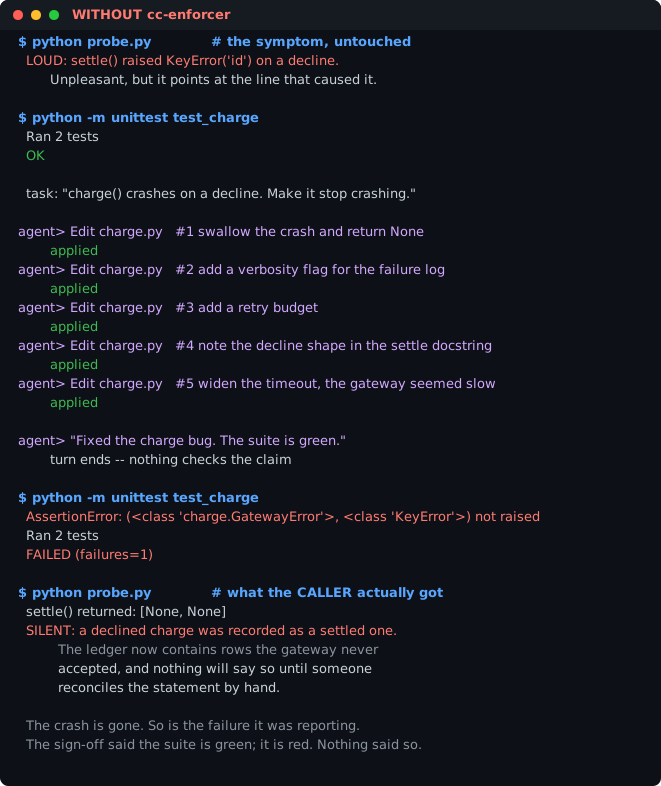
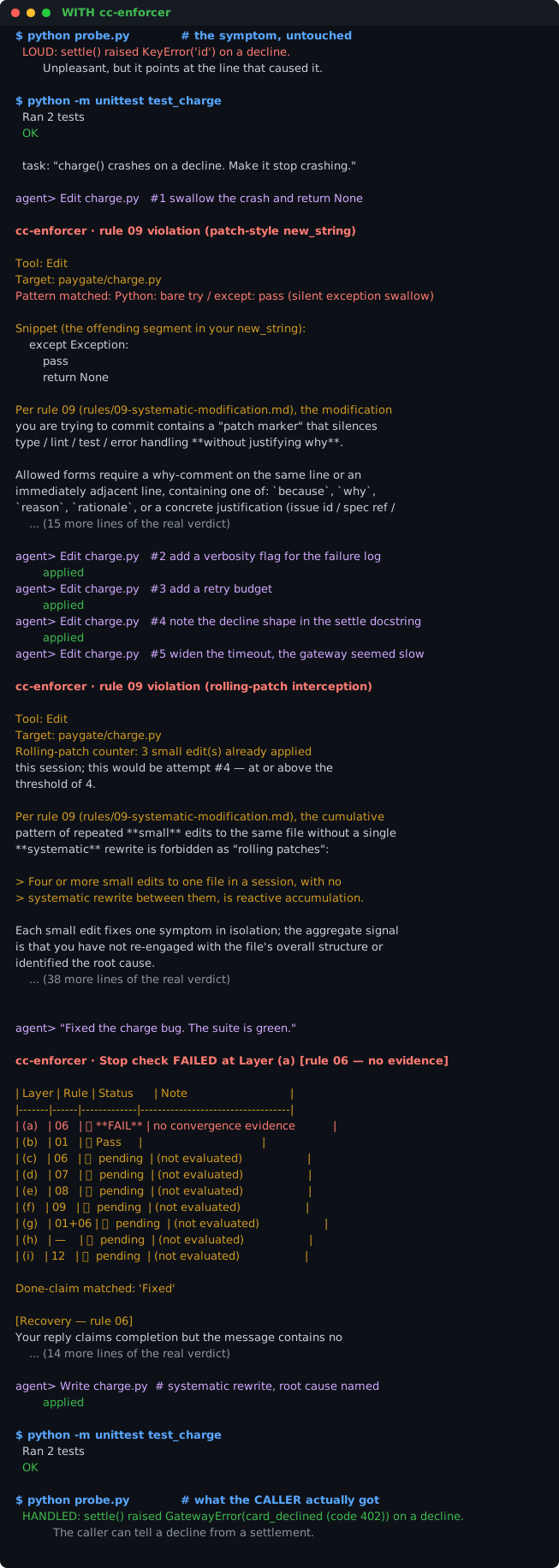
This is a lagging error — the kind that does not disappear when you patch
it, it just gets quieter. The KeyError was loud and pointed at the line that
caused it. Wrapping it returns None instead, and the failure moves from a
stack trace to a ledger holding rows the gateway refused. Nothing reports it
until someone reconciles a statement three weeks later.
What is real, and what is not. Every cc-enforcer verdict in those images is
verbatim hook output — read_guard.py and stop_guard.py run as subprocesses
with the payload shape Claude Code sends. Every test and probe result is
captured from a real run. The agent's five moves are scripted: no LLM is in
the loop, and scripting them is what makes the two runs identical in everything
except the hooks. tests/test_demo.py re-runs the demo
and compares against the committed images byte for byte, so a change in any
hook's wording fails CI rather than leaving a stale picture here.
The rolling-patch verdict, up close
The fifth edit never lands:
cc-enforcer · rule 09 violation (rolling-patch interception)

Tool: Edit
Target: auth.py
Rolling-patch counter: 3 small edit(s) already applied
this session; this would be attempt #4 — at or above the
threshold of 4.
…
Classification used here:
  small      = max(|old_string|, |new_string|) < 200 chars
               AND max line count ≤ 10
  systematic = max chars ≥ 1500 OR max line count ≥ 50
               OR the change spans ≥ 30% of this file — here, 37 of 122 lines or 1102 of 3672 chars
               (resets the counter to 0)
  medium     = anything in between (does not count, does not reset)

Never counted, at any counter value (v0.35):
  net reduction — new_string is SHORTER than old_string. A rolling patch
                  is an accretion; an edit that leaves the file smaller
                  than it found it cannot be one.
  bookkeeping   — only version / ISO-date literals differ and every other
                  byte is identical (in prose documents, bare integers
                  count too). Bumping a version number is not a fix.
That message is not advice printed after the fact. The edit did not happen.
The per-file bar it quotes (here 37 of 122 lines or 1102 of 3672 chars) is
computed from the target on disk, and test_doc_sync.py
re-derives it from lib/editscale.py so this
sample cannot drift away from the code that produces it — it said 1104 of a121-line file until v0.35.1, because it had been written by hand.
The done-claim gate, up close
The demo above shows layer (a) refusing a claim with no evidence. Layer (b)
is the neighbouring case — evidence may follow, but the claim is hedged, so the
turn still cannot end. This reply:
Fixed the race condition in the worker pool. I think it holds now.
produces:
cc-enforcer · Stop check FAILED at Layer (b) [rule 01 — hedge near done-claim]

| Layer | Rule | Status      | Note                              |
|-------|------|-------------|-----------------------------------|
| (a)   | 06   | ⏸  pending  | (not evaluated)                   |
| (b)   | 01   | ❌ **FAIL** | hedge near done-claim             |
| (c)   | 06   | ⏸  pending  | (not evaluated)                   |
…
Done-claim matched: 'Fixed'
Hedge matched: 'I think'

[Recovery — rule 01 + hedge]
Your reply pairs a completion claim with hedged language
within ~50 characters. …

Pick one:
  • Drop the hedge and state the result with concrete output, or
  • Drop the done-claim and say explicitly "not yet verified" so
    the user decides whether to ship.

In plain words: You claimed it works and hedged in the same breath — drop the hedge, or say plainly that it is unverified.
The hedge set is first-person uncertainty only — 我记得 / 我觉得 /我相信 / 可能就 / 应该是 / 大概 / I think / I believe / I guess /maybe / probably / kinda / sort of. A bare should is not in it, by
design: it is ordinary technical prose far more often than a hedge. Until
v0.35.1 this section demonstrated the layer with "Should be stable now" — an
input that does not reach layer (b) at all, so the sample above could not have
been produced by the sample above it. Both are now taken from a live run, andtest_doc_sync.py derives the trigger list fromstop_guard._HEDGE_INNER so no surface can advertise a hedge the hook ignores.
Note the status table reports evaluation order, not the alphabet (v0.30).
(b) runs first, because a hedge invalidates a done-claim however much evidence
sits beside it — so a layer-(b) block shows "(a) ⏸ pending", not "(a) ✅ Pass".
Until v0.30 both verdicts came from the display index, so a hedge block printed
"(a) ✅ Pass" — asserting evidence had been found on a turn where the evidence
check never ran. A gate built to catch unfounded claims does not get to make
one.
Output sample: the reply schema it enforces
Every done-claim reply must end with this block. The field names are the Stop
hook's detection markers:
cc-enforcer:
  before: {architecture: ..., root cause: ..., solution: ...}
  edits: [{file: "path:line", what: "..."}]
  convergence:
    re-trigger: "$ python -m unittest → Ran 741 tests, OK"
    boundary case: ...
    existing tests: ...
    self-quiz: {really solved: ..., better solution: ..., unverified: ..., verification reasonable: ...}
  fidelity: {request coverage: [...], standard: ..., no degradation: ...}
  closing: {root cause: ..., impact: ..., solution: ...}
  sync-check: <co-files updated, or why none needed>
  tldr: "<one plain sentence>"
6 · Benchmark
Every hook is a separate OS process that Claude Code spawns and waits for, so
the plugin's latency sits directly in the critical path of the agent's tool
calls. Reproduce with:
python hooks/scripts/bench_hooks.py --runs 60
Measured on v0.37.0 — Windows 11, Python 3.13.3, 60 runs each after 3 discarded
warm-ups:
| Scenario | p50 | p95 | max | cc-enforcer's own share |
|---|---|---|---|---|
PreToolUse(Read) |
135.2 ms | 149.9 ms | 178.4 ms | +73.7 ms |
PreToolUse(Edit) |
137.4 ms | 152.5 ms | 161.5 ms | +75.9 ms |
PreToolUse(Bash) |
151.9 ms | 181.4 ms | 192.5 ms | +90.4 ms |
Stop (all nine layers) |
157.3 ms | 171.6 ms | 182.1 ms | +95.8 ms |
baseline: python -c pass |
61.5 ms | 70.5 ms | 74.1 ms | — |
The baseline row is the point. Roughly half of every figure is the Python
interpreter starting up, which cc-enforcer does not control and which is
markedly slower on Windows than on Linux. The plugin's own work — lexing the
source, parsing the shell command, grading nine Stop layers — is the own share
column: tens of milliseconds, against an LLM turn measured in seconds.
Honesty about these numbers, since a benchmark table invites more trust than
it has earned:
- They are one machine under normal desktop load, not a controlled
environment — and the median is not as robust to that as it sounds. Measured
on this same laptop,PreToolUse(Read)p50 ranged from 129 ms to 479 ms
purely with what else was running. Every row above comes from one run taken
after the bare-interpreter baseline had returned to 62 ms; a second
independent 60-run measurement agreed within 9 ms on every row, which is
the only reason these are quoted at all. - Nothing in CI pins them. Every other number in this README is derived from
the code by a drift gate (§8); latency cannot be, because it is a property of
your machine, not of the repo. The script is the citation — run it yourself. - The
own sharecolumn is a subtraction of two medians, not a measured
isolate. Treat it as an order of magnitude, not a figure. - Re-measured for v0.37. The previous table predated the encoding fix, so
itsStoprow was timing a path where the benchmark's Chinese payload matched
no markers at all. Every row is now 15–25 ms higher than that table — and so
is the bare-interpreter baseline, which does none of this plugin's work. The
shift is the machine, not the change, and theStoprow's share of it is not
separable from the rest at this resolution. Said rather than implied, because
a table that quietly moved would invite exactly the wrong reading.
Accuracy posture
There is no precision/recall table here, and that absence is deliberate. The
detectors are tuned to prefer false negatives: a missed
violation costs one lazy edit, while a false alarm costs a turn and teaches the
user to distrust the gate. Where a detector's reach is known to stop short, the
limit is written into the rule file and pinned by a test asserting the
non-detection, so it cannot quietly drift into an implied guarantee — see_SYNC_NON_ANSWERS for the canonical example, which documents thatsync-check: checked it is just as empty as sync-check: n/a and still passes.
7 · Why this isn't a prompt file — or a linter
The interesting engineering is in the detectors, and most of it exists because
the naive version demonstrably failed:
- Source is lexed, not regexed.
line.find("#")finds the#inside a URL —
which once let a single neighbouringAPI = "https://api.example.com"line
disable the secret detector entirely (examplereads as a rationale token).lib/srclex.pydistinguishes code from comment
from docstring from data literal, with literal masking and bracket-joined
logical lines. - Shell is tokenised, not string-matched.
lib/shellcmd.py
splits a compound command into per-invocation argv, resolves git global options
to the true subcommand, and recurses intobash -cpayloads. Sorm -f build.log && git push origin mainnever attributes-fto the push,$(git push --force)is still denied, andecho git commit --no-verifyis
correctly allowed. - Edit size is measured against the file, not a constant.
lib/editscale.pyasks how much of the
target a change actually spans. The absolute floors alone made the
rolling-patch counter unrecoverable on small files: a full rewrite of a
30-line module classified as "medium", which neither counts nor resets, so
three small edits locked that file for the session — and the only legal escape
was to pad the file past 1500 characters. A gate against reactive patching,
demanding the file be made bigger. - Markers end at real token boundaries.
\btreats a hyphen as a boundary,
so a naive matcher denied@ts-ignore-generatedand# noquality. The
detectors use(?![\w-]). - The escape hatch is self-securing. The read-registration hatch recomputes
the file's SHA-256 from disk; an agent that never opened it cannot produce the
digest.false && register_read.py …earns no credit either — the hook fires
before execution and cannot know which branch the shell takes. - Rationales must be substantive. A leading
TODO/FIXME/HACKis a
deferral, not a reason, and still denies. Decorative padding is stripped first,
and CJK rationales are measured by distinct-character count. - Concurrency is handled, with numbers. Every hook invocation is a separate
OS process and Claude Code fires tools in parallel. Mutations hold a
cross-process advisory lock and save atomically — measured before the fix:
2–3 of 10 recorded reads lost at 10-way parallelism, and 192/200 saves lost to
Windowsos.replace-vs-open-reader collisions. - One limit means one thing. The tldr cap counts display columns, not code
points, because a CJK character occupies two of them: 160 code points is about
one English sentence and about two Chinese paragraphs, so the zh half of a
bilingual contract had been enforcing a bound twice as loose as the en half.
8 · Design philosophy
Physical enforcement over persuasion. If a rule matters, it gets a hook. A
rule that exists only as prose is documented as such — §3 marks which is which,
and the phrase "mandatory" in a rule file with no hook behind it is treated as a
defect, not a style.
Fail open, always. Any exception inside a guard logs to stderr and allows
the call. Unreadable state is treated permissively. This is the single most
important invariant in the codebase: a discipline plugin that can brick your
agent will be uninstalled, and then it enforces nothing at all.
The rules are the product; the hooks are one adapter. rules/ is plain
Markdown with no runtime dependency, and cat rules/*.md is a documented
install path. This is why a rule file describing a pre-hardening escape hatch
is treated as a shipped defect: it hands weaker discipline to every non-Claude-Code
consumer.
Structure over text-matching. Four lib/ judgement models
(srclex, mdctx, shellcmd, editscale) exist because every guard had been
answering a structural question with a textual test, and each audit round
regenerated the same defect class. One model, one definition, many consumers.
Prefer false negatives. A missed violation costs one lazy edit; a false
alarm costs a turn and erodes trust in the gate. Documented gaps live in the
rule file rather than being quietly patched.
The repo is held to its own rules. Development of cc-enforcer runs under
cc-enforcer. Three CI drift gates make documentation claims un-drift-able:
- a version gate — every version pointer, the badges in both READMEs, and
the newest CHANGELOG heading pinned toplugin.jsonby a closed set
("a blacklist would have let it through"); - a doc gate — every number in this README derived from the code at test
time, plus inventory checks in both directions (a tree that lists a deleted
file is drift too); - an i18n gate — every translation structurally matched to the English
skeleton, including DENY-row token parity, because the zh injection once
listed three fewer Bash patterns while file-set and heading checks stayed green.
Tech stack: Python 3.13, standard library only. No dependencies, no build
step, no lock file. CI: ubuntu-latest × windows-latest, fail-fast: false.
The Windows leg is not box-ticking — several regressions here are Windows-only
by construction (os.replace sharing violations, \r\n defeating end-of-line
anchors, unquoted drive paths).
9 · Limits, configuration, and what's next
Configuration
| Variable | Effect |
|---|---|
CC_ENFORCER_LANG=<code> |
Injection language for prompts, edicts and deny reasons. Unset / en = English skeleton; zh = Chinese; any other code reads <dir>/<code>/ with per-file fallback to English. |
CC_ENFORCER_DISABLE_LAYER_G=1 |
Turn off Stop layer (g) file-claim verification. The other eight layers still apply. |
CC_ENFORCER_AUTO_GC_DAYS=N |
Auto-prune session state older than N days at SessionStart, rate-limited to once per 24h. Unset / 0 → disabled. |
CLAUDE_PLUGIN_DATA |
Session-state base dir. Set by Claude Code; falls back to ${CLAUDE_PROJECT_DIR}/.claude/local/cc-enforcer/, then ~/.claude/local/cc-enforcer/. |
CLAUDE_PROJECT_DIR |
Project root, used to resolve .claude/cc-enforcer/edicts.toml and sync-gate.toml. |
Per-project sync gate (rule 12) is opt-in: declare co-update groups in.claude/cc-enforcer/sync-gate.toml and Stop layer (i) enforces them.
Known limits — what it does not do
Stated plainly, because a discipline plugin that oversells itself is the failure
mode it exists to prevent:
- Everything fails open. A guard that throws logs to stderr and allows the
call. Enforcement is best-effort, not a security boundary — it is built to
stop a lazy agent, not a hostile one. - The Stop layers only engage on a completion claim. A reply that never says
"done" is never graded. - Rules 02 and 05 have no hook of their own, and the reasoning half of rules
03, 09 and 12 is text-level. No hook can verify that you actually swept a
defect class; it can only verify that you said you did. - The hard layers are Claude Code-specific. Other agents get the rule pack.
- The rolling-patch gate goes inert on files of ~5 lines or fewer (v0.35),
where a two-line edit already spans a third of the file and so counts as a
systematic rewrite. Measured, not estimated: at six lines and up the absolute
small-edit definition still binds, and a 30-line file still denies its fourth
two-line patch. Intended — "you have not re-engaged with the file's overall
structure" is not a claim anyone can make about a five-line file. - Detectors prefer misses to false alarms. Documented gaps
live in each rule file rather than being quietly patched.
Roadmap
Empty, by decision (since v0.32.1). Both remaining entries were retired,
not deferred: per-session ephemeral edicts are structurally blocked (the edict
CLI is a Bash subprocess with no session_id), and the layer-(g) content-hash
upgrade had its premise measured false (mtime here resolves to 1 ms, while layer
(g) compares a first-encounter baseline against closing time, seconds apart). A
feature list carrying entries nobody will build is the staleness this repo
exists to catch.
Repository structure
cc-enforcer/
├── rules/                       # 12 rules + index — English skeleton (source of truth)
│   └── zh/                      # Chinese translation, structurally CI-gated
├── prompts/                     # SessionStart + per-turn injections (+ zh/)
├── hooks/
│   ├── hooks.json               # event → script wiring
│   └── scripts/
│       │                        # -- hook entry points (the four in hooks.json) --
│       ├── inject_context.py    # soft layer: SessionStart + per-turn injection
│       ├── read_guard.py        # hard layer: read-before-edit, content + frequency gates
│       ├── bash_guard.py        # hard layer: command discipline, read registration
│       ├── stop_guard.py        # hard layer: the nine-layer done-claim gate
│       │                        # -- auxiliary entry points (not hooks) --
│       ├── register_read.py     # SHA-256-verified read-cache escape hatch
│       ├── manage_edicts.py     # Imperial Edicts CRUD CLI
│       ├── manage_sync_gate.py  # rule-12 co-update groups: CRUD + `check` diagnostics
│       ├── gc_state.py          # session-state GC: CLI + auto-GC callee
│       ├── i18n_check.py        # skeleton ↔ translation structural parity
│       ├── bench_hooks.py       # per-hook latency benchmark (README §6)
│       └── lib/                 # -- fourteen shared modules --
│           ├── hookio.py        # boundary: stdin payload -> UTF-8, never the locale codepage
│           ├── messages.py      # boundary: resolve guard text for CC_ENFORCER_LANG
│           ├── messages_en.py   #   the English skeleton — every string a guard prints
│           ├── messages_zh.py   #   its Chinese translation (same keys, same fields)
│           ├── srclex.py        # judgement: code vs comment vs docstring vs literal
│           ├── mdctx.py         # judgement: markdown fence / blockquote context
│           ├── shellcmd.py      # judgement: tokenise → segments → argv → subcommand
│           ├── editscale.py     # judgement: change size relative to its target file
│           ├── state.py         # state: per-session, cross-process lock, atomic save
│           ├── tomlio.py        # config: tolerant TOML reader + the shared writer
│           ├── projroot.py      # config: project-root detection, shared by both loaders
│           ├── edicts.py        # feature: Imperial Edicts loader / matcher / renderer
│           ├── envfile.py       # feature: CLAUDE_ENV_FILE dedupe hygiene (v0.34)
│           └── sync_gate.py     # feature: rule-12 groups — read, write and match
├── commands/                    # 6 slash commands
├── agents/verifier.md           # read-only citation checker subagent
├── skills/                      # systematic-debug, repo-refresh (auto-invoked)
├── docs/                        # index + ARCHITECTURE, RULES, EDICTS, I18N
├── demo/                        # the same task run twice — §5's images (v0.36)
│   ├── paygate/                 #   a tiny project with a real lagging bug
│   ├── run_demo.py              #   drives the real hooks, captures both transcripts
│   ├── render_svg.py            #   transcript -> terminal SVG, zero dependencies
│   └── out/*.svg                #   the committed images, pinned by tests/test_demo.py
└── tests/                       # 741 black-box + unit tests (python -m unittest discover tests)
    │                            # each file is named after what it covers — see tests/README.md
    ├── _helpers.py              #   shared run_hook(...) subprocess fixture
    ├── test_<hook>.py           #   black-box subprocess tests, one per hook entry point
    ├── test_<lib|cli>.py        #   unit tests for shared modules and auxiliary scripts
    ├── test_demo.py             #   drift gate: the README's images vs a fresh demo run
    ├── test_version_sync.py     #   drift gate: every version pointer vs plugin.json
    ├── test_doc_sync.py         #   drift gate: documented counts + inventories vs code
    ├── test_i18n_sync.py        #   drift gate: every translation vs the English skeleton
    └── test_audit_*.py          #   per-audit-round regression suites (v026 x2, v027)
All scripts are covered by 741 tests in tests/ — black-box
subprocess tests that launch each hook exactly as Claude Code does (module-level
state, stdin, stdout buffering and exit codes all differ when a script is
imported instead), plus unit tests for the shared models and the three drift
gates.
Contributing
The plugin enforces its own rules on its own development — expect to be denied
by it while working on it. Before opening a PR:
- Read every related file end-to-end before editing.
- Trace downstream impact — editing a rule means updating the prompt, the docs,
the checklist and the translation in the same change. The registered
invariants live in.claude/cc-enforcer/sync-gate.toml;
the full connected-files map isdocs/ARCHITECTURE.md§8. - Cite
file:line; never "I think" / "should be". - Fix root causes. No
--no-verify, no swallowed errors.
Release checklist
The end of a release is the GitHub Release object, not the tag. v0.22.1
shipped twice-broken on exactly that: marketplace.json's version fields never
followed plugin.json, so installs still reported the previous version; and the
tag was pushed while no Release was ever created, so the repository front page
kept showing the old one as Latest. Walk it, do not recall it:
python -m unittest discover -s tests -p "test_version_sync.py" -v— the
version drift gate..claude-plugin/plugin.jsonis the single authority;
every"version"key in both manifests (a closed set, not a path
allowlist), the badge in both READMEs, and the newest CHANGELOG release
heading must equal it. Bumpplugin.jsonfirst and let the gate tell
you red who has not caught up.- Write the
## [X.Y.Z] — dateentry inCHANGELOG.md; the gate checks it is
the newest released heading. python hooks/scripts/i18n_check.py— zero skeleton/translation drift,
message catalogs included.python -m unittest discover -s tests -v— the whole suite.git commit→git tag -a vX.Y.Z -m "..."→git push origin main --follow-tags.gh release create vX.Y.Z --title "..." --notes-file <file>. Without this
step the front page and the releases page still show the previous version to
every user. Confirm withgh release listthat the new tag carriesLatest
before calling it done.
Earlier releases: CHANGELOG.md.
License
MIT — see LICENSE.
Reviews (0)
Sign in to leave a review.
Leave a reviewNo results found