cc-tree
Health Gecti
- License — License: MIT
- Description — Repository has a description
- Active repo — Last push 0 days ago
- Community trust — 161 GitHub stars
Code Gecti
- Code scan — Scanned 10 files during light audit, no dangerous patterns found
Permissions Gecti
- Permissions — No dangerous permissions requested
Bu listing icin henuz AI raporu yok.
Claude Code plugin: universal radial-tree exploration engine. One tree skill + swappable presets (brainstorm / attack / design / code-audit) for divergent ideation, adversarial critique, and design-space exploration. 12 framings × hard-ban-on-incomplete-leaves × stable convergence.
cc-tree




Language: English (canonical). Chinese:
README.zh.md.
cc-tree is a Claude Code plugin that turns open-ended thinking into a
tree you can audit. One universal radial-tree exploration engine, four
swappable presets: divergent brainstorming, adversarial critique,
design-space exploration, and code audit — same engine, different
vocabulary. It is a disciplined, disk-persisted take on tree-of-thoughts
search: every node is derived in full with file:line or URL evidence,defer / future-work / TODO / NEEDS-MORE-INFO leaves are hard-banned,
and the run stops on substantive convergence rather than on a node budget.
claude plugin marketplace add skymanbp/cc-tree
claude plugin install cc-tree@cc-tree
Refactor of
sci-paper'sbrainstorm+paper-attack-treeskills, stripped of paper-specific
anchors and parameterized via presets.
What it is
cc-tree treats any open-ended thinking task as a phylogenetic tree
growing outward from one root. The root is your input — a topic, a
document, a code path, a design prompt. Every node is expanded by the
same 12 framing passes, each child is fully derived and scored, and
only the high-value (advances) leaves get re-expanded, until the tree
reaches substantive convergence rather than an arbitrary count.
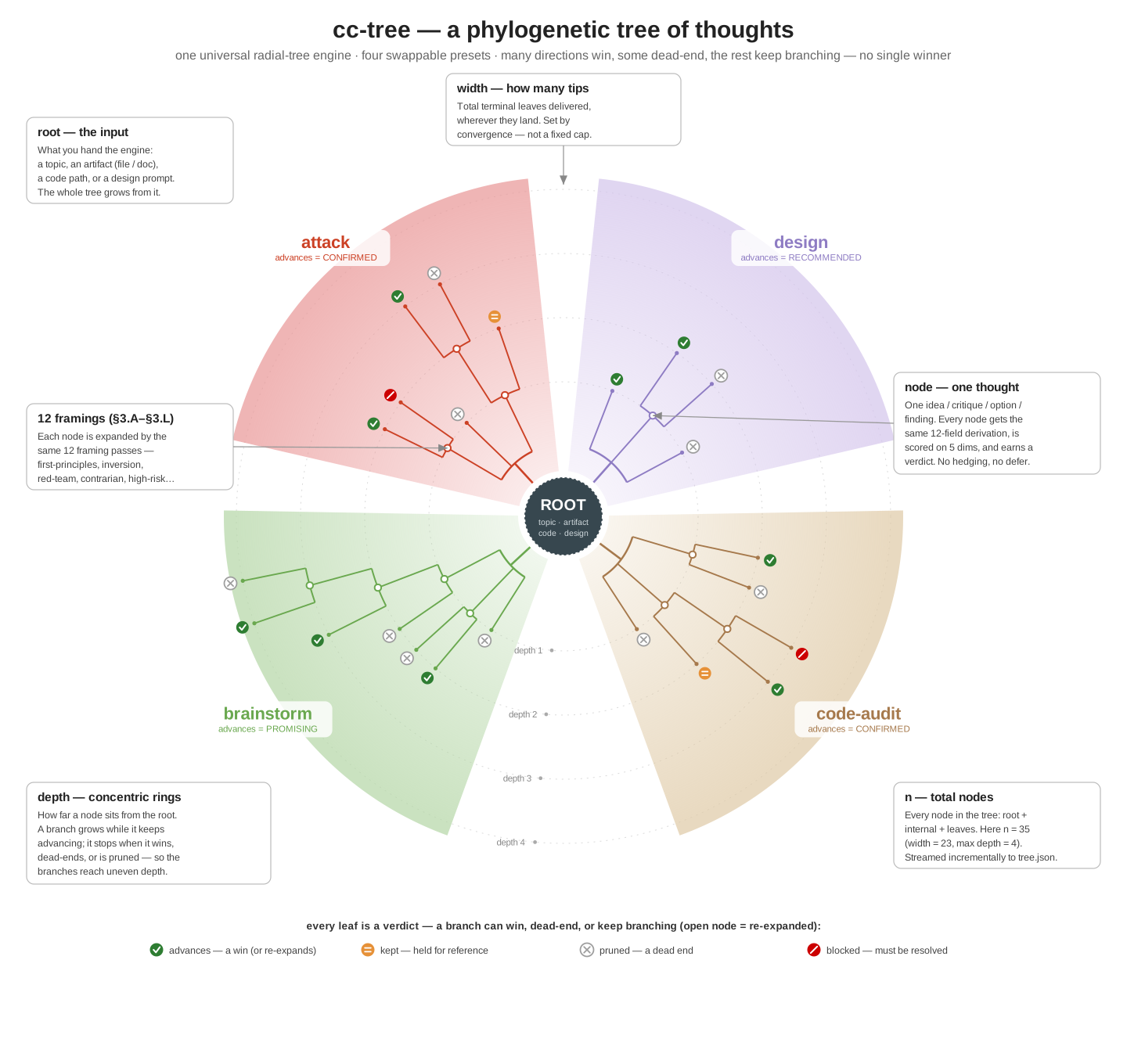
Inspired by the radial tree of life. The vocabulary the rest
of this README uses is all in this one picture: root (the
input at the centre — topic · artifact · code · design), node
(one idea / critique / option / finding, each with the same 12-field
derivation), depth (the concentric framing-recursion rings;
branches stop at different rings because only advances leaves
re-expand), width (the terminal leaves, wherever they
land — set by convergence, not a hand-picked cap, and never counting ablocked tip until it is completed, per §0.1), and
n (total nodes in the tree). Diagram source:tools/gen_radial_tree.py.
  the tree grows OUTWARD from one root. a branch can WIN, hit a DEAD END, or
  keep BRANCHING and be judged again — no single winner, wins at any depth:

    ROOT ──┬── pruned                      (dead end at depth 1)
           ├── advances                    (a win at depth 1)
           └── advances ──┬── pruned        (this branch keeps going…)
                          └── advances ──┬── advances   (…a deeper win)
                                         └── blocked

  each node → 12 framings (§3.A–§3.L) → 12-field derivation → score → verdict;
  branches that keep advancing grow deeper; pruned / blocked ones stop.
How it works
Five irreducible steps, all specified in docs/ENGINE.md
and binding on every preset.
flowchart LR
    R([root<br/>topic · artifact · code · design]) --> F{{12 framing passes<br/>§3.A–§3.L}}
    F --> D[per-node 12-field derivation<br/>evidence · no hedging · no defer]
    D --> S[score 5 dims → verdict]
    S -->|advances| RE((re-expand<br/>this leaf))
    RE --> F
    S -->|kept / pruned| K[keep in tree,<br/>don't re-expand]
    S -->|blocked| B[INCOMPLETE_FORBIDDEN<br/>drive to completion]
    B --> D
    S --> C{§6 convergence?<br/>6 conditions all true}
    C -->|no| RE
    C -->|yes| OUT[/final report +<br/>tree.md · tree.json/]
1 · Ground the root (§2)
The preset supplies the recipe; the engine enforces that every root field
carries a file:line, URL, or command-output citation. An optional
glossary-grill prelude (§2.0) locks the root's technical noun-phrases to
your project's term sheet before a single branch is generated, so the tree
does not spend a hundred leaves solving the wrong problem.
2 · Expand every node through 12 framings (§3)
Each node — root first, then every advances leaf — is put through all 12
framing passes, each of which must yield at least one child. The set is
fixed so that the model cannot quietly skip the uncomfortable angles.
| Pass | What it forces |
|---|---|
| §3.A First-principles | Strip a load-bearing assumption; see what survives |
| §3.B Inversion | Try the negation, the dual, the boundary where it fails |
| §3.C Cross-disciplinary | Transplant tooling from ≥ 3 other fields |
| §3.D Adversarial / red team | The 3 most damaging counter-arguments |
| §3.E Constraint variation | Relax one constraint; tighten another |
| §3.F Scale extrapolation | 1000× / 0.001× / domain boundary |
| §3.G Substitution | Swap a component and observe the change |
| §3.H Office-hours 6Q | YC-style demand-reality interrogation |
| §3.I Contrarian | Which mainstream consensus might be wrong here? |
| §3.J Failure-driven | Turn a concrete present failure into the next question |
| §3.K High-risk asymmetric | Force ≥ 1 low-probability, paradigm-level branch |
| §3.L Meta self-audit | 7-question audit of the model's own blind spots |
A thirteenth pass, §3.X, runs one external cross-check per node
(WebSearch then WebFetch of the actual page) unless --no-online is
set. Full prompts and per-preset examples:docs/framings.md.
3 · Derive every child in 12 fields (§4)
Each child is filled into the preset's 12-field node schema — statement,
parent framing, position, derivation, assumptions, predictions, defense,
alternatives, fix/cost, external check, branch potential, provisional
verdict. Blank, hedged, or deferred fields do not produce a weaker node;
they produce an INCOMPLETE_FORBIDDEN node that blocks termination
until it is driven to completion.
4 · Score, then decide whether to recurse (§5)
Five preset-declared dimensions, each an integer 0–3, summed to a maximum
of 15. score ≥ 11 (plus any preset-specific gate) → advances and the
leaf is re-expanded; 8–10 → kept; ≤ 7 → pruned; anything dominated
by an unverified claim → blocked. Near-duplicate siblings are merged at
cosine similarity ≥ 0.85 (§5.4) so width means coverage, not repetition.
5 · Stop only on substantive convergence (§6)
Six conditions must hold simultaneously: no incomplete node remains;
the advances ratio over the last two rounds has fallen below--min-novelty-ratio; all 12 framings have fired; every advances leaf
has been re-expanded and yielded nothing further; at least one fully
derived §3.K high-risk branch exists; and no user cap has tripped. If a
cap trips first, the engine reports WIDTH_CAP_REACHED /DEPTH_CAP_REACHED / ROUNDS_EXHAUSTED — truthfully, never asCONVERGED — and still completes every in-flight leaf first.
Why it's different
| ad-hoc "brainstorm with me" | cc-tree | |
|---|---|---|
| Coverage | the 3 obvious angles | 12 fixed framings per node, including contrarian / inversion / high-risk |
| Completeness | "we could look at X later" | hard ban on defer / TODO / future-work leaves — every leaf derived with file:line / URL evidence |
| When it stops | when the chat trails off | substantive convergence (6 conditions), not a node count |
| Output | a chat log | tree.md + tree.json + a structured per-preset report on disk |
| Crash safety | scroll back and hope | incremental write per node; re-invoke to resume |
| Reuse | re-prompt from scratch each time | one engine, 4 presets, chainable (brainstorm → design → attack) |
Two reasons, in prose.
Reason 1: the structure repeats. Brainstorming, adversarial review,
design exploration, and code audit all share the same skeleton —
generate candidates from N framings → derive each one completely →
score → recurse on the high-value branches → terminate on stable
convergence, not on running out of patience. Coding that skeleton once
and parameterizing the rest beats writing four near-duplicate skills.
Reason 2: the failure modes repeat too. Every divergent task LLMs do
has the same lazy-equilibrium attractors: defer to future-work, generate
near-duplicate branches with synonym swapping, skip the
high-risk/contrarian framings, declare convergence at the first slow
round. The engine encodes hard bans on all of these (§0.5 forbidden
patterns, §F1–§F8), and they apply equally well to brainstorming a
research direction and to auditing a Python file.
The full design rationale — including why 12 framings and not 7 or 20,
and how cc-tree differs from academic Tree-of-Thoughts and from agent
loops — is in docs/EVALUATION.md.
Feature reference
Exploration engine
- 12 framing passes per node per round (§3.A–§3.L), plus the §3.X
external cross-check;--min-frameworkshas a hard floor of 12. - 12-field derivation per node (§4), every field non-empty,
non-hedged, and citation-bearing. - 5-dimension scoring (§5.1), integer 0–3 each, max 15, mapped to a
four-role verdict (§5.2). - Sibling merging at cosine similarity ≥ 0.85 (§5.4), with the merged
node kept visible and taggedMERGED_INTO=<id>. - Six-condition convergence test (§6.1) with an explicit termination
decision table (§6.2); caps are escape valves, never success. - Mandatory sub-agent parallelism at fan-out ≥ 5 (§8.1), with a
re-verification contract: the main agent re-checks every citation a
sub-agent returns before the child counts.
Presets — 4 shipped, unlimited custom
Each preset (presets/) supplies the vocabulary; none of them
may weaken a universal rule (§10).
| Preset | Use when | Root | Verdicts (advances / kept / pruned / blocked) | Primary deliverable |
|---|---|---|---|---|
brainstorm |
Divergent ideation; surface unexplored research directions or exhaustive problem-solving paths | topic | PROMISING / MARGINAL / DEAD-END / NEEDS-MORE-INFO |
shortlist.md |
attack |
Adversarial critique of a finished artifact (document, argument, proposal) | artifact | CONFIRMED / MARGINAL / REFUTED / INCOMPLETE_FORBIDDEN |
confirmed.md |
design |
Design-space exploration; want an option × trade-off × reversibility table | design-prompt | RECOMMENDED / VIABLE / NOT-RECOMMENDED / NEEDS-MORE-INFO |
options.md |
code-audit |
Code-flavored adversarial review (security / perf / correctness / contract) | code | CONFIRMED / MARGINAL / REFUTED / INCOMPLETE_FORBIDDEN |
findings.md |
Authoring your own is one .md file with the documented frontmatter
schema — see docs/presets.md. The schema is
CI-enforced, so a malformed preset fails before it ever runs.
Commands
| Command | Equivalent to |
|---|---|
/cc-tree:tree <root> --preset <name|path> |
the engine itself; the only command that accepts a custom preset path |
/cc-tree:brainstorm <topic> |
/cc-tree:tree <topic> --preset brainstorm |
/cc-tree:attack <file> |
/cc-tree:tree <file> --preset attack |
/cc-tree:design <prompt|file> |
/cc-tree:tree <prompt> --preset design |
/cc-tree:code-audit <path> |
/cc-tree:tree <path> --preset code-audit |
/cc-tree:tree-chain <root> --stages … |
several presets in sequence, top-K piped between stages |
The wrappers also change the default output directory (brainstorm-out/,attack-out/, …) and carry preset-specific flags such as attack's--focus <section|claim|equation>.
Quality gates — the 8 forbidden patterns
Violating any of these invalidates the round (§0.5). They are enforced
semantically in every output language, not as an English phrase blocklist.
| Gate | Bans |
|---|---|
| §F1 | Memory-cited claims — every external assertion is verified in the same turn |
| §F2 | Pseudo-divergence — synonym-swapped siblings are one branch, and get merged |
| §F3 | Derivation skipping — no "obvious", no "details omitted"; numbers get a python sanity check |
| §F4 | Risk aversion — each pass must fully derive one high-risk branch, whatever its verdict |
| §F5 | Pseudo-convergence — "I'm out of ideas" is not §6 convergence |
| §F6 | Mid-run prompting — full-auto once the root and preset are loaded |
| §F7 | Self-narrowed caps — the engine may not shrink --width / --depth / --rounds on its own |
| §F8 | Deferred leaves — defer / future work / TODO / 待定 / NEEDS-MORE-INFO force INCOMPLETE_FORBIDDEN |
Domain weighting — field profiles
--field <name|path> loads a field profile
(field-profiles/): four short lists — reviewer
concerns, field consensuses, common failure modes, evidence bar — that
re-prioritize which branches the 12 framings explore first and raise the
citation bar (§2.2). Profiles are preset-agnostic: the same profile
sharpens an attack on a paper, a brainstorm on research directions,
and a code-audit on a simulation. A physics profile
(field-profiles/physics.md) ships built-in;
author others fromfield-profiles/_template.md. A missing
profile warns and continues — weighting is an enhancement, never a
blocker.
Cross-preset chaining
A natural workflow pipes one preset's best output into the next:
brainstorm → pick top-K → design each → attack the winner.
/cc-tree:tree-chain "ways to cut our API p99 latency" \
    --stages brainstorm,design,attack --top-k 3
Each stage converges independently; the top-K handoff between stages is
always logged, never silently truncated. The substrate is the universal--seed-from <primary.md> flag (alias --from-prior), which seeds a run
from a prior run's deliverable, so you can also chain by hand. Contract:docs/chaining.md.
Output, resume, and crash-safety
Every node lands on disk the moment its 12 fields are filled (§7.1) —
not batched at the end. If the process is killed, the context window
fills, or you interrupt the run, the on-disk tree is consistent up to the
last completed node. Re-invoke with the same --out <dir> and the engine
resumes from the highest-id leaf. tree.json is the machine source of
truth; tree.md is the human view; REPORT.md is the §7.4 final report.
Bilingual output and documentation
--lang <tag|auto> selects the run's human-readable output language
(en, zh, zh-Hans, zh-Hant, fr-CA, …); auto detects the
dominant natural language of the root and falls back to en for mixed,
unrecognized, path-only, and code-only input. The machine skeleton
stays English in every language: flags, frontmatter and JSON keys,root_kind values, verdict labels, score keys, node_schema fields,
framing IDs, status tokens, filenames, and paths. Root text, artifacts,
glossaries, custom-preset prose, citations, and quoted evidence may use
any language, and quotations stay verbatim with a localized explanation
added rather than substituted. One run keeps one language from start
through resume and chaining (§1.0).
The documentation itself follows the same rule: unsuffixed X.md files
are canonical English, X.zh.md files are maintained Chinese parallels
tracked in docs/languages.json, and each
translation records a SHA-256 digest of its English source so a stale
translation fails CI.
Extensibility
| You want to add | Write | Validated by |
|---|---|---|
| A new exploration mode | one preset .md with the frontmatter schema |
preset schema check + wrapper-parity check |
| A new domain lens | one field profile .md with four ## sections |
field-profile schema check |
| A shorter way to type it | one command .md wrapper |
command frontmatter + flag-documentation check |
| A new documentation language | a pairs entry in docs/languages.json |
digest, heading, fence, and machine-token parity |
Engineering guarantees
tools/validate_plugin.py runs seven check groups on every push and pull
request, across Python 3.11 and 3.13:
| Check | What it fails on |
|---|---|
| manifests | plugin/marketplace version or identity drift |
| skills | a SKILL.md without frontmatter, or whose name ≠ its directory |
| presets | any of the preset schema rules (§10–§11) |
| commands | a command without a description, or a preset shipped without its wrapper |
| tools | a Python file that does not parse |
| cross-refs | dead #anchors, unresolvable relative links, out-of-bounds example citations, undocumented command flags, malformed field profiles, dead §N references |
| i18n | an unregistered document, a stale digest, diverged headings or fences, a thin or English-copy translation, a dropped machine token |
The point is that everything this README claims is either executable or
CI-checked. Drift between the docs, the runtime prompt, and the schema is
the defect class this repository takes most seriously.
Install
cc-tree is a self-contained directory marketplace. Install it with the
Claude Code plugin CLI:
# 1. Register this repo as a marketplace (directory or GitHub source)
claude plugin marketplace add skymanbp/cc-tree

# 2. Install the plugin from it
claude plugin install cc-tree@cc-tree

# (optional) sanity-check the manifests before/after
claude plugin validate <path-to-this-repo>
claude plugin list
Restart your Claude Code session to load the plugin (new plugins are
loaded at session start). Skills then appear namespaced: /cc-tree:tree,/cc-tree:brainstorm, etc. To pick up later edits, runclaude plugin update cc-tree and restart.
Quick start
# Divergent ideation
/cc-tree:brainstorm "ways to detect dark-matter substructure with weak lensing"

# Adversarial critique of a finished doc
/cc-tree:attack ./paper.tex

# Design-space exploration
/cc-tree:design "auth flow for our internal admin tool"

# Code audit
/cc-tree:code-audit ./src/api/upload.py

# Use the engine directly with an explicit preset
/cc-tree:tree <root> --preset brainstorm
/cc-tree:tree <file> --preset ./my-custom-preset.md

# Domain-aware reviewer weighting (physics ships built-in; author other
# fields from field-profiles/_template.md)
/cc-tree:attack ./paper.tex --field physics

# Explicit Chinese human-readable output; machine keys/statuses stay English
/cc-tree:attack ./paper.tex --lang zh

# Detect the dominant natural language of the root; ambiguous inputs fall back to en
/cc-tree:brainstorm "如何验证弱引力透镜中的暗物质子结构" --lang auto

# Quick capped run when you want a taste rather than convergence
/cc-tree:brainstorm "topic" --width 20 --depth 2 --no-online
A worked, end-to-end example with input and expected output lives inexamples/attack/.
Flag reference
Common flags apply to every preset. The authoritative table, with the
per-flag semantics, is in skills/tree/SKILL.md.
| Flag | Default | Meaning |
|---|---|---|
--preset <name|path> |
required | brainstorm / attack / design / code-audit, or a path to your own |
--lang <tag|auto> |
en |
Output language for localized prose; machine tokens stay English |
--width N |
∞ | Cap on final leaf count |
--depth N |
∞ | Cap on tree depth from root |
--rounds N |
conv |
Cap on expansion rounds; conv = terminate by §6 convergence |
--max-branches N |
∞ | Cap on new branches per node per round; floor is 12 |
--out <dir> |
per-command | Output directory |
--glossary <path> |
preset-determined | Term sheet for the §2.0 glossary grill |
--field <name|path> |
none | Field profile for domain-aware weighting |
--seed-from <primary.md> |
none | Seed depth-1 from a prior run's deliverable (alias --from-prior) |
--no-grill |
off | Skip the §2.0 glossary prelude |
--no-online |
off | Disable WebSearch / WebFetch |
--min-frameworks N |
12 | Minimum framings per node; the floor is 12 |
--min-novelty-ratio R |
0.15 | §6.1 convergence threshold on the advances ratio |
tree-chain adds --stages <a,b,c> (default brainstorm,design,attack)
and --top-k N (default 3). Presets may document their own flags, such asattack's --focus <section|claim|equation>.
Output layout
Each run writes incrementally to <out>/<UTCdate>__<slug>/ (defaulttree-out/…; the per-preset commands default to brainstorm-out/,attack-out/, design-out/, code-audit-out/, and tree-chain tochain-out/).
<out>/
├── tree.md              # outline of every node; primary human view
├── tree.json            # full data for every node; machine source of truth
├── glossary-anchors.md  # §2.0 prelude output (unless --no-grill)
├── <primary>.md         # shortlist.md / confirmed.md / options.md / findings.md
├── <secondary>.md*      # marginal.md / refuted.md / pending.md / …
├── REPORT.md            # §7.4 final report (also echoed to the terminal)
└── nodes/
    └── <id>.md          # spilled when a node's evidence exceeds 100 lines
All of these directories are .gitignore-d by default — they are your
content, not the plugin's.
Repository map
cc-tree/
├── .claude-plugin/        Plugin + marketplace manifests (fixed location)
├── commands/              Slash-command wrappers, one per preset + tree-chain
├── skills/tree/           The engine skill (SKILL.md) Claude Code loads
├── presets/               The 4 shipped presets — resolved by --preset <name>
├── field-profiles/        Domain lenses — resolved by --field <name>
├── docs/                  Engine spec, framings, authoring guides, rationale
│   ├── assets/            Generated diagrams
│   └── languages.json     Bilingual document manifest + machine-token registry
├── examples/attack/       A worked example: input, expected output, how to rerun
├── tools/                 Repo validators and generators (no runtime dependency)
│   └── tests/             Self-tests for the validator, parser, and i18n contract
└── .github/workflows/     CI: validator + self-tests on Python 3.11 and 3.13
Runtime code and content live in commands/, skills/, presets/, andfield-profiles/; everything under docs/, examples/, tools/, and.github/ exists to specify, demonstrate, or verify them.
Documentation index
Start at docs/README.md for the annotated index. In
short:
| Document | Read it when |
|---|---|
docs/ENGINE.md |
You want the binding contract — §0 through §11 |
docs/framings.md |
You want the 12 framing prompts with per-preset examples |
docs/presets.md |
You are authoring a preset |
docs/chaining.md |
You are wiring several presets together |
field-profiles/README.md |
You are authoring a domain lens |
examples/attack/README.md |
You want to see real input and output |
docs/EVALUATION.md |
You want the design rationale and the alternatives that were rejected |
CONTRIBUTING.md |
You are about to open a pull request |
CHANGELOG.md |
You want the per-version history |
Every document above has a maintained Chinese parallel at X.zh.md,
except docs/EVALUATION.md, CONTRIBUTING.md, and CHANGELOG.md, which
are canonical-English by declaration indocs/languages.json.
What cc-tree is not
- Not a one-shot brainstorm tool. The engine is recursive and
convergence-terminated; a real run takes minutes to hours. - Not a chat interface. Once invoked it runs to convergence without
further prompting (§F6). You steer with flags on the next invocation. - Not a substitute for a domain expert. It produces a cited,
structured exploration; a human still decides which leaves to act on. - Not bundled with a model. It is pure prompt engineering on top of
your existing Claude Code model setting. - Not a linter.
code-auditlooks for what a static analyzer cannot:
threat-model-dependent, contract-level, and cross-file reasoning bugs.
Related terms
If you arrived searching for one of these, cc-tree is probably what you
want: tree of thoughts (ToT) for Claude Code · structured LLM reasoning ·
recursive exploration agent · AI brainstorming tool · adversarial review /
red-team prompt · reviewer-style paper critique · rebuttal preparation ·
LLM code audit and security review · design-space exploration and
trade-off analysis · architecture decision support · research ideation ·
divergent thinking framework · multi-agent fan-out · convergence criteria
for LLM search · Claude Code plugin, skill, and slash commands ·
bilingual English/Chinese prompt engineering.
Relationship to sci-paper
skymanbp/sci-paper was the
original home of this engine, scoped to scientific paper writing and
review. cc-tree is the domain-agnostic extraction; sci-paper keeps its
paper-specific versions independent (no coupling). If you write papers,
use sci-paper. If you want the engine for anything else, use cc-tree.
Contributing
Issues and pull requests are welcome. CONTRIBUTING.md
covers the repository layout, the one command that reproduces CI locally,
and the two rules that trip up first-time contributors: presets are
schema-validated, and editing an English document requires refreshing its
Chinese parallel's source digest.
License
MIT. The code, skills, presets, commands, and docs in this
repository are MIT-licensed. Run-output directories (tree-out/,brainstorm-out/, attack-out/, design-out/, code-audit-out/,chain-out/) are user-generated and .gitignore-d by default.
Yorumlar (0)
Yorum birakmak icin giris yap.
Yorum birakSonuc bulunamadi