goal-workflow
Health Warn
- License — License: MIT
- Description — Repository has a description
- Active repo — Last push 0 days ago
- Low visibility — Only 7 GitHub stars
Code Pass
- Code scan — Scanned 1 files during light audit, no dangerous patterns found
Permissions Pass
- Permissions — No dangerous permissions requested
No AI report is available for this listing yet.
AI-driven development workflow with /prd, /goal, /review-it and /ship-it skills
goal-workflow
English | 简体中文
An AI development workflow with /prd, /goal, /review-it, /ship-it, /refactor, /humanize-it, /listenhub-tts and /insight-diagram — from requirements to shipping code, all within Claude Code.
Development Workflow
/prd → /goal → /review-it → /ship-it
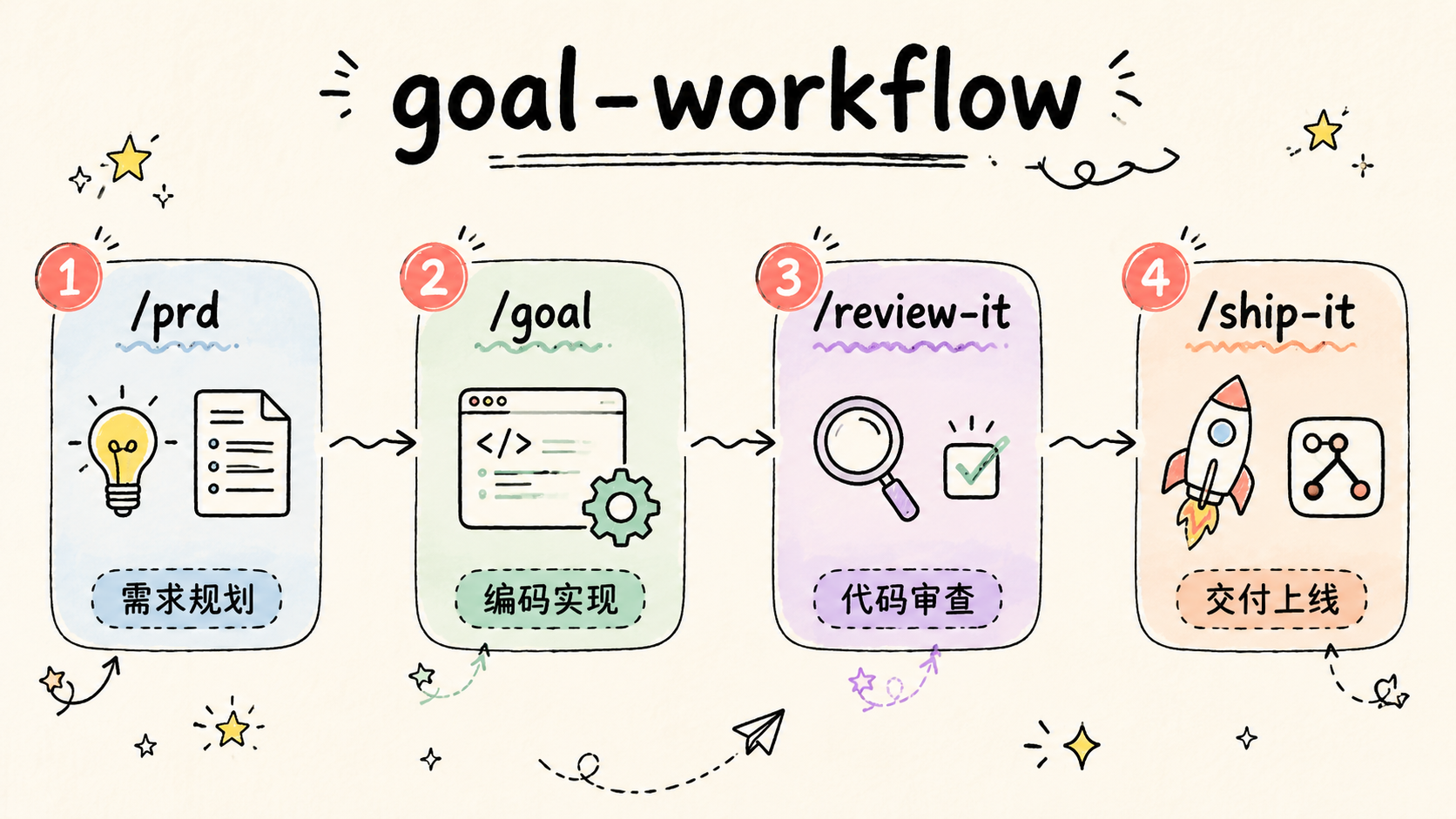
| Step | Command | What it does |
|---|---|---|
| 1. Plan | /prd |
Write a PRD, decompose into features, generate Issue cards |
| 2. Implement | /goal |
Pick an Issue and implement it (Claude Code or Codex) |
| 3. Review | /review-it |
Run code review, verify findings, fix issues iteratively |
| 4. Ship | /ship-it |
Commit, create PR, merge, add summary, close the Issue |
Step 1 — Plan: Describe your feature idea. /prd asks clarifying questions, generates a structured PRD, then decomposes it into small, independent Issues (GitHub / Local / iCafe).
Step 2 — Implement: Use /goal (Claude Code) or codex --goal (Codex) to pick an Issue and implement it end-to-end in a single focused session.
Step 3 — Review: Run /review-it to perform automated code review. It verifies each finding against real code and iterates until the review is clean. Works across Claude Code, Codex, OpenCode, and DeepSeek TUI.
Step 4 — Ship: Run /ship-it to commit code with Issue reference, push branch, create PR, merge via squash, add implementation summary, and close the Issue.
Bonus — Humanize: Run /humanize-it to remove AI-generated traces from documents. It automatically selects the best humanization strategy (humanizer-zh / humanize-chinese / technical-writing) based on document type and iterates until the result passes quality checks (up to 42 iterations).
Skills
/prd — PRD Generator + Issue Decomposer
Generate structured Product Requirements Documents for new features, then decompose them into implementable Issues.
- Asks 3-5 clarifying questions with lettered options for quick iteration
- Generates well-structured PRD with user stories, functional requirements, non-goals, etc.
- Decomposes PRD into small, independent, implementable Issues
- Creates Issues in GitHub / Local
.mdfiles / Baidu iCafe
Triggers: create a prd, write prd for, plan this feature, 写PRD, 需求文档, 需求分析
Adapted from snarktank/ralph/skills/prd
/review-it — Code Review Closeout
Automated code review closeout check before committing or shipping. Supports Claude Code, Codex, OpenCode, and DeepSeek TUI.
- Auto-detects review target: uncommitted changes or branch diff
- Supports parallel test + review execution
- Treats review output as advisory — verifies every finding against real code
- Keeps iterating until review is clean
Triggers: review-it, autoreview, or use before final commit/ship
Adapted from steipete/agent-scripts/skills/codex-review
/ship-it — Commit, PR, Merge & Close
Standard post-implementation workflow: commit code → push branch → create PR → merge → close Issue.
- Commits code with Issue reference in commit message
- Creates PR with
Closes #Nfor auto-closing - Merges via
gh pr merge --squash --delete-branch - Handles error cases (failed checks, merge conflicts, branch protection)
Triggers: 提交代码, commit and merge, 创建PR, 合入, 关闭issue, ship-it
/humanize-it — Iterative AI Trace Removal
Remove AI-generated traces from documents by automatically selecting and iterating across multiple humanization strategies.
- Auto-detects document type (technical / academic / general / long-form) and selects the optimal skill
- Iterates across
humanizer-zh→humanize-chinese→technical-writinguntil quality threshold is met - Scores each iteration on 5 dimensions: AI trace removal, naturalness, information retention, style consistency, readability
- Up to 42 iterations with smart skill-switching (auto-switches when progress stalls) — 42 is a tribute to The Hitchhiker's Guide to the Galaxy
Triggers: humanize this, 去AI味, 降AIGC, 人性化改写, 改成人话, 去除AI痕迹, humanize document
Combines humanizer-zh, humanize-chinese, and technical-writing skills
/listenhub-tts — Text to Speech via ListenHub
Convert text to speech using the ListenHub API. Supports three synthesis modes: quick TTS, multi-speaker scripts, and long-form async synthesis.
- Auto-selects the best synthesis mode based on text length and use case
- Presents speaker list for selection when voice is not specified, defaulting to
chat-girl-105-cn(Xiaoman) - Supports quick synthesis (
/v1/tts), multi-speaker scripts (/v1/speech), and long-form async (/v1/flow-speech/episodes) - AI polish mode for long-form text to improve naturalness
Triggers: tts, text to speech, 语音合成, 文字转语音, 朗读, 生成语音, 生成音频, 转音频
Powered by ListenHub OpenAPI
/refactor — Expert Code Refactoring
Surgical code refactoring based on Martin Fowler's catalog — improve maintainability without changing external behavior.
- Catalog of 22 code smells organized by category (Bloaters, OO Abusers, Change Preventers, Dispensables, Couplers)
- 40+ refactoring techniques from Fowler's catalog in 6 categories (Composing Methods, Moving Features, Organizing Data, Simplifying Conditionals, Method Calls, Generalization)
- Each technique includes mechanical steps with before/after examples
- Strict 5-phase safety protocol: Prepare → Identify → Refactor → Verify → Clean Up (tests + commit after every step)
- Design patterns for refactoring: Strategy, Template Method, State, Composite, Decorator, Null Object
- Language-specific guidance for Java, TypeScript, Python, Go, and Rust
Triggers: refactor, 重构, clean up, improve code, code smell, extract method, rename, simplify
Based on Martin Fowler, Refactoring: Improving the Design of Existing Code (2nd Edition)
/insight-diagram — UML & Architecture Diagram Generator
Generate UML diagrams, architecture diagrams, and flowcharts for any project. Analyzes the codebase, lets you choose diagram types, renders as HTML+SVG, and saves to the docs/ directory.
- Analyzes project codebase structure and identifies key components
- Supports 17 diagram types: architecture + 14 UML diagrams (class, object, component, deployment, package, composite-structure, profile, usecase, activity, state-machine, sequence, communication, timing, interaction-overview) + flowchart + swimlane
- User selects desired diagram type from interactive options
- Renders diagrams using the
architecture-diagramskill as HTML+SVG - Saves output to
docs/directory for project documentation visualization
Triggers: generate diagram, create architecture diagram, draw UML, 生成架构图, 画流程图, 生成UML图, insight-diagram
Installation
Install skills via npx skills:
# Install all skills from this repo
npx skills add smallnest/goal-workflow

# Or install specific skills
npx skills add smallnest/goal-workflow --skill prd
npx skills add smallnest/goal-workflow --skill review-it
npx skills add smallnest/goal-workflow --skill ship-it
npx skills add smallnest/goal-workflow --skill humanize-it
npx skills add smallnest/goal-workflow --skill listenhub-tts
npx skills add smallnest/goal-workflow --skill insight-diagram
npx skills add smallnest/goal-workflow --skill refactor

# Install globally (available across all projects)
npx skills add smallnest/goal-workflow -g

# Install to specific agent
npx skills add smallnest/goal-workflow -a claude-code
Documentation
- Workflow Usage Guide (HTML) — visual guide with diagrams, step-by-step instructions, and FAQ
License
MIT
Reviews (0)
Sign in to leave a review.
Leave a reviewNo results found