threadknot
Health Warn
- License — License: Apache-2.0
- Description — Repository has a description
- Active repo — Last push 0 days ago
- Low visibility — Only 5 GitHub stars
Code Warn
- fs module — File system access in .github/workflows/build.yml
Permissions Pass
- Permissions — No dangerous permissions requested
No AI report is available for this listing yet.
A desktop app that runs Claude Code, Codex and Kimi. Your machines find each other over your own network, so you can start work on whichever one you like — and check on it from your phone. Free and open source, no cloud and no account.

All your work, machines and models, in one place.



A Tauri (Rust) desktop app that drives Claude Code, OpenAI Codex, and Kimi Code
natively over their wire protocols — no terminal wrapping, no Node server — and
serves the same UI to any browser on your LAN.
Pair your machines and they become one mesh: launch a thread on your desktop
from your laptop, watch three models work on three different computers at once,
and drive the whole thing from your phone. No cloud, no account — your machines
talk to each other directly.
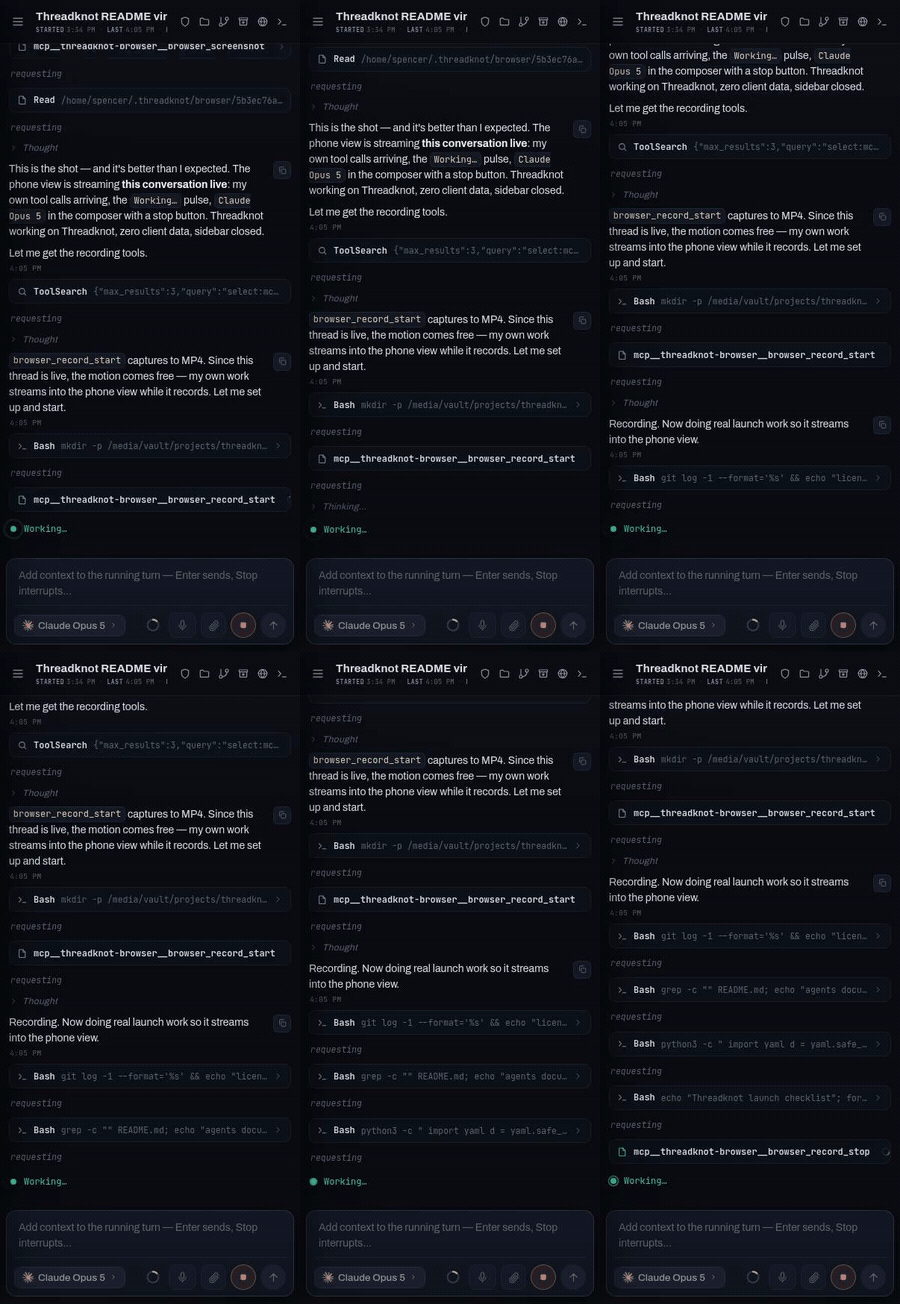
The same UI a phone gets, streaming a live model turn over the LAN.
(That's Threadknot working on Threadknot.)
Install
Prebuilt packages are on
Releases — no
Rust, no Node, no toolchain. Take the one for your platform.
macOS (Apple Silicon) — Threadknot_<version>_aarch64.dmg
Open the disk image and drag Threadknot to Applications. The build is ad-hoc
signed rather than notarised, so the first launch needs right-click →
Open; a plain double-click reports that the app "cannot be opened" and looks
like a corrupt download. Once is enough. Or clear the quarantine flag outright:
xattr -dr com.apple.quarantine /Applications/Threadknot.app
Windows (x64) — Threadknot_<version>_x64-setup.exe
Run the installer. It is unsigned, so SmartScreen interrupts with "Windows
protected your PC" — More info → Run anyway.
Debian / Ubuntu — Threadknot_<version>_amd64.deb
sudo apt install ./Threadknot_<version>_amd64.deb
Fedora / RHEL — Threadknot-<version>-1.x86_64.rpm
sudo dnf install ./Threadknot-<version>-1.x86_64.rpm
Any distro, Arch included — Threadknot_<version>_amd64.AppImage
chmod +x Threadknot_<version>_amd64.AppImage
./Threadknot_<version>_amd64.AppImage
There is no pacman package and there will not be one; the AppImage is the
download-and-run answer for every distro without a native bundle.
You also need an agent CLI
Threadknot drives the coding agents you already have — it does not replace them
and it never handles their auth. Install at least one and log in before first
launch: claude, codex, or kimi. Each runs against your own subscription,
so everyone uses their own account. An agent you are not logged into simply
shows as unavailable in the composer; nothing else breaks.
First run
- Launch Threadknot. It opens on an empty fleet.
- Add workspace in the sidebar, and point it at a project folder.
- New chat, pick a model, and type.
Settings is the gear at the foot of the sidebar: the LAN URL for
phone access, themes, and updates.
Run it headless
Every release also carries threadknot-headless-<platform> — the same server
without the desktop window, which is what you want on a spare machine or a
homelab box:
chmod +x threadknot-headless-linux
./threadknot-headless-linux        # prints the LAN URL and access token
Open that URL from any browser on your network and you get the same UI the
desktop app shows. Real model turns work with no desktop session at all.
Sharing one machine with teammates
A headless box holding the team's checkouts is the case this is for. Add each
person under Settings → People, pair their browser, and assign the two to
each other under Settings → Phone & access. From then on each of them gets
their own sidebar: their own chats by default, a row of faces to look at anyone
else's, and their own stars, stashed projects and settled shelf, so filing
something away stops filing it away for everybody. Give each person their own
Claude login from the same panel and their turns spend their own subscription
seat instead of all three sharing one.
Everyone can still open everyone's chats, which is the point — you drop into a
colleague's thread to help. It is not an isolation boundary: agents all run
as the same OS user, so anyone granted files or terminal can read anything
on that machine. If you need people separated rather than merely tidy, run one
headless instance per OS user instead.
Working on somebody else's machine from your own app
Adding a machine under Settings → Machines makes two installs equals: both
sides dial, and both push their whole project catalog to the other. That is
what you want for your own laptop and homelab, and it is the wrong shape for a
box you share with colleagues — pair three laptops to one and all three
sidebars merge through it.
Settings → Servers is the other shape. Paste the machine's address and a
one-time pairing code from its Settings → Phone & access, and its projects
appear in your sidebar next to your own, marked with its name. Chats there run
there. The link is one way: your desktop never sends its catalog, nothing of
theirs is written to this machine, and what you hold is an ordinary device
credential their owner scopes, assigns to you by name, and can revoke without
asking. Starring or stashing one of their projects is your own view of it and
does not touch theirs.
Updating
Installed copies update themselves: Settings → updates → check now, then one
click downloads the new build, installs it over this one and relaunches. The
download survives closing the window. A machine that has a Threadknot git
checkout builds from master instead of downloading — it says so on the card,
and either machine can be switched to the other route from the same panel.
Building from source instead
With Rust and Node 22+ present:
npm install
npx tauri build --no-bundle
./src-tauri/target/release/threadknot
Or ./build-linux.sh, ./build-mac.sh, .\build-windows.ps1 to produce the
same installable packages the releases carry. You will also need your platform's
webview toolchain — see Prerequisites. More build detail,
including the one mistake that produces a binary with no UI, is under
Build & run.
One phone, every machine
Pair two or more machines and they form a symmetric mesh — no hub, no cloud,
no account. Whichever Threadknot you happen to be looking at drives all of them,
and that includes the one in your phone's browser.
        phone · laptop · any browser on the LAN
                        │
             connect to ANY one machine…
                        ▼
   ┌───────────────┐         ┌───────────────┐
   │    desktop    │◀───────▶│    macbook    │
   │   claude ▶▶   │  peer   │   codex  ▶▶   │
   └───────┬───────┘         └───────┬───────┘
           │                         │
      peer │      ┌───────────────┐  │ peer
           └─────▶│    homelab    │◀─┘
                  │    kimi ▶▶    │
                  └───────────────┘

          …and you are driving all three.
A workspace groups threads that live on different machines under a single
sidebar entry. Starting a thread means picking which machine, and which of that
machine's registered folders, it runs in. From then on the thread is pinned
there — and its events stream to every paired device.
Workspace "Storefront"
 ├─ desktop   ~/projects/storefront        ← Claude, mid-refactor
 ├─ macbook   ~/work/storefront-seo        ← Codex, running tests
 └─ homelab   /srv/storefront              ← Kimi, on a long build
Three models, on three machines, working at once. Open a new thread on any of
them, or interrupt a turn you don't like, from whichever device is in your hand.
- Discovery is mDNS plus explicit pairing. Identity is the machine id, so a
DHCP lease change never breaks the mesh; IP addresses are disposable hints. - No cloud plane. Peers talk directly over your LAN or tailnet. There is no
sync service, no account, and nothing to sign up for. - Nothing is copied around. A thread is pinned to the machine that owns it
and runs against that machine's real filesystem. Git stays the only channel
for code.
Still machine-local: git panes, terminals, and artifact bytes are served only by
the machine owning the thread, and push notifications don't yet fire for remote
threads. Details and the remaining work: docs/MULTI-MACHINE.md.
Make them argue
Models are confidently wrong in ways another one often catches immediately.
So point one at another one's work.
Review with… throws one or more reviewers at a live thread. Claude planned
a refactor; hand the plan to Codex and let it argue. Reviewers are read-only —
they cannot touch a file, only make a case — and any model can review, including
the one that did the work.
 thread: "Rewrite the sync layer"

   Claude  ── plans the refactor ──▶
                                     Codex    ── "this drops writes on
                                                  reconnect; here's the case"
                                     Kimi     ── "agreed, and the retry is
                                                  unbounded"
   Claude  ── concedes, revises ──▶
                                     …until everyone concedes, or you call it
One reviewer at one round is a plain critique. Add reviewers, or raise the round
count, and it becomes a debate that runs until the participants stop objecting.
They can be different providers, different models, or the same model twice —
each with its own model, effort, and access.
Design notes and the reasoning behind the roles: docs/PARLEY.md.
Controls (per thread)
| Control | Options |
|---|---|
| Agent | Claude Code, Codex, Kimi Code, Claudex (Claude harness + any model) |
| Model | Claude: Fable 5 / Opus 5 / Sonnet 5 / Haiku 4.5 · Codex: discovered via model/list · Kimi: K3 / K3 256K / K2.7 Code |
| Effort | K3: low / high / max (high default) · other models expose their supported levels (+ 1M context toggle on supported Claude models via the [1m] suffix) |
| Access | Read-only (ask for everything) / Edits (auto-accept edits) / Full (no prompts) |
| Mode | Plan (read-only planning, plan approval card → one-click "Approve & build") / Build |
How it works
┌───────────────────────────────────────────────┐
│ Tauri shell (desktop window)                  │
│   └─ React UI  ←────────────┐                 │
├─────────────────────────────┼─────────────────┤
│ Rust core (threadknot_lib)  │  same UI, phone │
│   axum server :42800 ───────┴──── browser ────┼──→ http://<lan-ip>:42800/?token=…
│   ├─ /ws  (token-gated JSON protocol)         │
│   ├─ /browser (shared Chrome screencast)      │
│   ├─ /mcp (agent browser + artifacts)         │
│   ├─ agent hub (events → JSONL + fanout)      │
│   ├─ claude driver ── spawns `claude`         │   stream-json + control_request
│   ├─ codex driver ─── spawns `codex`          │   app-server (JSON-RPC/stdio)
│   ├─ kimi driver ──── spawns `kimi acp`       │   ACP (JSON-RPC/stdio)
│   └─ claudex ──────── `claude` + gateway env  │   any model, Claude harness
└───────────────────────────────────────────────┘
- Auth is your existing subscriptions: the local drivers spawn the
installedclaude,codex, andkimiCLIs, which use their ownclaude login/codex login/kimi logincredentials. No API keys for
the local agents. (Claudex is the exception: it runs the sameclaude
harness against a compatible gateway, so it takes a base URL and key.) - Projects are folders; each thread runs in that folder with its own
model / effort / access / plan-build settings. - Everything is event-sourced: normalized agent events are appended to
~/.threadknot/threads/<id>.jsonland broadcast to every connected client, so
desktop and phone stay in sync and threads replay on reconnect. - Provider sessions resume: Claude via
--resume <session_id>, Codex viathread/resume, and Kimi via ACPsession/resume. - Agent and human share one browser: the agent gets semantic page snapshots
and deterministic browser tools while the Browser workspace shows the same
live Chrome, including the agent cursor, target, action status, and failures.
You can take over its mouse and keyboard at any time.
Protocol contract: docs/PROTOCOL.md. Codex app-server
schemas vendored in docs/protocol/.
Prerequisites
- Rust (stable) and Node 22+.
- Platform toolchain for Tauri's webview stack. On Linux:
macOS needs the Xcode command-line tools; Windows needs the MSVC buildsudo apt-get install -y libwebkit2gtk-4.1-dev libayatana-appindicator3-dev \ librsvg2-dev libgtk-3-dev libssl-dev patchelf
tools. Linux is the primary development target and gets the most testing. - The agent CLIs you intend to drive, installed and already logged in:
claude,codex,kimi. Threadknot does not handle auth — it reuses each
CLI's own subscription login, so every person runs against their own account.
An agent you are not logged into shows as unavailable in the composer;
nothing else breaks.
The first build compiles the full dependency tree and takes a while. Later
builds are incremental.
Develop
npm install
npm run tauri dev          # desktop app w/ vite HMR (port 1430)
Build & run
npx tauri build --no-bundle                      # desktop app
./src-tauri/target/release/threadknot            # desktop app
./src-tauri/target/release/threadknot-headless   # LAN server only, prints URL
Build the desktop app with the Tauri CLI, as above. A plain
cargo build --releaseproduces a binary with no UI embedded: it tries to
load the dev server and opens on "Could not connect to localhost".npx tauri buildrunsnpm run buildfor you.
Server state: ~/.threadknot/ (server.json holds the port + access token —
delete it to rotate the token). Override port with THREADKNOT_PORT, UI location
with THREADKNOT_DIST.
Upgrading from Armada? Nothing is migrated: an existing ~/.armada keeps being
used, in place. See "Rename compatibility" in CLAUDE.md.
Phone access
Open Settings (gear, bottom of sidebar) in the desktop app and open/copy the
LAN URL — e.g. http://192.168.0.54:42800/?token=… — on any device on your
network. The token persists in the browser after first load.
Credits
Inspired by t3code and
Codex — thanks to both teams.
t3code is MIT-licensed, © 2026 T3 Tools Inc.; its notice is inTHIRD-PARTY-NOTICES.md.
License
Apache License 2.0. Use it for anything — personally, at work,
commercially — modify it, fork it, redistribute it. Keep the copyright notice
and license text if you redistribute it, modified or not.
The hosted relay that backs the optional paid tier is a separate service and is
not in this repository. Nothing here needs it: the LAN server, the mesh, and the
mobile companion all work with no account and no internet.
Reviews (0)
Sign in to leave a review.
Leave a reviewNo results found