smithers
Health Gecti
- License — License: MIT
- Description — Repository has a description
- Active repo — Last push 0 days ago
- Community trust — 314 GitHub stars
Code Uyari
- fs module — File system access in .github/workflows/sota-research.yml
- process.env — Environment variable access in .smithers/agents.ts
Permissions Gecti
- Permissions — No dangerous permissions requested
Bu listing icin henuz AI raporu yok.
Durable runs for coding agents: survive crashes, pause for human approval, rewind mistakes. Claude Code, Codex, Gemini, any model.
Smithers
Long agent jobs shouldn't die when your terminal does.




Tell your coding agent to do real, multi-step work, then Smithers runs it for minutes or
days with crash recovery, retries, human approvals, and full observability. The same
workflow runs across Claude Code, Codex, Pi, AI SDK models, and remote sandboxes.
Watch every step of a workflow run, pause execution, approve gates, and rewind to an
earlier checkpoint. Independent steps can run at the same time.
What you get
- 🛡️ Durable runs that survive crashes: every completed step is persisted the moment it
finishes, so a run resumes from where it stopped instead of starting over. - 🔌 Any agent, any model: Claude Code, Codex, Pi, Antigravity, and more, plus any model
through the AI SDK. Swap the harness without rewriting the workflow. - 🛠️ Higher-quality output: review loops, human approvals, and evals give agents the
structure that real work demands. - 🧩 Dozens of ready-to-run workflows: planning, implementation, review, debugging,
tickets, audits, and long-horizon missions. Your agent can author new ones.
When to use Smithers
| You want to… | Smithers? |
|---|---|
| Get one answer from one prompt | No, call the model directly |
| Let a coding agent change a repo across many steps | Yes |
| Pause for a human approval, then resume later | Yes |
| Run several agents that review, retry, and converge | Yes |
| Survive crashes and replay, fork, or rewind a run | Yes |
Smithers is the durable runtime for coding-agent work: when the unit of work is an agent
editing a real repository over many steps, and you need that work to be inspectable,
approvable, and recoverable.
Why not just let my agent orchestrate itself?
Claude Code, Codex, and the other harnesses already fan out subagents, and for work that
fits in one sitting they are the right tool. The fan-out is ephemeral, though: it lives
inside one session, one vendor, and one terminal.
| Built-in subagent fan-out | A Smithers run |
|---|---|
| Dies when the session ends or crashes | Persists and resumes from the last finished step |
| One vendor per session | Claude, Codex, Gemini, and Pi share one workflow |
| An approval blocks the terminal | An approval suspends the run durably, overnight if needed |
| A bad decision means starting over | Rewind, fork, or replay from any step |
| Orchestration is a prompt you retype | A workflow is a file you version, review, and rerun |
When the work has to survive the session, hand the fan-out to Smithers. Your agent still
drives everything; the run just stops being disposable. The longer argument is in
the open, durable version of agent workflows.
Get started
Smithers is driven by your coding agent, not a GUI you click. Your agent runs Smithers
on your behalf: it scaffolds workflows, kicks off runs, watches them, and handles
approvals.
One command sets everything up. From inside your project:
bunx smithers-orchestrator init
init does everything:
- Installs the
smithersskill into the coding agents on your machine (Claude Code,
Pi, and more), so your agent knows how and when to use Smithers. Nomkdir, nocurl. - Scaffolds
.smithers/with ready-made workflows (hello,implement,plan,review,debug, and more) your agent can pick from.
Then just ask:
"orchestrate an agent to add rate limiting and keep iterating until the tests pass."
Your agent picks the right workflow, starts the run, and keeps going through retries and
review loops until the work is actually done.
To wire the MCP server into every detected agent too, run bunx smithers-orchestrator mcp add. See Agent Support for the full per-agent
matrix, and skills/smithers/ for the onboarding skill itself.
What a workflow looks like
A workflow is a JSX tree of tasks. You usually don't write these by hand: you prompt your
agent, and it writes them from the same primitives the built-in pack uses. Each example
below starts with the prompt that produces it.
1. Two tasks, typed and persisted
"make me a smithers workflow that analyzes a bug report, then fixes it"
import { createSmithers, Sequence, OpenAIAgent } from "smithers-orchestrator";
import { z } from "zod";

const { Workflow, Task, smithers, outputs } = createSmithers({
  input: z.object({ description: z.string() }),
  analyze: z.object({
    summary: z.string(),
    severity: z.enum(["low", "medium", "high"]),
  }),
  fix: z.object({
    patch: z.string(),
    explanation: z.string(),
  }),
});

const analyzer = new OpenAIAgent({ model: "gpt-5.6-terra" });
const fixer = new OpenAIAgent({ model: "gpt-5.6-luna" });

export default smithers((ctx) => (
  <Workflow name="bugfix">
    <Sequence>
      <Task id="analyze" output={outputs.analyze} agent={analyzer}>
        {`Analyze the bug: ${ctx.input.description}`}
      </Task>

      <Task id="fix" output={outputs.fix} agent={fixer} deps={{ analyze: outputs.analyze }}>
        {(deps) => `Fix this issue: ${deps.analyze.summary}`}
      </Task>
    </Sequence>
  </Workflow>
));
Each task output is validated against its Zod schema and persisted to SQLite the moment it
completes. deps gives the fix task typed access to the analysis and mounts it only afteranalyze finishes. If the process crashes, the run resumes without re-running finished
work.
This page is the 90-second version. The Tour is the
15-minute version: it builds a real code-review workflow one capability at a time.
2. Loop until a reviewer approves
"implement this request and keep iterating until a reviewer signs off"
import { createSmithers, Loop, CodexAgent } from "smithers-orchestrator";
import { z } from "zod";

const { Workflow, Task, smithers, outputs } = createSmithers({
  input: z.object({ request: z.string() }),
  impl: z.object({ summary: z.string(), filesChanged: z.array(z.string()) }),
  review: z.object({ approved: z.boolean(), feedback: z.string() }),
});

const coder = new CodexAgent({
  model: "gpt-5.6-luna",
  config: { model_reasoning_effort: "medium" },
});
const reviewer = new CodexAgent({
  model: "gpt-5.6-sol",
  config: { model_reasoning_effort: "xhigh" },
  sandbox: "read-only",
});

export default smithers((ctx) => (
  <Workflow name="implement-reviewed">
    <Loop until={ctx.latest(outputs.review, "validate")?.approved} maxIterations={5}>
      <Task id="implement" output={outputs.impl} agent={coder}>
        {`Implement: ${ctx.input.request}
Address this reviewer feedback first: ${ctx.latest(outputs.review, "validate")?.feedback ?? "none yet"}`}
      </Task>

      <Task id="validate" output={outputs.review} agent={reviewer}>
        {`Review the working-tree changes for: ${ctx.input.request}.
Approve only when the change is correct and tested.`}
      </Task>
    </Loop>
  </Workflow>
));
This is the loop a one-shot agent call can't give you: implement, review, feed the
feedback back in, repeat until approved. Every iteration is persisted, so a crash mid-loop
resumes at the current iteration instead of iteration one.
3. A small engineering team in one file
"split this request into tickets, implement them in parallel worktrees with review
loops, and after I sign off merge the approved branches one at a time"
import {
  createSmithers, Sequence, Parallel, Loop, Worktree, MergeQueue,
  Approval, CodexAgent, approvalDecisionSchema,
} from "smithers-orchestrator";
import { z } from "zod";

const { Workflow, Task, smithers, outputs } = createSmithers({
  input: z.object({ request: z.string() }),
  triage: z.object({
    tickets: z.array(z.object({ id: z.string(), description: z.string() })),
  }),
  impl: z.object({ ticketId: z.string(), summary: z.string() }),
  review: z.object({ ticketId: z.string(), approved: z.boolean(), feedback: z.string() }),
  shipApproval: approvalDecisionSchema,
  merge: z.object({ ticketId: z.string(), status: z.enum(["merged", "conflict"]) }),
});

const planner = new CodexAgent({
  model: "gpt-5.6-sol",
  config: { model_reasoning_effort: "xhigh" },
  sandbox: "read-only",
});
const coder = new CodexAgent({
  model: "gpt-5.6-luna",
  config: { model_reasoning_effort: "medium" },
});
const reviewer = new CodexAgent({
  model: "gpt-5.6-sol",
  config: { model_reasoning_effort: "xhigh" },
  sandbox: "read-only",
});

export default smithers((ctx) => {
  const plan = ctx.outputMaybe(outputs.triage, { nodeId: "triage" });
  return (
    <Workflow name="ship-tickets">
      <Sequence>
        <Task id="triage" output={outputs.triage} agent={planner}>
          {`Split this request into independent tickets: ${ctx.input.request}`}
        </Task>

        <Parallel maxConcurrency={4}>
          {plan?.tickets.map((t) => (
            <Worktree key={t.id} path={`.worktrees/${t.id}`} branch={`ticket/${t.id}`}>
              <Loop until={ctx.latest(outputs.review, `review-${t.id}`)?.approved} maxIterations={4}>
                <Task id={`implement-${t.id}`} output={outputs.impl} agent={coder}>
                  {`Implement ticket ${t.id}: ${t.description}
Reviewer feedback: ${ctx.latest(outputs.review, `review-${t.id}`)?.feedback ?? "none yet"}`}
                </Task>
                <Task id={`review-${t.id}`} output={outputs.review} agent={reviewer}>
                  {`Review the work for ticket ${t.id}. Approve only when correct and tested.`}
                </Task>
              </Loop>
            </Worktree>
          ))}
        </Parallel>

        <Approval
          id="ship"
          output={outputs.shipApproval}
          request={{ title: `Merge ${plan?.tickets.length ?? 0} reviewed branches?` }}
          onDeny="fail"
        >
          <MergeQueue id="merge" maxConcurrency={1}>
            {plan?.tickets.map((t) => (
              <Task key={t.id} id={`merge-${t.id}`} output={outputs.merge} agent={coder}>
                {`Rebase ticket/${t.id} onto main, run the test gate, and merge.`}
              </Task>
            ))}
          </MergeQueue>
        </Approval>
      </Sequence>
    </Workflow>
  );
});
Triage fans the request into tickets. Each ticket gets its own git worktree and its own
implement-review loop, with a frontier model planning, a fast model implementing, and a
different lab's model reviewing. Nothing merges until a human approves, and the merge
queue then lands branches one at a time. Kill the process at any point and resume:
finished tickets are skipped, in-flight ones re-run.
The full version of this pattern (dependency-ordered waves, a researcher agent for blocked
implementers) is examples/parallel-tickets.jsx.
Durable by default
Durability is the differentiator. Runs survive crashes, restarts, and flaky tools because
every completed step is persisted to SQLite the moment it finishes. The runtime always
knows what's done and what to run next. Approvals, human questions, retries, and replay are
first-class.
prompt → render workflow → run task → validate output → persist to SQLite → re-render → resume · inspect · replay
That loop is the whole model: a task runs, its output is validated against a schema and
written down, then the workflow re-renders from persisted state to decide the next task. A
crash at any point resumes from the last write, not from the top.
A run killed mid-task, then resumed: the completed task is skipped, the interrupted task re-runs, the run finishes.
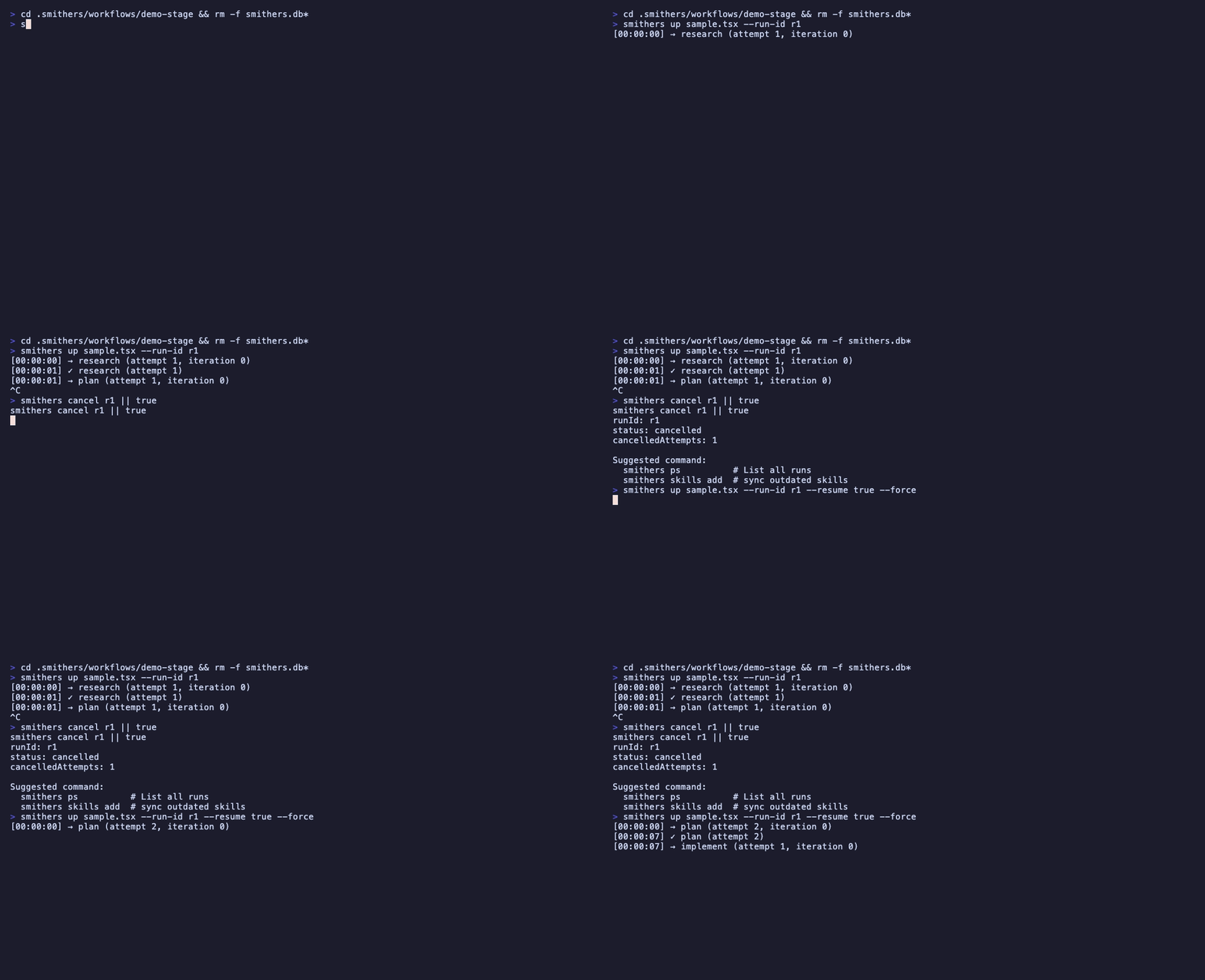
bunx smithers-orchestrator up workflow.tsx --input '{"description":"Fix bug"}'
bunx smithers-orchestrator up workflow.tsx --run-id abc123 --resume true   # resume after a crash
bunx smithers-orchestrator rewind abc123 --frame 4                          # time-travel to an earlier frame
bunx smithers-orchestrator fork abc123                                      # branch an alternate timeline
bunx smithers-orchestrator replay abc123                                    # replay from a checkpoint
Drive and watch your runs
Prefer the CLI? The seeded workflows run directly, and whether your agent started a run or
you did, you can see exactly what's happening:
bunx smithers-orchestrator workflow run hello   # smallest possible run; prompt lives at .smithers/prompts/hello.mdx
bunx smithers-orchestrator workflow run plan --prompt "add rate limiting and API key rotation"

bunx smithers-orchestrator ps              # list active, paused, and recently completed runs
bunx smithers-orchestrator inspect RUN_ID  # steps, agents, approvals, and outputs for one run
bunx smithers-orchestrator logs RUN_ID     # tail the event log
bunx smithers-orchestrator chat RUN_ID     # read the agent's chat output
ps shows you what needs attention (a paused approval, a recent failure); inspect drills
into a single run so you can follow each step and agent as it works. Runbunx smithers-orchestrator starters to browse plain-English starters.
Any agent, any model
Smithers doesn't bet on one lab or one harness. Point a task at whichever agent is best for
the job, mix several in one workflow, and switch freely. The workflow doesn't change when
the model does, so a frontier model can plan, a fast model can fan out, and a specialized
harness can do the edits.
Agents that run tasks
| Agent | How it runs |
|---|---|
| Claude Code | CLI harness |
| Codex | CLI harness |
| Pi | CLI harness |
| Antigravity | CLI harness |
| Any AI SDK model | SDK agent, with tools, structured output, and MCP |
Sandboxes that isolate them
The same <Sandbox> primitive runs an agent locally or on a remote provider with no change
to the workflow:
| Target | Notes |
|---|---|
| Local | default; syscall-isolated via Bubblewrap or Docker |
| Docker | containerized execution on your machine or CI |
| Freestyle | managed remote sandbox (see the example provider) |
| Bring-your-own | implement the SandboxProvider interface for any backend (gVisor, Kubernetes, Daytona, Cloudflare, …) |
Beyond init, bunx smithers-orchestrator mcp add also wires the MCP
server into Cursor, Copilot, Hermes, OpenClaw, and ~20 more coding agents.
Built-in workflows
bunx smithers-orchestrator init installs a pack of ready-to-run workflows: implement,plan, research, review, debug, tickets-create, kanban, mission, grill-me,improve-test-coverage, audit, research-plan-implement, and more. Point your agent at
one, or run it yourself:
bunx smithers-orchestrator workflow run implement --prompt "add rate limiting"
See docs/workflows/ for the full pack.
Examples
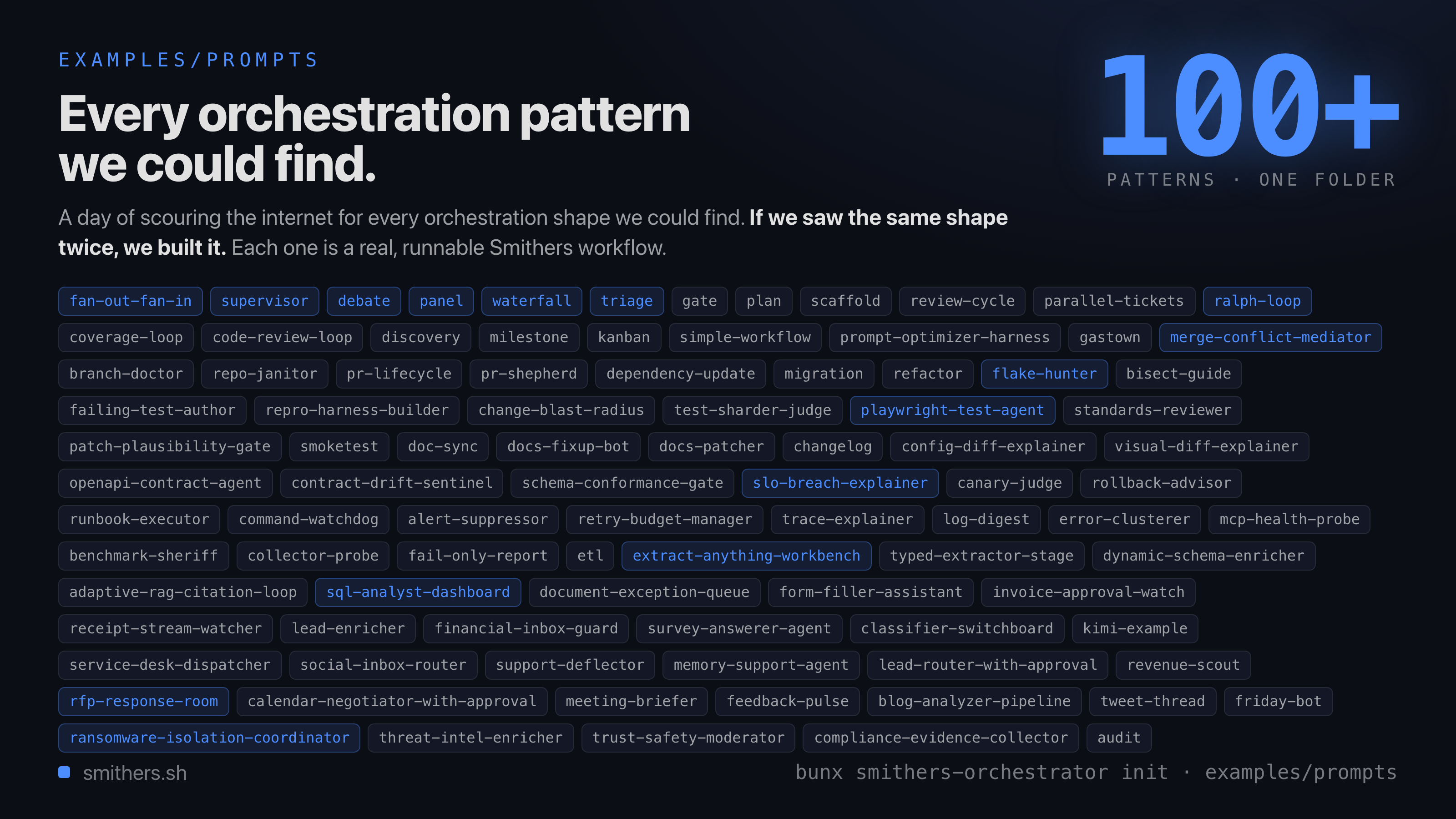
The examples/ folder has 100+ runnable workflows, one per orchestration
pattern. Copy one as a starting point:
| Example | Pattern |
|---|---|
code-review-loop |
Implement → review → fix, looped until approved. |
parallel-tickets |
Triage, run waves of work in parallel, merge-queue the results. |
supervisor |
A boss agent plans and delegates to workers dynamically. |
playwright-test-agent |
Plan E2E flows, generate Playwright tests, run/heal until stable. |
sql-analyst-dashboard |
Discover schema, check read-only SQL, execute, summarize with a chart. |
The folder also covers panels, debates, migrations, RAG citation loops, canary judging,
SLO-breach explainers, repo janitors, and dozens more. Browse the full set inexamples/.
Components
The examples above use a handful of primitives from a much larger set:
| Component | Purpose |
|---|---|
<Workflow> |
Root container |
<Task> |
AI or static task node |
<Sequence> |
Ordered execution |
<Parallel> |
Concurrent execution |
<Branch> |
Conditional execution |
<Loop> |
Repeat tasks until a condition is met |
There are many more: approvals, worktrees, merge queues, sub-workflows, signals, timers,
sagas, and composite patterns. See Components.
Also in the box
Smithers is built for agents that modify real repositories, so control is wired into the
runtime:
- Approvals: gate destructive or risky steps behind a human
approve/denybefore
they run. - Inspectable and reversible: every step, tool call, and output is persisted and
replayable;rewind,fork, orreplayany run from a checkpoint instead of living
with whatever the agent left behind. - Isolated: run agents in a sandbox (Bubblewrap, Docker, or a
bring-your-own remote provider) so edits never touch your host. - Observability: every run emits Prometheus metrics and OpenTelemetry traces. Bring up
the local stack withbunx smithers-orchestrator observability --detach(Grafana, Prometheus, Tempo, OTLP
collector) and serve metrics withbunx smithers-orchestrator up workflow.tsx --serve --metrics. - Evals: run repeatable workflow regressions from JSON/JSONL cases with
bunx smithers-orchestrator eval workflow.tsx --cases evals/smoke.jsonl --suite smoke; the command exits
non-zero when any case fails. - Prompt optimization: run GEPA-style optimization against an eval suite with
bunx smithers-orchestrator optimize, which writes an optimized prompt artifact only when the score
improves. - Hot reload: edit prompts, config, agent settings, or JSX structure mid-run with
bunx smithers-orchestrator up workflow.tsx --hot. In-flight tasks finish on their original code; only
newly scheduled tasks pick up changes.
Read next
- Tour: build a real code-review workflow in six steps.
- Install the agent skill: make your coding agent fluent in Smithers.
- How It Works: the durable execution model.
- Components: the full primitive set.
- Awesome Smithers: community projects, workflow packs, examples, and integrations.
Docs
Full documentation lives at smithers.sh.
License
MIT
Yorumlar (0)
Yorum birakmak icin giris yap.
Yorum birakSonuc bulunamadi