awesome-claude-output-styles
Health Gecti
- License — License: NOASSERTION
- Description — Repository has a description
- Active repo — Last push 0 days ago
- Community trust — 15 GitHub stars
Code Uyari
- network request — Outbound network request in install.sh
Permissions Gecti
- Permissions — No dangerous permissions requested
Bu listing icin henuz AI raporu yok.
Make Claude talk like a human: 17 installable output styles for Claude Code, built on credited methodologies
awesome-claude-output-styles
same brain. nineteen mouths.
Make Claude talk like a human. 19 installable output styles for Claude Code,
each distilled from a credited author's methodology — from Boeing-manual English
to the Minto Pyramid to bedtime stories. One curl to install and switch.




See it · Install · The styles · Make your own · Design rules · Catalog
Output styles are the right layer for fixing Claude's voice: they rewrite the
system prompt itself and reframe the agent's identity around your voice —
unlike CLAUDE.md rules, which are injected as context alongside everything
else. Every style here mirrors the exact structure of Anthropic's built-in
styles (identity line, Style Active marker, procedural rules), and the
optional --enforce hook gives them the same per-turn reminder the built-ins
get from the harness. One markdown file each, correct 2026 frontmatter,
MIT-licensed, with the original author credited in the table below.
Why
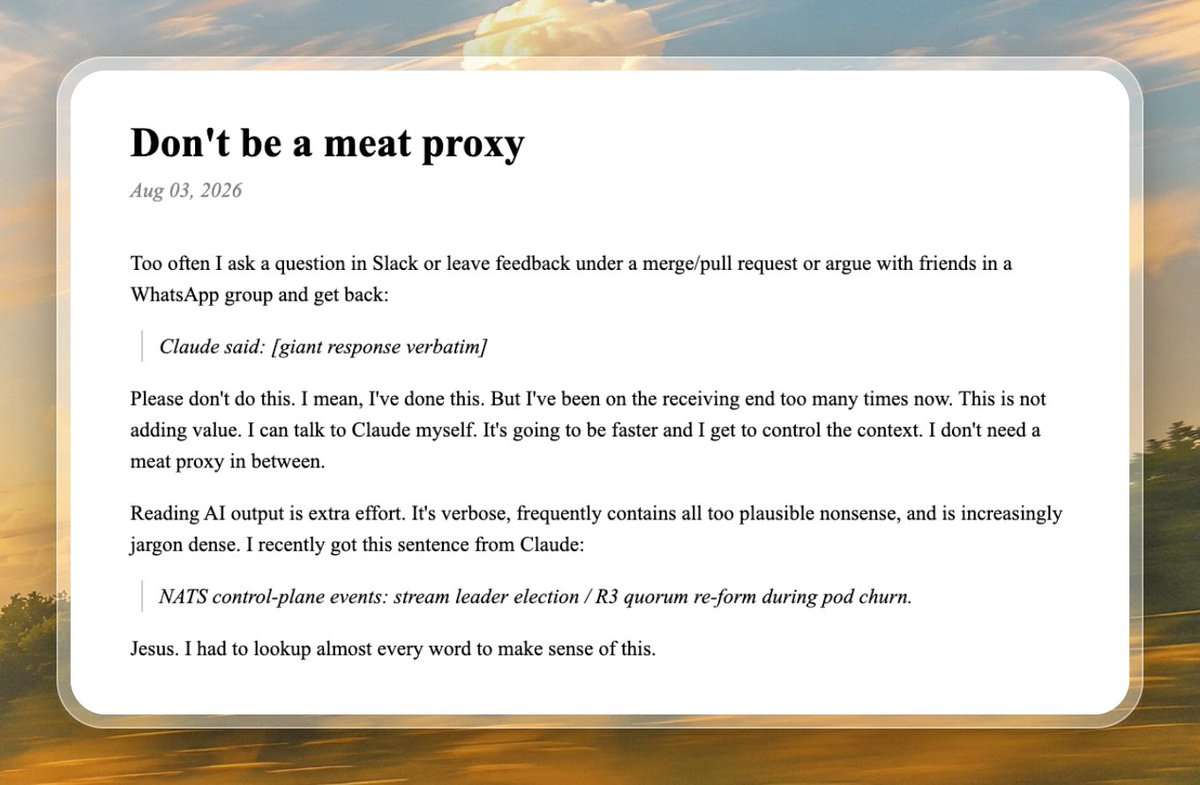
Niklas Gruhn, "Don't be a meat proxy" · as shared by Josh (@joshtriedcoding)
Jesus. I had to lookup almost every word to make sense of this.
He's not alone — the August 2026 complaint threads run hundreds of upvotes,
and the word "Claudisms" now has its own field guide.
The model is brilliant; the register is exhausting. Pick a voice below and fix
it in one command.
Before / after
Real, unedited Opus 5 voice, July 2026 threads:
The reason your React component is re-rendering is likely because you're
creating a new object reference on each render cycle, which breaks React's
referential equality check, so you may want to consider memoization…
The same answer, six voices:
| Voice | Same answer |
|---|---|
|
|
|
|
|
|
|
|
|
|
|
|
|
|
|
|
|
|
┌──────────────────────────────────────────────────┐
│  styles                          19              │
│  credited authors & standards    20+             │
│  code touched by any persona     never           │
│  jargon left unexplained         0, by spec      │
└──────────────────────────────────────────────────┘
Install
One style (installs and activates it):
curl -fsSL https://raw.githubusercontent.com/smixs/awesome-claude-output-styles/main/install.sh | bash -s -- eli15
Everything (installs all 19 + the style-maker skill; activate later via /config):
curl -fsSL https://raw.githubusercontent.com/smixs/awesome-claude-output-styles/main/install.sh | bash -s -- --all
After install — 3 steps. Styles only load at session start, so nothing
changes until you restart Claude Code:
- Restart Claude Code (or run
/clear). - Type
/configand find the Output style setting. - Pick the style you want from the list. Done — Claude answers in that voice
from the next message on.
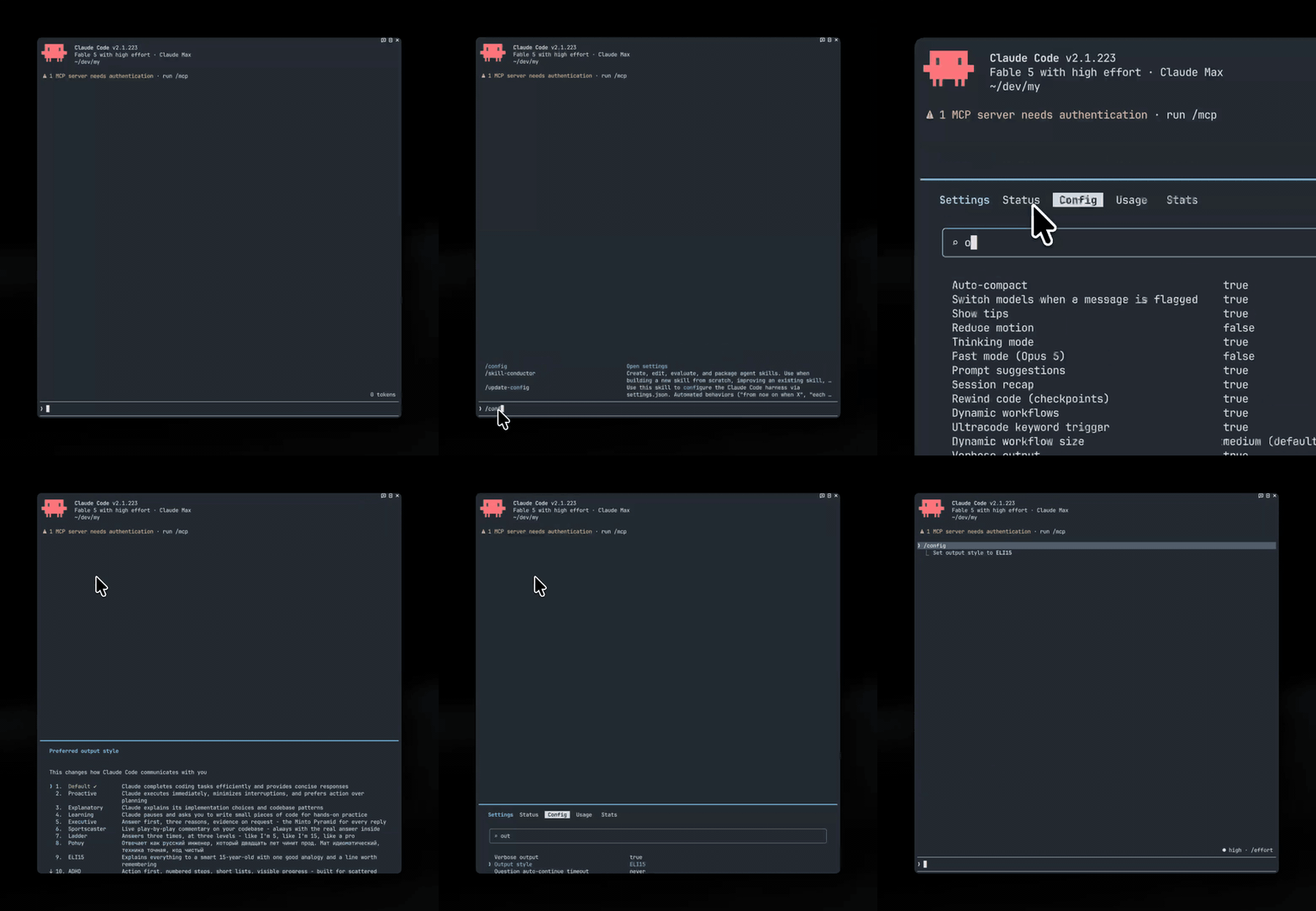
If you installed a single style, it's already selected — you only need step 1.
Switching back: /config → Output style → Default.
[!TIP]
The old/output-stylecommand was removed in Claude Code v2.1.91 — most
guides online still mention it and are outdated./configis the way.
Make it stick: --enforce
Claude Code reminds itself about its built-in styles every single turn
("Explanatory output style is active. Remember to follow…") — but never about
custom ones, so custom voices fade over a long session. Add --enforce to any
install command and a tinyUserPromptSubmit hook replicates that exact
reminder for whatever style you have active:
curl -fsSL https://raw.githubusercontent.com/smixs/awesome-claude-output-styles/main/install.sh | bash -s -- eli15 --enforce
The hook is silent for built-in styles (no double reminders) and fordefault. Remove it anytime by deleting the entry from~/.claude/settings.json → hooks.UserPromptSubmit.
The styles
Understand — for explaining to humans
| Style | What it does | Method · author |
|---|---|---|
wait-what |
Context first, Simplified Technical English, your project's own vocabulary | Matt Pocock (@mattpocockuk) — his wait-what skill as an always-on style |
plain-english |
≤20-word sentences, one word one meaning, active voice | ASD-STE100 (aerospace, 1983) · Amin Boulegroun |
eli15 |
Smart-teenager explanations: one analogy, its breaking point, a line to remember | ELI5 prompt research · r/explainlikeimfive house rules |
analogy-engine |
One sustained analogy with part-by-part mapping | IEEE ProComm · Reijnierse et al. (JCOM 2025) · CMU metaphor checklist |
feynman |
Teaches, names the hard part, checks understanding with questions | Richard Feynman's technique |
thing-explainer |
Only the ten hundred most common words | Randall Munroe (xkcd, Thing Explainer) |
ladder |
Every answer at 3 levels: like I'm 5 → 15 → pro | the classic r/PromptEngineering pattern |
Business — for decision-makers
| Style | What it does | Method · author |
|---|---|---|
executive |
Answer first, ≤3 reasons, evidence on request | Barbara Minto's Pyramid Principle · BLUF · Sruthi Reddy · Joe Cotellese (@jcotellese) |
smart-brevity |
6-word tease, "Why it matters:", "Go deeper:" | Smart Brevity · Jim VandeHei, Mike Allen, Roy Schwartz (Axios) |
coach |
One note, one image, one next action | Hemingway App rules · Paul Graham's "Write Like You Talk" · Hardik Pandya (@hvpandya) |
Terse — for speed
| Style | What it does | Method · author |
|---|---|---|
caveman |
Ultra-compact: same signal, all fluff dropped | Julius Brussee (@julius_brussee) · Carlos Duplar Mello |
adhd |
Action first, numbered steps, lists ≤5, visible progress | Ayoub Ghriss · Ramsay & Rostain (The Adult ADHD Tool Kit) |
no-slop |
A plain, specific human voice — the anti-Claudism style | Siqi Chen (@blader) · Conor Bronsdon (@ConorBronsdon) · Joe Cotellese's generic-sentence test |
no-ai-slop |
Direct, opinionated, zero filler — slop removed at the source | Peter Yang (@petergyang) — his editing principles as Claude's default voice |
Fun — personas that still get it right
| Style | What it does | Method · author |
|---|---|---|
street |
Sharp senior engineer in modern street slang. 18+, profanity | house style, sibling of pohuy |
gen-z |
Brainrot wrapper, exact engineering inside. Slang dated by design | Anirudh Konidala · Steve Nims |
sportscaster |
Live play-by-play on your codebase | STAA Play-by-Play Pyramid · broadcasters' craft rules |
yoda |
Plain answer first; the closing lesson, inverted it is | house style |
bedtime-story |
Concepts as tiny calming stories, real mechanism inside | house style |
Make your own: style-maker
Presets not fitting? Install the interview skill:
curl -fsSL https://raw.githubusercontent.com/smixs/awesome-claude-output-styles/main/install.sh | bash -s -- style-maker
Then tell Claude "make my output style". It asks ~10 questions (audience,
length, jargon level, tone, samples of writing you like and hate), generates
a personal style file following this repo's conventions — countable specs,
positive framing, safety guardrails — shows you a live demo, and activates it.
Shared design rules
Every style in this hub follows the same conventions
(full authoring guide: docs/format-guide.md):
- Specs, not adjectives. "No sentence over 20 words" is checkable;
"be clear" is not. - Positive framing. Styles describe the voice they want. Ban lists summon
the banned patterns — so the Claudism list lives
in docs for humans, not inside prompts. - Byte-exact guardrails. Code, commands, error messages, file paths, and
numbers are never stylized. Every persona shuts off for security warnings,
destructive-action confirmations, and order-critical instructions. - Cut ceremony, not reasoning. Styles shrink the wrapper, never the
"why". keep-coding-instructions: trueeverywhere — the engineering stays intact.
The wider catalog
Original-author projects worth knowing, beyond what's adapted here:
- mattpocock/skills — Matt Pocock
(@mattpocockuk):wait-what, the four-line
re-pitch panic button, andwriting-for-agents, the best methodology for
writing agent-consumed docs. Install from his repo. - JuliusBrussee/caveman — Julius
Brussee (@julius_brussee): the original,
with six intensity levels, 30+ agent integrations and real benchmarks. - ayghri/i-have-adhd — Ayoub Ghriss:
the top community answer to Opus 5 verbosity. - AminBlg/SimpleEnglish — Amin
Boulegroun: ASD-STE100 enforcement with a deterministic linter. - blader/humanizer — Siqi Chen
(@blader): the definitive AI-writing-pattern
remover (33 patterns, self-audit loop). - petergyang/no-ai-slop — Peter
Yang (@petergyang): 20+ slop patterns with a
voice-preservation-first stance and a self-check eval the skill runs on its
own output. - hardikpandya/stop-slop —
Hardik Pandya (@hvpandya): 8 rules plus a
50-point scoring rubric. - conorbronsdon/avoid-ai-writing
— Conor Bronsdon (@ConorBronsdon): the most
rigorous pattern catalog (61 categories, severity tiers). - nattergabriel/claude-code-output-styles —
13 well-crafted styles (Socratic, Roast, Ship It…). - hesreallyhim/awesome-claude-code —
the canonical Claude Code index, with an Output Styles category.
Sister project
pohuy — the Russian profanity output
style that started this collection. Same guardrails, four roots, 18+.
Star this repo
If one of these voices saved you a re-read, a star helps the next person find
it — and helps the credited authors get found too. ⭐
Contributing
PRs welcome. One style per PR, following
docs/format-guide.md: built-in prompt structure
(identity line, Style Active header), countable specs, positive framing,
the shared guardrails block, one positive example, a verify clause, credits
in docs/CREDITS.md — not in the style body. If you're the
original author of a methodology we adapted and want changes — open an issue,
you outrank us.
License
MIT. Adapted styles preserve their sources' copyright notices; see
docs/CREDITS.md and the catalog tables above.
Docs: Format guide · Claudisms field guide · style-maker · Issues
Also by smixs: pohuy — Russian profanity output style · visual-skills — image prompting skills
MIT — the voices are free; the credit stays with their authors.
Yorumlar (0)
Yorum birakmak icin giris yap.
Yorum birakSonuc bulunamadi