framewright
Health Warn
- License — License: MIT
- Description — Repository has a description
- Active repo — Last push 0 days ago
- Low visibility — Only 9 GitHub stars
Code Fail
- fs module — File system access in .agents/skills/framewright/scripts/doctor.sh
- process.env — Environment variable access in .agents/skills/framewright/scripts/export-curves.mjs
- process.env — Environment variable access in .agents/skills/framewright/scripts/inject.mjs
- process.env — Environment variable access in .agents/skills/framewright/scripts/look.mjs
- rm -rf — Recursive force deletion command in .agents/skills/framewright/scripts/make.sh
- process.env — Environment variable access in .agents/skills/framewright/scripts/render.mjs
Permissions Pass
- Permissions — No dangerous permissions requested
No AI report is available for this listing yet.
Agent skill + template: short videos made entirely from code. One HTML file, every frame a pure function of (frame, seed, width). Claude Code, Codex, Gemini CLI, Cursor.
framewright






An agent skill and a project template for short videos made entirely from code.
One HTML file. Every frame is a pure function of (frame number, seed, width).
Rendered with headless Chrome, assembled with ffmpeg, scored by a script. No footage, no images, no CDN.

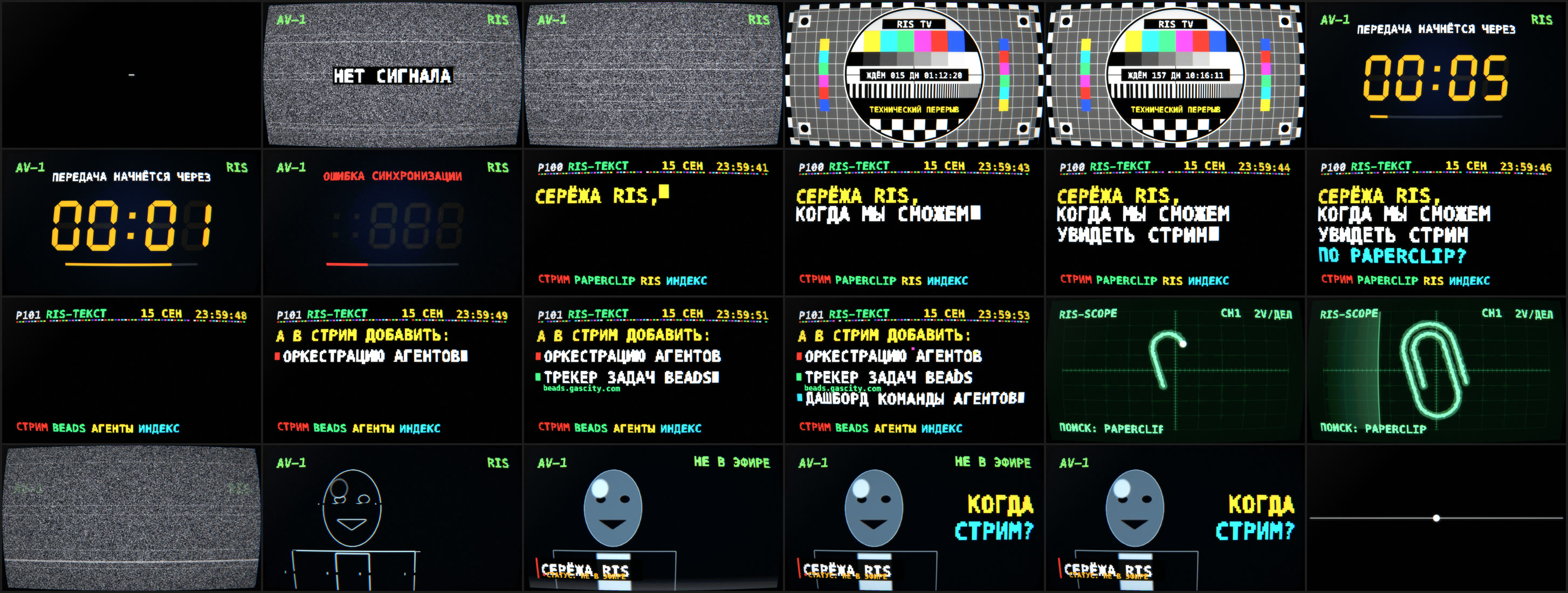
The example: 40 seconds, 8 scenes, 1200 frames, one 45 KB HTML file. The portrait scene in the public example uses a synthetic placeholder. Full MP4 with sound: ris-tv-sample.mp4 (27 MB).
What it does
You describe the video you want. The agent runs a short interactive brief, proposes three
concepts (a literal one, a metaphor, a genre parody), agrees a storyboard on a beat grid,
then builds the video scene by scene, looking at rendered frames after every step. It renders
the frames, synthesizes a soundtrack to the locked scene lengths, assembles the MP4 and
checks the file. Photos become posterized polygons, never pixels. Every step has a visual
checkpoint and a rule against guessing.
For a film without cuts it builds one continuous world instead of separate scenes: a line that
remembers when each of its points was drawn, a camera on keyframes with even zooms and smooth
following, a light layer with bloom, and a soundtrack that follows the line's speed and position
on screen.
| Step | What the agent does | What you see |
|---|---|---|
| 0 | checks node, ffmpeg, Chrome, python; offers to install what is missing | a short report |
| 1 | the brief: message, format, length, tone, style, assets, sound, deliverables | 8–11 questions with defaults |
| 2 | three concepts with palette, key scenes, ending, sound and risk | a table and a recommendation |
| 3 | storyboard in bars, scaffold from the skeleton, first frame | one "go" |
| 4 | one scene at a time, three frames per scene, a contact sheet every 2–3 scenes | contact sheets |
| 5 | photos traced into polygons, placeholders until files arrive | a portrait preview |
| 6 | full contact sheet, render in parallel tabs, encode, verify from the MP4 | a preview MP4 |
| 7 | soundtrack synthesized to the cue map, MP4 rebuilt | the final MP4 |
| 8 | variations on request: another seed, vertical cut, GIF, poster frame | files |
Quick start
Option 1: clone and run your agent inside
git clone https://github.com/smwbev/framewright my-video
cd my-video
npm install
claude        # or: codex, gemini, cursor, opencode ...
Then say what you want, for example: "a 20-second deadpan video asking Anna when the
release ships, retro TV style". The agent picks up AGENTS.md, loads the skill and starts
with the brief.
Option 2: add the skill to your own project
npx skills add smwbev/framewright          # installs into the agents you choose
gemini skills install https://github.com/smwbev/framewright --path .agents/skills/framewright --consent   # Gemini CLI
Or copy .agents/skills/framewright into your project. Claude Code reads.claude/skills/, so add a symlink or copy there.
Supported agents
| Agent | How it picks the skill up |
|---|---|
| Claude Code | .claude/skills/framewright (symlink to the skill); CLAUDE.md imports AGENTS.md; invoke with /framewright |
| OpenAI Codex | reads AGENTS.md and .agents/skills/ natively; $framewright |
| Gemini CLI | .gemini/settings.json points at AGENTS.md; skills from .agents/skills/ |
| Cursor | AGENTS.md and .agents/skills/ natively |
| GitHub Copilot coding agent | AGENTS.md and .agents/skills/ natively |
| OpenCode, Amp, Zed, Warp, Factory, Cline, Roo, Windsurf | AGENTS.md; most read .agents/skills/ too |
| anything else | point it at .agents/skills/framewright/SKILL.md |
The skill follows the Agent Skills specification: SKILL.md with
frontmatter, references/ loaded on demand, scripts/ and assets/.
Requirements
Node 20+, npm, ffmpeg with libx264, Chrome via Puppeteer (installed by npm install).
Python 3 with numpy, scipy and Pillow only if a photo will be traced. macOS and Linux;
Windows through WSL.
bash .agents/skills/framewright/scripts/doctor.sh            # report
bash .agents/skills/framewright/scripts/doctor.sh --install  # install what is missing, asks first
Repository layout
AGENTS.md                      entry point for agents
CLAUDE.md, GEMINI.md           one-line imports of AGENTS.md
.gemini/settings.json          Gemini CLI reads AGENTS.md
.agents/skills/framewright/
  SKILL.md                     the workflow
  references/                  questionnaire and concept generator, styles, engine guide, one-world films, audio, photo, troubleshooting
  scripts/                     doctor, init, look, render, build, make, export-curves, trace, inject, portrait
  assets/                      skeleton.html, world.html, audio-template.mjs, storyboard.md
.claude/skills/framewright     symlink for Claude Code
examples/ris-tv/               a finished video: index.html, audio.mjs, previews
The example
examples/ris-tv is a complete 40-second video in the retro TV style: the set powers on,
snow and NO SIGNAL, a test card with a day counter, a countdown that breaks, two teletext
pages with the question, an oscilloscope tracing a paperclip, a portrait that locks in, and
the tube switching off. Render a contact sheet of it:
npm install
npm run example        # writes shots/example-sheet.png
Or render the whole thing: HTML=examples/ris-tv/index.html node .agents/skills/framewright/scripts/render.mjs frames 7 1920 5,
then cd examples/ris-tv && node audio.mjs ../../track.wav, then bash .agents/skills/framewright/scripts/build.sh out.mp4.
Making videos by hand
The skill is also a manual. references/guide.md explains the engine, the helpers, the
timing grid and the review protocol; references/styles.md catalogues twelve visual systems
with post-processing recipes; references/world.md covers films made as one continuous world;references/audio.md and references/photo.md cover sound and portraits.assets/skeleton.html and assets/world.html are working starting points: open one in a
browser for a live preview, add ?f=30&w=1200 for a single frame, ?grid=24 for a contact sheet.
License
MIT. Videos you make with it are yours.
Reviews (0)
Sign in to leave a review.
Leave a reviewNo results found