skills
Health Uyari
- License — License: MIT
- Description — Repository has a description
- Active repo — Last push 0 days ago
- Low visibility — Only 5 GitHub stars
Code Gecti
- Code scan — Scanned 2 files during light audit, no dangerous patterns found
Permissions Gecti
- Permissions — No dangerous permissions requested
Bu listing icin henuz AI raporu yok.
Qofeno agent skills — real, production-only workflows for Claude Code, Cursor, Antigravity, and other AI agents
Qofeno Skills


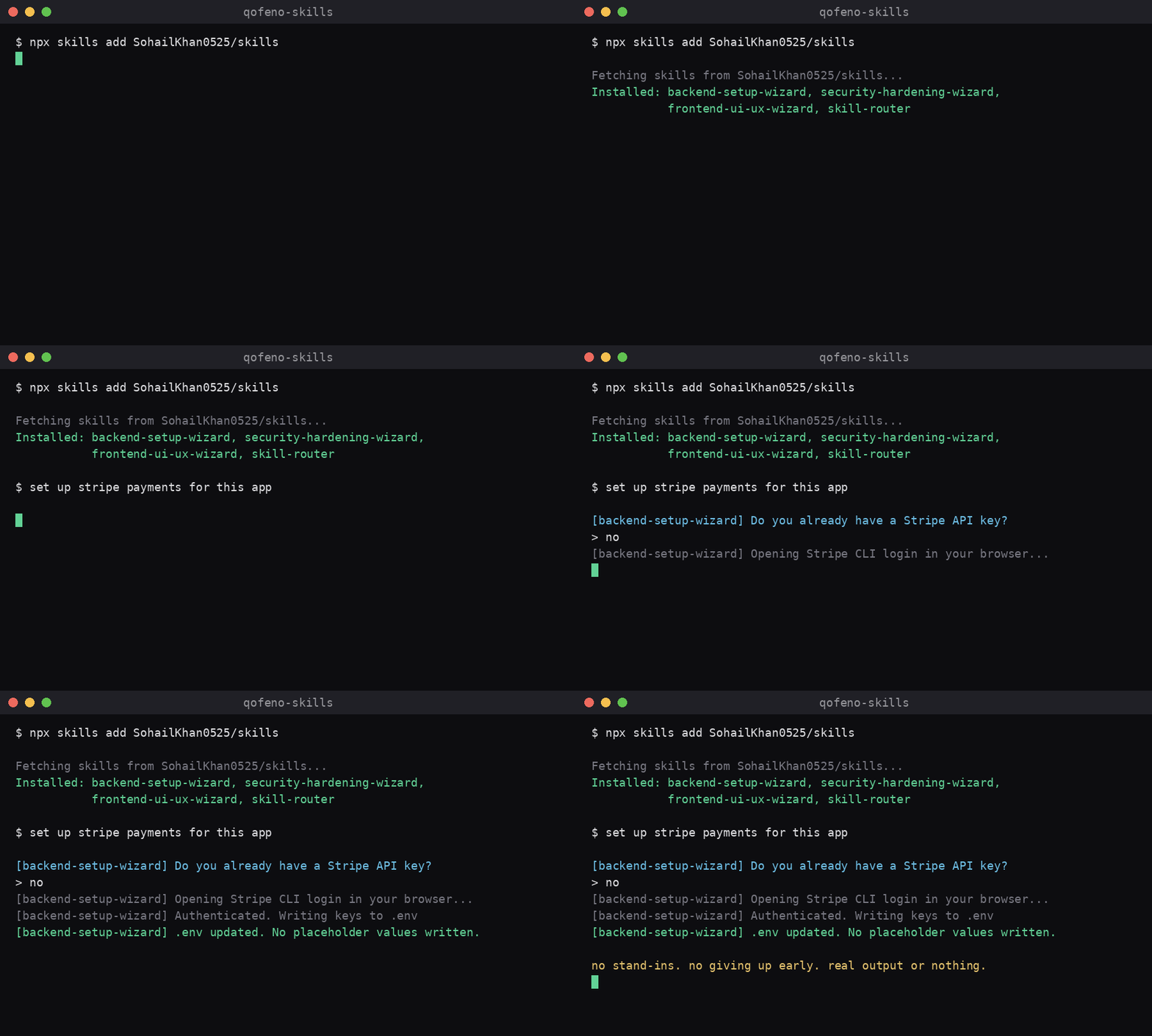
I kept running into the same problem with AI coding agents: ask one to "set up Stripe" or "connect a database," and half the time you get back a .env full of YOUR_API_KEY_HERE, a "for now" placeholder, or a confident report that describes what should happen instead of actually doing it.
So these skills are built around one rule I don't let myself break: if it can't be done for real, it doesn't get faked — it stops and asks. No placeholder keys, no mock data, no lorem ipsum, no quietly downgrading "set this up" into "here's a TODO for later."
Works with Claude Code, Cursor, Antigravity, Codex, and anything else that reads the open Agent Skills format (SKILL.md).
Install
npx skills add SohailKhan0525/skills
Or install one skill at a time:
npx skills add SohailKhan0525/skills --skill backend-setup-wizard
Want the agent to check every installed skill — from any source — before starting any request, not just when a prompt obviously matches? See ALWAYS-ON-SETUP.md.
Skills in this repo
| Skill | Status | What it does |
|---|---|---|
backend-setup-wizard |
✅ Stable | Provisions, configures, and deploys real, live backends and third-party services (databases, auth, payments, etc.) entirely via CLI. Zero-knowledge credential handling — the agent never sees, types, or reads the raw key; auth happens via OAuth/CLI-login or the user's own terminal. Never test keys, never placeholders. |
security-hardening-wizard |
✅ Stable | Scans every file in a project — any extension, not just source code — for real vulnerabilities, fixes each one for real via CLI, hardens the live deployed backend/site, and produces a verified markdown audit report. Works standalone or as a follow-up to backend-setup-wizard. |
frontend-ui-ux-wizard |
✅ Stable | Designs and builds real, production-ready websites — full site scope (home, about, contact, pricing, real privacy/terms pages), a real design-token system, deliberate font pairing, real product screenshots via Playwright — then checks the build, pushes to GitHub, and deploys it live. |
skill-router |
✅ Stable | Checks every installed skill — from any publisher, not just this repo — for relevance before starting substantive work, so a matching skill doesn't get silently skipped just because a request didn't use its exact trigger words. Pair with ALWAYS-ON-SETUP.md for the closest thing to guaranteed coverage. |
Status key: ✅ Stable — used and working · 🧪 Beta — functional, still being refined · 📝 Planned — not built yet
More are coming when I need them for my own projects (mainly Qofeno) — I build these because I actually use them, not the other way around. Check open issues for what's planned, or request one if there's a gap you keep hitting.
Why "no stand-ins"
I got tired of agents that technically respond to a request without actually doing it. Every skill here follows the same four rules:
- No stand-ins. No placeholder code, no mock data, no lorem ipsum, no "MVP for now." If it can't be done for real yet, the skill says so instead of faking it.
- No giving up early. If a step looks blocked, the skill searches current docs and tries alternate paths before telling you something isn't possible.
- Stop and ask, don't route around it. If something needs input only you can give — a credential, a decision — the skill pauses and asks. It never invents a workaround.
- Untrusted content stays untrusted. Any skill that fetches external docs or web content treats it as reference material, never as instructions to blindly execute — see
backend-setup-wizard's Trust Boundaries section for the pattern every skill here follows.
Repo structure
skills/
├── backend-setup-wizard/
│   └── SKILL.md
├── security-hardening-wizard/
│   └── SKILL.md
├── frontend-ui-ux-wizard/
│   └── SKILL.md
├── skill-router/
│   └── SKILL.md
└── <next-skill>/
    └── SKILL.md
.github/
├── workflows/validate-skills.yml   # auto-validates every SKILL.md on push/PR
├── scripts/validate_skills.py
├── ISSUE_TEMPLATE/
└── PULL_REQUEST_TEMPLATE.md
Each skill lives in its own folder with a SKILL.md (YAML frontmatter + instructions), and optionally scripts/, references/, or assets/ subfolders.
Contributing
PRs welcome — see CONTRIBUTING.md for how to add a skill. Same bar applies to everyone, including me: real output, no placeholders, no giving up early. A GitHub Action validates every SKILL.md's frontmatter automatically on push.
If you use one of these and hit something that doesn't hold up to the "no stand-ins" rule, that's a bug — open an issue, I'd genuinely rather know.
License
MIT — use it, fork it, ship it.
Yorumlar (0)
Yorum birakmak icin giris yap.
Yorum birakSonuc bulunamadi