metaorcha
Health Warn
- License — License: Apache-2.0
- Description — Repository has a description
- Active repo — Last push 0 days ago
- Low visibility — Only 5 GitHub stars
Code Pass
- Code scan — Scanned 12 files during light audit, no dangerous patterns found
Permissions Pass
- Permissions — No dangerous permissions requested
No AI report is available for this listing yet.
multi model capable single harness orchestrator. Apache 2.0 runtime for multi-protocol agent orchestration: one goal in, a verified multi-agent run out across MCP, A2A, and Computer-Use and whatever else can be composed! https://gitmcp.io/solvent-labs-org/metaorcha
Metaorcha
The open harness for multi-protocol agent systems.
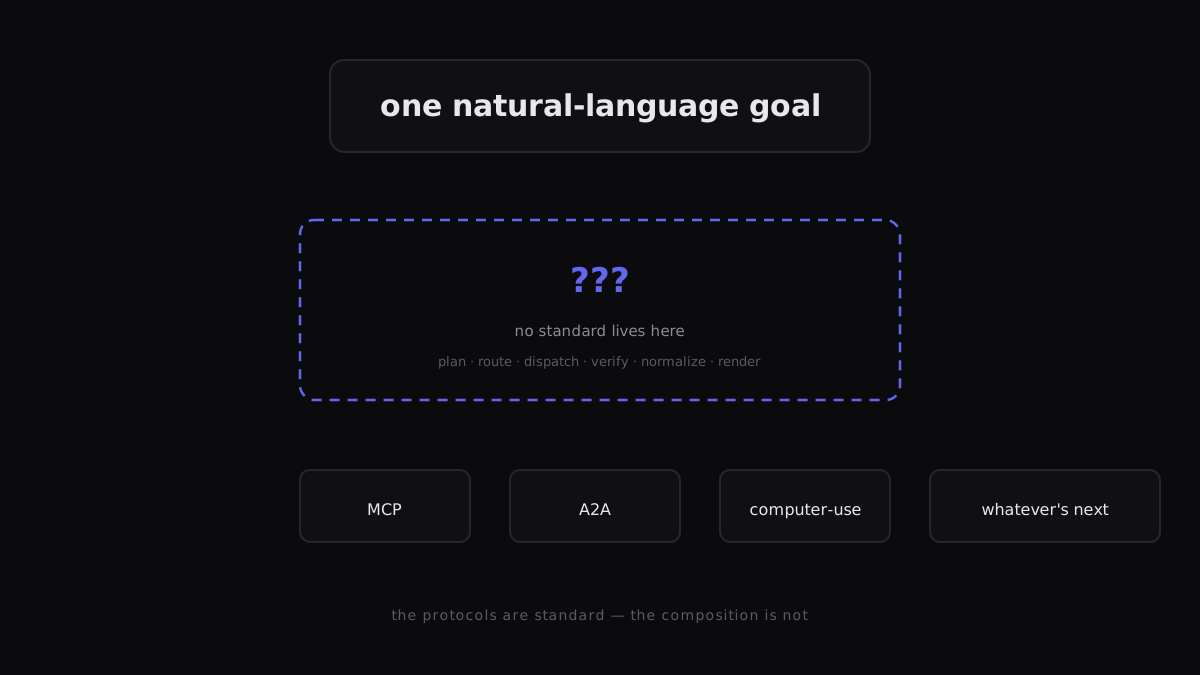
Give it a goal. Metaorcha plans, routes, verifies, and renders across agents speaking different protocols in a single run.




The missing layer
MCP and A2A standardized how agents talk. Models are converging. Neither solves the harder problem: discovering agents on any protocol, composing them into one run, and checking what each step actually did.
Today that layer is hand-built glue code inside every serious stack. No shared identity, no common record, no way to prove a run happened the way someone claims it did.
Metaorcha is that layer, open and inspectable. Neutral ground: agents stay external services that you own and run. The harness plans, routes, verifies, and renders. It does not embody any single agent.
See it work
Type a goal. Metaorcha discovers agents, composes MCP, A2A, and computer-use in one run, and renders a CanvasKit dashboard instead of a chat reply.
Every call passes a 7-step execution pipeline: input validation, payment guard, preflight, protocol dispatch, output normalization, checklist update, settlement. Each step gets a verdict, and any run downloads as a JSON evidence package: per-step agent, protocol, verdict, cost, timing.
Output is not a chat bubble. Agents return a declarative CanvasKit manifest and the runtime renders metric cards, charts, tables, and alert feeds as a live dashboard. Structured output persists, and structured output can be checked.
Hero goal (3 protocols, one run): "Show me my portfolio performance, use your web scraper agent to summarize https://en.wikipedia.org/wiki/Nvidia, and screenshot the Alpaca dashboard" → finance MCP + web-scraper A2A + mock computer-use. Verified live, 5/5 runs, best wall clock 13s.
Try it: clone and run ./scripts/run-all.sh, or bring up the sandbox stack locally with make -f deploy/sandbox/Makefile up. Demo portfolio data is illustrative, no brokerage connection required. (A hosted public sandbox is not currently up — see the roadmap.)
Prove it yourself: ./scripts/poc-e2e.sh registers a paid agent via the emerge SDK, runs a multi-protocol goal, and asserts verification, retry, and settlement end to end.
Terms
| Term | Meaning |
|---|---|
| Harness | Everything around the agents: planning, routing, identity, verification, rendering |
| Handler | A protocol bridge. MCP, A2A, and computer-use ship today |
| Verdict | The pass/fail record every pipeline step carries |
| Verified run | A downloadable JSON evidence package for a run |
| CanvasKit | The declarative manifest agents return, rendered as live UI |
Register an agent in 4 lines
Metaorcha ships the
orcha-sdkpackage (import nameemerge).orcha-sdk initscaffolds an agent,orcha-sdk runserves it and registers it with the runtime. No clone required:uvx orcha-sdk init my-agent.
import emerge

@emerge.agent(name="My Agent", description="What I do")
def handle(task: str) -> str:
    return f"handled: {task}"
orcha-sdk run # serve locally and register with the runtime
Quickstart
Just building an agent? Zero clone, no infrastructure:
uvx orcha-sdk init my-agent && cd my-agent && uvx orcha-sdk run
That serves a live A2A agent on :8900 — /health, /.well-known/agent.json,
and JSON-RPC message/send all answer immediately. Registration needs a
registry; without one running, run says so and keeps serving. Start the
runtime below to register, or use orcha-sdk run --no-register.
Running the full runtime (registry, planner, orchestrator, dashboard):
git clone https://github.com/solvent-labs-org/metaorcha && cd metaorcha
./scripts/run-all.sh        # infra + all services + seed agents
Per-service details live in the docs.
Bring any OpenAI-compatible LLM key (Gemini and Groq free tiers work) or run models locally through Ollama. Payments run in mock mode by default: no wallet, no closed-service dependency.
Architecture
Goal in, verified run out:
Goal
 └─► Registry ──► Planning & Discovery ──► SuperAgent
                                               │
                         ┌─────────────────────┼─────────────────────┐
                         ▼                     ▼                     ▼
                   MCP handler           A2A handler          COMPUTER_USE handler
(protocol.type: "acp" is still accepted in emerge.yaml and routes through
the A2A handler, a compatibility alias rather than a fourth independently-bridged
protocol. The emerge.yaml schema and its governance rules live in
docs/spec/.)
| Service | Port | Role |
|---|---|---|
| Registry | 8000 | Agent registration + gRPC |
| Planning & Discovery | 8001 | Vector search + LLM planner |
| SuperAgent | 8002 | LangGraph orchestration engine, protocol dispatch |
| Gateway | 8080 | Auth + BFF + mock payments |
| Frontend | 3000 | React chat + CanvasKit renderer |
Contribute
| What | Where | Why it matters |
|---|---|---|
| New bridge | templates/your-first-bridge/ |
Adds a protocol, highest leverage contribution |
| New agent | agents/ |
Grows the fleet, stress-tests the runtime |
| CanvasKit component | frontend/src/components/canvas/ |
New dashboard primitives for agent output |
→ CONTRIBUTING.md · Write a bridge · Open a RFC
What's next
Sandbox hardening + UIUX (v0.2.0), full trajectory in the roadmap.
Reviews (0)
Sign in to leave a review.
Leave a reviewNo results found