spec2ship
Health Gecti
- License — License: MIT
- Description — Repository has a description
- Active repo — Last push 0 days ago
- Community trust — 28 GitHub stars
Code Gecti
- Code scan — Scanned 12 files during light audit, no dangerous patterns found
Permissions Gecti
- Permissions — No dangerous permissions requested
Bu listing icin henuz AI raporu yok.
Spec-driven, multi-agent AI development for Claude Code: from specs to shipping via roundtable collaboration
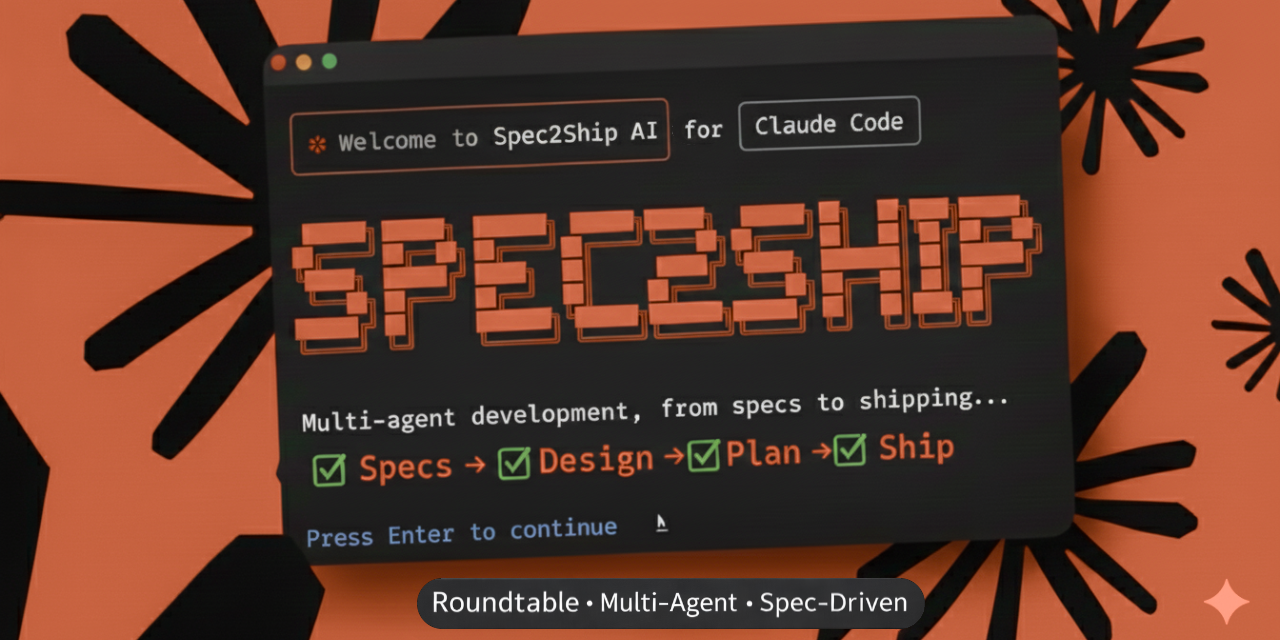
Spec-driven development framework that orchestrates multi-agent workflows on top of Claude Code


🎯 What Spec2Ship Is
Spec2Ship is a Claude Code plugin that adds structured orchestration for requirements, architecture, and implementation planning.
The core idea: instead of prompting Claude Code directly, you run roundtable discussions where multiple agents, each representing a real role, debate and refine decisions collaboratively.
It is:
- A spec-driven framework where specifications are treated as executable intent
- An orchestration layer built on Claude Code primitives
- A deliberation system with configurable facilitation strategies
It is not:
- A standalone CLI or generic tool (requires Claude Code)
- A prompt library or template pack
- A code generator (it produces specs and plans; you write the code)
[!NOTE]
Spec2Ship requires Claude Code to run. It extends Claude Code with structured workflows, not replaces it.
❓ Why Not Just Prompt Claude Code Directly?
When you prompt Claude Code directly for requirements or architecture decisions:
| What happens | The problem |
|---|---|
| Single perspective | Optimized for agreement rather than rigorous challenge |
| No adversarial review | Security gaps, edge cases, feasibility issues missed |
| Freeform output | Hard to review, audit, or hand off to team |
| Ephemeral sessions | Context lost between conversations |
| No structure | Each session starts from scratch |
Spec2Ship solves this by:
- Convening 12 specialized agents with distinct viewpoints
- Enforcing structured discussion via facilitation strategies
- Producing standards-based artifacts (arc42, ISO 25010, MADR)
- Persisting sessions with full audit trail
- Supporting escalation triggers for human review
⚖️ How Spec2Ship Compares
| Aspect | Spec2Ship | Claude-Flow | Spec-Kit | OpenSpec |
|---|---|---|---|---|
| Approach | Multi-agent deliberation | Swarm task execution | Document checkpoints | Lightweight diffs |
| Agents | 12 specialized roles debating | 54+ task workers | Single agent | Single agent |
| Quality mechanism | Adversarial review built-in | Speed optimization | Human review points | Minimal overhead |
| Strategies | 5 facilitation methods | Hierarchical/mesh | Linear | Linear |
| Output | arc42, ISO 25010, MADR | Custom | Markdown | Diff-based |
| Best for | Decisions needing debate | Parallel task execution | Greenfield features | Brownfield changes |
Choose Spec2Ship when:
- Decisions need multiple expert perspectives
- You want adversarial review (security, scalability, edge cases)
- Artifacts must be auditable and standards-based
- You're already using Claude Code
Choose alternatives when:
- Claude-Flow: Parallel execution of many independent tasks
- Spec-Kit: Simple greenfield specs with checkpoint review
- OpenSpec: Incremental changes to existing codebases
🚀 Quick Start
# 1. Add the plugin
/plugin marketplace add spec2ship/spec2ship

# 2. Install it
/plugin install s2s

# 3. Initialize your project
/s2s:init

# 4. Run your first roundtable
/s2s:specs
After /s2s:specs completes, you'll have:
.s2s/sessions/YYYYMMDD-specs-*.yaml: full discussion transcript.s2s/requirements.md: structured requirements with IDs (REQ-001, REQ-002...)
[!TIP]
For your first run, use/s2s:specs --interactiveto pause after each round and see how the discussion unfolds.
🔄 Roundtable: The Core Primitive
Roundtable is the fundamental abstraction of Spec2Ship.
Every major decision flows through a structured discussion:
┌──────────────────────────────────────────────────────────────┐
│                        ROUNDTABLE                            │
│                                                              │
│  FACILITATOR                                                 │
│  ├── Generates questions from agenda                         │
│  ├── Prepares context for each participant                   │
│  └── Synthesizes responses into artifacts                    │
│                                                              │
│  PARTICIPANTS (respond in parallel, blind to each other)     │
│  ┌──────────┐ ┌──────────┐ ┌──────────┐ ┌──────────┐         │
│  │    PM    │ │ Architect│ │ QA Lead  │ │ Security │  ...    │
│  │          │ │          │ │          │ │ Champion │         │
│  │  Value   │ │  System  │ │  Edge    │ │  Threat  │         │
│  │ & scope  │ │  design  │ │  cases   │ │  model   │         │
│  └──────────┘ └──────────┘ └──────────┘ └──────────┘         │
│                                                              │
│  OUTPUT: Numbered artifacts with provenance                  │
│  REQ-001, ARCH-002, CONF-003...                              │
└──────────────────────────────────────────────────────────────┘
Why This Matters
Blind voting: Participants respond without seeing each other. This prevents anchoring, reduces sycophancy, and surfaces genuine disagreements.
Role-based expertise: Each agent anchors to domain principles:
View all 12 specialized agents| Agent | Focus |
|---|---|
| Product Manager | User value, priorities, scope |
| Software Architect | System structure, patterns, scalability |
| Technical Lead | Implementation feasibility, effort |
| QA Lead | Testability, edge cases, acceptance criteria |
| Security Champion | Vulnerabilities, compliance, threat modeling |
| DevOps Engineer | Deployment, monitoring, operational burden |
| UX Researcher | Usability, accessibility, user journeys |
| Business Analyst | Domain rules, use cases, requirements clarity |
| Documentation Specialist | Clarity, completeness, maintainability |
| Claude Code Expert | Platform constraints, best practices |
| OSS Community Manager | Contributor experience, governance |
Concrete output: Not chat transcripts, but structured artifacts:
## REQ-001: User Authentication
**Priority**: Must-have
**Source**: Roundtable 20250117-specs-auth, Round 2
**Acceptance Criteria**:
- User can log in with email/password
- Session expires after 24h inactivity
- Failed attempts rate-limited (5/min)

**Participants**: PM (proposed), Architect (refined), Security (hardened)
**Agreement**: Consensus
Facilitation Strategies
Different decisions need different discussion structures:
| Strategy | Phases | When to use |
|---|---|---|
| Standard | Single round | General input, simple decisions |
| Disney | Dreamer → Realist → Critic | Creative exploration, new features |
| Debate | Opening → Rebuttal → Closing | Trade-offs, technology choices |
| Consensus-Driven | Propose → Refine → Converge | Requirements, team alignment |
| Six Hats | Facts → Emotions → Risks → Benefits → Ideas → Process | Complex decisions needing thorough analysis |
Strategies are auto-detected from topic keywords or explicitly specified:
/s2s:roundtable "new payment flow"           # → Disney (creative keyword)
/s2s:roundtable "REST vs GraphQL"            # → Debate (comparison keyword)
/s2s:design --strategy six-hats              # → Explicit override
📋 Operational Flow
Spec2Ship guides you through a real development pipeline:
┌──────────┐    ┌───────────┐    ┌───────┐    ┌────────┐    ┌──────┐
│   init   │───▶│ brainstorm│───▶│ specs │───▶│ design │───▶│ plan │
│          │    │ (optional)│    │       │    │        │    │      │
│ Analyze  │    │ Explore   │    │ Define│    │ Decide │    │ Break│
│ project  │    │ ideas     │    │ WHAT  │    │ HOW    │    │ down │
└──────────┘    └───────────┘    └───────┘    └────────┘    └──────┘
What happens at each phase
| Command | What runs | What's produced |
|---|---|---|
/s2s:init |
Project analysis | .s2s/CONTEXT.md, config.yaml |
/s2s:brainstorm "topic" |
Disney roundtable | Ideas, risks, mitigations |
/s2s:specs |
Consensus-driven roundtable | requirements.md with REQ-, BR-, NFR-* |
/s2s:design |
Debate roundtable | architecture.md + ADRs with ARCH-, COMP- |
/s2s:plan |
Plan generation | plans/*.md with tasks and dependencies |
Each phase can run independently. Missing prerequisites trigger prompts, not failures.
🤖 Autonomous vs Interactive Mode
Spec2Ship supports both modes. This is a design choice, not a limitation.
Autonomous Mode (default)
Roundtables run end-to-end without interruption:
/s2s:specs # Runs complete requirements roundtable
The facilitator manages all rounds automatically. Results are written to session files for review after completion.
Interactive Mode
Human-in-the-loop when you want control:
/s2s:specs --interactive # Pauses after each round
You review each round's output and can redirect the discussion.
Escalation Triggers
Even in autonomous mode, the system pauses for human input when:
- Low confidence (<50%) on a decision
- Critical keywords: "security vulnerability", "legal requirement", "breaking change"
- Unresolved conflicts after maximum rounds
- Blocking questions that prevent progress
[!IMPORTANT]
Spec2Ship knows when to ask for help. It's not a black-box generator.
[!TIP]
Disable auto-compact for better control. Run/configand set "Auto-compact" tofalse. Auto-compact triggers at ~85% context and may interrupt the facilitator mid-round, compromising context passed to participants. Sessions save all artifacts, so you can resume if needed, but completing each round uninterrupted produces better results.
[!WARNING]
Avoid permission interrupts. Start Claude Code withclaude --dangerously-skip-permissionsto prevent permission prompts during roundtable execution. Workflows invoke multiple tools in sequence, and permission dialogs can disrupt the facilitator's flow.
📐 Supported Standards
Specifications and designs use established formats:
| Standard | Used for | Output example |
|---|---|---|
| arc42 | Architecture documentation | Context, components, runtime views |
| ISO 25010 | Quality requirements | Performance, security, maintainability targets |
| MADR | Decision records | Options, rationale, consequences |
| STRIDE | Threat modeling | Threat categories, mitigations |
| Conventional Commits | Commit messages | feat(auth): add OAuth2 support |
Why this matters:
- Determinism: Same input → predictable structure
- Reviewability: Teams can audit decisions
- Handoff: Artifacts work across tools and people
💻 Commands
Workflow
| Command | Purpose | Default strategy |
|---|---|---|
/s2s:init |
Analyze project, create context | - |
/s2s:brainstorm "topic" |
Creative exploration | Disney |
/s2s:specs |
Define requirements | Consensus-driven |
/s2s:design |
Design architecture | Debate |
/s2s:plan |
Generate implementation plan | - |
/s2s:roundtable "topic" |
Generic roundtable | Auto-detected |
Session management
| Command | Purpose |
|---|---|
/s2s:session |
Current session status |
/s2s:session:list |
List all sessions |
/s2s:session:validate |
Check consistency |
/s2s:session:close |
Close active session |
Flags
| Flag | Effect |
|---|---|
--strategy <name> |
Override facilitation strategy |
--participants <list> |
Specify which agents participate |
--interactive |
Pause after each round |
--verbose |
Save detailed round dumps |
🔧 Extensibility
Spec2Ship is designed to be extended:
| What | How |
|---|---|
| New agent role | Add agents/roundtable/{name}.md |
| New strategy | Add to skills/roundtable-strategies/ |
| New output format | Add template to templates/ |
| New workflow | Add commands/{name}.md |
[!TIP]
For extension guides, ask Claude:"how to extend s2s"(loads the s2s-guide skill with step-by-step instructions).
📚 Documentation
- Core Concepts: workflows, roundtables, sessions
- Architecture: system design and ADRs
For interactive help:
"what commands does s2s have": command reference"how do roundtables work": detailed explanation"how to create a new agent": extension guide
🗺️ Roadmap
See BACKLOG.md for planned work.
🤝 Contributing
See CONTRIBUTING.md.
📄 License
MIT - see LICENSE
Yorumlar (0)
Yorum birakmak icin giris yap.
Yorum birakSonuc bulunamadi