ippon
Health Gecti
- License — License: Apache-2.0
- Description — Repository has a description
- Active repo — Last push 0 days ago
- Community trust — 36 GitHub stars
Code Basarisiz
- eval() — Dynamic code execution via eval() in benchmarks/kit/adapters/clef.py
Permissions Gecti
- Permissions — No dangerous permissions requested
Bu listing icin henuz AI raporu yok.
Run decision models on your Mac, blazing fast, down to 51 ms text (14 ms cached), 39 ms audio, 179 ms image, 828 ms video on M5 Pro. No PyTorch or cloud API.





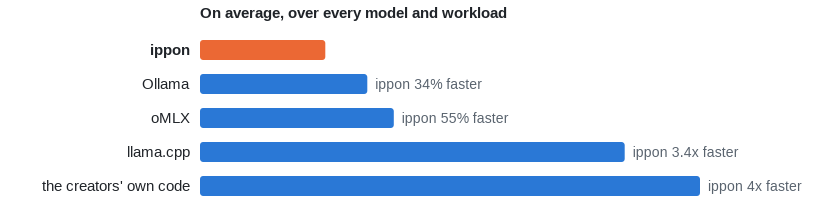
Every runtime answers the same requests on the same model builds. Each model's chart is under Speed.
Run decision models on your Mac, blazing fast, down to 51 ms text (14 ms on cached context), 39 ms audio, 179 ms image, and 828 ms video on M5 Pro, 4x faster on average than creators' code and 45% less memory than Ollama (up to 68% less), with no PyTorch, text generation, or cloud API.
Try it with your agent
Paste this into Claude Code, Codex, Cursor, OpenCode, Pi or Hermes to install ippon and run Kettei Core on your Mac:
Install ippon on my Mac (`curl -fsSL https://sqwish.ai/ippon/install.sh | sh`), then run `ippon pull kettei-core --dry-run`. Show me the licence link and ask before downloading with `ippon setup kettei-core --yes --accept-license` (use `kettei-core:q8` or `kettei-dot` if bf16 does not fit this Mac). Then read `ippon skills ippon`, run a sample `ippon decide` call with Kettei Core using `--server`, and show me the probabilities and warm latency.
Highlights
- Faster than Ollama, oMLX and llama.cpp on the same models (results).
- Faithful to the creators, because every build is checked against its creator's own code, with the tolerances
published. - Multimodal, with text, images, audio and video, each read the way the model's own code reads it.
- Made for agents, with many questions in one read, growing conversations and one model shared by all your agents.
- Our own models, Kettei Core and Kettei Dot, lead the open decision models of their size.
- Plugs in to the Sqwish Labs SDK, the decision APIs of TypeSafe, Perplexity and
SGLang, Claude Code, Codex, Hermes, OpenCode, Pi and MCP. - Private and light, because nothing you send leaves your Mac and ippon uses less memory than Ollama and oMLX
(memory).
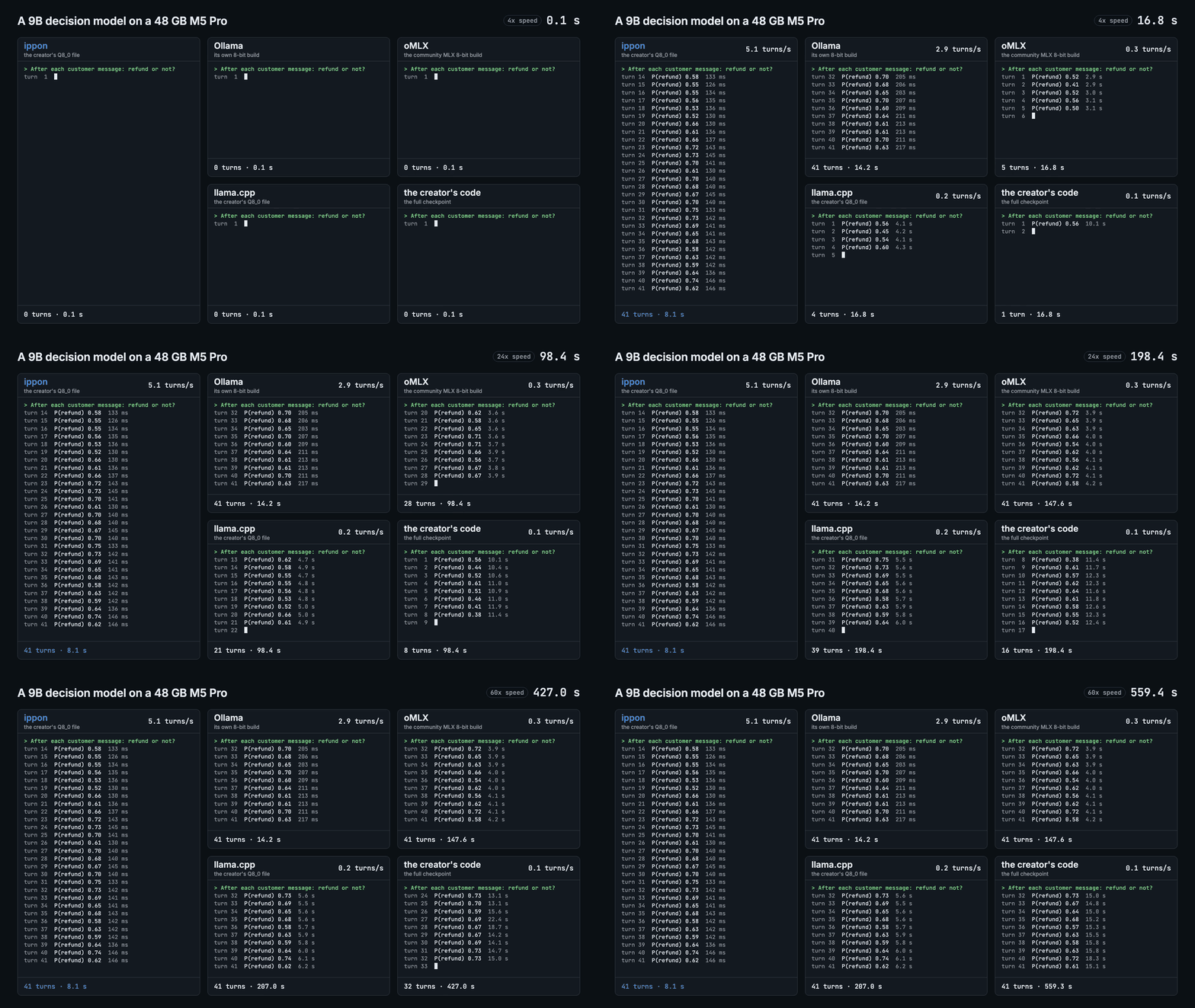
41-turn agent loop on Clef-Flash 9B (48 GB M5 Pro, played at 4x then faster once ippon and Ollama finish): 8.1 s on ippon, 75% faster than Ollama (14.2 s), 18x faster than oMLX (148 s), 26x faster than llama.cpp (207 s) and 69x faster than the creator's code (559 s).
Installation
To install ippon, run this command.
curl -fsSL https://sqwish.ai/ippon/install.sh | sh
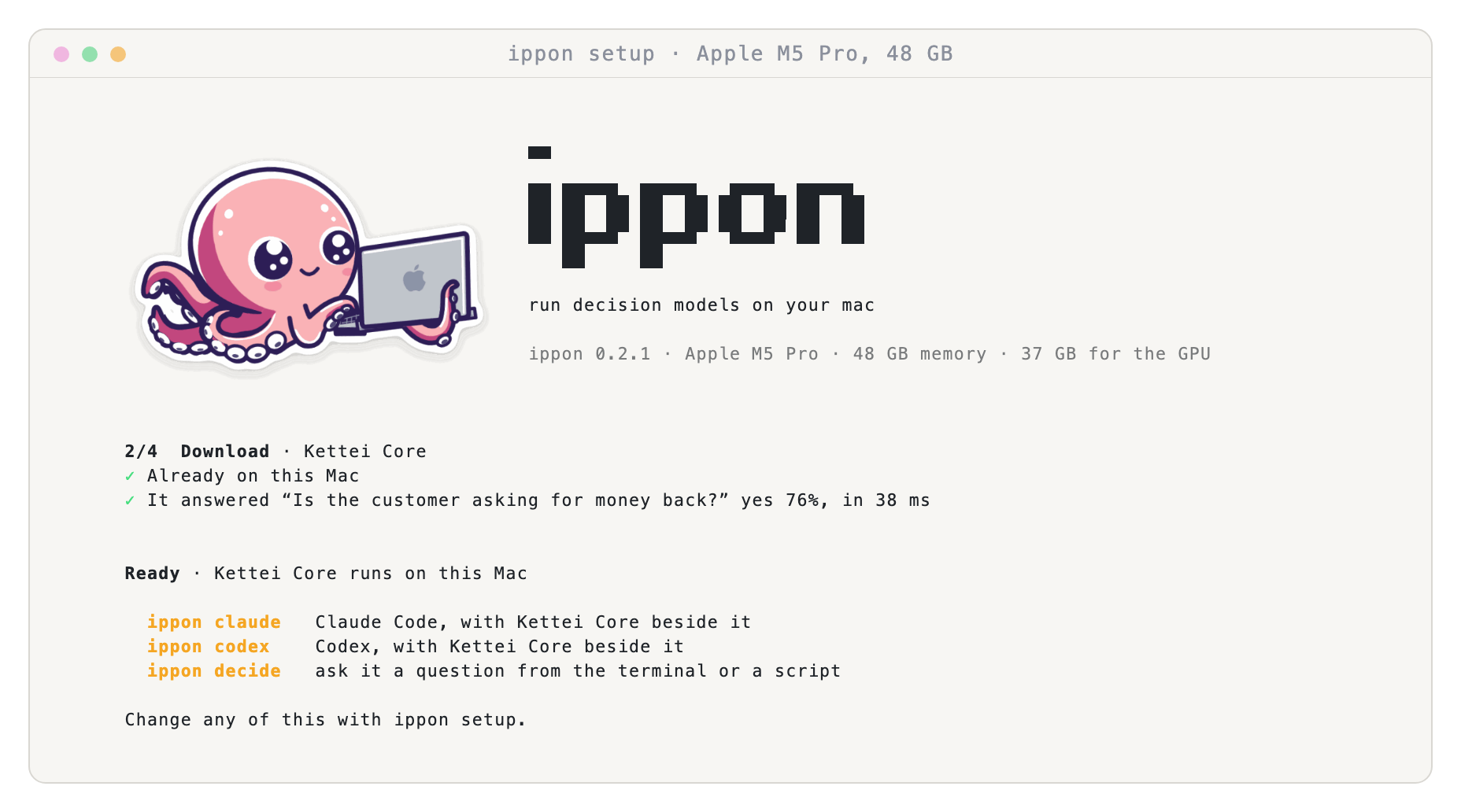
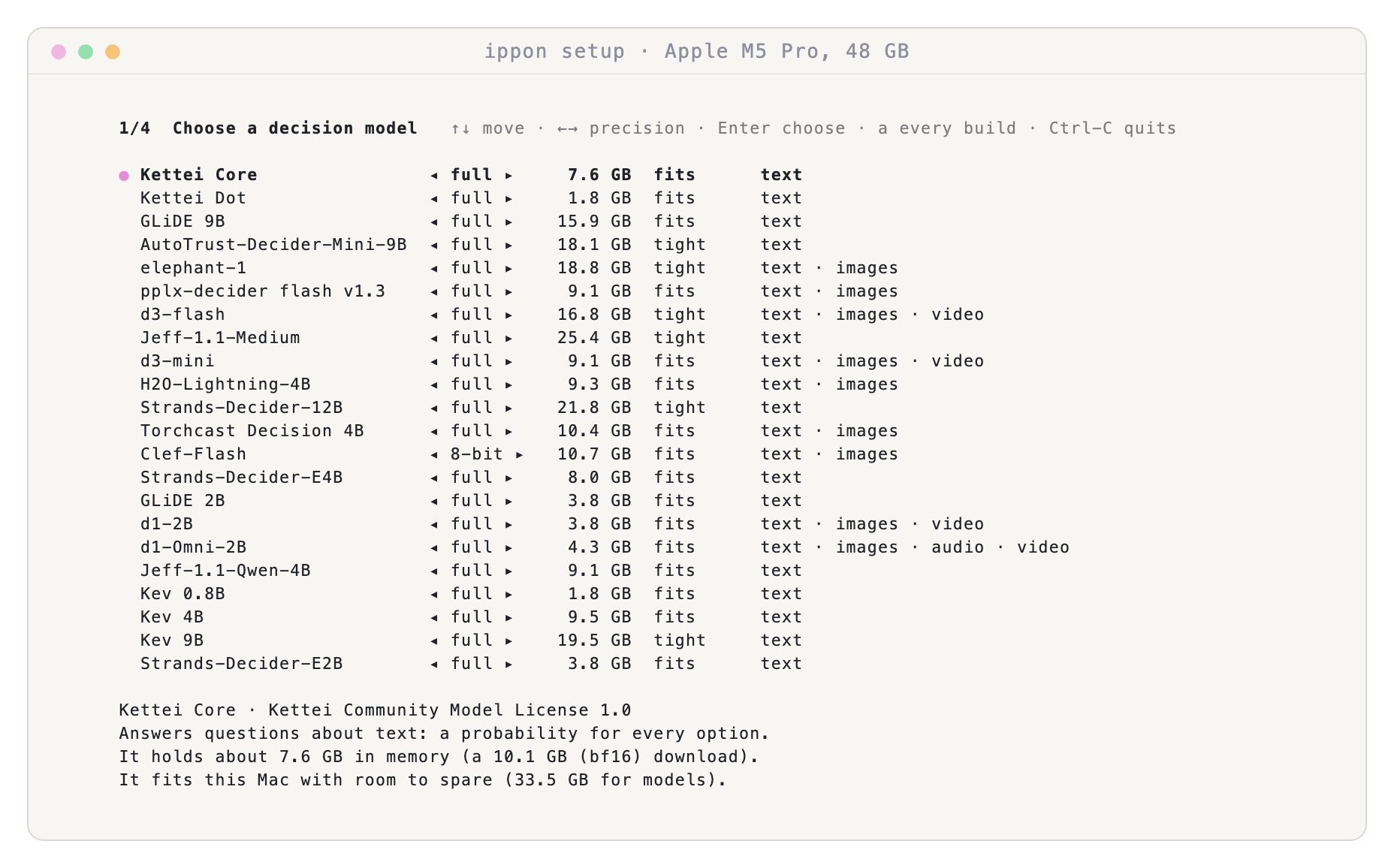
The installer lists the decision models with whether each fits your Mac, downloads the one you choose and asks it a
first question. In its list, the left and right arrow keys change a model's precision and show whether its answers
hold there. Esc goes back a step. A model under an open licence (Apache-2.0, MIT, BSD, the LFM Open License or the
Fastino Community License) downloads without a question. For any other licence, Kettei's included, ippon shows it
and asks you once (licences).
To upgrade, run the installer again. To remove ippon, run ippon remove all --models, thenuv tool uninstall ippon. The first command takes ippon out of your agents' settings and your login items and
stops its server. It also deletes ippon's settings, its caches, the models it downloaded and the link the installer
made to the ippon command.
To use ippon from Python 3.11 or newer on an Apple-silicon Mac, install ippon:
pip install ippon                # or uv add ippon
ippon setup                      # then choose a model, download it and see it answer
To install from source, first install Rust's cargo.
pip install git+https://github.com/sqwishai/ippon
Paste this into Claude Code, Codex, OpenCode or Pi.
Set up ippon on this Mac, the runtime for local decision models at https://github.com/sqwishai/ippon.
1. Install it with: curl -fsSL https://sqwish.ai/ippon/install.sh | sh
2. ippon will download Kettei Core, or Kettei Dot on a Mac where Core does not fit as published, under the Kettei Community Model License 1.0 (https://huggingface.co/Sqwish/Kettei-Core). Show me that licence and ask me to accept it.
   Stop here if I don't.
3. Once I accept, start the setup in the background, because it downloads about 10 GB, which can take 20 minutes
   or more, longer than one shell command waits:
   nohup ippon setup --yes --accept-license --use AGENT --every-session > ~/ippon-setup.log 2>&1 &
   where AGENT is claude, codex, opencode or pi, whichever you are. Check `tail -n 3 ~/ippon-setup.log` every minute and
   tell me how far the download is, until the log shows the first answer. Setup adds ippon's MCP tools and skill to
   your settings for every session, and `ippon remove AGENT` takes them out again.
4. Read ippon's skill with `ippon skills ippon`. Then show me how my own Python code asks the model directly.
   Write ask.py that uses `from ippon import Decider, YesNo` and `Decider.load(MODEL).decide(...)`,
   where MODEL is "kettei-core" or "kettei-dot", whichever `ippon status` names, with one yes/no question about a short
   customer message. Run it with `uv run --with ippon ask.py`, and show me its answer and how sure it was.
5. Tell me to restart you, so the new tools load.
Quick start
Run one decision directly from the terminal with no file setup:
ippon decide kettei-core:q8 '{"state":"Charged twice, please refund.","questions":{"refund":{"type":"noul","instructions":"Is the customer asking for a refund?"}}}'
To ask several questions in one read, save a request.json file and run ippon decide kettei-core:q8 request.json:
{
  "state": "I was charged twice. Please refund the second charge today.",
  "questions": {
    "refund": {"type": "noul", "instructions": "Is the customer asking for a refund?"},
    "team": {"type": "choice", "instructions": "Which team should help?", "criteria": {"billing": "Charges and refunds", "technical": "App faults"}},
    "urgency": {"type": "score", "instructions": "How urgent is the request?", "criteria": ["Can wait", "Needs help today", "Cannot continue working"]}
  }
}
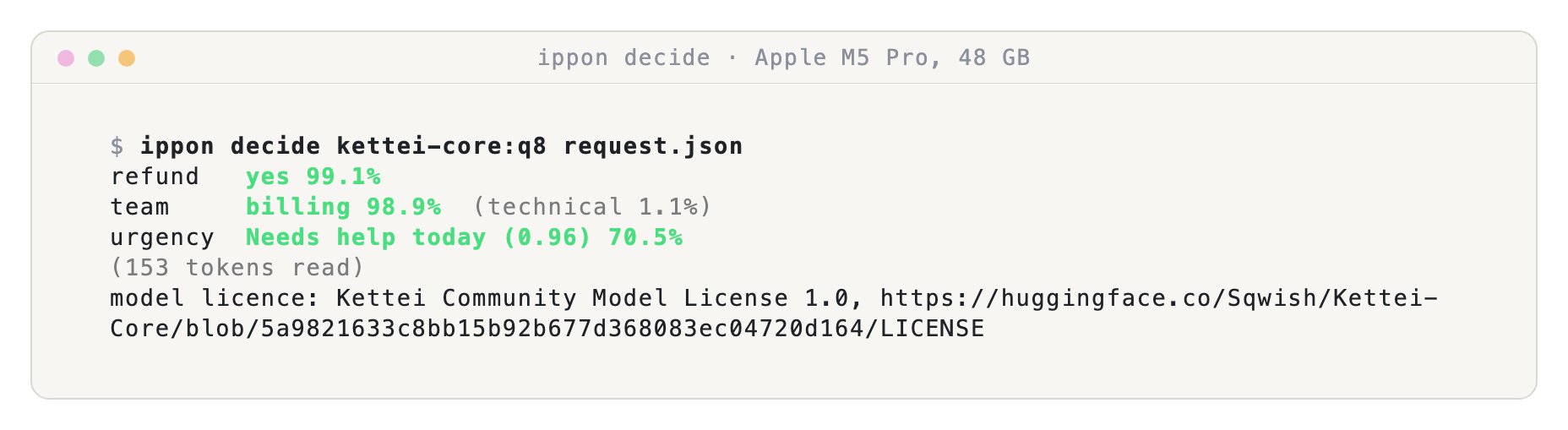
A noul question asks yes or no, and its answer is the probability of yes. A choice answer gives each option's
probability, and a score answer places the message on your scale. Add --json to get the whole response. Add:q8 after a model's name to run it at 8-bit in about half the memory.
To ask from Python, in your own process, load the model with ippon.Decider:
from ippon import Choice, Decider, YesNo

with Decider.load("kettei-core:q8", accept_license=True) as model:
    result = model.decide(
        "I was charged twice. Please refund the second charge today.",
        {
            "refund": YesNo("Is the customer asking for a refund?"),
            "team": Choice("Which team should help?", ["billing", "technical"]),
        },
    )
    print(result["refund"].p_yes, result["team"].top)
accept_license=True accepts the Kettei Community Model License, which Kettei asks for once before its first
download. Every licence but an open one (Apache-2.0, MIT, BSD, the LFM Open License or the Fastino Community License)
asks the same way: confirm it in the CLI, or pass accept_license=True in Python.
To share one model with every app and agent on your Mac, serve it. In a terminal, ippon serve kettei-core prints a
line for each answer it sends, and ippon start runs the same server in the background.
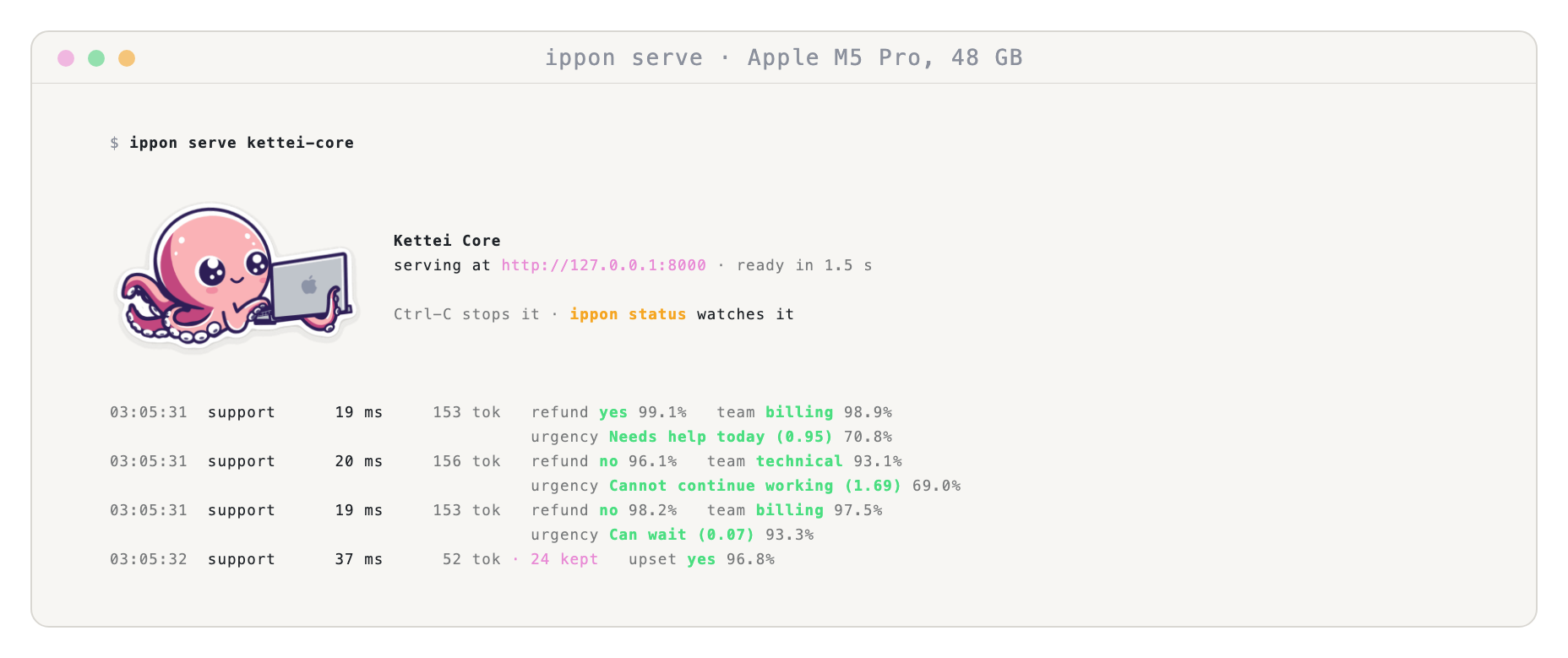
curl -sS http://127.0.0.1:8000/v1/systemone -H 'Content-Type: application/json' -d @request.json
A client that sends the X-Ippon-Client header has its name on each of its lines. When a request repeats a context
that the model read before, its line shows how many tokens ippon kept from that reading.
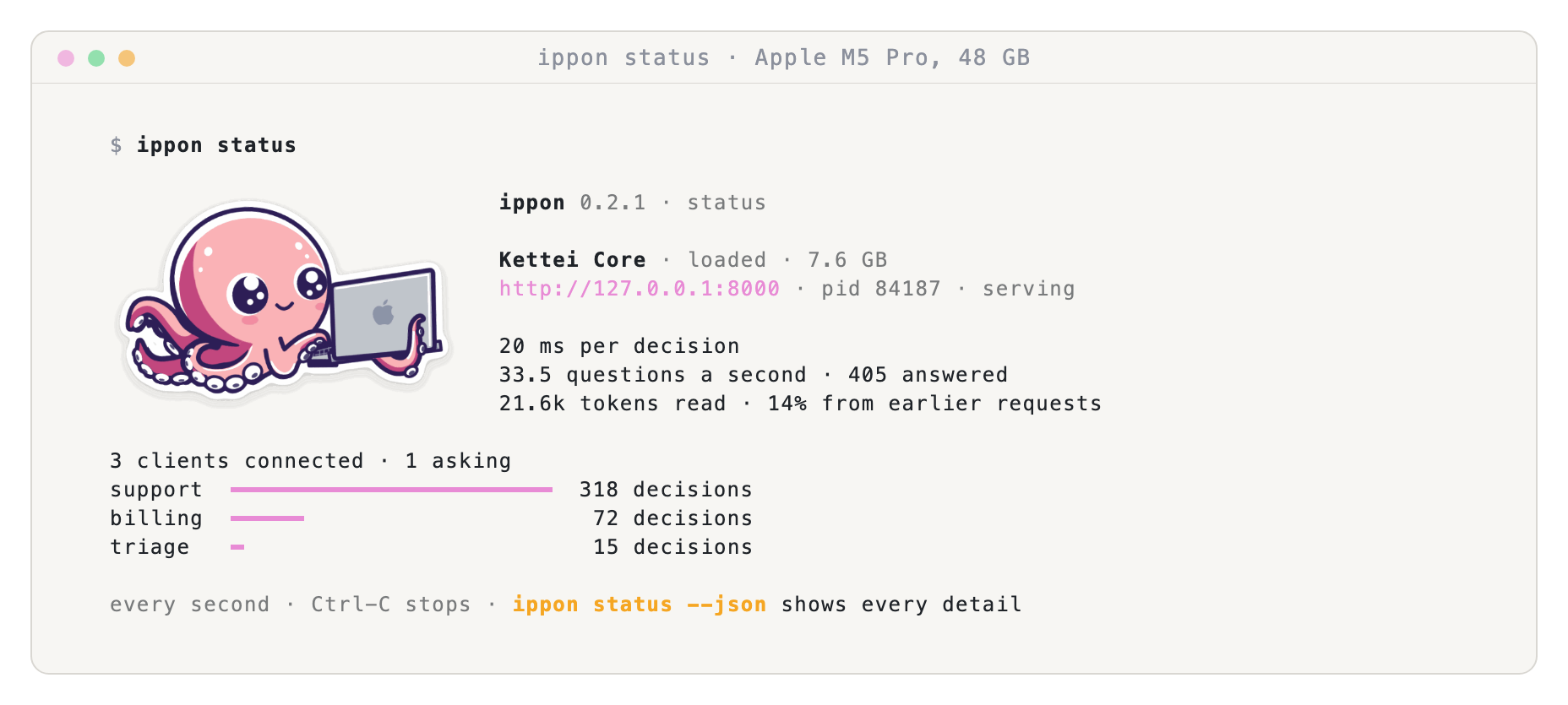
If another program uses port 8000, ippon start serves on a free port and prints its URL, and ippon status shows
that URL too. In a terminal, ippon status watches live throughput, cache reuse, and per-client traffic.
ippon status
Features
Agents
ippon claude opens Claude Code with your decision model ready for that session, and ippon codex,ippon opencode and ippon pi do the same for Codex, OpenCode and Pi.
ippon claude # or ippon codex, ippon opencode, ippon pi
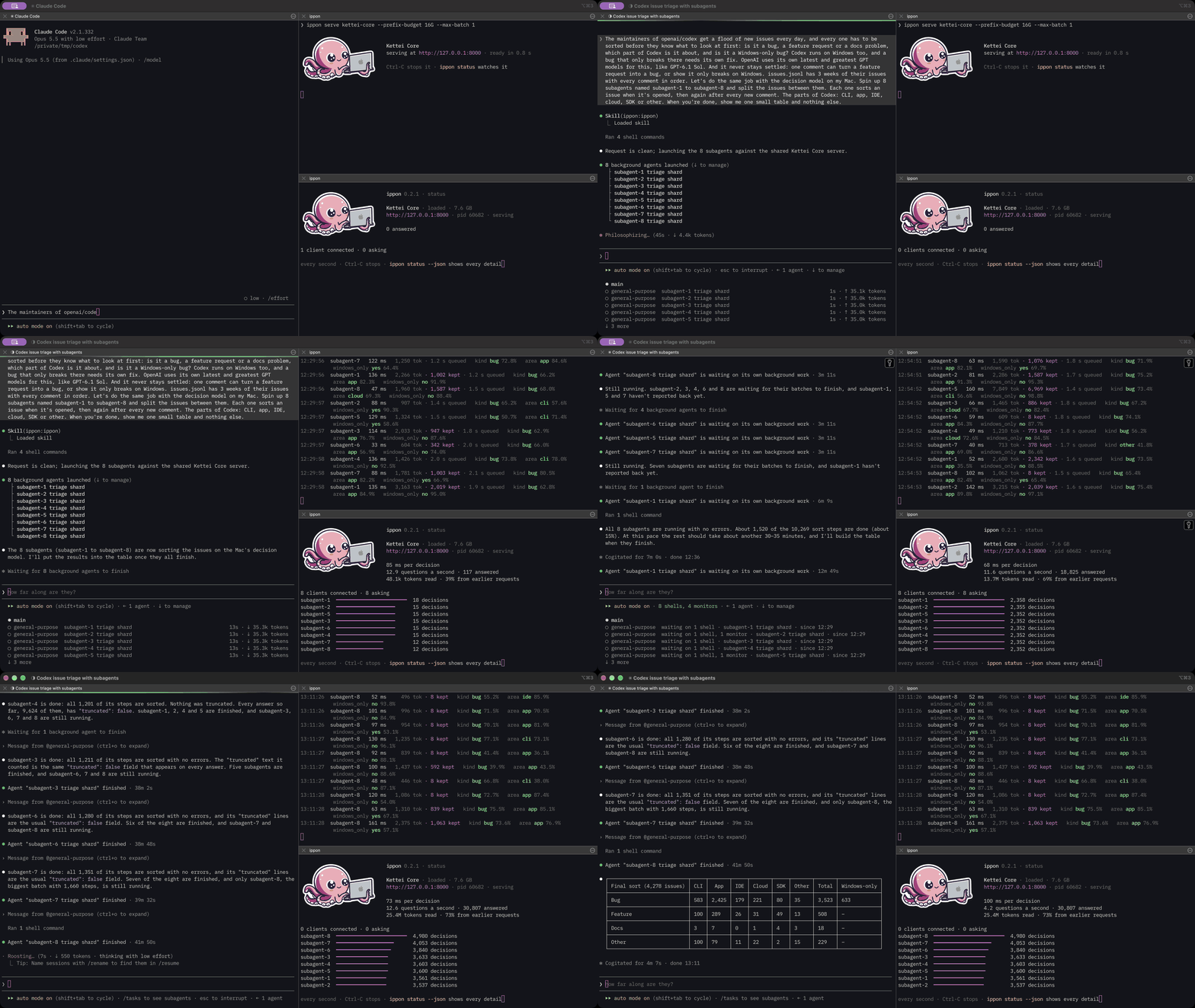
Claude Code spinning up 8 subagents on one local Kettei Core server, sorting 4,278 issues and 5,991 comments (30,807 questions in 42 minutes, 12 a second, 73% cache reuse) on a single Mac.
To keep it in every session, add ippon's MCP server.
claude mcp add --transport stdio ippon -- ippon mcp kettei-core:q8
On Kettei Dot, ippon serve answers the Quick start request a second time in 0.5 ms instead of 15 ms, because it
keeps its answers by default. It returns the answer the model gave the first time, which is safe because a decision model
does not sample. Agents send the same request many times, so the saving adds up. To turn the answer cache off, use--answer-cache 0.
ippon skills teaches your agent when a decision model is worth asking, and Agents covers Cursor,
Hermes and other hosts.
Multimodal
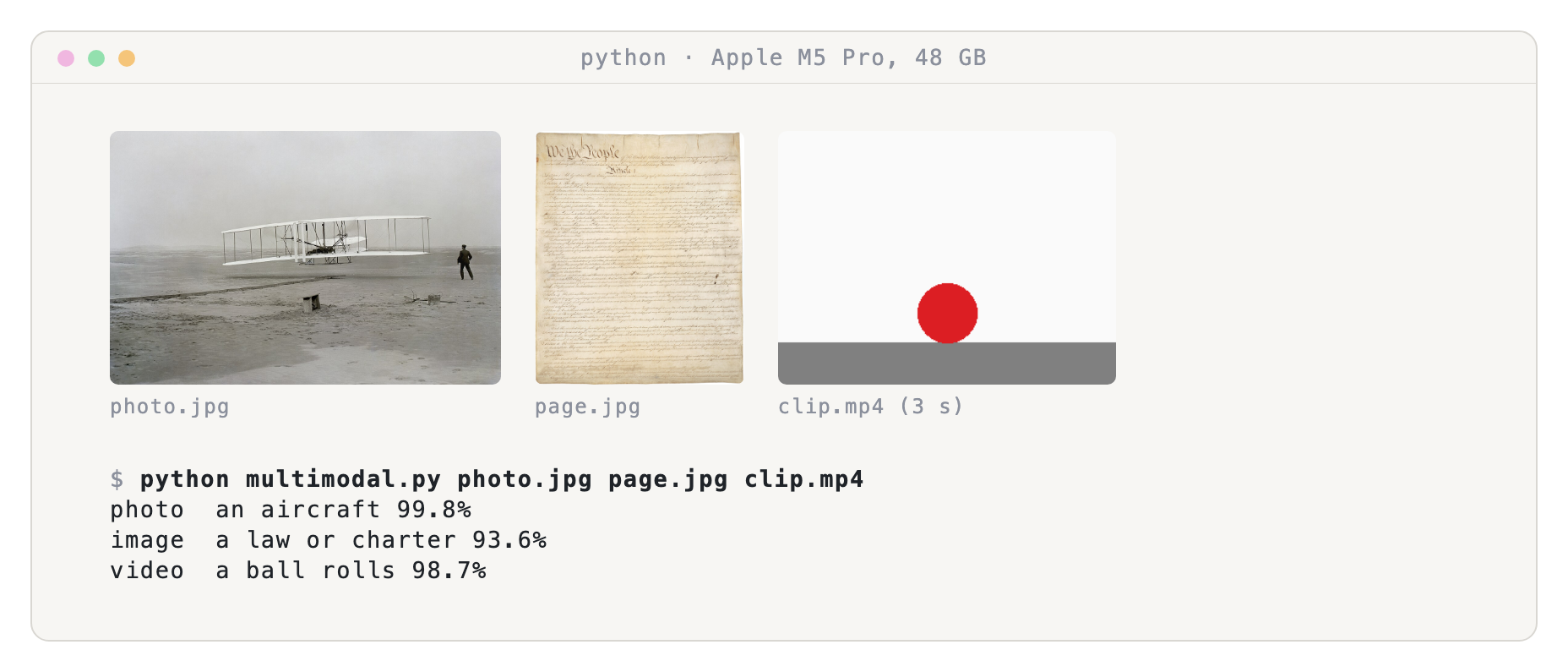
Add an image, an audio clip or a video to a request and ask about it as you would about text. ippon
prepares each input just as the model's own code does. examples/multimodal.py asks
Liquid's d1-2B about a photo, a document image and a short video by file path. Most models read media ahead of the text,
as their creators' code does, and elephant-1 and Torchcast read each where its <image:N> tag sits. From the command
line, ippon decide MODEL request.json --image photo.jpg (or --video, --audio) adds files to a request; MCP tools
accept local file paths directly too.
from ippon import Choice, Decider

with Decider.load("d1-2b:bf16") as model:
    result = model.decide(
        "The clip.",
        {"what": Choice("What happens in the video?", ["a ball rolls", "nothing moves"])},
        videos=["clip.mp4"],
    )
SDKs and HTTP
In your own Python process, ippon.Decider runs any model directly via .decide(), .systemone(), or .sqwish().
From another process, language, or the Sqwish Labs SDK, ippon serve answers the
same decide API over HTTP at POST /v1/decide.
ippon serve kettei-core:q8 --port 8000
curl -s http://127.0.0.1:8000/v1/decide -H 'Content-Type: application/json' -d '{
  "context": "I was charged twice and the app crashes when I open my invoices.",
  "decisions": [{"id": "refund", "question": "Should this customer get a refund?", "kind": "binary"}]
}'
Kettei Core and Dot read the prompts the SDK writes token for token, and every other model ippon runs answers the same
request. ippon also serves these other decision APIs.
- TypeSafe's System One at
POST /v1/systemone, which TypeSafe's
Python SDK sends. The SDK adds/v1/systemoneitself, so
give it the server's address with no/v1(base_url="http://127.0.0.1:8000"). - Perplexity's Decisions API and
SGLang atPOST /v1/decisions.
Answers you can trust
ippon checks every model it supports against its creator's own code. It runs a fixed set of requests and compares
each probability with the creator's, within a tolerance published for each model. A near tie can change the top
answer and still pass. Two probabilities inside the tolerance can also fall on opposite sides of your app's cutoff,
for example when it blocks a command at 85%.
Before you rely on a cutoff, see how closely each build matches the creator's probabilities in
Accuracy. Then test your threshold on your own examples. ippon verify MODEL repeats the
creator check on your Mac. ippon eval examples.jsonl --model MODEL scores the model on your labelled examples. It then picks a
threshold for each yes/no question and checks it on examples held out from that choice. If a build is past its
tolerance, Models marks it and gives the reason.
Models
ippon supports the decision models that are practical on a Mac, from creators who publish their weights and
reference code. Kettei Core and Kettei Dot sit first, and each section orders the rest by public benchmark score
per gigabyte of memory (highest value per GB first; models without a public board score sit at the end). Each name
downloads the build that ippon pull --list marks with a star. Add :q8 after any name to run it at 8-bit
(kettei-core:q8). If the creator publishes a verified 8-bit build, :q8 takes that build (d1-2b:q8 is Liquid's
own Q8_0 file). If you already have a model, give its folder, its GGUF file or ollama://TAG in place of the name.
Text
| Model | Creator | Size | Pull | Weights | Licence |
|---|---|---|---|---|---|
| Kettei Core | Sqwish Labs | 3.7B | kettei-core |
10.1 GB (7.6 GB resident) | Kettei Community Model License 1.0 |
| Kettei Dot | Sqwish Labs | 0.9B | kettei-dot |
2.2 GB (1.8 GB resident) | Kettei Community Model License 1.0 |
| GLiDE 2B | Fastino | 2B | glide-2b |
3.8 GB | Fastino Community License |
| Strands-Decider-E2B | StrandsAgents | 2B active | strands-e2b |
10.3 GB (3.8 GB resident) | Apache-2.0 |
| Kev 0.8B | Jared Palmer | 0.8B | kev-0.8b |
1.8 GB with its base | Apache-2.0 |
| Strands-Decider-E4B | StrandsAgents | 4B active | strands-e4b |
16.0 GB (8.0 GB resident) | Apache-2.0 |
| Jeff-1.1-Qwen-4B | Jonathan Geuter | 4B | jeff-qwen-4b |
9.1 GB | CC BY-NC 4.0 |
| GLiDE 9B | Fastino | 9B | glide-9b |
15.9 GB | Fastino Community License |
| Kev 4B | Jared Palmer | 4B | kev-4b |
9.5 GB with its base | Apache-2.0 |
| Strands-Decider-12B | StrandsAgents | 12B | strands-12b |
23.9 GB (21.8 GB resident) | Apache-2.0 |
| Jeff-1.1-Medium | Jonathan Geuter | 12B | jeff |
25.4 GB | CC BY-NC 4.0 |
| Kev 9B | Jared Palmer | 9B | kev-9b |
19.5 GB with its base | Apache-2.0 |
| AutoTrust-Decider-Mini-9B | AutoTrust | 9B | autotrust-mini-9b |
18.1 GB | Apache-2.0 |
Text and images
| Model | Creator | Size | Pull | Weights | Licence |
|---|---|---|---|---|---|
| H2O-Lightning-4B | H2O.ai | 4B | h2o |
9.3 GB | Apache-2.0 |
| pplx-decider flash v1.3 | Perplexity | 4B | pplx-flash |
9.1 GB | Apache-2.0 |
| Torchcast Decision 4B | Torchcast AI | 4B | torchcast |
10.4 GB | Apache-2.0 |
| Clef-Flash 9B | Cloudflare | 9B | clef-flash |
10.7 GB, MLX 8-bit | Apache-2.0 |
| elephant-1 | Base Labs | 9B | elephant |
18.8 GB | MIT |
Text, images and video
| Model | Creator | Size | Pull | Weights | Licence |
|---|---|---|---|---|---|
| d1-2B | Liquid AI | 2B | d1-2b |
3.8 GB | LFM Open License v1.0 |
| d3-mini | vllm-sr | 4B | d3-mini |
9.1 GB | Apache-2.0 |
| d3-flash | vllm-sr | 9B | d3-flash |
16.8 GB | Apache-2.0 |
Text, images, video and audio
| Model | Creator | Size | Pull | Weights | Licence |
|---|---|---|---|---|---|
| d1-Omni-2B | Liquid AI | 2B | d1-omni-2b |
4.3 GB | LFM Open License v1.0 |
d1-2b:q8 pulls Liquid's own Q8_0 file instead. It is 2.0 GB with
its image encoder, which reads images and video too, a little further from Liquid's answers than the full model
(accuracy). ippon runs models at full precision or 8-bit unless you ask
for fewer bits. If you do, it warns how far the model drifts from its creator's answers
(formats). Weights keep their creators' licences, and Jeff's do not allow commercial use.
Models lists every build and what was checked of it.
Our largest models, Kettei Chub and Kettei Fat, run on console.sqwish.ai, where Kettei
Fat leads every listed decision model on the public Decision Index and JevBench. There you can also fine-tune Kettei
on your own labelled data and call it through the Sqwish Labs SDK or the OneHot API.
Speed ⚡
Each model has one chart, in the section for the inputs it was timed on. Open a model to see ippon beside every
runtime that runs the same build, each in its own server and answering the same requests.
Benchmarks has the method and the raw results.
Text only
Per-model timings for typical calls, repeated contexts, growing agent conversations (see the 41-turn recording under
Highlights), and 16 concurrent clients.
| Model | Typical call | Same context again | Context grown | 16 clients at once |
|---|---|---|---|---|
| Kettei Core | 183 ms | 44 ms | 48 ms | 12.0 req/s |
| Kettei Dot | 51 ms | 14 ms | 16 ms | 46.4 req/s |
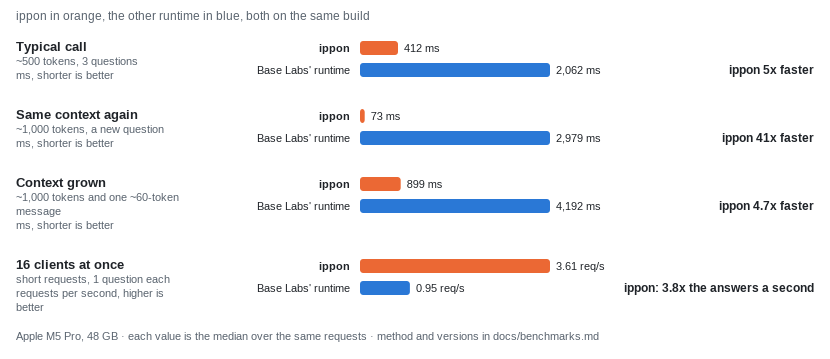
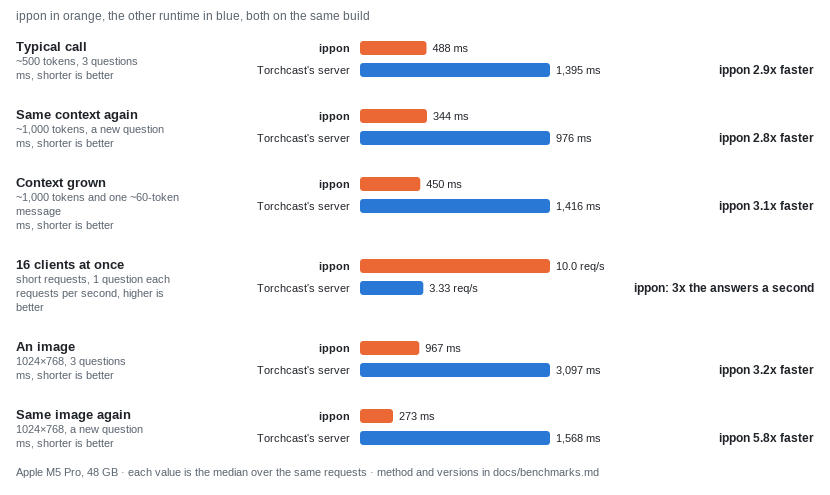
 elephant-1 - typical call in 412 ms on ippon, 5x faster than Base Labs' runtime
 Clef-Flash 9B - typical call in 437 ms on ippon, up to 2x faster than Cloudflare's code, Ollama, llama.cpp and oMLX
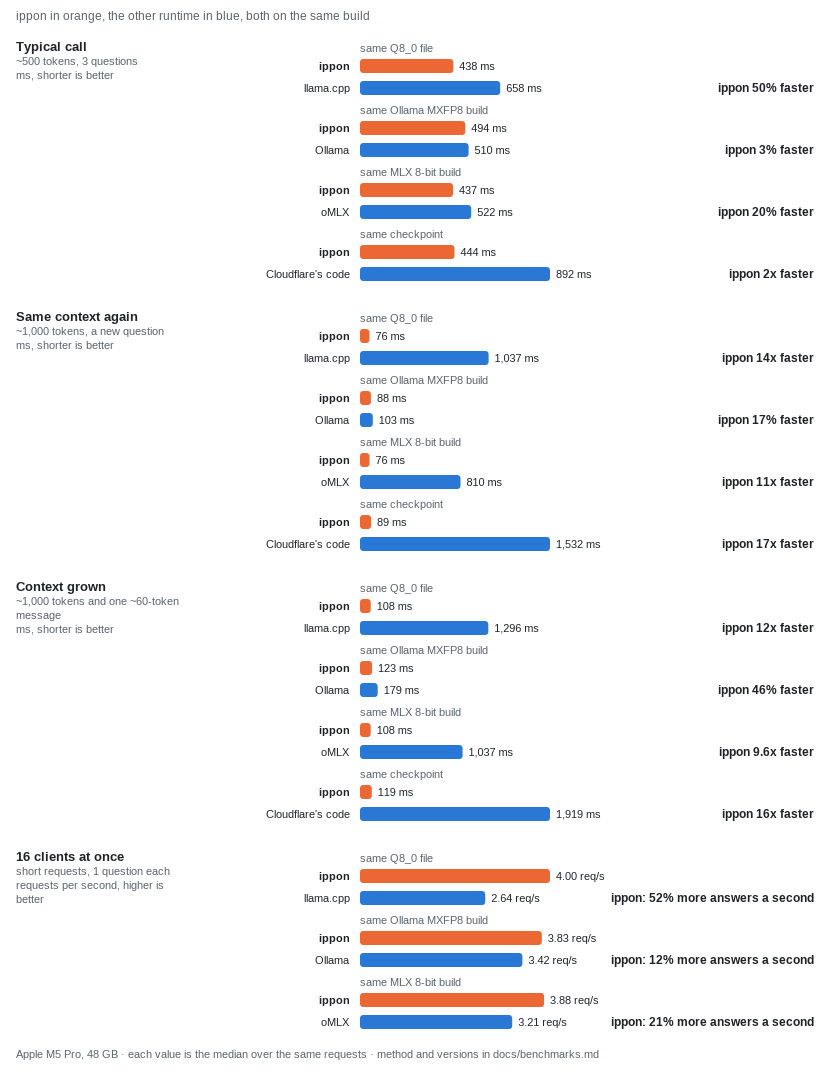
With 16 clients at once, llama.cpp's median wait is lower than ippon's, at 759 ms against 3,986 ms. It answers some clients at once and makes others wait, so its 90th-percentile wait is 33,003 ms against ippon's 4,192 ms. It answers 2.64 requests per second, and ippon answers 4.00.
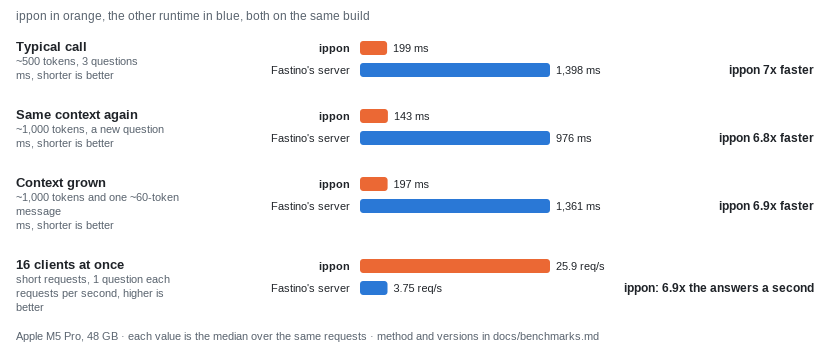
GLiDE 9B - typical call in 1,255 ms on ippon, 4.8x faster than Fastino's server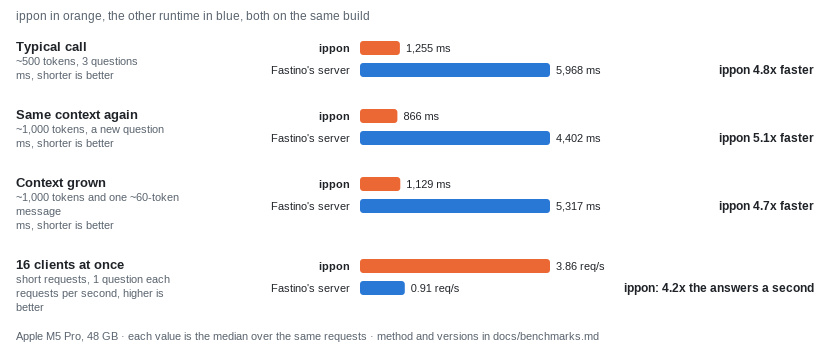 GLiDE 2B - typical call in 199 ms on ippon, 7x faster than Fastino's server
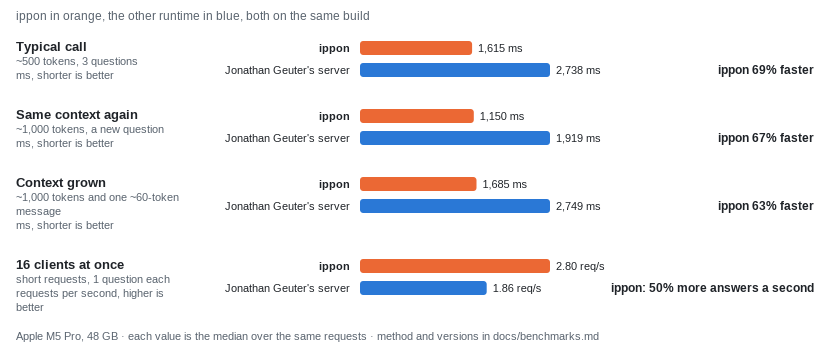
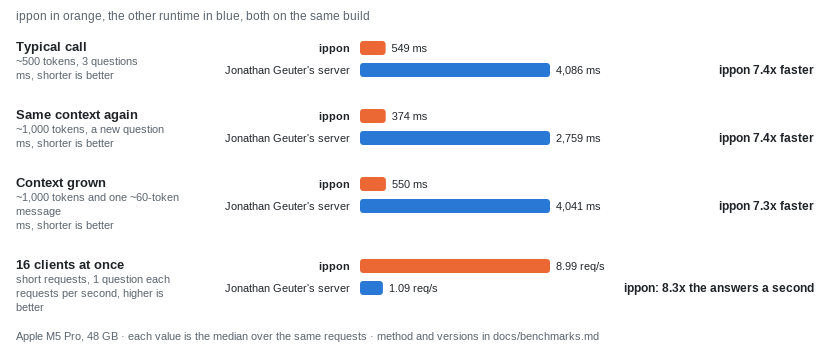
 Jeff-1.1-Qwen-4B - typical call in 549 ms on ippon, 7.4x faster than Jonathan Geuter's server
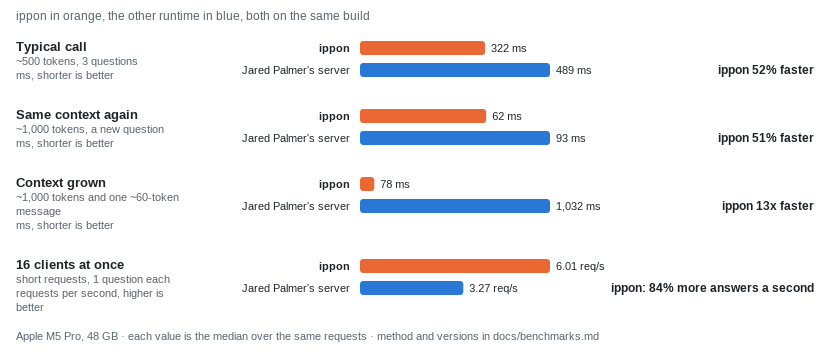
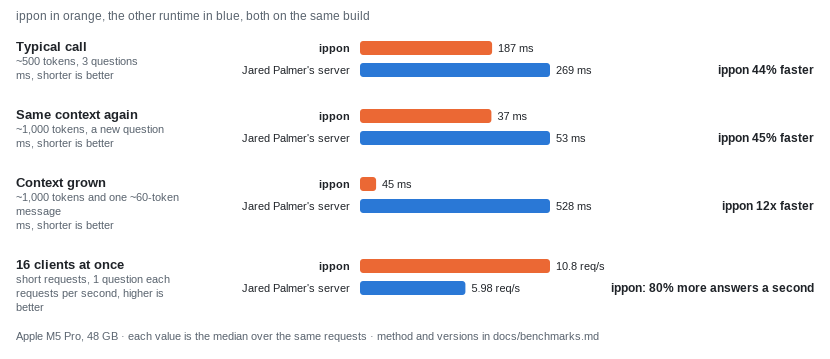
 Kev-9B - typical call in 322 ms on ippon, 52% faster than Jared Palmer's server
 Kev-4B - typical call in 187 ms on ippon, 44% faster than Jared Palmer's server
 Strands-Decider-12B - typical call in 677 ms on ippon, 34% faster than AWS Strands' server
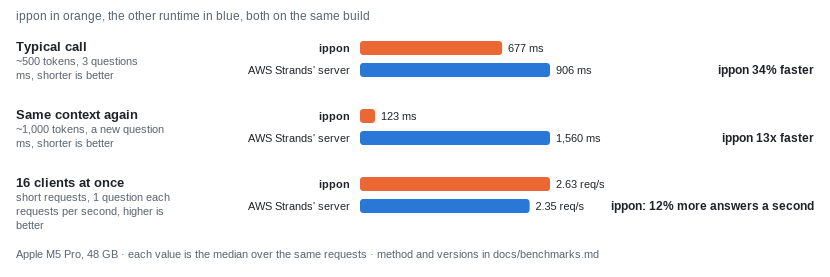
On the 48 GB Apple M5 Pro, with a growing context, AWS Strands' server returned errors on 2 of its 20 requests, while ippon answered every request.
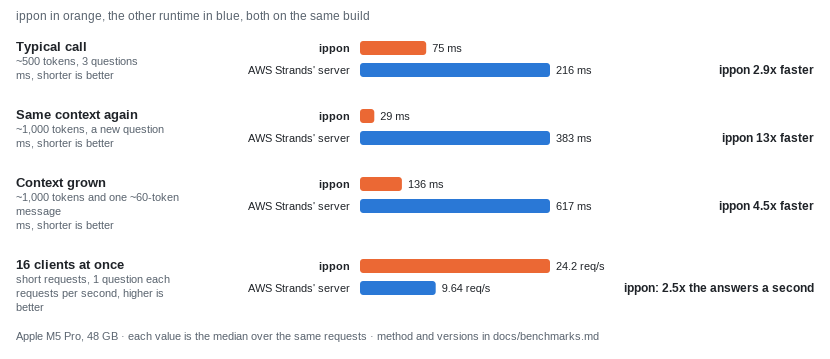
Strands-Decider-E4B - typical call in 191 ms on ippon, 2x faster than AWS Strands' server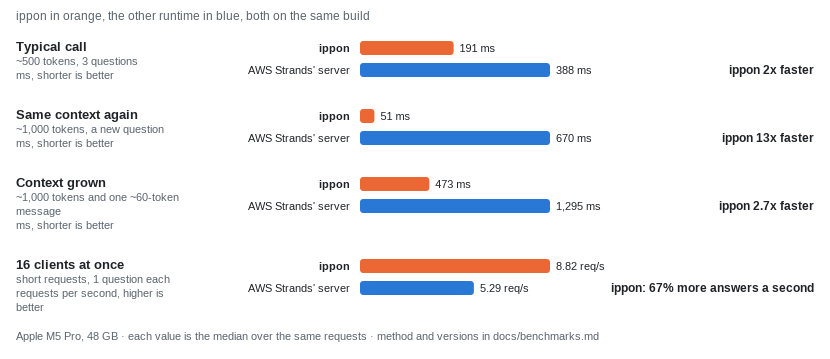 Strands-Decider-E2B - typical call in 75 ms on ippon, 2.9x faster than AWS Strands' server
Both text and images
When a request sends the images of the request before it plus one more, ippon reads only the new image. On a 4B
vision decision model, each request stays near 450 ms however many images came before. On the same file, llama.cpp
reads every image again, takes 5 s by the eighth image and refuses a ninth
(the round).
A model that reads images both ways, such as d1-2B or d1-Omni-2B, must read the earlier images again, but ippon still
keeps the encoding of each image. With 8 images, the model answers in 820 to 910 ms on ippon. Ollama takes 1.5 s on
its own MLX build, and llama.cpp takes 2.1 s on the same Q8_0 file. On d3-mini, oMLX takes 3.6 s and ippon takes
2.2 s on the same checkpoint. From the sixth image, Ollama's d3 runner stopped instead of answering or refusing the
request (the round,
oMLX's).
 pplx-decider flash v1.3 - typical call in 507 ms on ippon, 7.6x faster than Perplexity's package
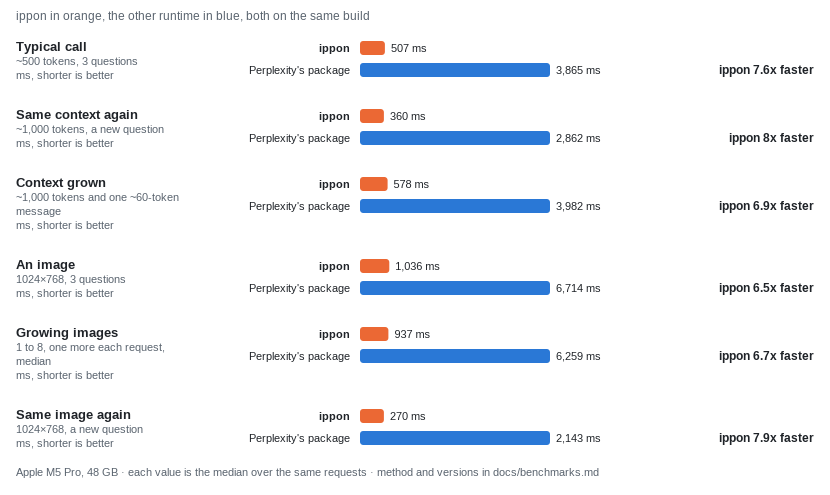
These timings use the full BF16 checkpoint. Perplexity publishes no GGUF or MLX build of flash v1.3, so its own package is the other runtime.
H2O-Lightning-4B - typical call in 229 ms on ippon, 89% faster than llama.cpp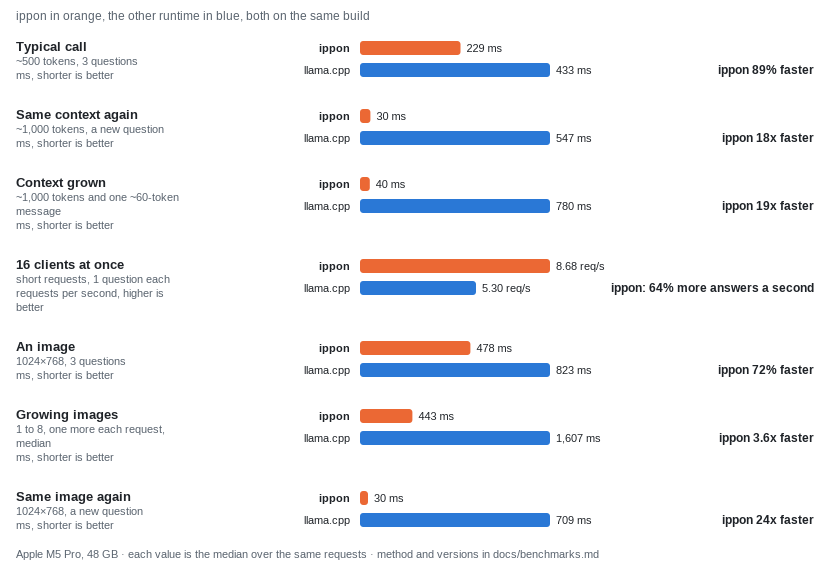
Text, images and video
Each model is timed beside its creator's own code and every other runtime that reads its video, with 3 questions
about a new 4-second 720p clip (the round,
oMLX and llama.cpp). oMLX reads video for d3, llama.cpp reads it
for d1, and Ollama refuses video for every decision model.
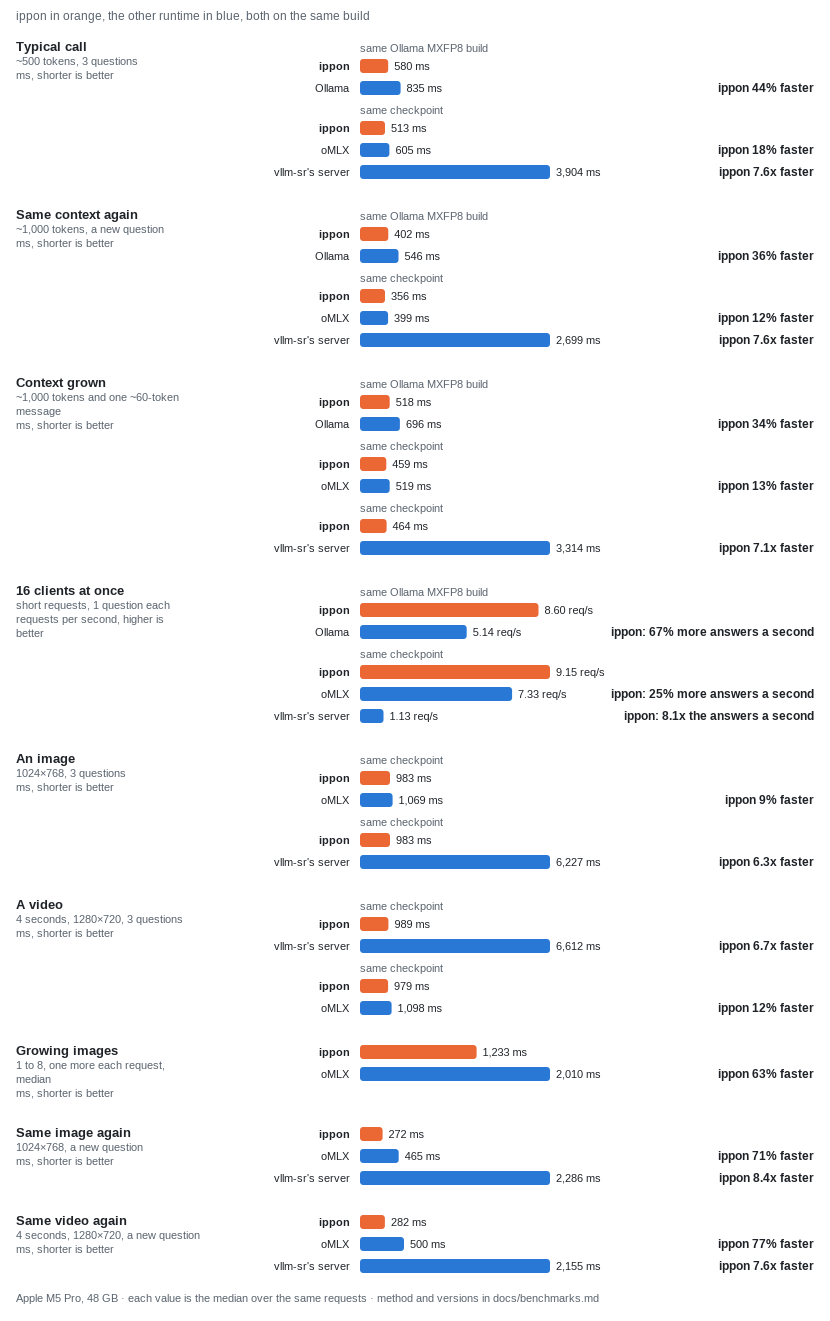
On the 48 GB Apple M5 Pro, with growing images, Ollama returned errors on 5 of its 7 requests, while ippon answered every request.
d3-flash - typical call in 920 ms on ippon, up to 4.8x faster than Ollama, oMLX and vllm-sr's server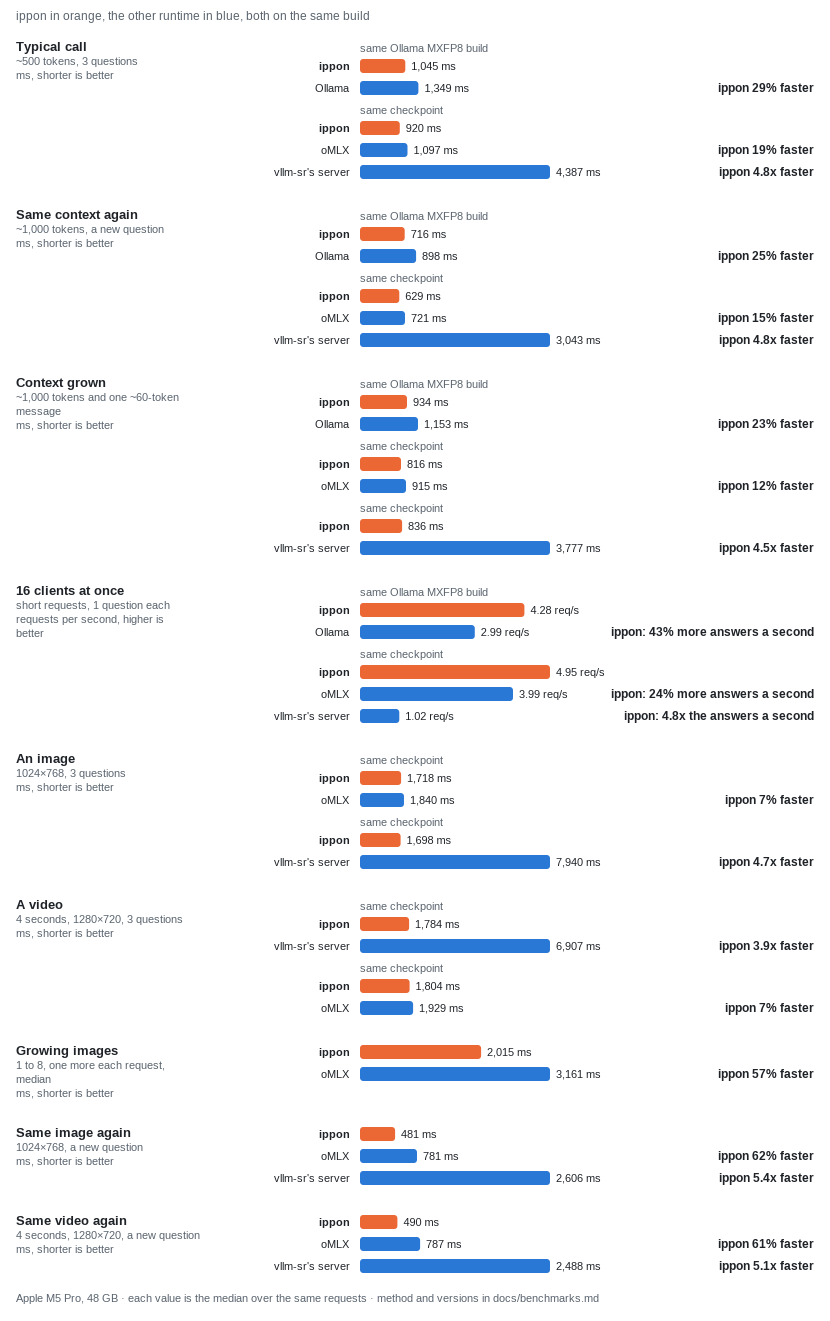
On the 48 GB Apple M5 Pro, with growing images, Ollama returned errors on 6 of its 8 requests, while ippon answered every request.
d1-2B - typical call in 67 ms on ippon, up to 4.3x faster than Liquid's code, Ollama and llama.cpp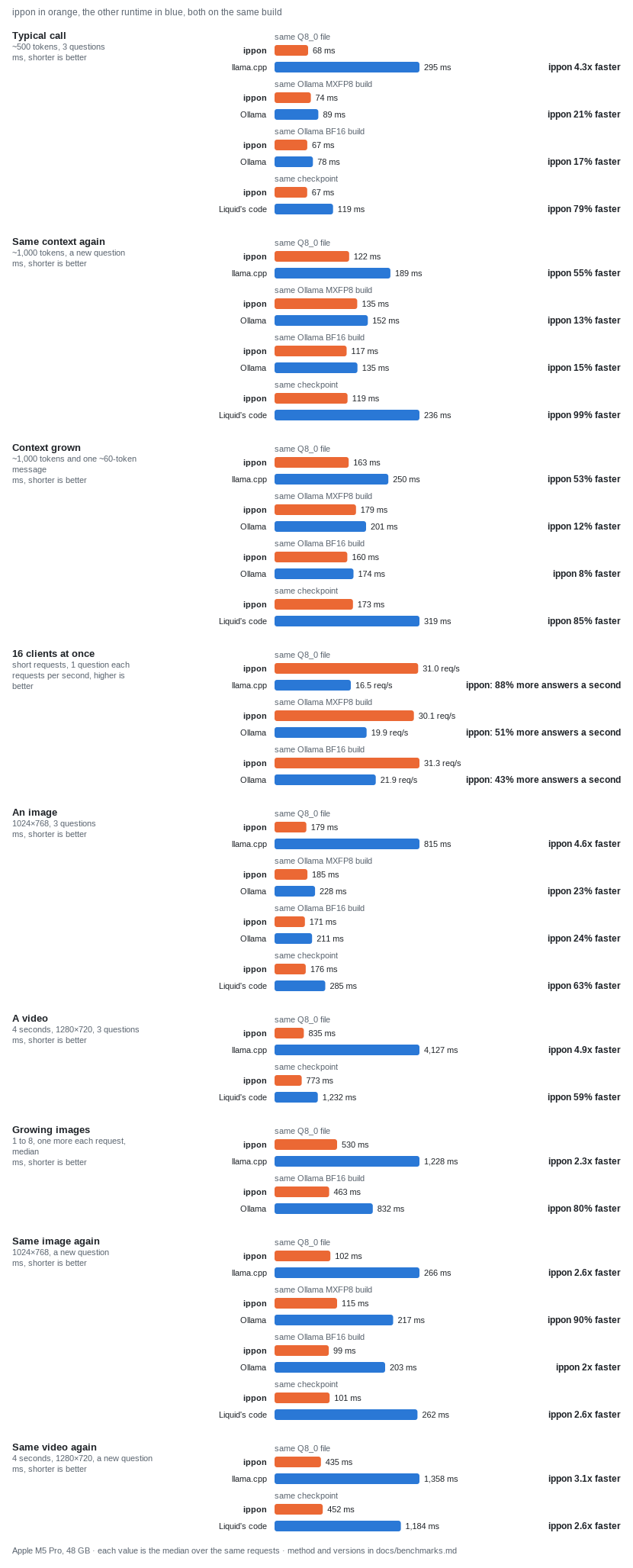
With 16 clients at once, llama.cpp's median wait is lower than ippon's, at 121 ms against 515 ms. It answers some clients at once and makes others wait, so its 90th-percentile wait is 5,278 ms against ippon's 518 ms. It answers 16.5 requests per second, and ippon answers 31.0.
Text, images, video and audio
A question about 10 seconds of audio takes d1-Omni-2B 39 ms on ippon. It takes 70 ms in Liquid's code on the same
checkpoint and 76 ms on llama.cpp with the same Q8_0 file.
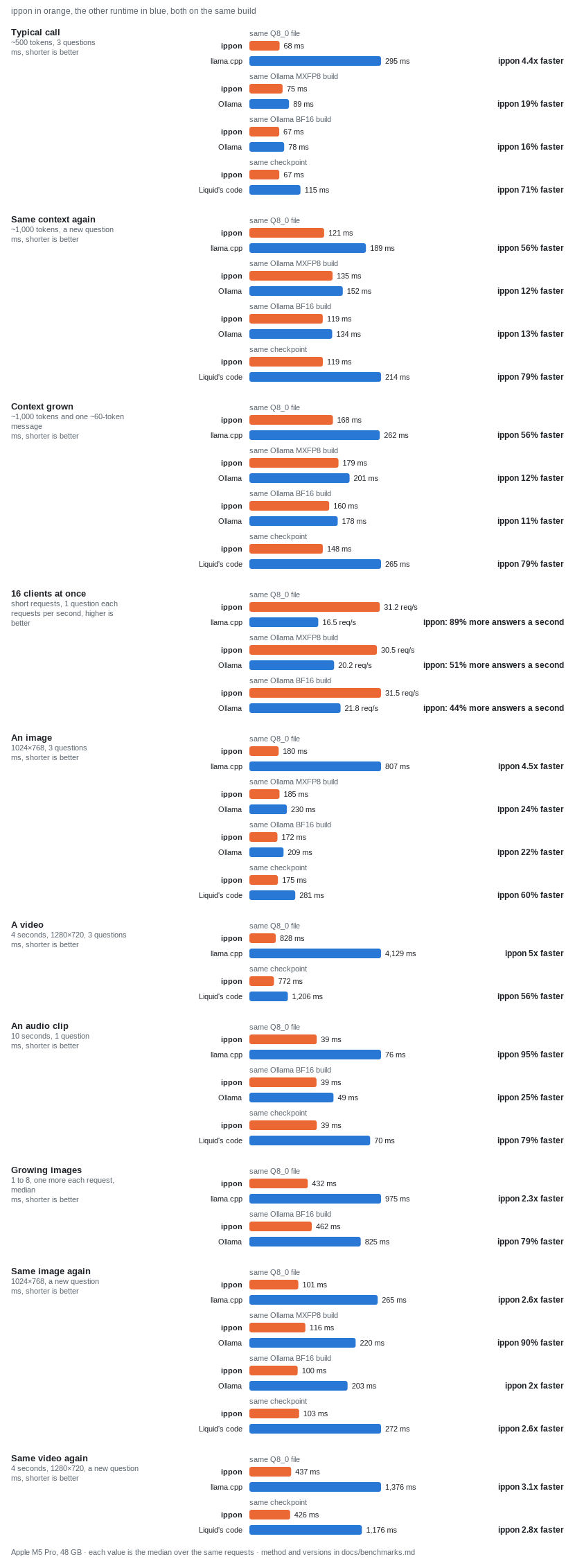
With 16 clients at once, llama.cpp's median wait is lower than ippon's, at 122 ms against 513 ms. It answers some clients at once and makes others wait, so its 90th-percentile wait is 5,286 ms against ippon's 517 ms. It answers 16.5 requests per second, and ippon answers 31.2.
Memory
A decision model runs beside your agent, its editor and a browser full of tabs. On the same builds, Ollama needs 80%
more memory than ippon at its peak while answering. oMLX, which runs the same MLX checkpoints as ippon, needs 10% more.
ippon's peak includes the contexts it keeps to answer the next call sooner.

Ollama's bar averages its highest memory on each build it shares with ippon, over the typical, repeat, grow,
16-client and image-again workloads (details).
Getting help
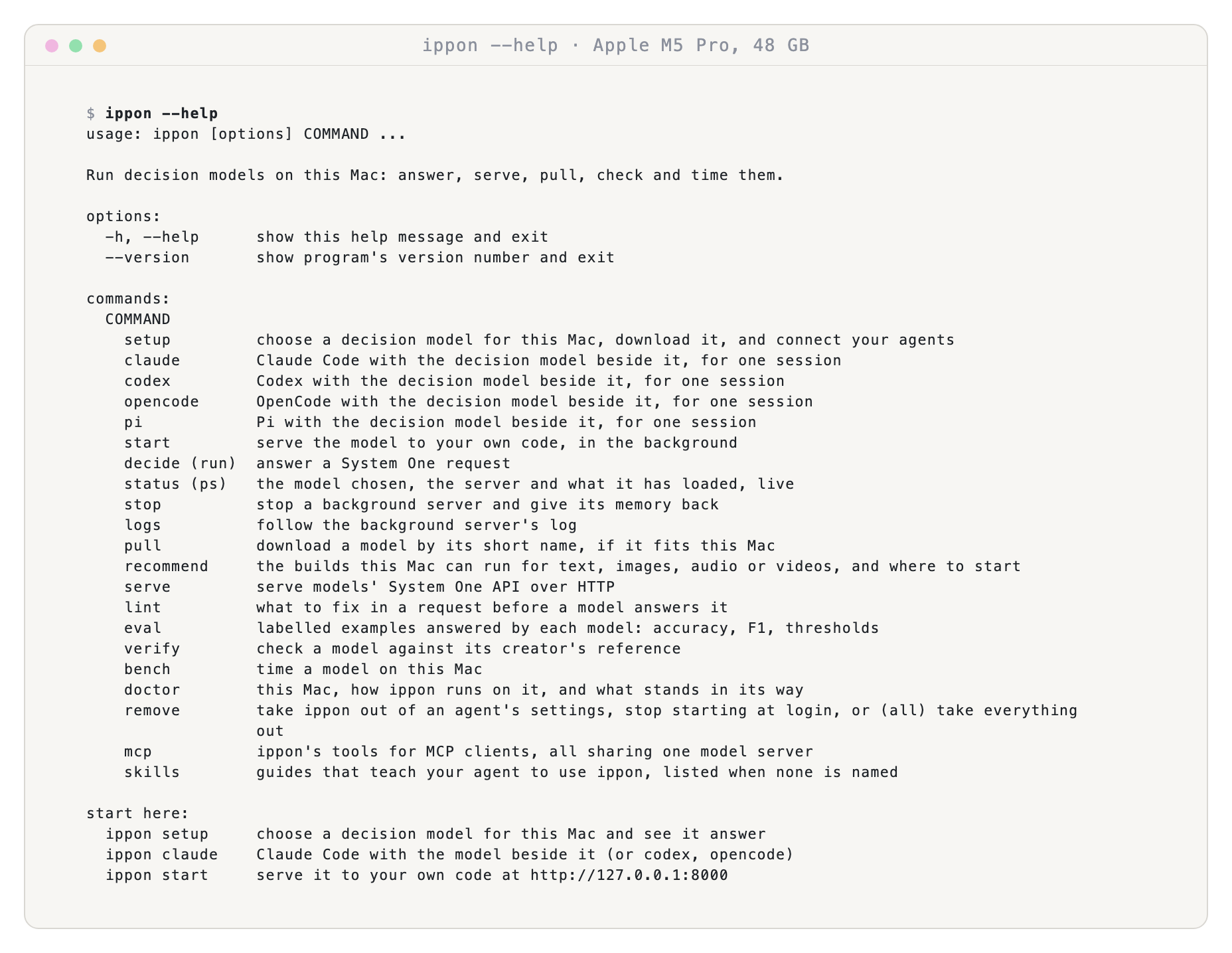
ippon --helplists the main commands, andippon COMMAND --helpexplains one and ends with examples.ippon doctorchecks your Mac's setup and says what stands between it and full speed.ippon skillsteaches your agent to use ippon.- To report a bug or ask for a model, open an issue.
- Report security problems as SECURITY.md describes, never in a public issue.
Documentation
- Choosing and evaluating - pick a model and measure it on your own examples.
- Models - every build, what it reads and what was checked of it.
- Agents - MCP, the shared server and the errors an agent can get.
- Accuracy - the references, the tolerances and every result.
- Benchmarks - how each timing was taken, with the raw results.
- Architecture - the command line, HTTP and Python reference, and how a request runs.
- Kernels and Packed formats - what runs on your Mac's GPU, and the files it reads.
- Bring your own and Adding a model - run another model.
- Errors - exit codes, HTTP statuses and what to retry.
- Contributing - prepare, check and measure a change.
ippon is licensed under Apache-2.0. See NOTICE for attribution and SECURITY.md to report a
vulnerability. Model weights keep their creators' licences and are downloaded separately.

Yorumlar (0)
Yorum birakmak icin giris yap.
Yorum birakSonuc bulunamadi