universal-bluetooth-sdk
Health Gecti
- License — License: MIT
- Description — Repository has a description
- Active repo — Last push 0 days ago
- Community trust — 35 GitHub stars
Code Gecti
- Code scan — Scanned 12 files during light audit, no dangerous patterns found
Permissions Gecti
- Permissions — No dangerous permissions requested
Bu listing icin henuz AI raporu yok.
Experimental Go Bluetooth daemon and CLI with Linux RFCOMM, MCP tools, and a hardware-free demo. Building toward nearby chat and optional local AI.
Universal Bluetooth SDK
A Go daemon and CLI for Bluetooth experiments, with AI and MCP integrations.
Build against one local API. Try it without a radio, send RFCOMM payloads on Linux,
and help build the missing foundations for nearby chat and local AI assistants.




Quick start · Build chat apps · Contribute · Roadmap
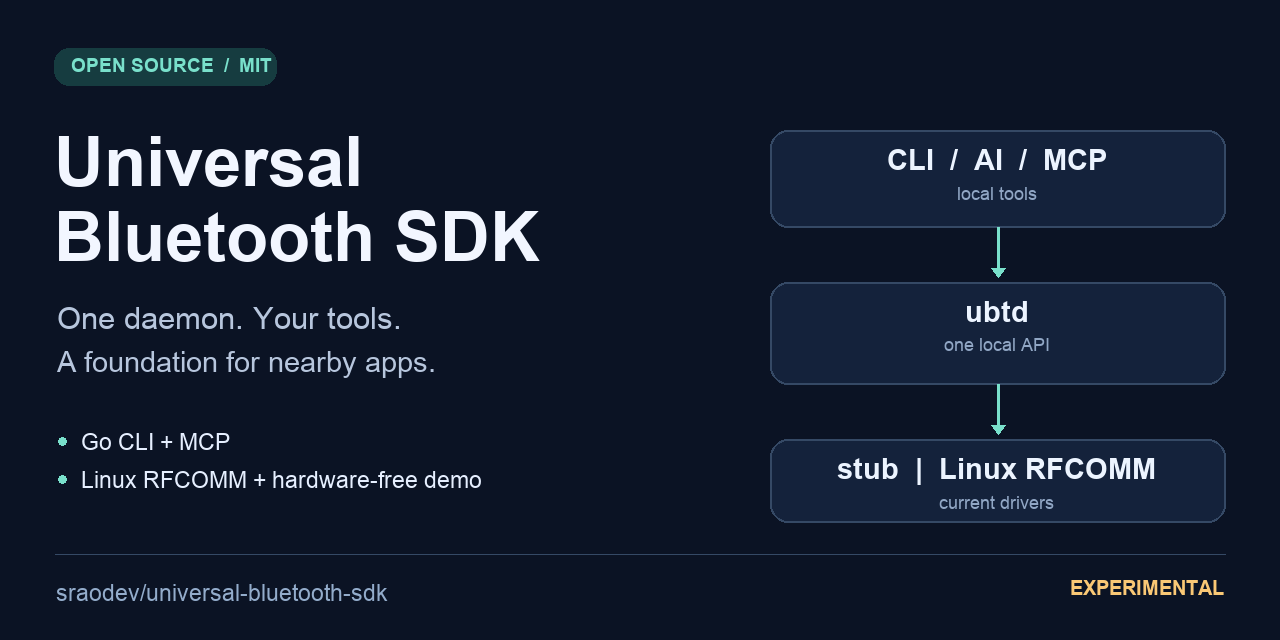
Experimental, not production-ready. The Go implementation supports a simulated
driver and Linux RFCOMM sending. It does not implement BLE GATT, bidirectional
chat, mesh routing, end-to-end encryption, or Bitchat interoperability.
“Universal” describes the project direction, not current platform coverage.
What can you build?
| Use case | Today | Next prerequisite |
|---|---|---|
| Raspberry Pi / Linux device commands | One-shot RFCOMM send to an existing compatible receiver | Hardware validation and bounded I/O |
| Bluetooth developer tools for agents | CLI, Claude planner, stdio MCP, saved plan replay | Enforced per-tool permissions |
| Local AI message drafts | Optional Ollama example; human reviews before sending | Receive sessions for a complete chat loop |
| Nearby BLE chat apps | Design and contributor backlog | GATT central/peripheral, framing, flow control |
| Bitchat-compatible clients | Not implemented or affiliated | Protocol study, test vectors, security and interoperability review |
The useful shared layer is radio access and messaging primitives. Your app owns
its UI, identity, conversation history, model runtime, and user consent.
Quick start without Bluetooth hardware
Requires Go 1.24+. These POSIX-shell commands target Linux/macOS; Windows
runtime behavior has not been validated. The first build downloads dependencies.
No API key, model download, pairing, or root access is needed for the stub demo.
git clone https://github.com/sraodev/universal-bluetooth-sdk.git
cd universal-bluetooth-sdk
go build -o bin/ubtd ./cli/ubtd
go build -o bin/ubtctl ./cli/ubtctl
Terminal 1 — keep this running; stop with Ctrl-C:
mkdir -p "$HOME/.local/run/ubtd"
chmod 700 "$HOME/.local/run/ubtd"
./bin/ubtd --socket "$HOME/.local/run/ubtd/daemon.sock" --driver stub
Terminal 2:
export UBTD_SOCKET="$HOME/.local/run/ubtd/daemon.sock"
./bin/ubtctl ping
./bin/ubtctl status
./bin/ubtctl discover --scan-timeout 3
./bin/ubtctl send --address AA:BB:CC:DD:EE:01 --data 'hello'
Discovery returns the synthetic stub-pi and stub-esp32 peers. Sending reportssent 5 bytes in 1234 µs: a simulation, not radio delivery or a benchmark.
For an automated check that starts and cleans up its own daemon:
python3 scripts/smoke.py
Real Bluetooth on Linux
The linuxrfcomm driver uses BlueZ's bluetoothctl devices to list already
known devices, not to perform a live scan. It opens a native RFCOMM socket for
sending. Configure pairing, adapter permissions, and a receiver separately.
On Debian/Raspberry Pi OS, install BlueZ with sudo apt install bluez. Then stop
the stub daemon and start ubtd --driver linuxrfcomm using the same private
socket path. Send using the receiver's actual address and RFCOMM channel (1–30):
./bin/ubtctl send --address AA:BB:CC:DD:EE:FF --port 1 --data 'hello'
The address is a placeholder. A successful write does not prove the remote app
processed the message. Do not assume raw Go payloads speak the legacy Python
SDK's length/acknowledgement/pickle protocol. Do not run the daemon as root by
default. See hardware validation and security.
AI, MCP, and replay
- Local AI: draft a short message with Ollama, review
the saved text, then explicitly invokeubtctl send. No automatic radio access. - Cloud planner:
ubtctl ask --dry-run "check daemon status"requiresANTHROPIC_API_KEY. It sends the goal and tool results to Anthropic and can incur
charges.--dry-runsuppresses sends; it does not make this an offline command. - MCP:
ubtctl mcp --socket "$UBTD_SOCKET"exposes daemon tools over stdio to
a compatible client. The current server includes a send tool; use only trusted
clients and their approval controls, preferably against the stub driver. - Replay:
ubtctl plan run --dry-run plan.jsonpreviews a saved trace without
the daemon or an LLM. Executing mutating tools requires--yesbefore the path.
The cloud planner's ask command currently has no --yes confirmation flag:
without --dry-run, its tool calls can send. Do not confuse that with replay's--yes gate. CLI details and configuration.
Architecture and current scope
CLI / Claude planner / MCP / saved plans
                  |
       length-prefixed JSON over local Unix socket
                  |
                 ubtd
                  |
           transport.Driver
             /         \
          stub       Linux RFCOMM
        simulated    one-shot send
| Component | Status |
|---|---|
| Go daemon, CLI, protocol | Implemented; automated tests and stub smoke check |
| Linux RFCOMM driver | Implemented; physical-device validation still required |
| macOS / Windows radio backends | Not implemented; macOS can run the stub |
| Python SDK | Legacy PyBluez implementation; unsafe pickle defaults, isolated labs only |
| Rust SDK, REST, gRPC, file-transfer and sensor apps | Placeholder directories, not working products |
The Go module still uses the historical import pathgithub.com/sraodev/bluetooth-service-rfcomm-python. Clone the current repository
URL above; module migration is tracked separately to avoid breaking consumers.
The JSON Go types are implemented in sdk/go/pkg/protocol;v1.proto is a design counterpart, not generated bindings.
Help build the next milestone
We especially need Linux/Raspberry Pi testers, Go contributors, BLE engineers,
and developers building chat apps. Start with the
good first issues
or help wanted backlog.
BLE, cryptography, and protocol work are not beginner tasks.
Read CONTRIBUTING.md for setup and a small first PR.
ROADMAP.md gives acceptance gates, not promised dates.
If this is useful, star it to bookmark the project; a reproducible bug report,
hardware result, or example app helps even more.
Yorumlar (0)
Yorum birakmak icin giris yap.
Yorum birakSonuc bulunamadi