perspica
Health Gecti
- License — License: MIT
- Description — Repository has a description
- Active repo — Last push 0 days ago
- Community trust — 35 GitHub stars
Code Basarisiz
- rm -rf — Recursive force deletion command in install.sh
Permissions Gecti
- Permissions — No dangerous permissions requested
Bu listing icin henuz AI raporu yok.
Review code changes by what they do, and learn the concepts behind them.





Review code changes by what they do, and learn the concepts behind them.
[!NOTE]
perspica is in beta. Expect rough edges, and behavior that may change between 0.x releases. If something looks wrong, please open an issue.
perspica reads a diff by working out what actually changed (a rename, a new parameter, a moved function, a real logic change), setting aside the mechanical noise (reformatting, comments, rename-only lines, unchanged moves, generated files), and pointing at what a plain diff hides: references to names that no longer exist, calls that weren't updated for a new signature, code left unused.
None of that needs a model. perspica parses both versions with tree-sitter and follows the calls between them, so it's one local binary that answers in a few hundred milliseconds on a typical PR, gives the same answer every time, and needs no API key. An LLM is an optional, but useful, extra: it groups the changes by intent, rates the risk of each group and writes a summary, and nothing leaves your machine unless you ask for it.
It understands TypeScript and JavaScript (including TSX and JSX), Python, Rust, Go, Java, Kotlin, Scala, C#, C, PHP and Ruby (Rails included). Files in other languages still show up, as ordinary line diffs.
It's built for reviewing work done with coding agents. When the change came from your Claude Code or Codex session, perspica shows what you asked for in your own words and, with an LLM, marks which parts you asked for and which the agent decided on its own.
And when a change relies on something you haven't worked with, the Learn tab explains it. Focus is on the few concepts or architecture changes that matter for the change. It will provide a short lesson, a diagram or animation when one helps, and a quiz to check you've got it. When there's nothing new to learn, it says so. See the demo video for Learn.

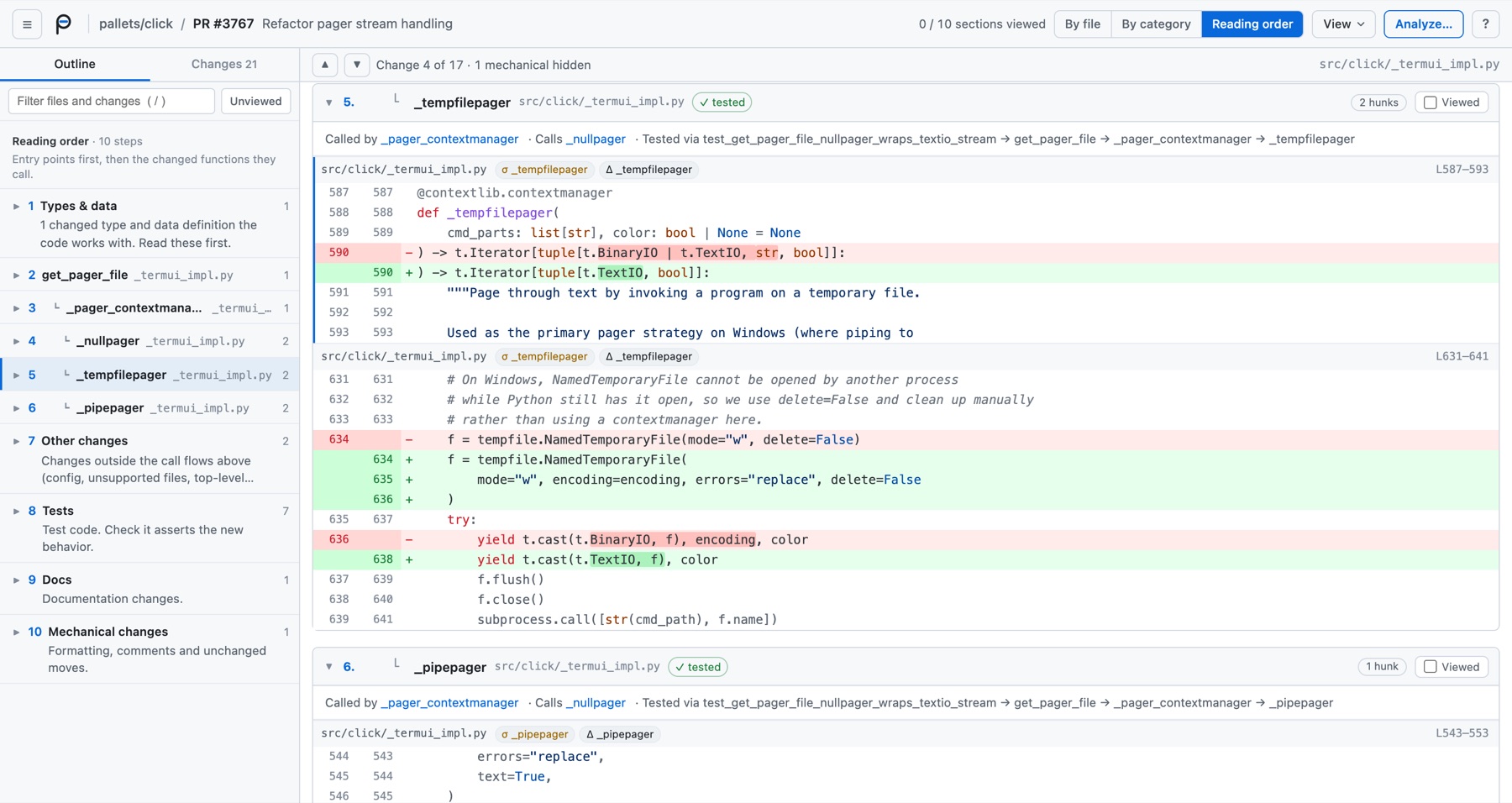
Reviewing pallets/click#3767 (analysis, reading order, terminal) and colinhacks/zod#6587 (summary, checks, split view). The agent-session example is illustrative. Full-quality video (MP4).
See it on real pull requests from ripgrep, Flask, Spark and more. Nothing to install.
Install
cargo install perspica
Or with Homebrew:
brew install sshah03/perspica/perspica
Or with the install script, which puts the binary in ~/.local/bin:
curl -fsSL https://raw.githubusercontent.com/sshah03/perspica/main/install.sh | sh
Or download a binary for macOS, Linux or Windows from Releases, or build from source:
git clone https://github.com/sshah03/perspica && cd perspica
cargo build --release          # → target/release/perspica
Use
Inside a repository:
perspica                 # review your current branch: commits, uncommitted and untracked files
perspica --web           # …in the browser
perspica --pr 123 --web  # a GitHub pull request (uses the `gh` CLI)
Other targets:
perspica --branch develop                 # against another base branch
perspica --staged                         # staged changes
perspica --git main...feature             # a range (merge-base, like a PR)
perspica --git HEAD~3                     # the working tree against a commit
perspica old.ts new.ts                    # two files
perspica --json                           # machine-readable output
perspica --pr 123 --format html           # the viewer as one file to share, with any saved analysis
Everything above works on its own. The optional LLM analysis (-s, or Analyze… in the viewer) runs through Claude Code, an API key or Ollama; see LLM analysis for setup. Alternatively you can ask your coding assistant to run it for you.
What you get
Limited Noise. Formatting, comment-only edits, lines that differ only by a rename, code moved unchanged, generated and vendored files are tagged and collapsed, so the lines that carry real changes stand out. Tests and docs are their own tier.
Every change named. Renames (even when the body was also edited), signature changes (new required vs. optional parameters), dependency changes per module and symbol, extractions into new functions, moves within and across files, logic changes per function and method.
What a diff hides.
- a renamed or removed name still used anywhere in the repository (for a method, only calls on its own type, so a common name like
Flushdoesn't raise false alarms); - calls to a changed function that weren't updated (only for changes that can actually break a caller);
- code the change left unused.
A reading order. Changed code from the entry points down to the changed functions they call (the order you'd want someone to walk you through it), and which of them the changed tests actually reach, with the call path.
What you asked for. If the change was made with Claude Code or Codex on your machine, perspica shows your prompts from the sessions that edited these files. With an LLM analysis, each group of changes is marked asked, with a short quote checked word for word against your prompts, or agent's call: the agent decided it on its own.
Intent, risk and a summary (optional). With an LLM, changes are grouped by what they're for, each with a risk level and what to verify, plus a summary and the model's notes. Those are kept apart from what perspica found in the code, and labeled as less certain.
The concepts behind it (optional). With an LLM, the Learn tab explains the ideas the change relies on and quizzes you on them. See Learn.
LLM analysis
Optional. -s in the terminal, or Analyze… in the viewer (with a model picker and a Standard or Thorough depth).
Setup. There's no key to paste anywhere. perspica uses whichever of these you have:
- Claude Code. perspica uses your Claude Code login, so no API key is needed; if you already use it, there's nothing to set up. New to it? Install Claude Code and run
claude auth login. Analyses and lessons run this way count toward your Claude plan's usage, like any other Claude Code request. - An API key in your environment. Add it to your shell profile (
~/.zshrc,~/.bashrc) and open a new terminal:export ANTHROPIC_API_KEY=sk-ant-… # or OPENAI_API_KEY - A local model with Ollama. Install Ollama, download a model and keep Ollama running:
perspica picks the best model you've downloaded (or choose one in the viewer, or withollama pull gemma4:12b # about 16 GB of RAM; qwen3-coder:30b with 32 GB--model). Local models are slower and less precise than hosted ones: about a minute for a 10-file PR on an M4 Pro.OLLAMA_HOSTpoints it at another machine.
If none is found, Analyze… in the viewer shows these steps, and Check again picks up a Claude Code login or Ollama without restarting. When there are several, the order is --api-key / --provider or PERSPICA_API_KEY (and PERSPICA_PROVIDER), then ANTHROPIC_AUTH_TOKEN (gateways), ANTHROPIC_API_KEY, OPENAI_API_KEY, Claude Code, Ollama; --provider ollama picks the local model over the rest. Prefer the environment to --api-key, which leaves the key in your shell history.
The default Claude model is claude-opus-5-5; --model claude-sonnet-5-5 is faster, claude-haiku-5-5 (or the older claude-haiku-4-5) is a quick first pass. What's sent: the list of classified changes and the changed code, never whole files (Thorough may also read definitions and files under 200 lines from the changed files). Analyses are saved per diff in .git/perspica/, so reloading or running again doesn't pay for the same analysis twice; --fresh reruns. Up to 100,000 characters of changed code are sent (16,000 to a local model). For a bigger change, Analyze… says how big it is and offers to send all of it, and --full-context does the same in the terminal; otherwise the model is told which files it can't see.
Learn
The Learn tab, next to Review in the viewer, picks out the concepts you need to understand this change. An architecture change comes first, then an algorithm, a protocol rule or a language feature it depends on. A small change gets one concept and a bigger one up to three. Formatting, renames and changes that need no background get "nothing to learn" instead of filler.
Each concept has:
- a one-line summary, and the idea in everyday terms;
- how it works, and where it shows up in this change, with links to the code;
- a diagram, animation or small interactive piece when one helps (often the text is enough);
- links to the documentation it comes from;
- a quiz of one to three questions, to check you've understood it before you approve the change.
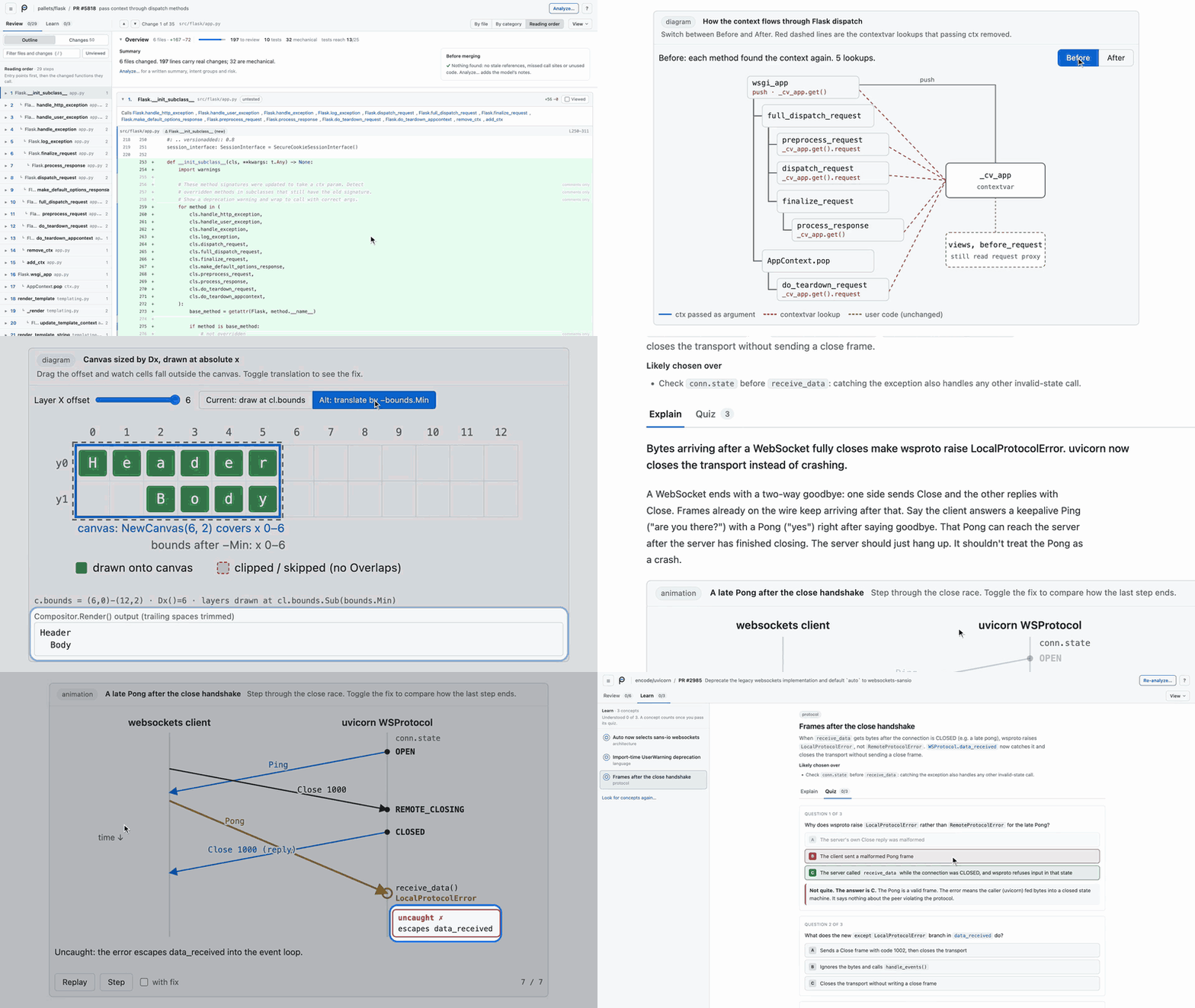
Learn on pallets/flask#5818 (architecture diagram), charmbracelet/lipgloss#591 (a hands-on piece and a quiz) and encode/uvicorn#2985 (an animation and a quiz). Full-quality video (MP4).
Learn uses the same setup as LLM analysis: open the tab, pick a model, and perspica looks for concepts. Each lesson is written the first time you open its concept, and saved in .git/perspica/ with the analysis, so it's only written once. If a lesson isn't good enough, Rewrite… writes it again, with a stronger model if you like. Lessons are kept in --format html exports, so a shared review keeps its lessons and quizzes.
Privacy
- Everything initially runs locally. Nothing is sent anywhere unless you ask for it:
-s/ Analyze…, or Find concepts… in Learn (after that, opening a concept writes its lesson). - Agent sessions (
~/.claude/projects,~/.codex/sessions) are read only for your own changes (uncommitted work, or commits authored with your git identity), never for someone else's PR. perspica says when it uses them;--no-sessionsturns this off. - The web viewer listens on
127.0.0.1and only answers its own page: other hosts (DNS rebinding) and other sites' requests are refused. - Learn's interactive pieces are written by the model, so they run in a sandboxed frame that can't reach the network or the rest of the page.
Languages and file roles
The semantic analysis covers TypeScript and JavaScript, Python, Rust, Go, Java, Kotlin, Scala, C#, C, PHP and Ruby. Every other file is shown as a line diff, with syntax highlighting where available, whitespace-only changes collapsed and its role (test, docs, generated…).
File roles come from paths and codegen markers; override them in .gitattributes with linguist-generated, linguist-vendored, linguist-documentation, or perspica-role=source|test|docs|generated|vendored.
Usage: perspica [OPTIONS] [OLD_FILE] [NEW_FILE]

Arguments:
  [OLD_FILE]  Old file path
  [NEW_FILE]  New file path

Options:
  -l, --language <LANGUAGE>  Override language detection
  -f, --format <FORMAT>      Output format: tty (default), json, web, html (the viewer saved as one file, see --out) [default: tty]
      --out <OUT>            Where --format html writes the page [default: perspica-review.html]
      --json                 Shorthand for --format json
      --web                  Open results in browser
      --port <PORT>          Port for web viewer (the next free port is used if taken) [default: 7890]
      --no-open              Don't open a browser tab (web mode)
      --no-color             Disable colored output
      --show-noise           Show mechanical changes (formatting, renames, moves) in full in the terminal
      --staged               Diff staged changes
      --git [<GIT>]          Diff working tree against HEAD, or specify a commit range (a..b, a...b, or a ref)
      --pr <PR>              Review a GitHub pull request by number (uses the `gh` CLI)
      --branch [<BASE>]      Review the current branch against its merge-base with <BASE> (default: origin/HEAD, main or master). What `perspica` does with no arguments
  -s, --summarize            Group changes by intent, with risk and a summary, using an LLM. Sends the change list and changed code, never whole files
  -d, --deep                 Thorough analysis: the LLM may first read definitions and small files from the changed files. Slower. Implies -s
      --api-key <API_KEY>    LLM API key (better: set it in the environment, see the README)
      --provider <PROVIDER>  With --api-key: anthropic (default) or openai. `ollama` needs no key and uses a local model
      --model <MODEL>        Model to use instead of the provider's default
      --no-sessions          Don't read the Claude Code or Codex sessions behind your change (your prompts are shown, and sent with -s). Never read for other people's changes
      --fresh                Run the LLM analysis again even if a saved one matches this diff
      --full-context         Send all of the changed code to the LLM, however large. By default perspica sends up to 100,000 characters (16,000 for local models)
  -h, --help                 Print help
  -V, --version              Print version
Viewer shortcuts: j/k next/previous change · n/p next/previous file or group · v mark viewed and go to the next unviewed file · f/i/r by file / by intent / reading order · m show/hide mechanical changes · u/s unified/split · / filter · l switch between Review and Learn · e/q explanation/quiz in Learn (j/k change concept) · ? all shortcuts.
perspica-core is a library with no I/O: source strings in, structured results out. It parses both sides with tree-sitter, fingerprints every item (token-level hashes that ignore formatting and comments), matches items across versions (by name, by shape for renames, by similarity for renamed-and-edited ones), classifies the differences, then links display hunks to them and tags the mechanical lines. Cross-file passes find moves between files, names that vanished, affected call sites, and a call graph (by name, gated on the caller importing the callee's module) for the reading order and test reach.
perspica (the CLI) collects the change from git (one git diff and one git cat-file --batch), renders it to the terminal, JSON or the embedded web viewer, and runs the optional LLM analysis, whose output is checked against perspica's own analysis (unknown entries dropped, "asked" quotes checked against the actual prompts).
crates/perspica-core/src   parser · diff · classify · cross_file · annotate · roles · flow · languages/
crates/perspica-cli/src    main · git · sessions · intel · llm · deep · web · render_tty
crates/perspica-cli/web    the viewer (no build step)
tests/fixtures             change-type fixtures, and real PRs from other projects (tests/fixtures/real)
Development: cargo test runs everything, including real pull requests from Flask and ky as fixtures.
License
MIT
Yorumlar (0)
Yorum birakmak icin giris yap.
Yorum birakSonuc bulunamadi