golden-line
Health Gecti
- License — License: MIT
- Description — Repository has a description
- Active repo — Last push 0 days ago
- Community trust — 10 GitHub stars
Code Gecti
- Code scan — Scanned 12 files during light audit, no dangerous patterns found
Permissions Gecti
- Permissions — No dangerous permissions requested
Bu listing icin henuz AI raporu yok.
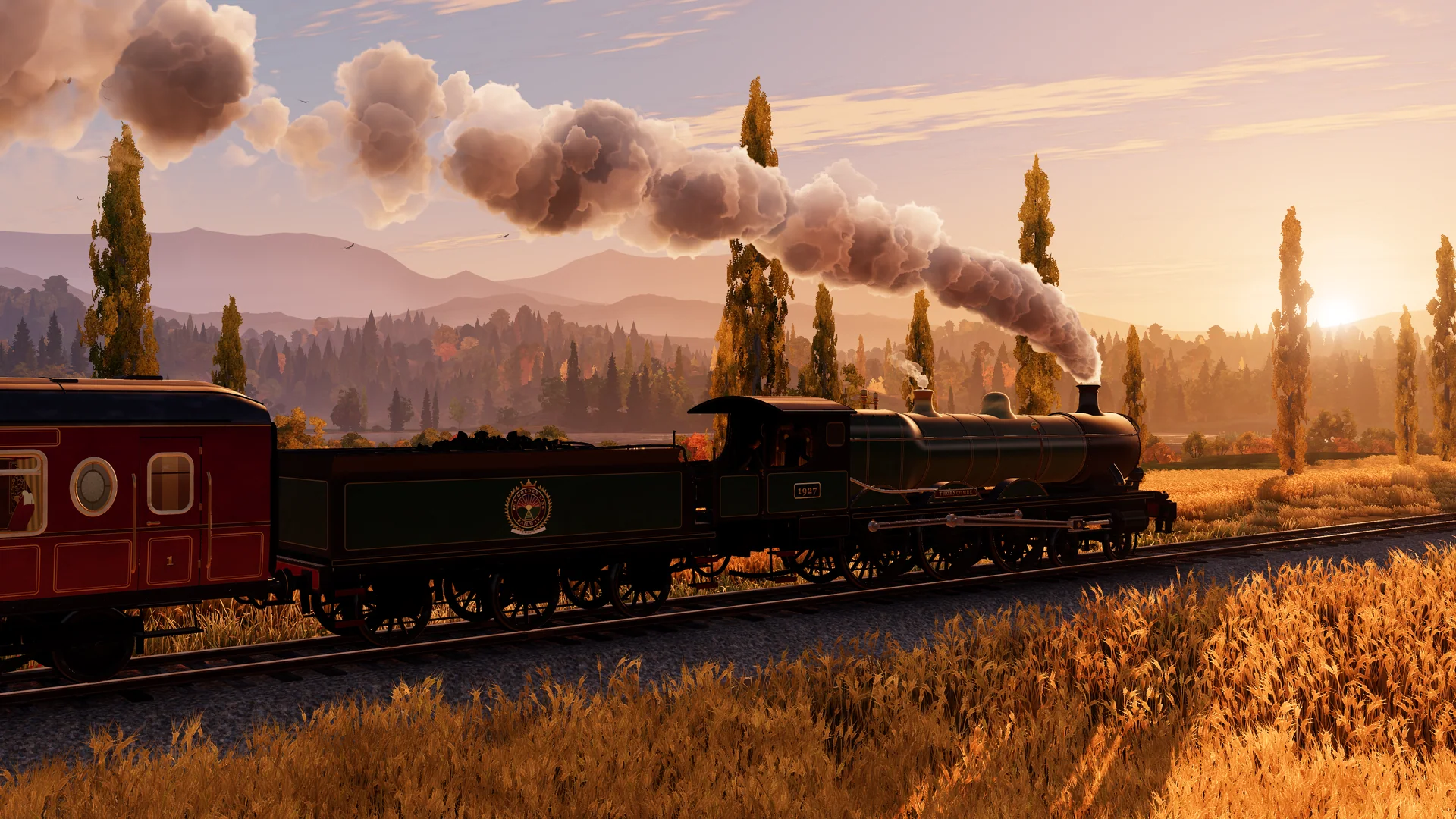
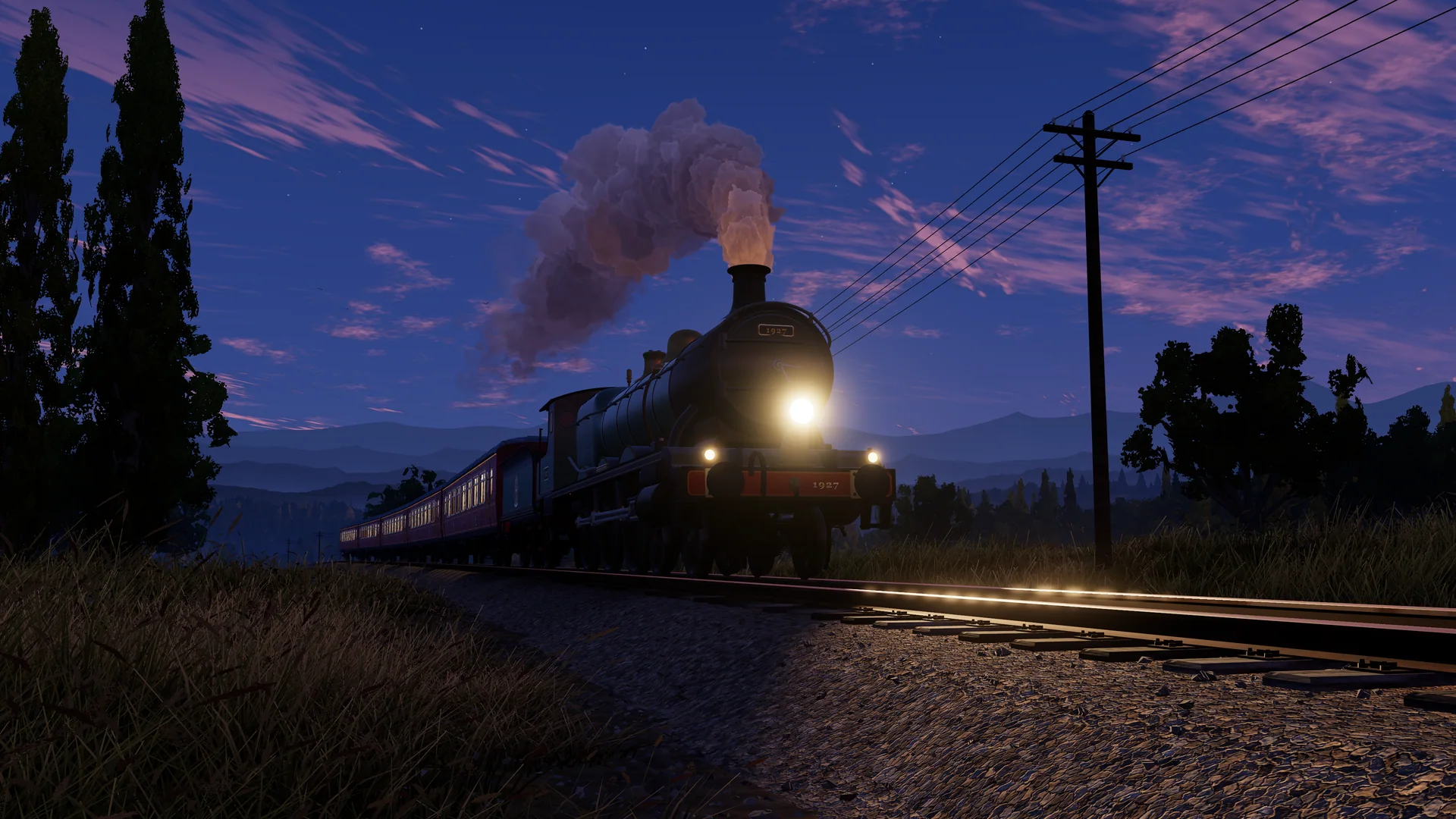
An endless cinematic steam train ride from golden hour to dusk, in your browser. three.js on WebGPU, everything made in code. Built by Claude Sonnet Next.
The Golden Line
An endless steam train ride through European-style countryside, in a browser tab, built in three.js
on WebGPU. It starts at golden hour and runs through sunset into dusk, past wheat fields, lakes,
rivers, pine forest, tunnels, station towns and a great stone viaduct, while the train's lights come
on. The train, the land, the trees, the water, the sky, the steam, the sound and the interface are
all made in code. There are no image files, 3D models or audio recordings behind any of it.
Nine shots from the film, which tools/render-video.mjs draws frame by frame from the running
build. Nothing in it is composited and nothing is retouched.




Ride it: https://starknightt.github.io/golden-line/
For a hands-off recording, ?director=1
cuts between the cameras by itself with no interface.
Read the brief it was built from: PROMPT.md. Unedited, with everything that was
added during the build.
It needs WebGPU, so use a current Chrome or Edge with a desktop GPU. It was built and measured on an
RTX 4060. A loading screen stays up while the world is laid and the shaders compile, about 9 seconds
on that card from a local copy. Browsers hold sound until your first click or key.
Running it locally
Open index.html in Chrome or Edge. It is a single self-contained file of about 1.8 MB that runs
straight from disk, with three.js bundled in.
To change it:
git clone https://github.com/StarKnightt/golden-line.git
cd golden-line
pnpm install
pnpm dev        # live development server
pnpm build      # rebuilds index.html
GitHub Pages serves the root index.html from master, so a change ships when the rebuilt file is
pushed. The build fails if the page references an external script or stylesheet.
Controls
| Key or action | What it does |
|---|---|
| C | Director mode: cuts between the cameras every few seconds, with no interface |
| 1 to 5 | Drone chase, trackside, viaduct, window seat, tunnel exit. Press again to recompose the shot |
| Drag, or click to capture the mouse | Look around (manual mode) |
| W / S | Faster / slower, from a standstill to 130 km/h. It cruises at 65 |
| H or the camera button | Photo mode, which hides the interface. Click, tap, H or Esc brings it back |
| M or the speaker button | Sound on and off |
| ? | Show the keys again |
Manual mode shows the time and weather, the next station and its distance, and the speed. The
weather text describes the sky on screen; there is no weather simulation behind it. On a touch
screen you can drag to look and use the two buttons, but changing camera or speed needs a keyboard.
| URL option | Effect |
|---|---|
director=1 |
Starts in director mode |
hud=0 |
No interface |
cam=hero |
Starts on a composed shot: hero, drone, trackside, bridge, interior, tunnel, sunset, dusk or dusk-interior |
time=0..1 |
Time of day to start at: 0 is golden hour, 1 is blue hour (default 0.1) |
dayspeed=2 |
Makes the day pass faster |
The five cameras
The brief called this the most important part.
| Key | Camera | What it does |
|---|---|---|
| 1 | Drone chase | Drifts around the engine's front quarter, and climbs until ground and trees no longer hide the train |
| 2 | Trackside | Sets up low beside the rails near a telegraph pole, widens as the engine arrives and shakes as it passes |
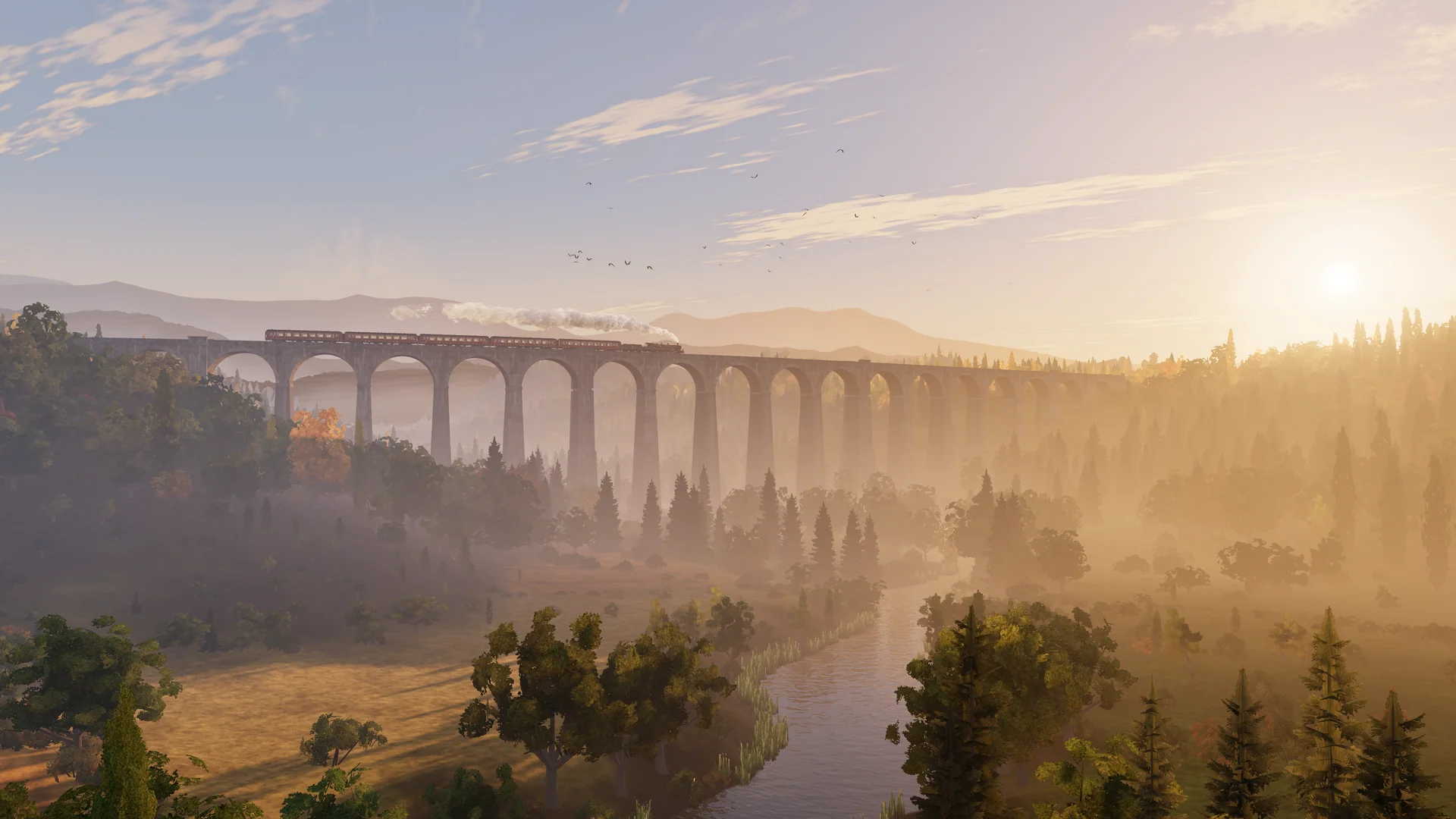
| 3 | Viaduct | Scouts 36 viewpoints across the valley for one that sees the span, with the train against sky and haze |
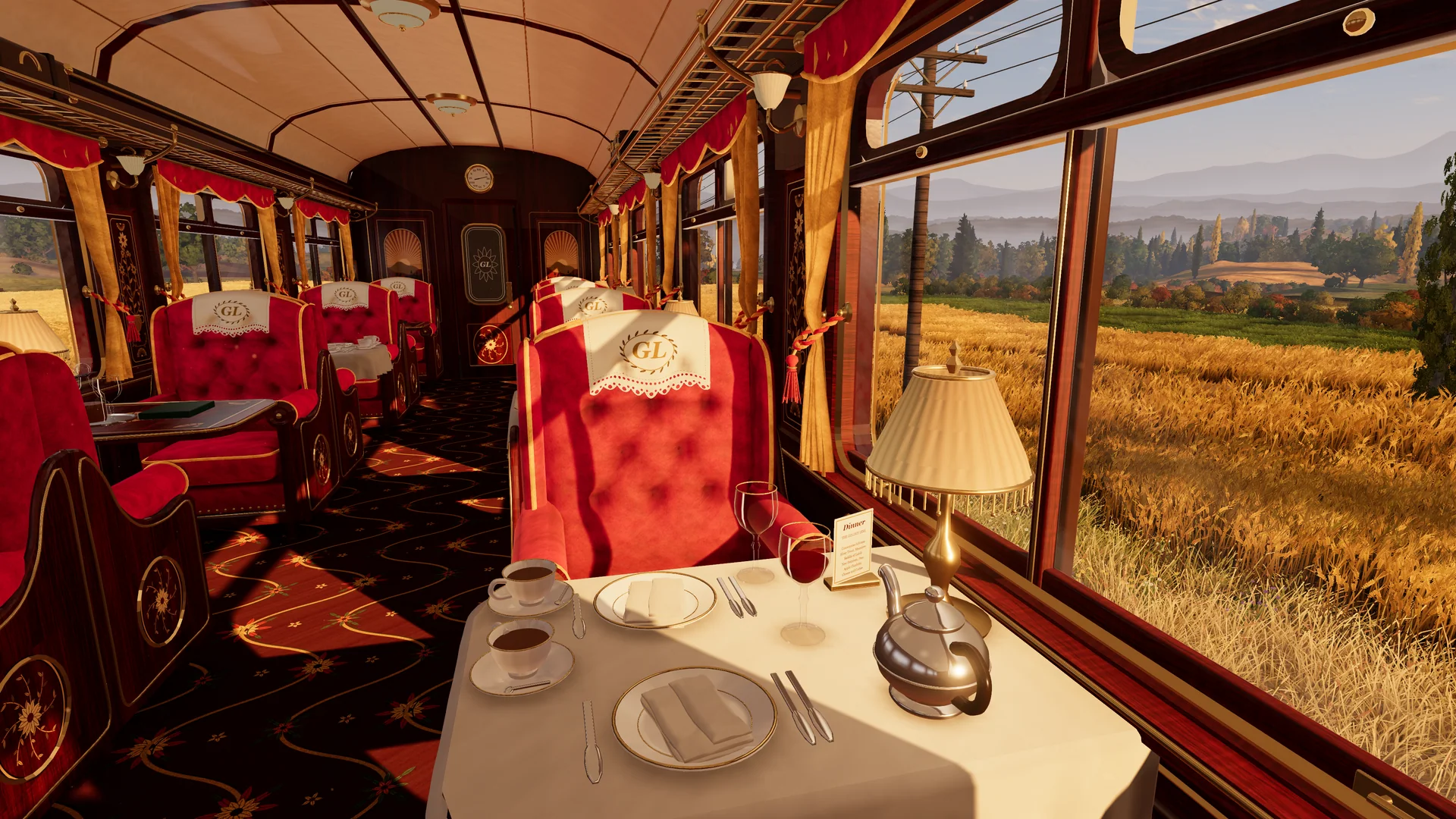
| 4 | Window seat | Two compositions inside the furnished saloon, with the country sliding past |
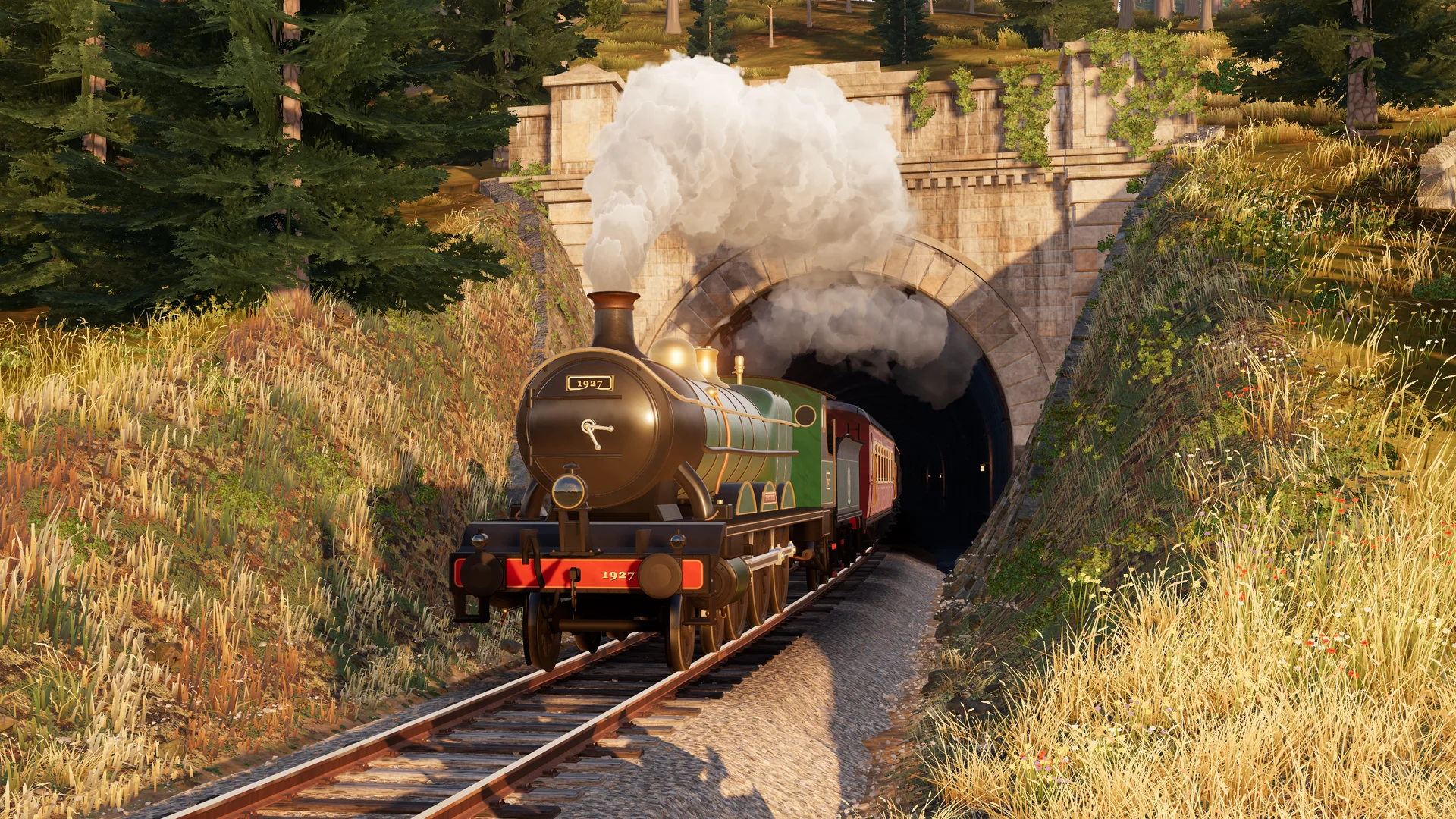
| 5 | Tunnel exit | Keyed to distance past the portal, so it holds at any speed. The exposure opens in the dark and closes in the sun |
Director mode works like a film editor. It picks the next shot early, streams in that stretch of
line if it is somewhere else, and cuts once it is ready (or after seven seconds at most). When a
viaduct or a tunnel exit is about to come up on its own, it times the cut to that instead.
What is in it
- About 23,000 lines of JavaScript across 107 files in
src/, blank and comment lines aside. - An endless line in seven kinds of country: fields, lake, pine forest, tunnel, viaduct, river
and station town. The opening stretch is hand-ordered. After that the order is shuffled from a
seed, and every tunnel opens onto a viaduct or a lake. - The train: a 4-6-0 express engine in green with working side rods, a six-wheeled tender and
five crimson coaches. One coach has a fully furnished saloon. Distant windows on the others are
ray-traced into an imaginary one. - The railway: ballast, sleepers and rails, the stone viaduct, arched stone and plate-girder
river bridges, brick-lined tunnels with cut-stone portals, telegraph wires, fences and farms. - Station towns with generated names, each with a platform, station house, signal box, water
tower, semaphores, level crossing, gas lamps, houses and a church. - Living things: rooks, geese and woodpigeons in the middle distance, and dust in the sunbeams
of the coach.
How it works
One line that keeps going
The world is a seeded sequence of set pieces. Web workers build the ground in 200 m chunks, which
stream in 2.5 km ahead of the train and 1.1 km behind it. The workers are classic inline ones, so
the single file still works from disk. A floating origin jumps forward in 1,024 m steps, and every
world-space texture tile divides that distance, so nothing visibly moves when it does.
Grass and trees on the GPU
Each frame a compute pass walks three rings of about 90,000 world-fixed candidate cells, reads what
grows under each one and appends the survivors to indirect draw lists. Placement depends only on
the cell, so nothing swims, and a camera cut is correct on its first frame. Trees live in one storage
buffer and are culled the same way into detailed, merged and impostor levels, with separate caster
lists for each shadow cascade. The impostors are the near trees photographed from eight headings at
load.
Steam
Puffs are born in world space at the chimney, cylinder cocks and safety valves, so they hang in the
air behind the train. Their motion is closed-form in age, which lets a camera cut rebuild 7.2
seconds of history in one step. All of them are one instanced draw. Their atlas is ray-marched on
the GPU at load and lit from six directions. Two low-resolution maps of the whole plume, one from
the camera and one toward the sun, let it shade as one body and throw its shadow on the land.
Light, air and water
One sun drives four shadow cascades out to 650 m, with the long shadows of distant hills baked
beyond them. The sky, the distance haze, the environment light and the water's sky reflection all
call the same atmosphere functions, so far land fades into exactly the colour behind it. The far
ridgelines are painted into the sky itself. The frame gets ACES tone mapping, bloom and 4x MSAA.
Lakes and rivers share one material. A single half-resolution planar mirror goes to whichever body
fills most of the view, and the others reflect the analytic sky.
Time of day
Golden hour, sunset, dusk and blue hour are one keyed track, so sun, sky, haze and lamps always
agree. From the default start it takes about seven and a half minutes to reach full dark. After the
night has held for a while, the clock rolls back to gold while the camera is inside a tunnel, and the
train comes out into a new evening.
Sound without samples
Every sample and echo is computed at load, in a worker, and played through Web Audio. The engine
beats four times per turn of its driving wheels. A rail clack is scheduled as each axle crosses a
joint. The chime whistle sounds before tunnels, out over viaducts, approaching stations and now and
then in open country. Around that are wind, rolling noise, the creak of the carriage, birds that
change with the hour and crickets as the light goes.
Performance
Director mode for 150 seconds in headless Chromium at 1920×1080 on an RTX 4060, measured on 29
November 2026 with pnpm perf --seconds 150. These are times between frames, in milliseconds, and
headless runs are not locked to a display's refresh rate.
| Shot | Frames | Median | 95th | 99th | Worst | Over 20 ms |
|---|---|---|---|---|---|---|
| Drone chase | 5,484 | 7.6 | 9.6 | 10.3 | 16.7 | 0 |
| Trackside | 5,201 | 6.2 | 8.2 | 13.2 | 19.6 | 0 |
| Viaduct | 3,906 | 6.9 | 8.5 | 10.2 | 39.2 | 3 |
| Window seat | 4,937 | 6.0 | 8.1 | 13.3 | 21.2 | 1 |
| Tunnel exit | 2,457 | 7.0 | 8.6 | 10.2 | 48.8 | 3 |
| All | 21,985 | 6.8 | 9.0 | 11.9 | 48.8 | 7 |
The 99th percentile is inside the 16.7 ms that 60 fps allows. Three frames took longer than 34 ms,
and none of the twelve worst fell on a camera cut. GPU time was 4.9 ms at the median and 7.0 ms at
the 95th percentile. The run peaked at 400 draw calls and 5.5 million triangles, with 18 cuts. It
started at golden hour and reached early sunset, so dusk is not covered by these numbers.
There are no quality tiers. The one automatic adjustment is that high-DPI screens are trimmed toward
2560×1440 worth of pixels, never below 1x scale.
What is not good enough yet
An independent critic compared every camera with real photographs in two rounds. The second round
found six major problems: three in the tunnel shot (staging, a cartoon-like cab, broken-looking
masonry), two in the opening and drone views (thin crop, a flat model-railway look), and a train
whose shadow could not be seen. A last round of fixes addressed all six. No critic round ran after
it, at the owner's request, so none of those fixes is independently confirmed.
Known differences from the photographs:
- Steam is softer and less torn. At the tunnel exit, some of it hangs under the arch as a separate
cloud. - The tunnel exit is a bright golden burst rather than a white-out, with no sun disc in frame.
- The train's shadow has a readable edge, but not the outline of a locomotive. The opening has two
or three long shadow stripes across the wheat. - From the drone, the ballast looks smooth and the stubble rows regular.
- Up close in the cab, the crew look like mannequins.
- Dusk coach windows are small and dim from a distance, and the trackside sky is bluer than in the
references. - Thin bright lines on wheels and trim may shimmer in the live ride. The film is supersampled, which
reduces this.
It was built and measured in Chromium on Windows. There is no mobile version.
The film
pnpm video renders sonnet-next-train.mp4, a 60-second film, frame by frame from the ride itself,
with no screen recording. Each picture is drawn at 3840×2160 and scaled to 1920×1080, while the ride
and its shaders advance exactly 1/60 s. It is encoded at 60 fps with NVENC. The soundtrack is
rendered offline from the same frames by the live sound engine, then levelled to about -14 LUFS.
The same run writes each shot to segments/ as its own clip and a 4K still of each to stills/.
The video files and stills are not in the repository. segments/cut-list.txt has the cut times and
shows how to leave shots out without re-encoding. The shot list is in tools/film.json.
Tools
The capture and test tools drive the real build in headless Chromium and refuse to run on anything
but an NVIDIA GPU. They were written for Windows. Install their browser once withpnpm exec playwright install chromium.
| Command | What it does |
|---|---|
pnpm check |
Screenshots from fixed cameras, measured and set beside reference photos, in .world-check/. The photos are not in the repository |
pnpm perf --seconds 150 |
Director-mode frame timing, per shot |
pnpm video |
Renders the film. Needs ffmpeg with NVENC on the PATH |
node tools/shot.mjs |
Quick screenshots; exits with an error on any console error or WebGPU warning |
Layout
index.html      the built ride, one self-contained file
src/
  main.js       boot, frame loop, URL options
  world/        the endless line: layout, terrain, track, towns, streaming workers
  render/       renderer and bloom, atmosphere, sun and shadows, time of day, floating origin
  train/        engine, tender, coaches, saloon, cab
  structures/   track, viaduct, bridges, tunnels, station towns, lineside
  vegetation/   GPU grass and wheat, trees and impostors, reeds
  water/        lakes, rivers, the planar mirror
  effects/      steam, birds, dust motes
  camera/       the five cameras and the director
  audio/        the synthesised soundtrack
  ui/           controls and HUD
  capture/      frame-by-frame film capture
  core/         math, noise, seeded random numbers
tools/          capture, check, timing and film scripts
media/          the pictures on this page
Zero assets
There is no TextureLoader, GLTFLoader, RGBELoader, AudioLoader, fetch, XMLHttpRequest,new Image or createImageBitmap anywhere in src/. The pictures in media/ are output of the
ride, not input to it.
How it was built
Claude Sonnet Next built it in Claude Code from the brief in PROMPT.md, using the
world-taste skill for art direction. The world is an
old passenger train on a single line, under clear skies with high thin cloud and haze in the
valleys. The direction was "golden-hour rail", with the dials at realism 9, density 8 and life 7.
The brief asked for a critic loop against real photographs, for up to five rounds. It was stopped
after two, at the owner's request, with the results listed above.
Credits
Built with three.js (MIT), Vite and Playwright.
The reference photos were used only as local visual targets while building. They are not part of the
ride, and refs/ is not committed or shipped. All are from Wikimedia Commons (licence texts:
https://creativecommons.org/licenses/):
| Reference | Author | Licence |
|---|---|---|
| Jacobite on Glenfinnan Viaduct 4 | Daniel Kraft | CC BY-SA 3.0 |
| Steam sunset at Peterborough, Nene Valley | Roger Carvell | CC BY 3.0 |
| Jacobite on Glenfinnan Viaduct 1 | Daniel Kraft | CC BY-SA 3.0 |
| Vintage carriage, 3rd class | James Petts | CC BY-SA 2.0 |
| Tunnel Merten 020 | Olbertz | CC BY-SA 3.0 |
| Sunset over Glenfinnan Viaduct | Tjdenholm | CC BY 4.0 |
| Harvest Season | Christoph Wurst | CC BY-SA 3.0 |
| Baureihe 35.1097 wieczór | "120Hz USB type C HDMI cable cord" | CC0 |
| 60163 Tornado, 22 May 2010 | Paul Downey | CC BY 2.0 |
| A passenger train crossing Ribblehead Viaduct | John Lucas | CC BY-SA 2.0 |
Licence
MIT. See LICENSE.
Built by Prasenjit Nayak (@prasenx).
Yorumlar (0)
Yorum birakmak icin giris yap.
Yorum birakSonuc bulunamadi